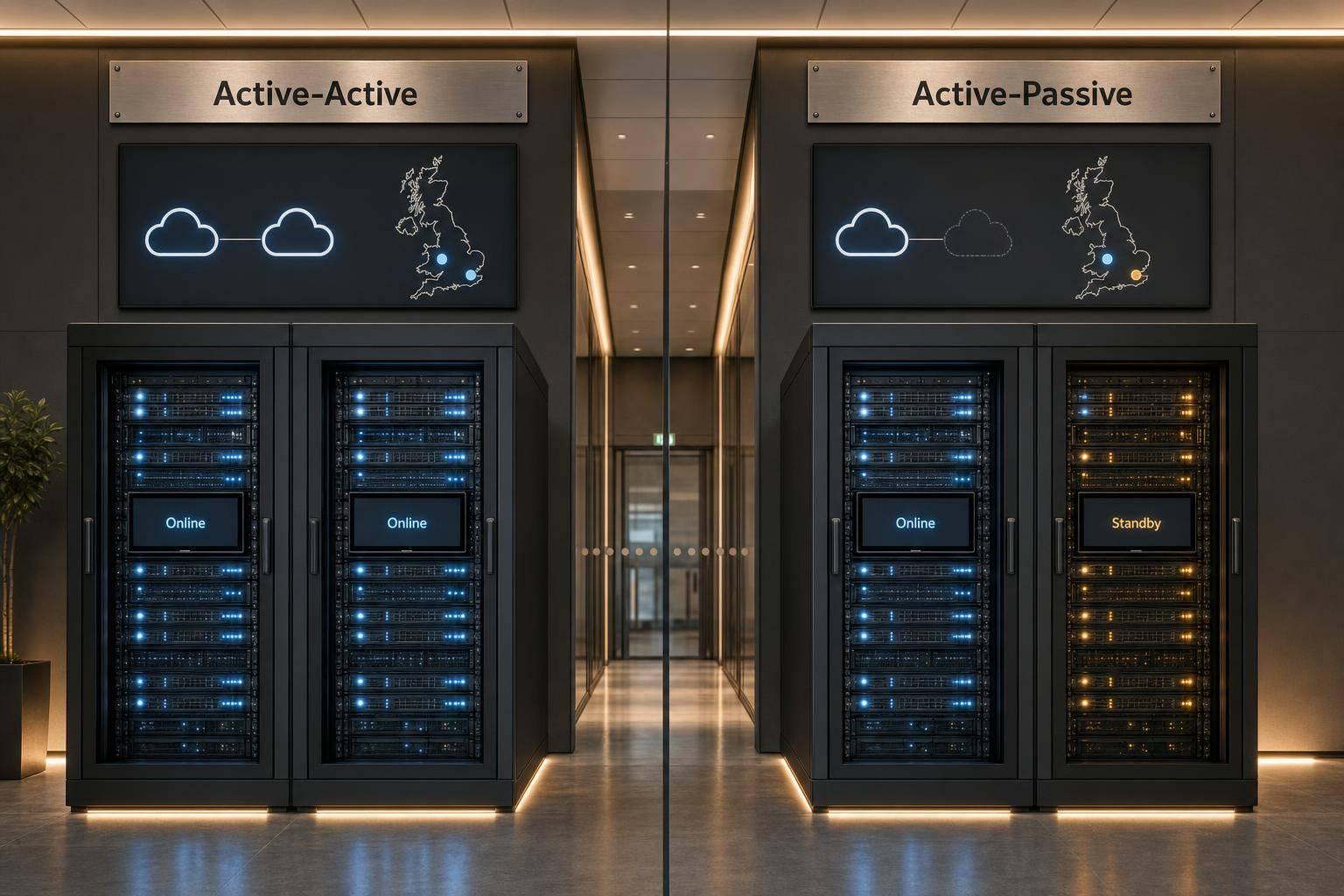
If I need the short answer, it’s this: active-passive is the safer default for most UK teams, while active-active only makes sense when downtime costs are high enough to justify the extra spend and complexity.
I’d make the choice based on six things:
- cost
- failover speed
- data consistency
- release risk
- traffic routing
- team capacity
The article makes one point very clear: this is not just an architecture choice. It affects cloud spend, recovery time, audit needs, and how much pressure your team takes on during an incident.
A few numbers stand out straight away:
- UK e-commerce downtime can cost about £3,608 per minute
- Large firms can lose about £9,000 per minute
- 99.99% uptime allows only about 52 minutes of downtime per year
- Active-active often costs about 2× baseline
- Warm standby active-passive often lands around 1.2× to 1.4× baseline
- Cross-cloud failover in active-active can be about 42 seconds
- Warm-standby failover is often around 7.8 minutes, with many setups landing in the 15–60 minute range
Here’s the plain-English version:
- Choose active-active if you need very low RTO/RPO, serve mostly stateless workloads, and have a team that can run multi-cloud traffic, observability, automation, and incident response at all hours.
- Choose active-passive if you want lower spend, have stateful systems, need a single write path, or your team relies on tested runbooks rather than constant live traffic balancing.
- Use a hybrid setup if your front end needs high availability but your data tier needs one clear writer.
::: @figure 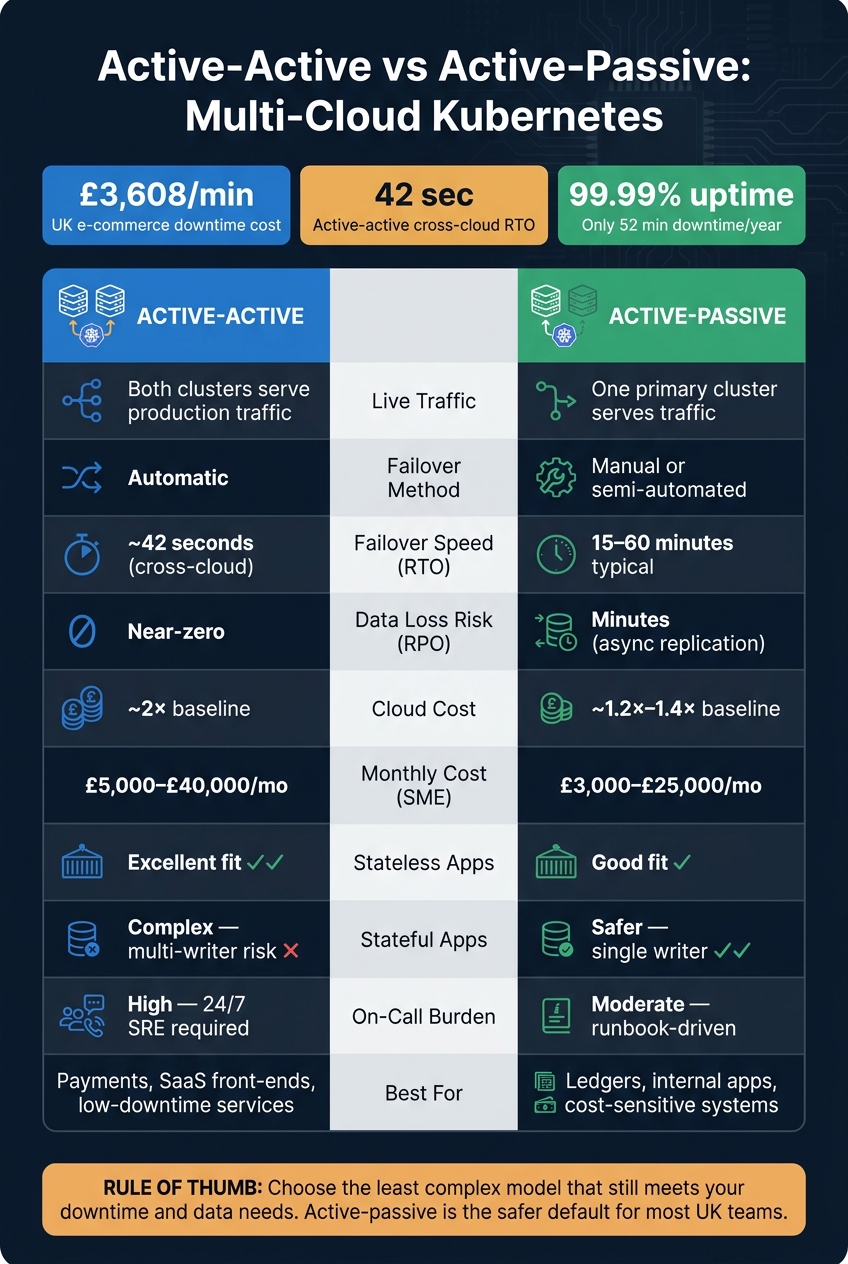 {Active-Active vs Active-Passive Multi-Cloud Kubernetes: Key Metrics Compared}
:::
{Active-Active vs Active-Passive Multi-Cloud Kubernetes: Key Metrics Compared}
:::
Quick Comparison
| Area | Active-active | Active-passive |
|---|---|---|
| Live traffic | More than one cluster serves traffic | One primary cluster serves traffic |
| Failover | Automatic | Manual or semi-automated |
| Cost | About 2× baseline | About 1.2×–1.4× baseline |
| RTO | Near-zero to a few minutes | Often 15–60 minutes |
| RPO | Near-zero in the right setup | Minutes with async replication |
| Stateless apps | Strong fit | Good fit |
| Stateful apps | Hard to run safely | Safer fit |
| Release risk | More control, but more ways to spread failure | Smaller live blast radius |
| Team demand | High | Lower |
| Best fit | Payments, SaaS front ends, low-downtime services | Ledgers, internal apps, cost-sensitive systems |
If I were advising a UK firm, I’d keep the rule simple: pick the least complex model that still meets your downtime and data needs. That’s the lens the rest of the article applies.
Active-active vs active-passive: core differences in multi-cloud Kubernetes
How active-active works across clouds
In an active-active setup, two or more Kubernetes clusters handle production traffic at the same time. One cluster isn't sitting around as a backup. They’re all live, all serving requests.
Traffic is routed by a global traffic layer, such as DNS-based load balancing or anycast global load balancers. These systems use latency-based or weighted rules, along with health checks, to send requests to the right place. If one cluster goes down or starts failing health checks, traffic moves to the other cluster on its own. One study puts cross-cloud RTO at around 42 seconds.[3] Low DNS TTLs help make that failover faster.
Within each cluster, a service mesh like Istio or Linkerd manages east-west traffic, mTLS, retries and circuit breaking.
This setup works well for stateless workloads like APIs, web front ends and batch workers, where workloads can be restarted or copied without much fuss.[4][5]
That said, there’s no free lunch. Running multiple live clusters at once can improve availability, but it also adds cost and more moving parts to manage.
How active-passive works across clouds
In an active-passive setup, one primary cluster handles all production traffic. The secondary cluster, or clusters, stay on standby and don’t serve live traffic during normal operation.
A warm standby keeps enough nodes and core services up and running so it can take over within minutes. Warm-standby setups usually deliver an RTO of around 7.8 minutes.[3]
Promotion usually follows a runbook:
- declare the incident
- bring up the standby if needed
- switch traffic
- verify health
This pattern fits stateful workloads well, especially relational databases like PostgreSQL or SQL Server. A single write path, paired with asynchronous replication, helps keep data consistent and makes audit trails easier to manage.[2][4] It also tends to fit regulator expectations around a clear system of record, which matters in sectors like financial services and healthcare.
The upside is lower spend and less day-to-day overhead. The downside is that failure handling depends on the promotion process working cleanly when you need it.
Comparison table: architecture, traffic flow and fit
| Dimension | Active-active | Active-passive |
|---|---|---|
| Traffic placement | All clusters serve production traffic | One cluster active; standby scaled down or idle |
| Failover method | Automatic failover | Manual or semi-automated promotion |
| Traffic control | Global DNS or anycast to multiple endpoints | Single primary endpoint; failover changes DNS during an incident |
| Stateless fit | Excellent | Good |
| Stateful fit | Complex - requires distributed write coordination | Straightforward - single writer with replication |
| Operational load | Higher - cross-cloud traffic tuning is ongoing | Lower - the primary cluster is the operational focus |
Those differences shape cost, resilience and release trade-offs in pretty direct ways.
Cost, resilience and release trade-offs
Cloud spend, utilisation and cost control
Those architecture choices show up straight away in your cloud bill, recovery time and release risk.
Running two live clusters costs about 2× what you’d pay for one active cluster. In most setups, active-active compute, storage and database costs land at around 2× baseline, while a warm standby usually sits closer to 1.2×–1.4×.[6] For UK SMEs, that can work out to roughly £3,000–£25,000 per month for active-passive, versus £5,000–£40,000 per month for active-active. Larger UK firms in finance or retail can go past £100,000 per month with active-active designs.[6]
There’s another cost that tends to sneak up on teams: data movement. Cross-cloud egress charges and managed database replication can add a lot for data-heavy workloads.[8]
Fault handling, RTO and RPO
When a cluster fails health checks, traffic can rebalance in seconds or minutes. Multi-cloud active-active setups can aim for near-zero RTO and RPO.[1] That makes them a strong choice for UK payment processors and other firms where downtime is costly and tightly managed.
Active-passive works differently. There’s a promotion step, and that changes the recovery profile. Failover means promoting the standby, scaling it up and switching traffic across, which usually puts RTO in the 15–60 minute range, depending on workload complexity and how well the runbook has been practised.[7]
RPO follows the same pattern. With asynchronous replication, the passive setup can trail the primary by minutes.[9] For internal systems, that may be fine. For transactional ledgers or health records, where near-zero data loss is expected, it’s a tougher sell.
That split gets more awkward once state and release safety come into play.
Release safety and blast radius
Release safety comes down to one plain question: how much traffic can you isolate at a time?
Active-active supports canary releases and weighted traffic splits, so one cluster can run the canary while the other stays on the stable version. That said, weak health checks or over-eager auto-promotion can turn one bad release into a problem in both clouds.[10][11][12]
Active-passive keeps the blast radius smaller by default because only the primary setup is live. But the trade-off shows up during failover. If an incident forces standby promotion in the middle of a release, teams need to know the passive setup is running a compatible version. Version mismatch between primary and passive is a common source of nasty surprises when the two sides drift out of sync.
Comparison table: cost, resilience and release risk
| Dimension | Active-active | Active-passive |
|---|---|---|
| Cloud spend | ~2× baseline; higher egress and duplicate managed databases[6] | ~1.2×–1.4× baseline; standby scaled down between tests[6] |
| RTO | Near-zero to minutes; automatic traffic rebalancing[1] | 15–60 minutes typical; depends on runbook and automation[7] |
| RPO | Near-zero with synchronous or high-frequency replication[1][9] | Minutes with asynchronous replication[9] |
| Blast radius during releases | Wider if controls are weak; canary possible but risk spreads fast[10][11][12] | Narrower; only primary is live, but failover mid-release is sensitive |
| State management difficulty | High; cross-cloud write coordination required | Lower; single writer with replication |
| Fit for business-critical services | Strong; suits finance, payments and clinical systems | Moderate; suits cost-sensitive workloads with tolerable downtime |
State, traffic control and team effort
Cost and RTO only mean something if your data layer and day-to-day operating model can actually carry the load.
Stateful apps and data consistency limits
The hard part isn't the diagram. It's whether your data layer and your team can run the setup without things going sideways.
Active-active is tough for write-heavy databases. Why? Because both clouds can accept writes at the same time. That opens the door to lag, conflicting updates and split-brain issues. Replication lag often sits in the 50–200 ms range[7]. That may sound tiny, but it's more than enough time for two conflicting writes to land. Think double bookings or duplicate financial transactions.
Fixing that isn't simple. You either need careful data modelling, such as idempotent operations or CRDTs, or you need to accept eventual consistency. And for many teams, especially in regulated systems, that's hard to run safely[26][27].
Active-passive avoids most of that pain. You keep one primary database and use read-only replicas, so write ownership stays clear and audit trails are easier to follow. For FCA- and PRA-regulated workloads, that clarity matters. Promotion and failback also need to be tested procedures, not improvised switches in the middle of an incident. Promotion should force final replication, verify data integrity, and only then switch traffic. Failback should rely on change data capture (CDC) tooling and application-level checks[7].
For FCA- or PRA-regulated ledgers, multi-writer active-active is usually the wrong place to take risks unless the data layer was built for it from the start. Active-passive is the safer fit for those systems. Active-active makes more sense for stateless or read-heavy services where eventual consistency is acceptable[26][28].
Traffic management and tooling needs
Once the data model is set, traffic routing becomes the next pressure point.
Active-active needs traffic distribution across both clouds all the time, and it has to react to health changes as they happen. Many teams bring in a service mesh such as Istio or Linkerd to deal with cross-cluster mTLS, circuit breaking and fine-grained traffic shifting for canary releases[13][14][16][17]. A common setup is a 50/50 split in normal operation, with traffic shifting to 100% on the surviving cluster during a failure.
That sounds neat on paper. In practice, keeping those rules aligned across two clouds takes discipline. Infrastructure as Code and GitOps workflows aren't nice extras here. They're the baseline[18][24].
Active-passive is less demanding. The global traffic layer mostly needs to spot primary failure and redirect traffic to the standby. The heavier lift sits in the runbooks: scripted DNS or traffic-manager changes, certificate handling, cache behaviour and rollback rules. All of that should live in version control and be tested on a regular basis[15][19][20].
On-call load and team capability
The last constraint is people and process. And this is often the one that decides the answer.
Active-active increases the operational surface area. You have to deal with asymmetric incidents, partial outages and failures tied to a specific release. Each one may need its own playbook. As those incidents become less neat and more uneven, the model gets harder to run safely without practised failover and traffic-shift procedures.
That means 24/7 SRE cover and mature platform engineering: automation, standardised cluster builds, shared observability across clouds, and engineers who are at home with distributed systems and multi-cloud networking[21][22][23][24][25].
Active-passive puts on-call effort in a narrower lane. The focus is keeping the primary healthy and the standby ready. When a major incident hits, the team follows a runbook-driven flow: promote the replica, verify system health, then handle failback in a controlled sequence. That's far more realistic for teams with limited 24/7 cover, as long as the runbooks are clear and rehearsed often[15][20].
If the team doesn't have round-the-clock cover and well-practised DR runbooks, active-passive is the safer fit. In many cases, that capability gap points straight to active-passive.
These constraints feed directly into the decision matrix below.
Comparison table: data, tooling and team demands
| Dimension | Active-active | Active-passive |
|---|---|---|
| State complexity | Multi-writer; conflict resolution and lag handling required[26][27] | Single primary with replicas; clear write ownership[7] |
| Traffic-control requirements | Global LB, latency-aware routing, service mesh, consistent ingress across clouds[13][14][16][17] | Global DNS or traffic manager with health checks; failover runbooks[15][19] |
| Monitoring needs | Centralised metrics, traces and logs across all clusters; per-region SLOs; synthetic checks from multiple locations[21][22] | DR readiness dashboards; replication lag alerts; passive cluster capacity checks[7][21][22] |
| CI/CD and automation maturity | IaC and GitOps required; automated canary promotion and traffic shifting[18][24] | GitOps plus scripted failover and failback automation[18][20] |
| On-call burden | High; asymmetric incidents, distributed systems expertise, 24/7 coverage needed[21][22][23] | Moderate; runbook-driven; achievable with limited 24/7 cover if runbooks are tested[15][20] |
| Documentation effort | Continuous; routing rules, mesh config, per-cluster runbooks and release procedures[24][25] | Focused; DR runbooks, promotion steps, failback procedures and data-flow records[20] |
Decision framework and conclusion
A decision matrix for UK organisations
Pick the model based on business risk, not on what looks nicer on a diagram.
A simple way to do that is to map six inputs against each option:
- Business criticality
- Downtime tolerance
- Monthly cloud budget
- Application statefulness
- Regulatory obligations
- Platform maturity
If a workload has an RTO of under one minute and the business stands to lose more than £25,000 per hour during core trading hours, it’s a strong fit for active-active [29][30]. If an RTO of 30 minutes or more is fine and revenue at risk is under £1,000 per hour, active-passive is usually the better default [29][30].
That sounds simple on paper. In practice, the smart move is to test the matrix against your own incident history and cost data before you commit. The table below helps turn those thresholds into a deployment choice.
For regulated workloads, especially those under FCA rules, data residency and auditability need to sit at the top of the list. If personal data must stay in the UK and write consistency cannot slip, active-passive with the primary in the UK is usually the safer and easier option to defend. Active-active only starts to make sense here when the data layer was built for that setup from day one.
Platform maturity is the last gate, and it matters more than teams sometimes admit. If automation coverage is below 70%, observability is split across tools, or DR runbooks haven’t been tested, active-active can add risk instead of cutting it [31][32]. In that case, start with active-passive, then move in stages. Low-risk stateless services are often the right place to test the waters.
Comparison table: which model fits which scenario
The rows below turn the matrix into common UK workload patterns.
| Scenario | Preferred model | Key caveat |
|---|---|---|
| Customer-facing SaaS or high-traffic e-commerce with 99.95%+ SLA and stateless front-end | Active-active | Use active-passive for stateful data tiers; transactional databases should use managed HA or active-passive [33][35] |
| Back-office reporting, batch billing, HR portal, or internal line-of-business applications | Active-passive | RTO of 30–120 minutes is typically acceptable; active-active adds unnecessary cost [34][35][36] |
| Multi-tenant SaaS with contractual 99.9% uptime across the UK and EU | Hybrid (active-active front-end, active-passive data) | Requires clear RPO/RTO per tier and compliance review [33][35] |
| FCA-regulated ledger or payment authorisation system | Active-passive | Multi-writer active-active introduces unacceptable consistency and audit risk [31] |
| Organisation with limited SRE cover and no tested DR runbooks | Active-passive | Active-active demands stronger operational capability; build maturity first [31][32] |
Key takeaways
The plain-English rule is straightforward: choose the least complex model that still meets your downtime and data needs. Active-active fits workloads that need very high resilience. Active-passive is simpler, lower-cost, and comes with a recovery window.
For most UK organisations, active-passive should be the starting point. Active-active should be kept for the smaller group of services where the cost of downtime clearly outweighs the extra complexity and spend.
FAQs
How do I choose between active-active and active-passive?
Choose active-active when you need continuous availability and near-zero failover, and you can live with higher cost, more operational work, and the headaches that come with shared state or write conflicts.
Choose active-passive when you want a simpler setup and lower cost, and you can accept failover that takes a few minutes with a clear single-writer model.
In practice, the right choice comes down to your RTO/RPO, budget, and how experienced your team is.
When is active-active worth the extra cost?
Active-active is worth the extra cost when you need near-zero downtime and very fast failover. That usually means mission-critical, high-traffic Kubernetes workloads where even a brief outage isn't acceptable.
If your team can live with recovery in minutes - say, up to about 10 minutes - active-passive is usually a much more cost-effective choice.
Can I use a hybrid model for Kubernetes?
Yes. A hybrid Kubernetes model can balance cost, performance and reliability by using different setups for different workloads.
For instance, active-active can work well for mission-critical systems. Active-passive or backup-led setups may be a better fit for less critical parts. You can also mix on-premises and cloud environments to support resilience and performance.
Hokstad Consulting can help design these recovery models and build policy-driven failover around your infrastructure and business needs.