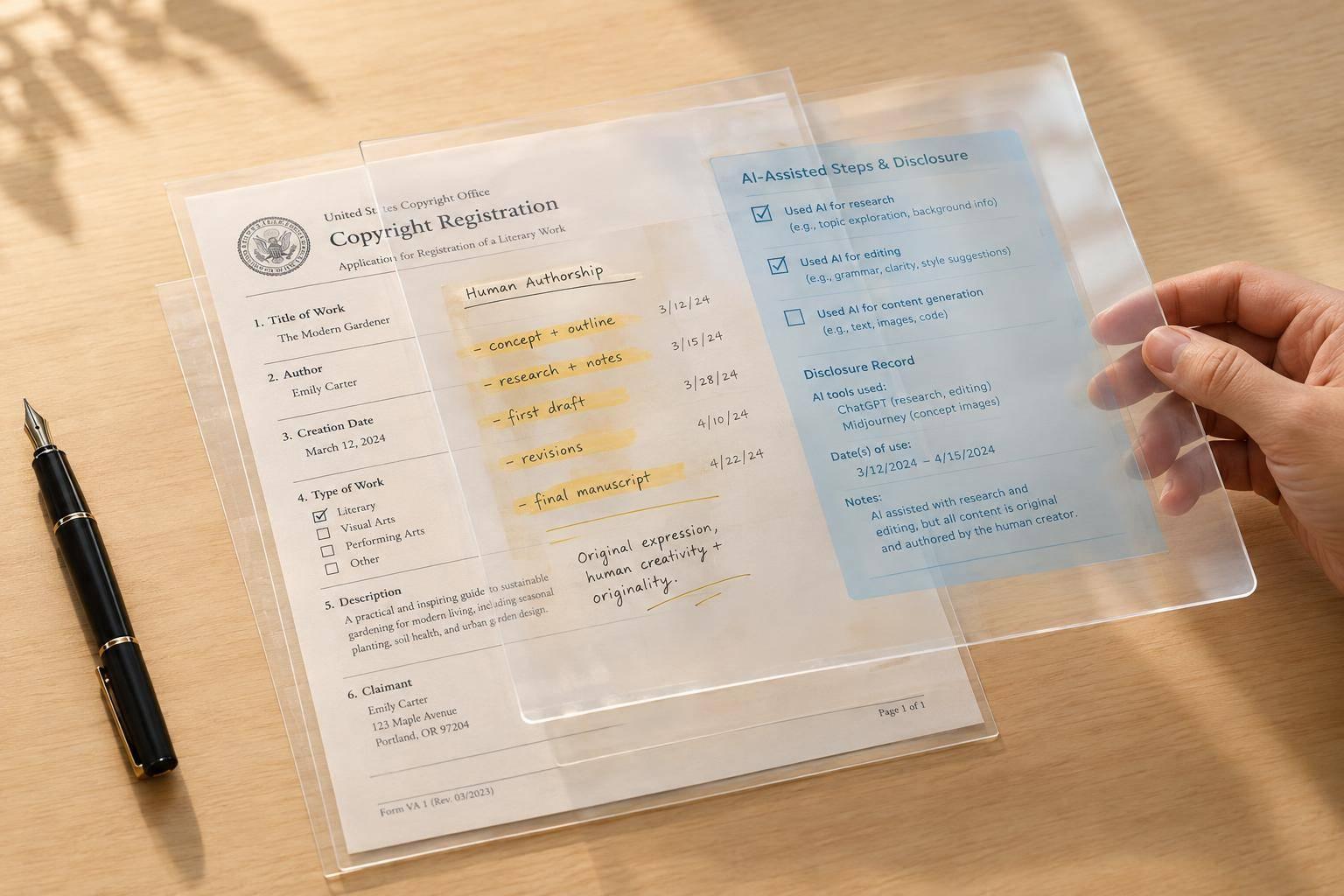
Using AI does not rule out copyright - but prompting alone usually does not establish authorship. My starting point: identify the human-written passages, original edits or arrangement, and keep dated records showing who made them.
The US Copyright Office’s report, published on 29 January 2025, explains how existing US law applies:
- Human expression may qualify. Purely AI-generated material does not.
- There is no fixed percentage test. Each work needs its own assessment.
- Records matter. Keep drafts and editing histories; disclose AI-generated material that is more than de minimis when registering.
- Protection and ownership are separate checks. Review employment terms, assignments and licences.
For UK businesses serving US markets, I would treat this as guidance, not new law - and avoid assuming that protection for human contributions covers the entire output.
::: @figure 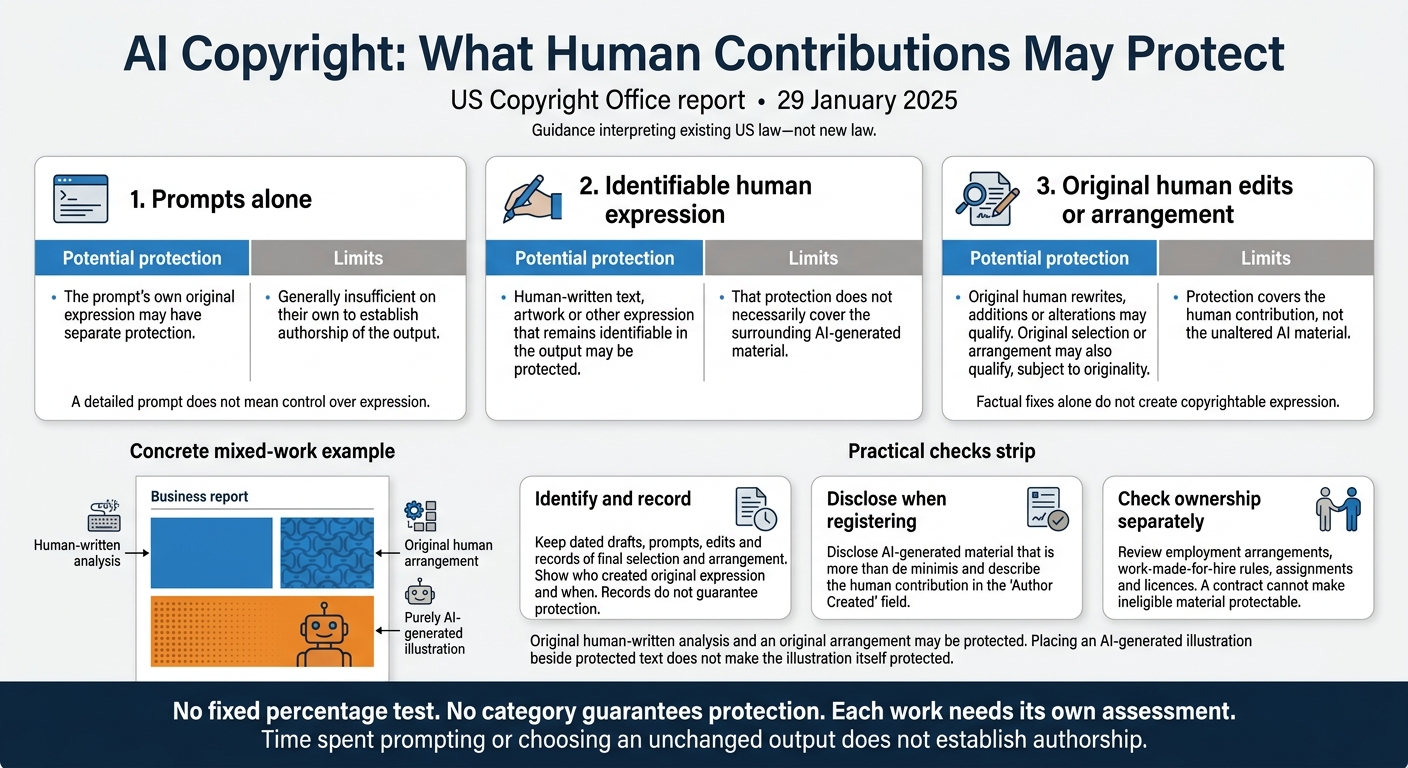 {AI Copyright: What Human Contributions May Protect}
:::
Copyright, AI & the Supreme Court: 2025 Update | ASMP 80th Anniversary
Prompts and Control Over AI Outputs
A detailed prompt does not mean control over expression. Identical prompts can produce different outputs because the system, not the user, chooses the wording and other expressive details. The report addresses the technology it reviewed, and each work still needs its own assessment.[5][8] Its focus is not how complex a prompt is, but whether the user controlled the expression in the output.
Instructions Are Not the Same as Authorship
Detailed instructions can narrow a task without controlling the final expression. Whether the prompt’s own original expression qualifies for copyright is a separate question. That protection does not automatically extend to the response.[4]
How the Report Treats Human Contributions
The key distinction is between directing a system and supplying identifiable expression:
| Human contribution | Potential copyright protection |
|---|---|
| Prompts | Generally insufficient on their own to establish authorship of the output. The prompt’s own original expression may have separate protection. |
| Human expression retained in the output | Human-written text that remains identifiable in the final work may be protected. That protection does not necessarily cover the surrounding AI-generated material. |
| Human modifications / original selection or arrangement | Original edits may support copyright in the edited material. Original selection or arrangement of AI-generated elements may also qualify, subject to originality. Protection covers the human contribution, not the unaltered AI material. |
No category guarantees protection, and the report sets no percentage threshold for human input.[2][7] Identify the human-written passages, original revisions or original arrangement. Keep drafts and edit histories that show those contributions: time spent prompting or choosing an unchanged output does not establish authorship.[5][6]
This distinction matters most in mixed human-AI works, where protected human expression sits alongside unprotected machine output.
Human Contributions in AI-Assisted Works
Once a prompt produces an output, the next question is which parts still reflect human authorship.
Human Expression Preserved or Added
Human expression can survive an AI transformation. If original text, artwork or a recording remains identifiable in the output, that human-authored expression may still be protected. AI-generated additions do not extend that protection.[2][7]
Factual fixes and expressive revisions are different. Correcting figures or contradictions improves accuracy, but does not create copyrightable expression. A later rewrite that introduces original language or structure may qualify.
What Copyright May Cover in Mixed Works
Look at the scope of the human contribution, rather than labelling the whole file “protected” or “unprotected”. The key question is whether that contribution remains identifiable enough to stand on its own.
| Work type | Possible coverage | Unprotected material |
|---|---|---|
| Output containing identifiable human expression | Recognisable human-authored text, artwork or other expression | New expression generated solely by AI |
| Human-edited output | Original human rewrites, additions or alterations | Unchanged AI-generated material |
| Mixed human–AI work | Human-authored content and original selection or arrangement | AI-generated components lacking human authorship |
Protection can cover the human contribution without covering the full output.
Business-report application: original human-written analysis and an original arrangement may be protected even when the report includes purely AI-generated illustrations. Placing those illustrations beside protected text does not make the illustrations themselves protected.[2][9]
Legal Sources and Business Checks
The Roles of Guidance, Legislation and Courts
For filing and ownership checks, start with the source of authority. This is guidance, not law.[1][5]
| Source of authority | Legal role | What businesses should check |
|---|---|---|
| Office report and registration guidance | Interprets existing law and explains registration practice | Use it for disclosure and filing practice, not as a source of rights. |
| Statutes enacted by Congress | Govern copyright subject matter, authorship and ownership | Check these separately; guidance cannot override them. |
| Judicial rulings | Decide disputes; their binding effect depends on jurisdiction and context | Check the relevant court and the scope of its ruling. |
Documentation therefore needs to show human authorship, not simply that someone used AI.
Records for Registration and Ownership Checks
Keep dated drafts, prompts, edits and records of final selection and arrangement to support registration. Record who contributed original expression and when. Prompts alone rarely prove authorship, so the records need to show what the human actually created. They do not guarantee protection.
Where AI-generated content is more than de minimis, disclose that material and describe the human contribution in the “Author Created” field.[3]
Check eligibility for protection separately from ownership. Employment arrangements, work-made-for-hire rules, assignments and licences may determine who owns eligible expression. Review contractor agreements and tool terms, but a contract cannot make ineligible material protectable. Seek separate legal advice for major ownership questions.
For mixed works, follow the same approach: identify the human contribution first.
Conclusion: Identify and Record Human Expression
AI use alone does not decide copyrightability. Identify and record the human expression, and do not assume protection extends to purely AI-generated portions.[2][7]
FAQs
How can I show my AI edits are original?
Keep a clear record that separates your own contribution from the raw AI output. Save the original outputs, details of where source material came from, the edits you made and your reasons for accepting or rejecting AI suggestions.
For stronger verification, use audit trails, signed diffs or cryptographic proofs. Label claims as supported, inferred or contested, and keep a correction record that links your manual edits to factual claims.
What counts as more than de minimis AI content?
Under the US Copyright Office’s guidance, copyright protection requires sufficient human authorship. Prompts alone or trivial computer-generated material do not meet that threshold.
For works that combine human and AI input, only human contributions - such as selection, arrangement or creative changes - qualify for copyright. AI-generated elements are excluded. This is the Office’s current administrative position on registration eligibility, not legislation or a court ruling.
How does this US guidance affect my UK business?
The US Copyright Office’s report confirms that copyright requires human authorship: AI output without sufficient human input into its creation is ineligible. The report provides guidance - it is not UK legislation.
For your UK business, this reinforces the need to separate AI-assisted work shaped and controlled by people from fully automated output. Hokstad Consulting helps organisations set up AI workflows and documentation that support human oversight, business goals and regulatory expectations.