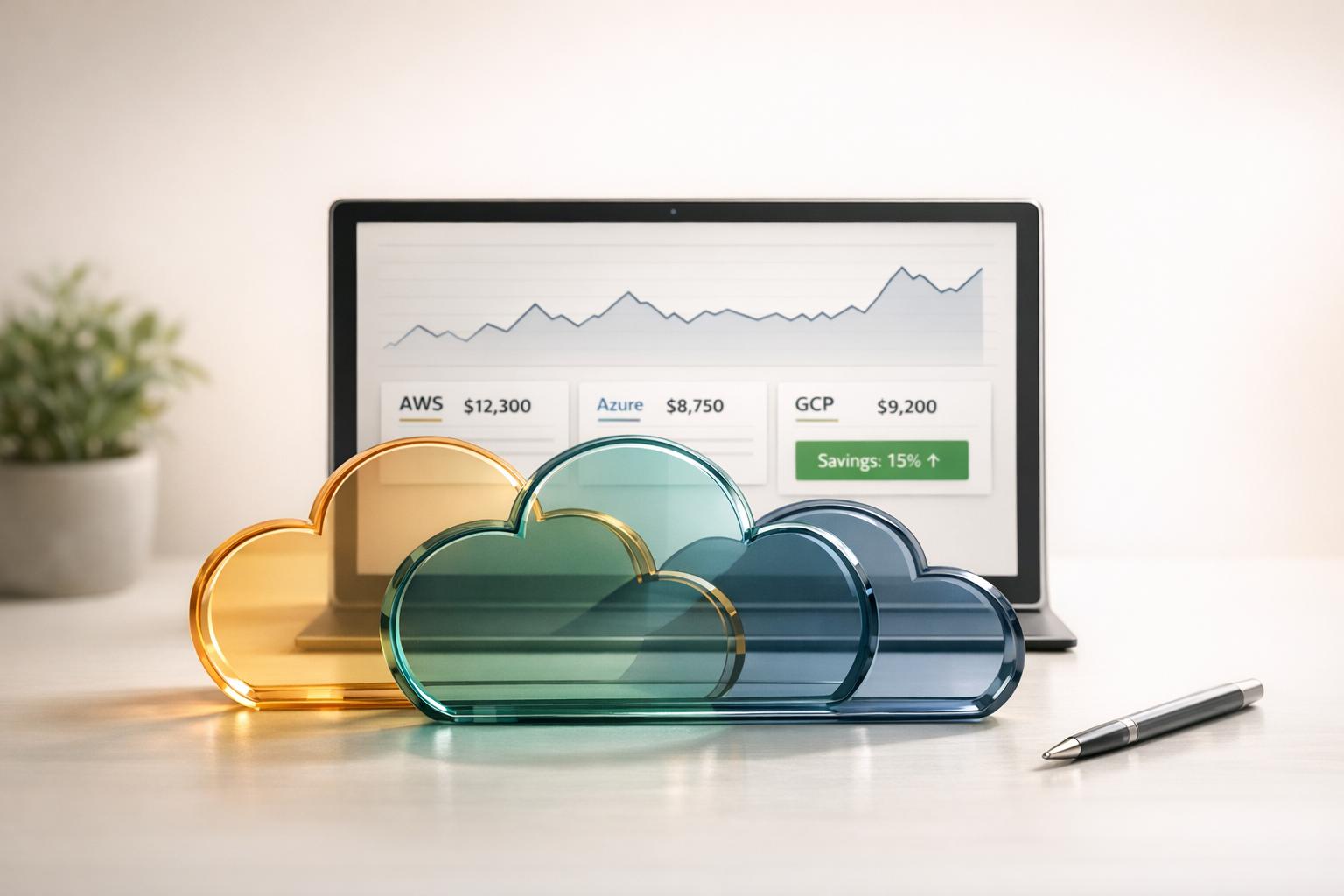
Managing multi-cloud costs is challenging, especially when using providers like AWS, Azure, and GCP. Tools that unify billing data, track spending in real-time, and automate optimisation are key to reducing waste - 51% of organisations report over 40% of their cloud spend is wasted. Here's what to look for in cost monitoring tools and top options to consider:
- Key Features: Real-time tracking, custom dashboards, accurate cost allocation, and budget alerts with machine learning forecasts.
- Top Tools:
- Expert Support: Hokstad Consulting offers tailored solutions to cut costs by 30–50%, integrating tools with CI/CD workflows and applying industry-specific strategies.
These tools and services help organisations turn cloud cost visibility into actionable savings.
Unified FinOps with Cloudshot: Multi-Cloud Cost Analytics & Optimization Across AWS, Azure & GCP
Key Features to Look for in Multi-Cloud Cost Monitoring Tools
When it comes to managing costs across multiple cloud platforms, not all tools are created equal. To navigate the complexities of multi-cloud environments effectively, focus on features that go beyond basic reporting and address the unique challenges these setups present.
Real-Time Cost Tracking
Waiting until the end of the month to review costs is too late. Real-time tracking shifts cost management from a reactive process to a proactive one. By offering live updates, these tools help teams catch and address cost spikes before they wreak havoc on budgets [6][7]. The most effective platforms refresh data hourly - or even more frequently - giving organisations a clear, up-to-the-minute view of how their spending aligns with deployments [4][2].
For instance, CloudZero enabled Drift to save £4 million in AWS expenses by leveraging real-time insights to eliminate waste [5]. Similarly, Ninjacat reduced its total cloud costs by 40% through immediate visibility into inefficiencies [5]. These successes highlight the power of acting on live data rather than waiting for retrospective reports.
Customisable Dashboards and Reporting
Different teams need different insights. A CFO might want a high-level view of departmental spending, while a DevOps engineer needs granular details, like which Kubernetes namespaces are consuming the most resources. Customisable dashboards let each stakeholder see the data that matters most to them without requiring additional custom reports [2].
Including unit economics - such as cost per customer or cost per transaction - adds another layer of strategic insight [6][5]. This approach ties cloud spending directly to business growth, answering critical questions like, Are we spending more because we're scaling, or because of inefficiencies?
These dashboards work best when paired with precise cost allocation methods, ensuring every expense is accounted for.
Cost Allocation and Tagging
Accountability starts with accurate cost allocation. Without it, over 30% of cloud usage costs often go to waste due to poor visibility and monitoring [10]. Manual tagging, however, is prone to errors and inconsistencies, especially across teams and providers.
Advanced tools address these gaps with features like virtual tags or telemetry-based mapping, which can assign costs even when metadata is incomplete [2][6]. They also handle shared expenses - such as NAT gateways or data transfer fees - by distributing these costs across departments based on fixed percentages or usage patterns [2][6]. In containerised environments, these tools can map costs down to specific namespaces, workloads, or pods, ensuring detailed accountability [2][6].
To build awareness, start with showback (showing teams their consumption) before moving to chargeback (holding them financially accountable) [1]. This creates a culture of cost-consciousness across the organisation.
Budget Alerts and Forecasting
Static budgets don't work in the ever-changing world of cloud computing. Modern tools use machine learning to predict future spending based on historical data, seasonal trends, and planned infrastructure changes [4]. These forecasts provide a range of projections, helping finance teams plan more accurately [4][6].
Automated alerts are equally crucial. Notifications for when usage nears or exceeds thresholds can help avoid unpleasant billing surprises [1]. To ensure swift action, anomaly alerts should integrate with tools like Slack or Jira and go directly to the engineer responsible, rather than a general inbox [6][7]. This targeted approach speeds up resolution and ensures accountability.
| Feature | What to Look For | Why It Matters |
|---|---|---|
| Real-Time Tracking | Hourly refresh with ML alerts [2] | Detects anomalies instantly and prevents budget overruns from sudden usage spikes [1][4]. |
| Customisable Dashboards | Role-based views and unit economics support [2][6] | Offers tailored insights for stakeholders without extra customisation. |
| Cost Allocation | Virtual tags and shared cost splitting [2][6] | Provides accountability even when manual tagging is incomplete. |
| Budget Alerts | ML forecasting with prediction ranges [4][6] | Enables proactive adjustments by predicting future spending accurately. |
Top Tools for Multi-Cloud Cost Monitoring
::: @figure 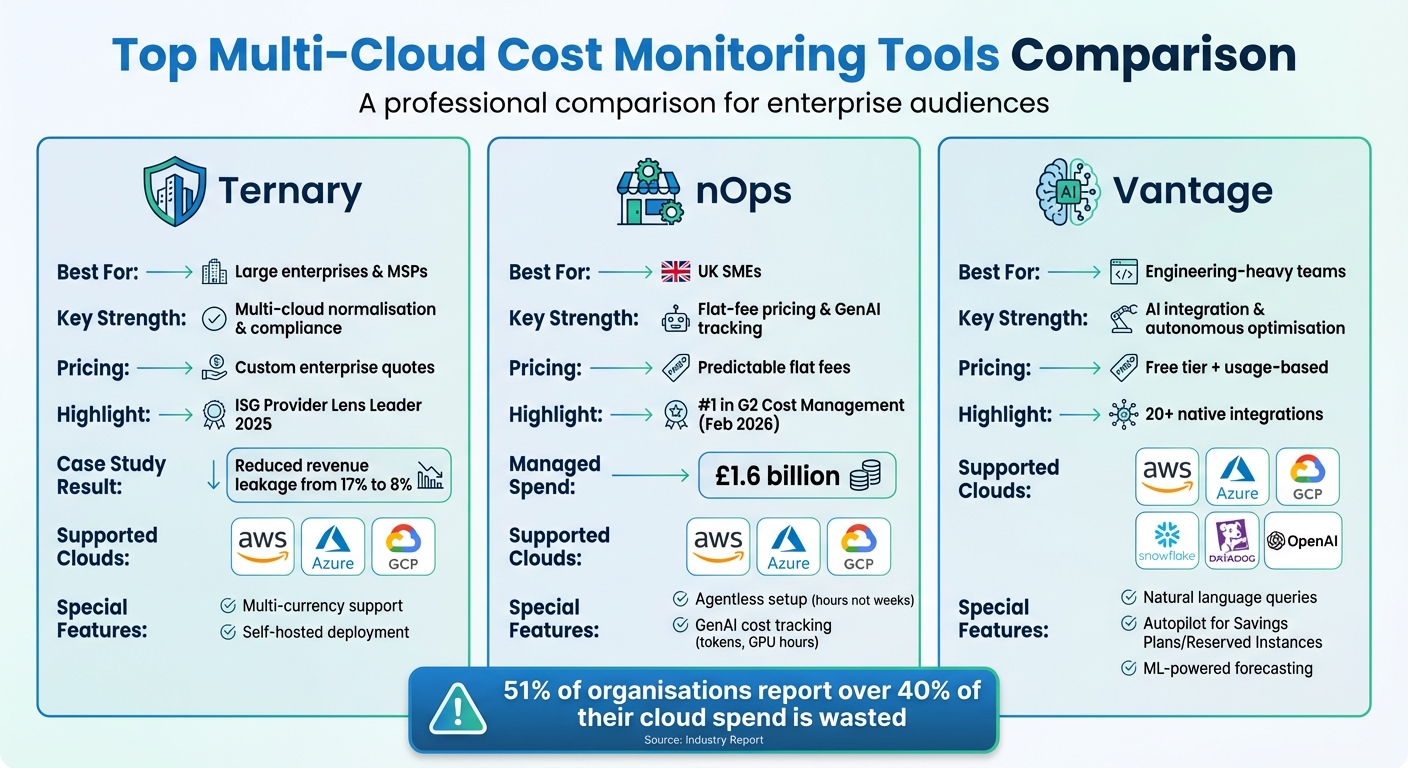 {Comparison of Top Multi-Cloud Cost Monitoring Tools for UK Businesses}
:::
{Comparison of Top Multi-Cloud Cost Monitoring Tools for UK Businesses}
:::
When selecting a tool for multi-cloud cost monitoring, it's essential to consider your organisation's size, technical expertise, and budget. Below, you'll find an overview of three platforms tailored to meet the needs of UK organisations, ranging from large enterprises to SMEs and tech-heavy teams.
Tool 1: Enterprise-Scale Monitoring Capabilities
Ternary is an excellent choice for large enterprises or managed service providers that need strong governance and multi-cloud normalisation. Recognised as a Leader in the 2025 ISG Provider Lens for FinOps Platforms [8], Ternary consolidates billing data from AWS, Azure, and GCP into a unified view [8].
One case study highlighted how Ternary helped lower non-GAAP revenue leakage from 17% to 8% [8]. Its multi-currency support and self-hosted deployment make it a great fit for global organisations or industries with strict data residency needs [8].
Before using Ternary, it would take me hours to analyse our cloud costs. Now, I have a single source of truth for all my cloud spending across Google Cloud, Azure, and AWS.– Pravash Mukherjee, Senior Director at Decisions [8].
Pricing for Ternary is provided via custom enterprise quotes.
Tool 2: Budget-Friendly Option for Small and Medium Businesses
nOps offers enterprise-grade features at a transparent, flat-fee price, making it a practical option for UK SMEs [2]. As of February 2026, it was ranked #1 in G2's Cost Management category, managing approximately £1.6 billion in cloud spend [2].
The platform includes automated forecasting and anomaly detection across AWS, Azure, and GCP. It also tracks GenAI-related costs, such as token calls and GPU hours [2]. Its agentless setup, which takes just hours instead of weeks, is particularly appealing to smaller teams with limited technical resources [9].
Tool 3: Advanced Automation and AI-Powered Insights
Vantage is a standout for teams that value automation and AI-driven tools. With over 20 native integrations, including Snowflake, Datadog, and OpenAI, Vantage allows users to query cost data using natural language through its integration with major LLMs [3][9].
Its machine learning-powered forecasting provides confidence intervals with frequent updates throughout the day [3]. Additionally, the Autopilot
feature autonomously manages Savings Plans and Reserved Instances, significantly reducing the workload for DevOps teams [11]. Vantage offers a free tier, with scalable, usage-based paid plans [11].
| Tool | Best For | Key Strength | Pricing Model |
|---|---|---|---|
| Ternary | Large enterprises & MSPs | Multi-cloud normalisation & compliance | Custom enterprise quotes |
| nOps | UK SMEs | Flat-fee pricing & GenAI tracking | Predictable flat fees |
| Vantage | Engineering-heavy teams | AI integration & autonomous optimisation | Free tier + usage-based |
Need help optimizing your cloud costs?
Get expert advice on how to reduce your cloud expenses without sacrificing performance.
How Hokstad Consulting Can Help
Hokstad Consulting takes cost monitoring a step further by transforming spending insights into real, actionable savings. While many tools can highlight where money is going, achieving meaningful reductions often requires expert guidance and automation. Hokstad Consulting works with UK businesses to bridge this gap, offering bespoke services that complement the platforms mentioned earlier.
Cloud Cost Engineering Services
Hokstad Consulting employs an engineering-first approach to help businesses cut cloud costs by 30–50%. Through in-depth audits and customised strategies, they identify inefficiencies like misconfigured storage, unused resources, and costly data transfers that automated alerts might miss.
Their reporting aligns with UK standards, presenting data in GBP, using DD/MM/YYYY formats, and adhering to GDPR and HMRC requirements. Hokstad’s strategies cater to industry-specific needs: financial services clients benefit from enhanced security and compliance measures, retailers gain scalable solutions for handling seasonal demand spikes, and healthcare organisations receive cost-effective data protection strategies that don’t compromise on security. This tailored approach ensures businesses get more than just cost monitoring - they gain solutions built for their unique challenges.
Custom Development and Automation
Hokstad Consulting also develops automation tools that seamlessly integrate into CI/CD workflows. These tools optimise resource usage, schedule shutdowns for idle systems, and automatically address anomalies.
Their DevOps transformation services embed cost-awareness into development processes, ensuring financial considerations are part of every deployment. Hokstad also helps businesses design tagging standards and governance policies for AWS, Azure, and Google Cloud, eliminating the fragmented visibility that often occurs in multi-cloud environments. With over 50% of organisations identifying workload optimisation and waste reduction as top priorities for 2025 [12], Hokstad’s proactive solutions directly address this growing need.
AI-Driven Cloud Optimisation
Hokstad leverages machine learning to predict resource needs and adjust allocations automatically. Their tools manage discount portfolios - like Reserved Instances, Savings Plans, and Committed Use Discounts - ensuring businesses maximise savings. These advanced strategies enable companies to turn cost management into a dynamic and efficient process.
Conclusion
Recap of Features and Tools
When it comes to managing cloud costs effectively, the right tools can make all the difference. Look for platforms that provide real-time tracking, custom dashboards, advanced tagging capabilities, and budget forecasting tools. The tools highlighted in this article cater to a range of needs, from large enterprises requiring strict governance to smaller businesses seeking affordable solutions. They also offer automation features tailored to specific cloud environments, helping to minimise waste. For instance, automated policies for untagged resources and integration with CI/CD pipelines ensure cost management becomes an integral part of development workflows. These capabilities help organisations turn visibility into concrete savings.
Partnering with Experts for Cost Optimisation
While tools provide essential visibility, working with experts can turn those insights into actionable savings. Monitoring alone isn’t enough - expert guidance ensures that cost reduction strategies are implemented effectively. Research shows that professional FinOps practices can slash cloud infrastructure costs from 17% of non-GAAP revenue to as low as 8%, offering an impressive return on investment without the need for a dedicated in-house FinOps team [13].
Partnering with experts can yield successful ROI without the overhead of maintaining an in-house team.– Rudy Grigar, Director of Cloud Services at The Linux Foundation [13]
For UK businesses, combining intelligent platforms with expert advice can reduce unnecessary cloud spending by up to 40% [10].
Hokstad Consulting offers a practical solution by bridging the gap between data and action. They specialise in cloud cost engineering, custom automation, and AI-driven optimisation, all tailored to meet UK regulatory standards. Their No Savings, No Fee
model ensures organisations only pay for actual savings realised. For companies managing complex multi-cloud setups, this approach transforms reactive monitoring into proactive cost management, delivering measurable and sustained value over time.
FAQs
What should I consider when choosing a tool to monitor multi-cloud costs?
When choosing a multi-cloud cost monitoring tool, it's essential to find one that supports major providers like AWS, Azure, and Google Cloud. This ensures smooth integration and allows you to track expenses across platforms in one place. Look for tools that provide real-time monitoring and anomaly detection, so you can spot unexpected cost spikes early and avoid unnecessary overspending.
Some key features to prioritise include cost allocation, detailed reporting, and forecasting. These help you break down spending, identify trends, and make better financial decisions. Automation is another major advantage - tools with policy-based cost controls or auto-scaling can help you manage resources more efficiently and cut down on waste. If you're a UK-based business, features like currency conversion (e.g., USD to £GBP) and compliance with local regulations are particularly useful.
The best tools also offer a unified dashboard, making it easier to oversee costs, along with scalability and AI-driven insights to streamline cost management in multi-cloud setups. These features can save time, reduce complexity, and improve overall efficiency.
How does real-time cost tracking help prevent overspending in multi-cloud environments?
Real-time cost tracking is a powerful way to keep your cloud expenses in check. It gives you instant visibility into your spending, helping you spot any unexpected spikes or irregularities before they blow a hole in your budget.
With the ability to monitor costs as they happen, you can make smarter decisions on the fly. This means you can tweak your resource usage as needed, keeping your cloud spending on track with your financial objectives.
Why is expert guidance essential for optimising cloud costs?
Navigating the complexities of cloud cost management is no small feat, especially in multi-cloud environments. Expert guidance plays a critical role in helping businesses identify hidden expenses, streamline resource use, and adopt smart strategies to cut waste. In the UK, many organisations struggle with issues like fragmented cost tracking, over-provisioned resources, and delays in monitoring, all of which can lead to unexpected budget overruns.
Specialists, such as Hokstad Consulting, offer tailored solutions to address these challenges. Their expertise includes automating resource tagging, setting and enforcing budgets, and conducting regular audits to maintain financial control. They also assist in applying FinOps principles - a framework designed to align cloud spending with business objectives, ensuring every pound spent delivers value.
With cloud pricing models and technologies constantly evolving, having expert advice ensures businesses stay ahead of the curve. This not only improves operational efficiency but also helps organisations make the most of their cloud investments.