Managing cloud costs across AWS, Azure, Google Cloud, and SaaS platforms can be complicated for UK businesses. Each provider uses different billing formats, currencies, and pricing models, making it tough to get a clear view of expenses. This often leads to wasted resources and budget overruns. Multi-cloud billing tools solve this by consolidating costs into a single dashboard, converting currencies (e.g., USD to GBP), and offering features like anomaly detection, cost allocation, and optimisation recommendations.
Here are the 7 tools covered:
- Finout: Combines cloud and SaaS costs into one bill with Kubernetes support and real-time tracking.
- CloudZero AnyCost: Focuses on unit economics and integrates with SaaS platforms like Snowflake and Databricks.
- Ternary: Offers SaaS and self-hosted options, with strong support for Kubernetes and machine learning-powered insights.
- CloudHealth (VMware Tanzu): Ideal for governance and real-time Kubernetes cost allocation.
- nOps: AWS-focused with automated cost-control actions and anomaly detection.
- Cloudaware: Hybrid and multi-cloud support with compliance-focused features.
- Vantage: Simple, fast setup for multi-cloud and SaaS cost tracking, with detailed Kubernetes insights.
Quick Comparison:
| Tool | Multi-Cloud Support | Kubernetes Cost Tracking | Anomaly Detection | SaaS Integration | Deployment Options |
|---|---|---|---|---|---|
| Finout | AWS, Azure, GCP + SaaS | Yes | Yes | Yes | SaaS |
| CloudZero AnyCost | AWS, Azure, GCP + SaaS | Yes | Yes | Yes | SaaS |
| Ternary | AWS, Azure, GCP | Yes | Yes | Limited | SaaS & Self-hosted |
| CloudHealth | AWS, Azure, GCP + Hybrid | Yes | Yes | Limited | SaaS |
| nOps | AWS, Azure, GCP | Yes | Yes | Limited | SaaS |
| Cloudaware | AWS, Azure, GCP + Hybrid | Limited | Yes | Custom API | SaaS |
| Vantage | AWS, Azure, GCP + SaaS | Yes | Yes | Yes | SaaS |
Choosing the right tool depends on your needs. If you require Kubernetes cost tracking, CloudHealth or Ternary may work best. For SaaS-heavy environments, consider Finout or CloudZero AnyCost. AWS-focused teams may benefit from nOps, while compliance-driven organisations might prefer Cloudaware. Each tool offers unique features to simplify multi-cloud cost management for UK businesses.
1. Finout
Finout is a modern FinOps platform that simplifies cloud, Kubernetes, and SaaS cost management by consolidating everything into one unified bill. For UK organisations juggling AWS, Azure, Google Cloud, and a growing list of data and observability tools, Finout’s standout feature - MegaBill - brings together invoices from multiple providers into a single, streamlined view. This eliminates the hassle of navigating multiple portals or manually reconciling costs across platforms [6][7].
The platform integrates directly with AWS Cost and Usage Reports, Azure cost exports, Google Cloud billing feeds, and a variety of SaaS and data platforms. By doing so, it allows finance teams to replace scattered invoices with a consolidated dashboard where all costs are converted to GBP, billing periods are aligned, and service mappings are standardised. This makes month-end reconciliations smoother, supports clearer showback and chargeback to different business units, and reduces reliance on spreadsheets - especially when managing complex discounts or vendor credits. Essentially, it lays the groundwork for effective multi-cloud cost management [1][9].
Multi-cloud and SaaS Cost Management
Finout stands out by not only consolidating core infrastructure costs but also addressing the increasing spend on data platforms and observability tools. These tools often form a significant portion of cloud bills for many organisations [6][7]. While traditional tools might focus solely on infrastructure-as-a-service (IaaS) costs, Finout takes it a step further by combining both infrastructure and SaaS billing into a single view. This approach helps organisations manage their spending across core cloud services and specialised platforms, offering a more comprehensive perspective [1][9].
Kubernetes Cost Allocation
For organisations using Kubernetes, Finout provides detailed cost attribution, breaking down container expenses by cluster, namespace, deployment, service, or label. This granularity supports precise showback and chargeback processes. Shared costs - like those for ingress controllers, logging systems, or shared databases - can also be allocated across teams or products using metrics such as percentages, requests, or CPU/memory usage. For instance, a UK-based SaaS company could allocate EKS or GKE cluster costs to individual products based on namespace usage, enabling more accurate gross margin analysis by product or customer segment. This level of detail is crucial for effective FinOps practices in complex cloud environments [1][9].
Anomaly Detection and Cost Optimisation
Finout helps teams stay on top of their budgets by identifying unusual changes in spending, usage, or unit economics. Alerts and dashboards notify finance, engineering, and FinOps teams when spending deviates from historical patterns. Budgets or thresholds can be set for cloud accounts, projects, teams, or products, triggering notifications when limits are exceeded. Beyond alerts, the platform offers optimisation workflows to tackle inefficiencies - like rightsizing instances, removing idle resources, adjusting commitments, or refining cost allocation rules. These tools not only help reduce costs but also improve forecasting and speed up month-end processes [1][6][9].
Real-time Cost Tracking
Finout is designed to ingest and process billing data frequently, offering near real-time visibility into costs. This allows continuous budget monitoring and quick investigations into spending spikes. By integrating directly with provider billing exports - such as importing Google Cloud billing data into BigQuery - the platform normalises and enriches data for immediate use in dashboards and reports. This shift from static monthly reporting to ongoing optimisation means teams can address cost issues as they arise [6][8].
One unique feature is Instant Virtual Tagging, which overlays raw billing data with existing metadata. This lets teams define business-specific dimensions - like cost centres, product lines, customer segments, or environments - without changing native cloud tags. For organisations with inconsistent or legacy tagging practices, Finout enables rules to infer or override cost allocations based on factors like account IDs, project names, or regions. This approach ensures even untagged resources can be accounted for, allowing for 100% allocation accuracy at the point of data ingestion [6].
Finout uses a custom, quote-based pricing model tailored to your cloud usage and footprint, with no fixed public pricing tiers. A free trial is available to test its multi-cloud bill consolidation and validate the accuracy of its MegaBill feature against internal reports. The platform’s cost is typically offset by the savings achieved on total cloud and SaaS spending, making it an appealing option for organisations with large multi-cloud bills [6][7].
For teams without in-house FinOps expertise, partnering with a consultancy like Hokstad Consulting can speed up implementation and improve cost governance. A consultancy can tailor Finout to align with strategic goals, integrate it into CI/CD workflows and incident response processes, and develop custom automation for budgeting, anomaly resolution, and chargeback. This partnership can deliver faster results and stronger cost controls [1][9].
2. CloudZero AnyCost
CloudZero AnyCost simplifies the complex task of managing billing data from AWS, Azure, Google Cloud, Kubernetes, and various SaaS platforms by consolidating it into a single, GBP-based view. For UK organisations juggling multiple cloud services, this eliminates the headache of manually reconciling different billing formats, currencies, and service taxonomies across providers [3].
What makes CloudZero stand out is its emphasis on cost intelligence rather than just aggregating data. It digs deeper to provide insights into unit economics, such as the cost per product, feature, or customer. This detailed breakdown is invaluable for businesses like SaaS providers and tech firms, allowing them to link infrastructure expenses directly to business outcomes. For example, a UK-based SaaS company could use CloudZero to calculate the cost of serving each enterprise customer across various cloud services, enabling smarter decisions around pricing and margins. By unifying cost data, CloudZero offers a clearer picture of allocation and spending [3].
Multi-cloud Coverage and SaaS Integration
CloudZero AnyCost integrates billing and usage data from major public clouds - AWS, Azure, and Google Cloud - as well as Kubernetes and third-party SaaS platforms like Snowflake, New Relic, MongoDB, and Databricks. Its ability to handle costs from any source that sends a bill
extends beyond traditional cloud providers to include databases, CDNs, observability tools, and other SaaS vendors. By normalising these diverse billing formats into a single model, the platform enables seamless multi-cloud cost aggregation and comparison, sparing UK finance teams the hassle of manual reconciliation [3].
A key feature is its ability to allocate spending across resources without requiring extensive tagging updates. This means engineering and finance teams can still assign costs to specific features, teams, or customers, enabling effective chargeback and showback processes [3].
Kubernetes and Container Cost Allocation
For organisations heavily reliant on microservices and container orchestration, CloudZero provides robust cost allocation for Kubernetes workloads. It imports cluster-level spending data and correlates it with provider billing information, integrating these costs with overall cloud and SaaS expenses. This allows for granular allocation by product, team, or customer. For instance, a UK fintech managing multiple EKS clusters can use CloudZero to distribute shared infrastructure costs - such as those for ingress controllers or shared databases - across different product lines based on namespace usage. This mapping of workloads and namespaces to internal cost centres offers engineering teams clear insights into service and feature costs [3].
Anomaly Detection and Optimisation
While not a dedicated alerting tool, CloudZero enhances FinOps workflows by highlighting unexpected cost changes and patterns across AWS, Azure, GCP, Kubernetes, and SaaS platforms in one unified view. It flags unexpected cost spikes and identifies opportunities for optimisation, such as rightsizing or addressing underutilised resources. Teams can configure dashboards and alerts around unit metrics like cost per customer or feature, helping to spot anomalies in a business context. For example, if the cost per active user suddenly rises due to an inefficient query in a data warehouse, CloudZero's dashboard can pinpoint this, enabling quicker problem-solving. Near real-time data updates ensure that teams can make informed decisions daily and respond swiftly to new deployments [3].
Real-time Cost Aggregation and Implementation
CloudZero’s real-time aggregation capabilities allow for daily decision-making and quick responses to spending anomalies. Updates occur as frequently as provider exports permit, meaning that UK teams can set up alerts for sudden cost spikes - like unexpected AWS S3 storage costs - and act promptly to address them.
Getting started with CloudZero involves connecting cloud providers, Kubernetes clusters, and key SaaS platforms to import and normalise billing data. FinOps and engineering teams can then define cost dimensions - such as Product A
or Team Alpha
- and map resources accordingly using CloudZero’s correlation engine, bypassing the reliance on tagging alone. This approach supports detailed dashboards that track unit costs, like cost per customer per month, and aligns seamlessly with GBP-based budgeting and forecasting [3].
CloudZero operates on a custom-quote pricing model, tailored to the customer’s cloud spend and required features. UK organisations can expect quotes in GBP, often tied to annual cloud spend thresholds and support levels. For those without in-house FinOps expertise, consulting services like Hokstad Consulting can assist in customising cost allocation models and workflows [3].
3. Ternary
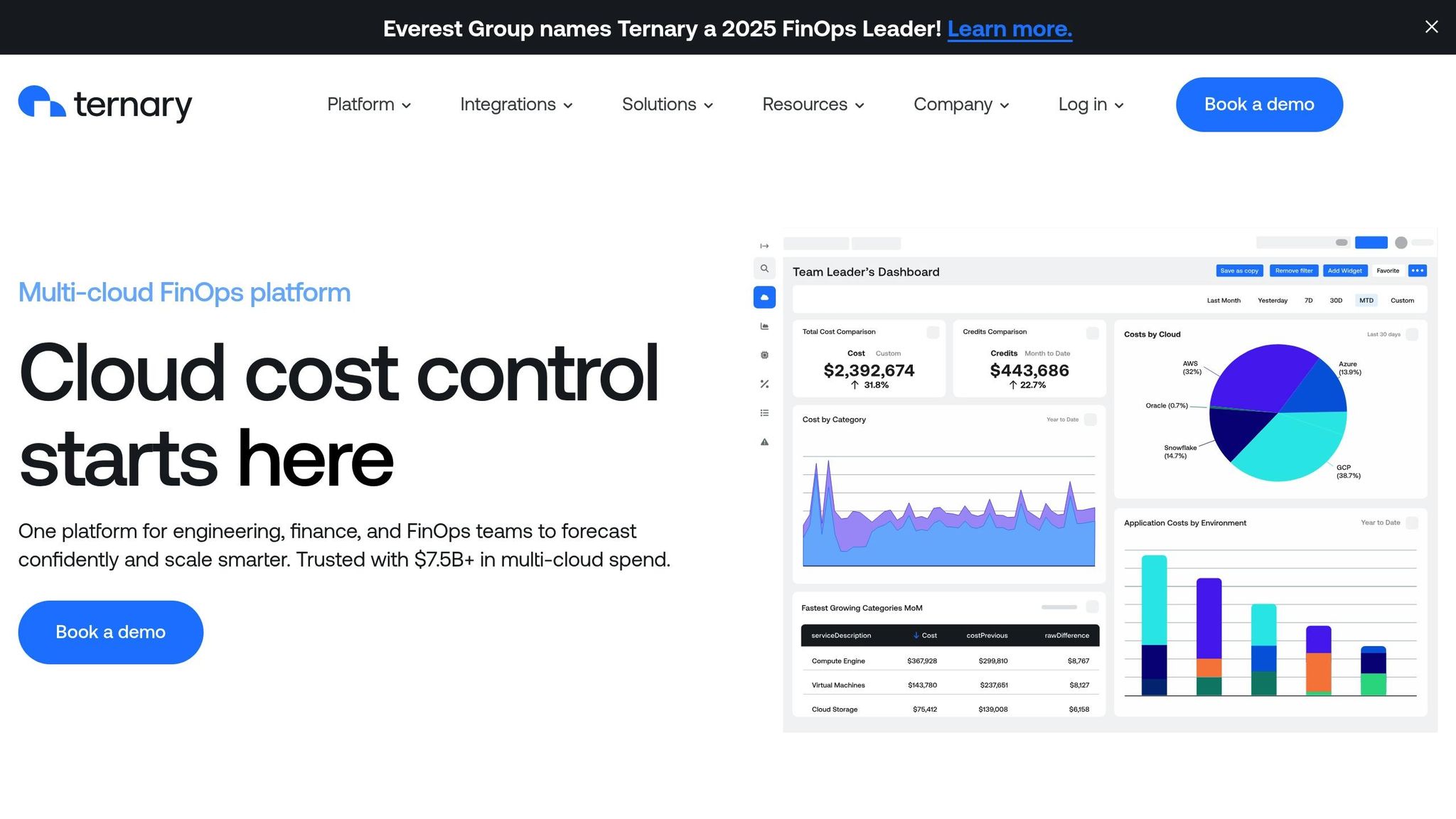
Ternary is a FinOps platform designed to simplify cloud cost management for organisations operating across AWS, GCP, and Azure. It consolidates billing data from these providers into a single, unified view. For UK businesses juggling workloads on multiple cloud platforms, this eliminates the headache of manually reconciling billing formats, currencies, and service classifications. By ingesting billing exports - like AWS Cost and Usage Reports (CUR), GCP Billing Export to BigQuery, and Azure data from Enterprise or Microsoft Customer Agreements - Ternary standardises everything into a consistent format. This makes it easier for finance teams to report in GBP and align cloud costs with UK-specific financial planning cycles.
What makes Ternary stand out is its deployment flexibility. It offers both SaaS and self-hosted options, which is particularly useful for UK enterprises with strict data residency or compliance needs. Sensitive billing data can be kept within a company's own infrastructure or a preferred cloud region - something especially relevant for sectors like finance, healthcare, and government. With a G2 rating of 4.9 out of 5 stars, Ternary is built to handle organisations managing over £6 billion in annual cloud spend globally [10]. Beyond its core functionality, it also integrates with SaaS and Kubernetes systems, adding depth to its cost management capabilities.
Multi-cloud Coverage and SaaS Integration
Ternary pulls together cost and usage data from AWS, Azure, and GCP, enabling teams to compare spending across platforms without the hassle of inconsistent billing formats. Beyond the major cloud providers, Ternary connects with SaaS tools and observability platforms like Snowflake and Datadog, adding operational context to cost data. For example, a UK SaaS company can directly link performance metrics with infrastructure costs, helping teams understand how resource usage changes affect overall expenses and customer experience.
The platform also allows for custom reporting and role-based views. This means stakeholders - from CFOs to product managers to FinOps specialists - can access the specific spending data they need. Finance teams get high-level summaries in GBP aligned with cost centres, while engineering teams can drill down into detailed breakdowns by service, resource, or project. This tailored reporting approach streamlines processes like showback and chargeback, helping UK organisations enforce better cost governance.
Kubernetes and Container Cost Allocation
For businesses running containerised workloads, Ternary provides detailed cost allocation for Kubernetes environments across multiple clouds. It gathers data at every level - cluster, namespace, deployment, service, pod, and container - and aligns this with cloud billing information. This granular visibility allows teams to attribute costs accurately to specific products, teams, or projects. For instance, a UK fintech using hybrid Kubernetes workloads across AWS EKS, Google GKE, and Azure AKS can break down costs by namespace to identify inefficiencies like over-provisioned or idle resources, leading to better cost accountability and optimisation.
By linking Kubernetes usage to cloud billing, Ternary helps teams understand the true cost of running microservices and shared infrastructure like databases or ingress controllers. This level of detail enables fair cost distribution across product lines or internal teams, supporting smarter decision-making around resource allocation and capacity planning. Such precision also lays the groundwork for effective anomaly detection and cost-saving measures.
Anomaly Detection and Optimisation
Ternary uses machine learning to spot unusual spending patterns in near real time, sending alerts for immediate action - like flagging a misconfigured deployment that’s driving up Azure compute costs. The platform also provides optimisation suggestions, such as rightsizing over-provisioned instances, identifying idle resources, and improving the use of reserved instances or savings plans. These insights help teams cut waste and align spending with business goals.
Real-time Cost Aggregation and Implementation
Ternary frequently updates its dashboards and cost aggregation to reflect current spending. However, the speed of updates depends on the cloud provider's billing export frequency. For example, AWS CUR data has a 24–48 hour delay, while GCP BigQuery exports can be nearly real time. Ternary processes and normalises this data with minimal lag, giving UK teams the timely visibility they need for faster decision-making, accurate budget tracking, and quick responses to anomalies in multi-cloud environments.
Getting started is straightforward: connect cloud accounts, configure billing exports, and set up custom allocation rules to map costs to business categories like teams, products, or environments. This ensures accurate showback and chargeback, supports departmental budgeting, and simplifies executive reporting. For UK organisations, this means finance teams can monitor GBP-denominated budgets and forecasts in line with internal planning cycles, while engineering teams get the detailed insights needed to optimise resource usage.
Ternary uses a quote-based pricing model tied to the scale of cloud spending and the number of accounts or integrations. The pricing is transparent, with no hidden fees or overages - an important feature for UK finance teams aiming to control cloud costs. Free trials are available, allowing teams to explore multi-cloud ingestion and dashboards before committing. For organisations that lack in-house FinOps expertise, consulting services like Hokstad Consulting can assist with cost allocation models, integrating Ternary into existing DevOps workflows, and developing governance policies tailored to UK financial and operational standards.
4. CloudHealth (VMware Tanzu)
CloudHealth, now branded as VMware Aria Cost powered by CloudHealth, is a powerful multi-cloud cost management and governance platform. Tailored for large organisations with complex cloud environments, it doesn’t just compile billing data - it acts as a FinOps control hub. For UK enterprises managing extensive cloud budgets, CloudHealth provides a consolidated view of costs and usage, mapped to internal cost centres, enabling financial reporting in GBP.
What sets CloudHealth apart is its ability to enforce cost governance. It allows organisations to set budgets, define usage rules, and establish compliance alerts - for example, triggering notifications if spending exceeds forecasts by 20% or if resources lack proper tagging. This makes it especially valuable for industries like financial services, healthcare, and the public sector, where strict cost controls and audit trails are non-negotiable. The platform also streamlines processes like showback and chargeback by mapping aggregated cloud costs to internal business structures.
In early 2025, Broadcom introduced significant updates to CloudHealth, including a refreshed user interface and AI-powered features like Intelligent Assist and Smart Summary. These new tools allow users to query cost data in natural language and quickly identify opportunities for cost optimisation.
Multi-cloud Coverage and SaaS Integration
CloudHealth goes beyond governance, offering extensive visibility across AWS, Azure, Google Cloud, and on-premises environments. This broad coverage ensures comprehensive financial management and governance across hybrid and multi-cloud setups. It also supports business group reporting, enabling organisations to align cloud costs with specific business units, projects, or cost centres. While its primary focus is on IaaS and PaaS billing, businesses with substantial SaaS expenses might need additional tools or custom data ingestion to fully integrate their SaaS spend.
Kubernetes and Container Cost Allocation
For organisations leveraging Kubernetes, CloudHealth provides detailed container cost allocation, breaking down expenses by namespace, deployment, service, pod, and container. This granular visibility helps engineering and finance teams implement accurate chargeback and showback processes, converting cloud provider costs into GBP and aligning them with internal cost codes. By maintaining consistent Kubernetes labelling, organisations can ensure precise cost attribution, aiding better resource management and capacity planning.
Anomaly Detection and Optimisation
CloudHealth offers practical recommendations to optimise cloud spend, such as identifying unused workloads, over-provisioned resources, and opportunities for rightsizing in both Kubernetes and virtual machine environments. These insights can be aligned with financial reporting cycles, whether monthly or quarterly, and expressed in GBP. For organisations lacking in-house FinOps expertise, consultancies like Hokstad Consulting can assist in designing tagging standards, reporting structures, and automation workflows tailored to multi-cloud environments.
Real-time Cost Aggregation and Implementation
One of CloudHealth’s standout features is its ability to aggregate cost and usage data into a single, unified view. This enables continuous monitoring, providing near real-time insights based on billing exports and APIs from providers like AWS, Azure, and Google Cloud. While formal financial reconciliation still requires official GBP invoices, UK FinOps teams can track spending trends and address anomalies as they arise during the workday.
To maximise CloudHealth’s potential, integrate it with all relevant cloud accounts and on-premises systems, configure billing exports for GBP reporting, and map costs to internal business groups. For Kubernetes environments, consistent labelling by team, application, and environment is essential for effective cost governance. Many organisations establish regular FinOps routines to review optimisation suggestions and monitor savings achieved through the platform.
5. nOps
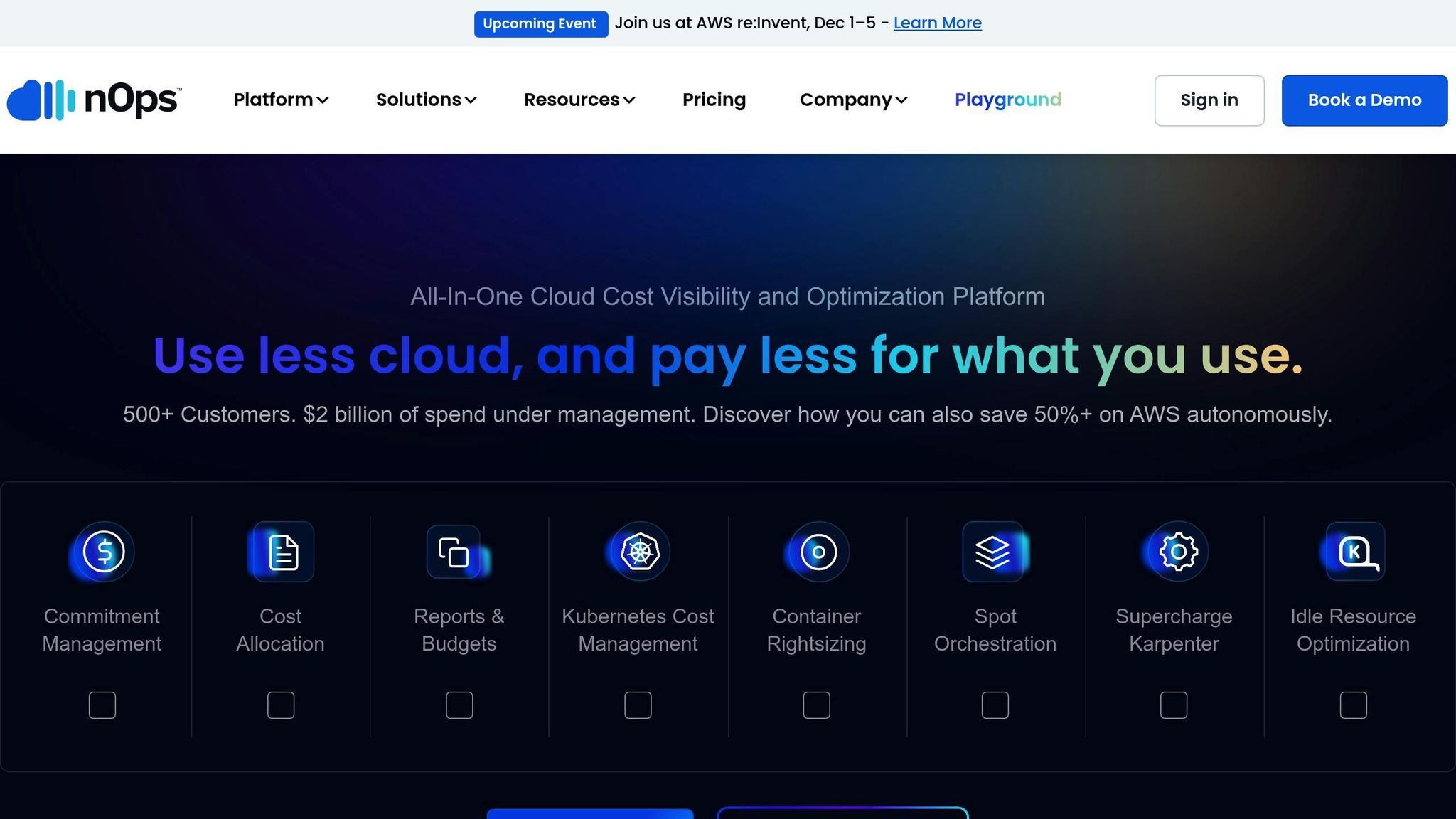
nOps addresses the challenge of managing multi-cloud costs by adding a layer of automation that continuously optimises spending. As an automated FinOps platform, it integrates cost control into DevOps workflows, helping UK businesses manage cloud expenses across AWS, Azure, and Google Cloud. With nOps, organisations can view their spending in one place while automatically identifying and resolving inefficiencies - no manual intervention required.
What sets nOps apart is its ability to go beyond recommendations. It automates actions like shutting down idle resources, adjusting commitments, and enforcing cost-control policies. This ensures businesses stay within budget while allowing engineering teams to focus on innovation. For industries like technology, media, and professional services - where cloud usage often fluctuates - nOps' automation ensures spending remains predictable and aligned with financial goals [8].
Multi-cloud Coverage and SaaS Integration
nOps consolidates billing data from AWS, Azure, Google Cloud, and third-party SaaS platforms like Snowflake and Databricks into a single dashboard. All figures are automatically converted to £, making it easier for UK organisations to manage multi-currency cloud expenses and report them in a consistent format.
The platform also includes role-based access, budget controls, and compliance-ready features, which are particularly useful for enterprises with stringent financial governance requirements. Whether it's for internal reporting or external audits, nOps simplifies financial management [8].
Kubernetes and Container Cost Allocation
For teams running containerised workloads, nOps provides detailed Kubernetes cost tracking across services like EKS, AKS, and GKE. It breaks down costs for compute, storage, and networking at the pod and container level, enabling precise chargeback and showback. This makes it easier to allocate costs to specific teams, applications, or environments.
By maintaining consistent Kubernetes labelling across clusters, UK organisations can ensure accurate cost attribution, which is especially important in sectors where cost accountability is critical. This granular insight also allows businesses to compare efficiency across deployments and identify opportunities to optimise workloads or consolidate resources [8].
Anomaly Detection and Cost Optimisation
nOps employs machine learning to detect spending anomalies in near real-time, alerting teams to unexpected deviations like misconfigured auto-scaling or unplanned data transfers. This helps UK organisations avoid surprise bills and maintain predictable monthly costs in £, which is essential for financial planning and compliance.
On the optimisation front, nOps offers actionable recommendations and automated solutions. It flags over-provisioned resources, suggests rightsizing, and identifies idle or orphaned instances for clean-up. It also automates recommendations for Reserved Instances, Savings Plans, and committed use discounts. For businesses without in-house FinOps expertise, consultancies like Hokstad Consulting can help set up tagging standards, cost allocation models, and automation workflows to maximise the platform's value [8].
Real-time Cost Aggregation and Implementation
nOps updates billing data daily, with some metrics refreshed multiple times per day, providing near real-time visibility into spending. This allows UK FinOps teams to monitor budgets, enforce cost controls, and trigger automated remediation through integrated DevOps workflows. By standardising tagging for teams, applications, environments, and cost centres, organisations can ensure accurate cost allocation.
Many UK businesses also integrate nOps alerts and policies into their existing DevOps workflows and ticketing systems. For instance, when a cost policy is breached, nOps can automatically create remediation tasks. This event-driven approach keeps cloud environments under control while minimising manual effort [8].
Need help optimizing your cloud costs?
Get expert advice on how to reduce your cloud expenses without sacrificing performance.
6. Cloudaware
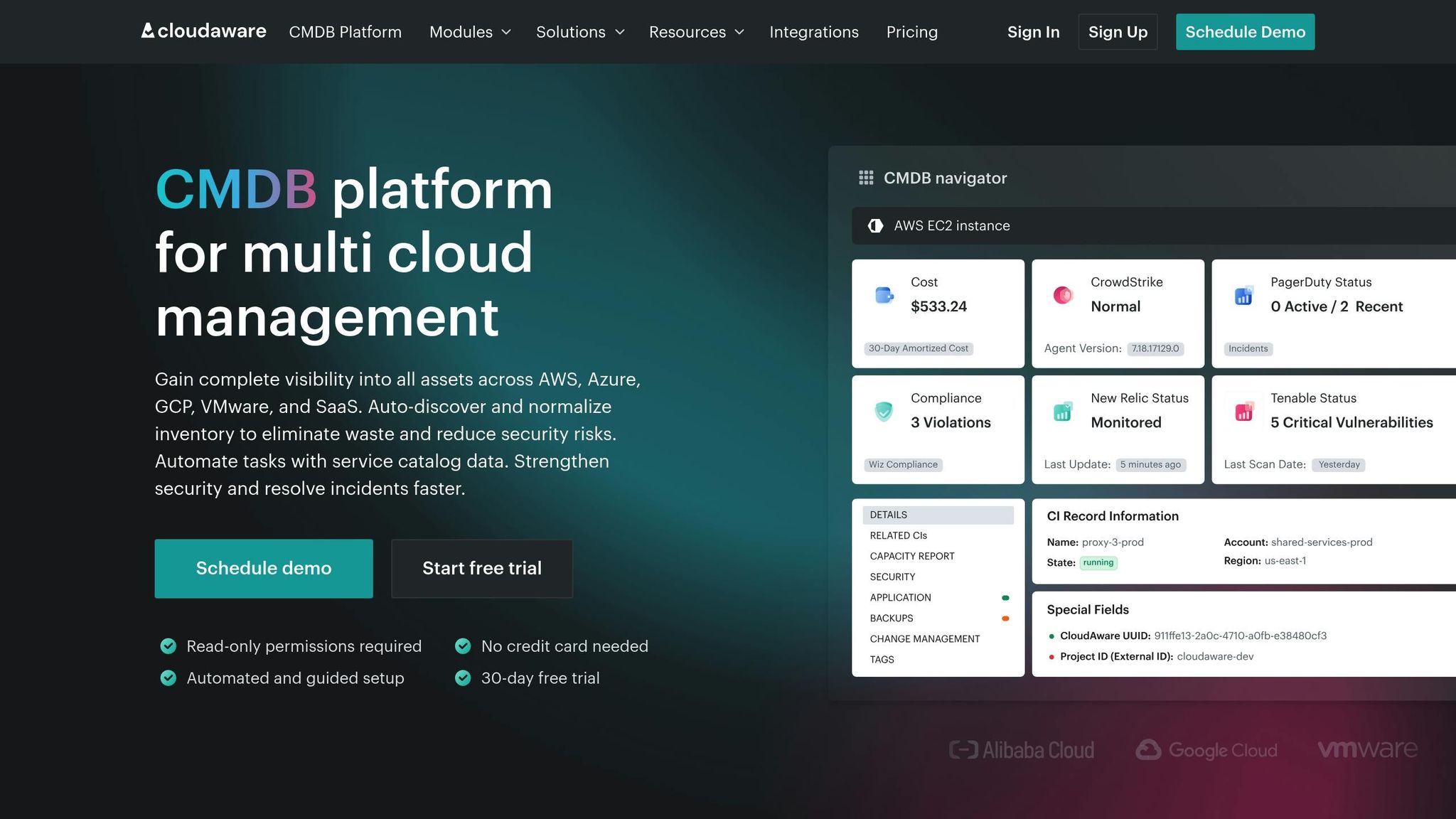
Cloudaware offers a comprehensive solution for managing multi-cloud costs, compliance, and inventory, tailored to organisations with strict governance requirements. This makes it particularly appealing to sectors like financial services, public sector, telecoms, and healthcare in the UK, where balancing cost control with stringent regulations is critical.
The platform combines cost and usage data from AWS, Azure, and Google Cloud Platform, while also accommodating VMware-based and on-premises environments. This hybrid approach provides a unified view, enabling finance teams to consolidate cloud and traditional infrastructure spending in £. By normalising data across these environments, Cloudaware simplifies budgeting and showback processes, removing the need for manual reconciliation. This consolidated view lays the groundwork for precise cost allocation, anomaly detection, and real-time monitoring.
Multi-cloud Coverage and SaaS Integration
Cloudaware automatically integrates billing data and usage metrics from AWS, Azure, and GCP into a unified reporting layer, eliminating the hassle of manual CSV reconciliations. Costs can be categorised by business unit, project, environment, or cost centre, making chargeback and showback processes more efficient.
The platform also supports SaaS cost integration through custom data sources or APIs. For instance, invoices from SaaS tools can be exported into Cloudaware's CMDB and cost models. While not all SaaS products have native connectors, this method allows organisations to approximate a single bill
covering cloud and related services. Many UK enterprises map their ERP system cost centres and project codes to Cloudaware dimensions, using scheduled reports to inform monthly management accounts and board-level dashboards.
For mid-sized organisations with well-tagged environments, initial visibility can often be achieved within two to four weeks. More advanced chargeback models and optimisation strategies typically take six to twelve weeks, depending on data quality and how engaged stakeholders are.
Kubernetes and Container Cost Allocation
Cloudaware enhances multi-cloud cost aggregation with container cost breakdowns, though its primary focus is on VMs, cloud accounts, and traditional infrastructure. It doesn't provide deep Kubernetes cost allocation, such as costs by namespace, deployment, or pod. Teams running containerised workloads on platforms like EKS, AKS, or GKE can allocate node costs to Kubernetes clusters using external tools or a hybrid approach with a dedicated Kubernetes FinOps tool for more detailed insights.
This approach ensures finance teams still get a consolidated view of expenses by product or business unit in £, even if the most granular per-pod cost details are managed separately. This trade-off is often practical in environments where governance and compliance are as important as cost precision.
Anomaly Detection and Optimisation
Cloudaware employs rule-based governance and alerts to identify budget overruns and idle resources, helping organisations optimise costs. Policies can highlight under-utilised resources - such as oversized VMs, orphaned volumes, or unused IP addresses - providing opportunities for ongoing FinOps improvements.
The platform's integration with its CMDB is a key strength, making it easier to assign anomalies to specific teams and establish clear remediation steps. For businesses lacking in-house FinOps expertise, consultancies like Hokstad Consulting can assist with designing tagging strategies, reporting hierarchies, and optimisation workflows. They can also help integrate additional data sources, such as SaaS bills, and establish processes like chargeback mechanisms and engineering scorecards to embed FinOps practices into daily operations.
Real-time Cost Aggregation and Implementation
Cloudaware also supports near real-time cost monitoring, with most providers updating within hours. Costs and usage data are ingested on a scheduled basis, enabling teams to track same-day or previous-day spending trends. This timeframe is usually sufficient for spotting major issues, such as a misconfigured autoscaling group or a runaway data-processing job. Dashboards and alerts provide a clear view of month-to-date spending in £, supporting weekly FinOps reviews and monthly forecasting.
However, Cloudaware isn't designed for second-by-second monitoring. Teams needing millisecond-level insights would need to complement it with provider-native metrics or application performance monitoring (APM) tools. This balance makes it a practical choice for organisations prioritising governance and compliance alongside cost management.
7. Vantage
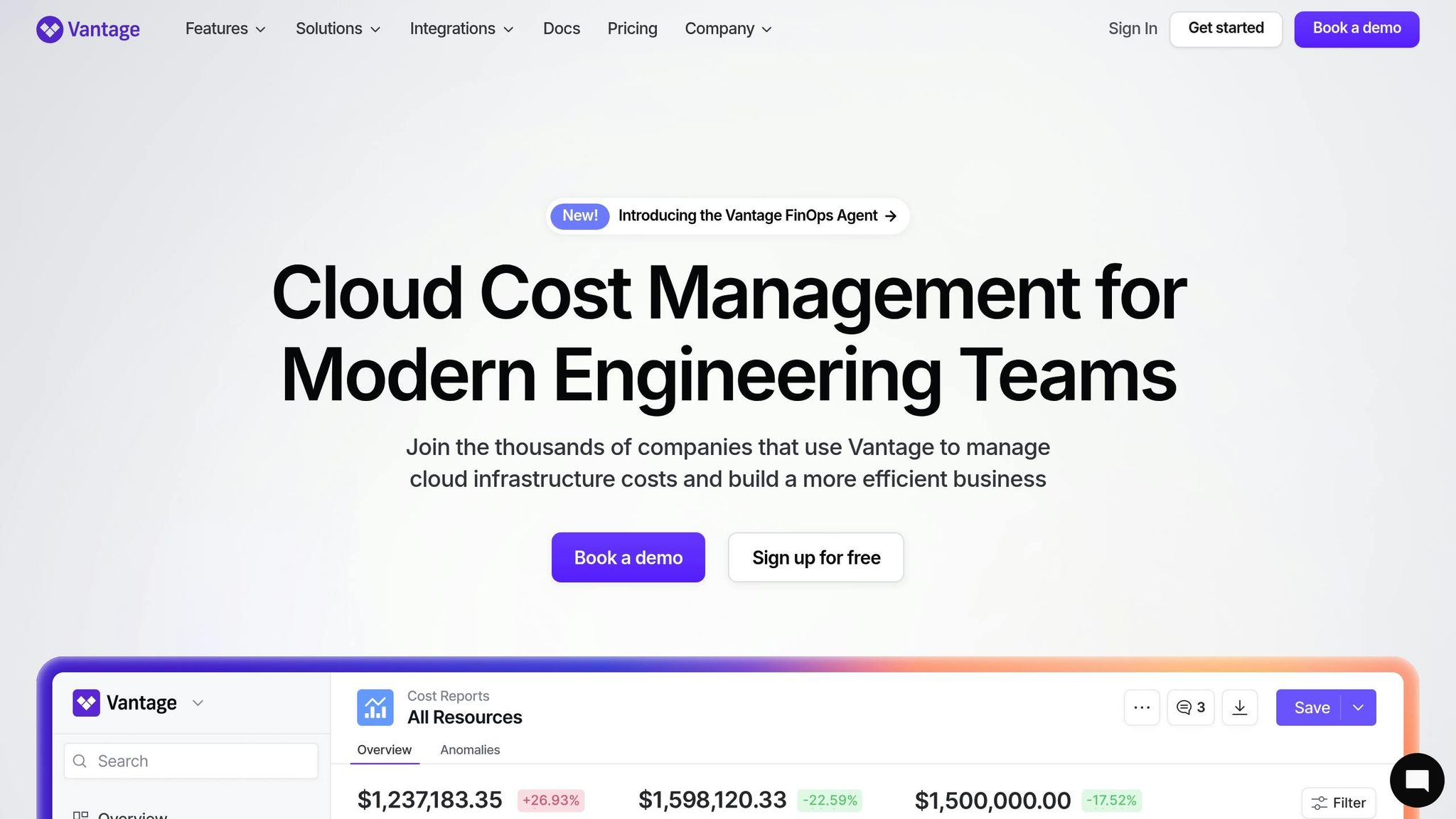
After examining broader platforms, Vantage emerges as a straightforward, flexible option tailored for mid-sized businesses. It’s built for organisations that need a clear view of multi-cloud costs and SaaS spending, all in one place. With its focus on simplicity and quick deployment, Vantage is particularly appealing to UK businesses keen on establishing FinOps practices without the hassle of lengthy implementation.
The platform automates the aggregation of billing data from major cloud providers, eliminating the need for manual CSV reconciliations. This consolidated view allows finance teams to track total cloud expenditure in pounds (£), streamlining monthly reporting and budget management. Vantage also supports virtual tagging and allocation rules, enabling accurate cost assignment for untagged resources or shared services - without requiring changes to existing cloud setups. Its emphasis on delivering actionable cost insights aligns well with the needs of UK businesses.
Multi-cloud Coverage and SaaS Integration
Vantage goes beyond traditional cloud services by integrating with popular SaaS platforms like Snowflake, Databricks, MongoDB Atlas, and New Relic. This lets businesses monitor both cloud and SaaS costs together, simplifying allocation and enabling more precise chargeback models. For UK firms juggling multiple cloud accounts and SaaS subscriptions, this unified view reduces the complexity of managing separate invoices and reveals spending trends across the tech stack.
The platform’s virtual tagging feature further simplifies processes by allowing costs to be quickly assigned to departments or products. This means finance and FinOps teams can generate meaningful reports within days, bypassing the need for engineering teams to implement tagging strategies across every resource.
Kubernetes and Container Cost Allocation
For organisations running Kubernetes workloads, Vantage provides detailed cost breakdowns for managed services like EKS, AKS, and GKE. Costs can be attributed to clusters, namespaces, deployments, services, pods, and labels, giving engineering teams a clear understanding of how their containerised workloads contribute to cloud expenses. This level of detail supports accurate chargeback models and highlights inefficiencies, such as idle containers driving unnecessary costs.
With this granular insight, businesses can make better decisions about resource allocation and scaling policies. Engineering teams can see the financial impact of their deployments in pounds (£), helping them justify infrastructure needs or identify areas for optimisation. This shared visibility fosters collaboration between engineering and finance, ensuring both teams work from the same data when discussing budgets or cost-saving measures.
Anomaly Detection and Optimisation
Vantage takes cost management a step further by using machine learning to detect unexpected spikes in service or regional costs. Alerts can be sent via email, Slack, or webhooks, enabling teams to respond quickly to sudden increases. The platform also offers optimisation recommendations, such as rightsizing over-provisioned instances, identifying idle resources, or suggesting savings plans like reserved instances.
These features shift the focus from reactive monitoring to proactive cost control. Instead of discovering budget overruns at the end of the month, teams receive timely alerts to address issues as they arise. For organisations without dedicated FinOps expertise, these recommendations provide a practical starting point for reducing costs. UK consultancies like Hokstad Consulting can assist businesses in implementing these suggestions, from designing tagging strategies to creating workflows that align with broader cloud governance practices.
Real-time Cost Aggregation and Implementation
Vantage delivers near real-time cost updates, with AWS data refreshed every 2–4 hours and Azure and GCP data updated daily. This ensures teams have up-to-date insights into spending trends, enabling quicker responses to anomalies and more timely optimisation decisions.
The platform integrates seamlessly with tools like Slack, PagerDuty, and CI/CD pipelines, making it easy to embed cost alerts into existing workflows. Teams can set budget thresholds and receive notifications as spending approaches or exceeds limits, supporting regular FinOps reviews and accurate forecasting. For UK businesses, costs are displayed in pounds (£) and aligned with local financial reporting periods, ensuring consistency with internal accounting practices.
Vantage offers a free tier, with paid plans scaling based on the number of cloud accounts and monthly spend. While pricing is typically quoted in US dollars, UK customers can view costs in pounds (£) for convenience. This flexible pricing approach ensures businesses pay in line with the value they gain from improved cost visibility and savings opportunities.
Feature Comparison Table
This feature comparison table simplifies the decision-making process by outlining the key attributes of each tool. Whether you're prioritising Kubernetes visibility, real-time anomaly detection, or integration with SaaS platforms, this table offers a clear snapshot of what each option brings to the table.
| Tool | Multi‑Cloud Coverage | Kubernetes Cost Allocation | Anomaly Detection | Aggregation Freshness | Notable Integrations | Deployment Options |
|---|---|---|---|---|---|---|
| Finout | AWS, Azure, GCP + extensive SaaS (Snowflake, Datadog, MongoDB, Databricks)[11][6] | Yes – cluster and workload‑level allocation as part of unified cost observability[11][6] | - | Near real‑time (daily updates) | BigQuery, Snowflake, Datadog, MongoDB, Databricks[9] | SaaS |
| CloudZero AnyCost | AWS, Azure, GCP, Kubernetes + SaaS platforms (Snowflake, New Relic, MongoDB, Databricks)[3][5] | Yes – allocates Kubernetes costs across business dimensions[3][5] | Yes – anomaly detection with investigation features[5] | Daily to near real‑time | Snowflake, New Relic, MongoDB, Databricks[3] | SaaS |
| Ternary | AWS, GCP, Azure with feature parity across all three[2][9] | Yes – supports Kubernetes as part of multi‑cloud FinOps[2] | Yes – ML‑powered anomaly detection with optimisation recommendations[2] | Near real‑time cost tracking[2] | Snowflake, Datadog[9] | SaaS and self‑hosted |
| CloudHealth | AWS, Azure, GCP + hybrid cloud environments[5][4] | Yes – real‑time allocation with breakdowns by namespace, deployment, service, label, pod, and container[4] | Yes – policy‑driven anomaly detection with AI‑assisted features[5][4] | Real‑time for Kubernetes; frequent updates for cloud billing[4] | VMware Tanzu ecosystem, multi‑cluster aggregation[5][4] | SaaS (enterprise) |
| nOps | Primarily AWS; also supports Azure and GCP[11][12] | Yes – pod‑level visibility and cross‑cluster cost allocation[8] | Yes – anomaly detection with alerts[8][12] | Daily updates | AWS‑focused integrations | SaaS |
| Cloudaware | AWS, Azure, GCP with enterprise governance focus[11] | Limited public documentation on granular Kubernetes support | - | Daily aggregation | Enterprise and MSP‑oriented integrations | SaaS (enterprise) |
| Vantage | AWS, Azure, GCP + SaaS platforms (Snowflake, Databricks, MongoDB Atlas, New Relic) | Yes – detailed breakdowns for EKS, AKS, GKE by cluster, namespace, deployment, service, pod, and label | Yes – ML‑based anomaly detection with alerts via email, Slack, and webhooks | Near real‑time (AWS: 2–4 hours; Azure/GCP: daily) | Slack, PagerDuty, CI/CD pipelines | SaaS |
The table highlights key differences, such as CloudHealth's real-time container-level allocation across clusters[4], which is particularly appealing for UK enterprises managing complex, containerised workloads across multiple cloud providers.
For organisations managing both cloud and SaaS costs, Finout and CloudZero AnyCost stand out. Finout's MegaBill feature consolidates cloud and SaaS expenses into a single dashboard, serving as a single source of truth
for cost management[11][6][3].
Ternary offers flexibility with its SaaS and self-hosted deployment options, making it a strong choice for UK organisations with strict data sovereignty or regulatory requirements. The platform has also demonstrated its capability to handle enterprise-scale operations, managing over $7.5 billion (approximately £6 bn) in annual cloud spend[2].
For AWS-focused organisations, nOps provides deep insights and optimisation tools tailored to that ecosystem, including features like automated commitment and savings plan recommendations[8][12]. However, its narrower multi-cloud support makes it less suitable for businesses heavily reliant on Azure or GCP.
When it comes to anomaly detection, Ternary leverages machine learning to actively manage costs with optimisation recommendations[2]. CloudHealth combines policy-driven guardrails with AI-assisted features to identify potential overspending risks[5][4]. Meanwhile, CloudZero focuses on investigation tools to help teams not only detect anomalies but also understand their root causes[5].
Data freshness is another critical factor. Vantage updates AWS data every 2–4 hours, while Azure and GCP updates occur daily. CloudHealth provides real-time updates for Kubernetes costs, though cloud billing data typically refreshes daily[4]. Both Ternary and Finout offer near real-time tracking, with latency depending on the cloud provider and data source[2][11].
Ultimately, the best tool depends on your specific requirements. Businesses with extensive Kubernetes workloads might find CloudHealth's real-time container-level visibility invaluable. Those looking to integrate SaaS and cloud costs should consider Finout or CloudZero. For organisations requiring self-hosted options, Ternary offers a practical solution, while AWS-centric companies may benefit from nOps' optimisation capabilities.
For additional support, visit Hokstad Consulting. This table serves as a starting point to help you identify the tool that aligns best with your needs.
Conclusion
Having unified cost visibility is a game-changer for managing expenses effectively, especially when dealing with AWS, Azure, GCP, and SaaS platforms. The right tools can ensure precise cost attribution, even for untagged resources, building on the capabilities we've explored earlier.
It's important to differentiate between simple cost aggregation and full FinOps functionality. While basic tools consolidate bills, FinOps platforms go further with features like anomaly detection, optimisation recommendations, and governance tools to actively manage spending. For UK businesses navigating complex environments, advanced features such as real-time Kubernetes cost allocation and machine learning-powered anomaly detection can lead to measurable savings - often cutting cloud waste by 20–30% through better visibility and rightsizing.
Tools that offer near-real-time updates are invaluable for catching overspending early. Additionally, strong API support and pre-built connectors for finance and BI tools (like Power BI or Snowflake) make it easier to integrate these solutions into your existing workflows. For organisations with strict data sovereignty requirements, deployment flexibility is crucial - for example, Ternary’s self-hosted option can be a key consideration.
When evaluating tools, pricing models are another critical factor. Some platforms charge a percentage of monthly cloud spend, while others use flat fees or tiered subscription plans. For UK businesses, assessing these costs in GBP is essential to avoid surprises as usage scales. Transparent and predictable pricing makes budget planning far simpler.
Each platform brings its own strengths to the table. For example, CloudHealth offers real-time container-level visibility for Kubernetes-heavy environments, while Finout’s MegaBill or CloudZero’s unified views are excellent for managing both cloud and SaaS costs. AWS-focused organisations might lean towards nOps for its deep integration with the AWS ecosystem, and businesses prioritising governance may find CloudHealth or Ternary particularly appealing - the latter has proven its scalability by managing over £6 billion in annual cloud spend.
For tailored support in cloud cost optimisation, Hokstad Consulting offers expert services. From cloud cost engineering to strategic migrations and custom automation, they help businesses cut cloud spending by 30–50% across diverse hosting environments. Their guidance ensures these tools are seamlessly integrated into your FinOps practices, helping you maximise ROI and align teams around shared cost goals.
FAQs
How do multi-cloud billing tools manage currency conversion and ensure accurate financial reporting in GBP for UK businesses?
Multi-cloud billing tools often come equipped with features to manage currency conversion, ensuring that cost aggregation and reporting are accurate and region-specific. For businesses in the United Kingdom, these tools typically allow GBP (£) to be set as the default currency, automatically converting costs from other currencies based on the latest exchange rates.
This functionality ensures that financial reports present costs clearly in pounds, aligning with local accounting standards. On top of that, many of these tools offer detailed expense breakdowns across various cloud platforms, simplifying the process of tracking and managing spending effectively.
What should UK businesses look for in a multi-cloud billing tool to track Kubernetes costs and integrate with SaaS platforms?
When choosing a multi-cloud billing tool, UK businesses should focus on features that make Kubernetes cost tracking straightforward, enable smooth SaaS integration, and deliver clear, actionable insights. Opt for tools that offer detailed cost breakdowns, usage analytics, and customisable reporting in GBP (£) to align with local accounting standards.
It's also worth considering platforms with automation features to consolidate data from multiple cloud providers. This not only reduces manual work but also helps minimise errors. Look for solutions that can scale with your needs, accommodate hybrid environments, and integrate seamlessly with existing DevOps workflows to streamline operations and improve cost management.
Can multi-cloud billing tools help detect and optimise unusual cloud costs in real time?
Multi-cloud billing tools are crafted to help businesses spot and address unusual cloud spending patterns as they happen. By pulling together billing data from various cloud providers, these tools can pinpoint anomalies, like sudden usage spikes or inefficient resource use.
Equipped with features such as automated alerts, detailed cost analyses, and predictive insights, these tools allow businesses to act quickly, minimising waste and ensuring budgets are managed wisely. For those aiming to refine their cloud cost strategies even more, consulting services - such as those provided by Hokstad Consulting - offer customised solutions to improve efficiency and cut down on expenses.