
Speculative tool execution pays off when slow, predictable reads save more time than incorrect predictions and checks cost. Start with read-only support lookups, keep account changes outside speculation, and test against simpler options first.
The four approaches solve different problems:
- Serial: runs confirmed calls one after another when steps depend on earlier results.
- Parallel: runs confirmed, independent calls together.
- Batched: groups compatible requests to cut request overhead.
- Speculative: starts a predicted call early, then uses its result only if the confirmed request, permissions and data validity match.
Stable support requests are a better starting point than changing shopping searches. In one study covering 165 GAIA queries, median latency fell from 34.7 to 31.2 seconds - about 10% - but that does not establish the same gains for other workloads.
Quick Comparison
| Approach | Best fit | Main trade-off |
|---|---|---|
| Serial | Dependent steps and account changes | Waiting time adds up |
| Parallel | Independent, confirmed reads | Concurrent calls can strain capacity |
| Batched | Compatible requests | Batch formation can delay replies |
| Speculative | Slow reads with predictable inputs | Discarded calls add cost and load |
Start with predictions that do not execute tools. Then pilot one read-only endpoint, measuring exact prediction accuracy, actual reuse, median and p95 latency, and cost per successful task. Expand only if time savings hold without weakening permission checks, data validity or capacity for confirmed work.
::: @figure 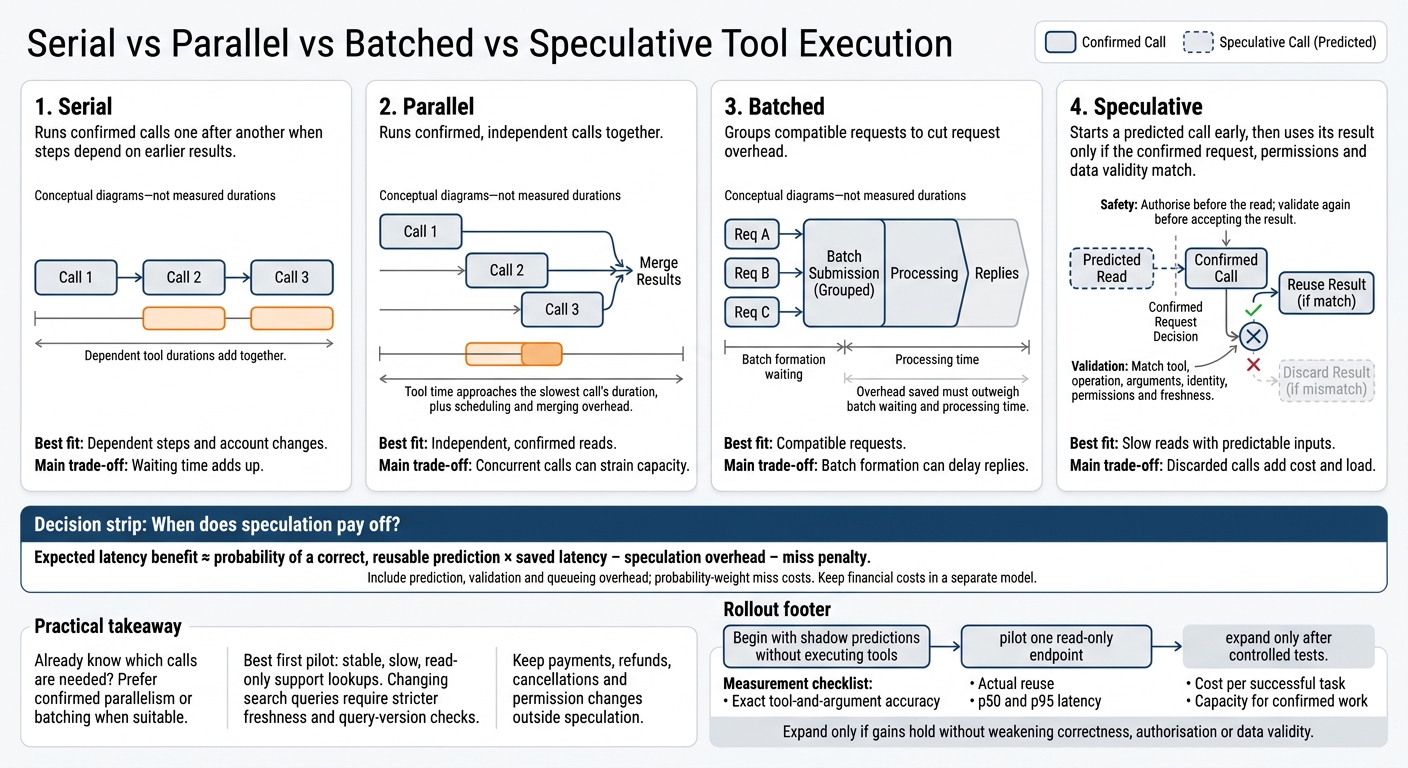 {Serial vs Parallel vs Batched vs Speculative Tool Execution}
:::
How Speculative Tool Calls Make AI Agents 2x Faster at Inference
1. Serial Execution
Serial execution waits for each confirmed call to finish before choosing the next step. This makes dependencies explicit, but puts every step on the request’s critical path. Use it as the control case when comparing latency and failure cost with more aggressive execution patterns. It’s the safest baseline, but rarely the fastest.
Latency and Prediction Accuracy
Three dependent 100-millisecond calls take about 300 milliseconds of tool time, before model processing, network overhead and retries. Measure both the full chain and individual steps at p50, p95 and p99. There’s no prediction stage, so track completion, timeout and error rates instead.[4][5][6]
Implementation and Maintenance
Use a state machine or orchestration loop with validation, timeouts and a trace linking each call to the previous one. Pass only the fields the next step needs. Control flow is simpler than with speculation; maintenance centres on API contracts, authentication, retries and idempotency.
Costs and Risks
Serial execution avoids discarded calls, but extra model passes and slow dependencies still add cost and delay. One failed step can block the entire response. For state-changing calls, use idempotency keys and separate temporary failures from business-rule rejections before retrying.
In SaaS support, keep per-call authorisation checks and idempotency on retries.
In e-commerce, confirm the product or variant first, then fetch current stock, prices and delivery values; keep independent checks separate.
When steps don’t depend on one another, parallel execution removes this bottleneck.
2. Parallel Execution
Parallel execution removes the serial bottleneck by overlapping confirmed, independent calls. Every call is already needed. Speculation, by contrast, bets on a future branch.
Latency and Prediction Accuracy
Tool time approaches the slowest call’s duration, rather than the sum of all calls, plus scheduling and merging overhead. Prediction accuracy does not apply here; measure end-to-end latency and answer completeness instead. Check for shared bottlenecks before comparing parallel and serial paths under the same load.
Implementation and Maintenance
Launch a call only when its inputs are available and it does not depend on another call’s output or side effects. Use fan-out/fan-in, deadlines, cancellation and merge rules.
Test dependency barriers and partial failures. Trace each branch’s start, finish, retries and outcome. Running calls together is only part of the job; these controls add maintenance work.
Costs and Risks
Bound concurrency per workflow and per tool to protect shared connection pools, CPU, memory and API quotas. Use bounded queues, back-pressure and coordinated retry budgets.[7][8] Keep support lookups within safe account and rate limits, and search fan-out within current stock, price and delivery quotas.
Before launch, classify results as required or optional. A missing required result needs a fallback - not an answer that only looks complete. Keep account changes behind verified dependency barriers, check that stock and price results are still current when merging them, and discard responses from superseded searches.
Track cost per successful task alongside latency. Faster calls offer little if they lead to more throttling or incomplete answers.
3. Batched Execution
Batched execution combines compatible requests you already need into one submission. Parallel execution overlaps independent calls; batching reduces request overhead. The trade-off? Requests may have to wait while a batch fills.
Latency and Prediction Accuracy
There’s no prediction step. Latency improves only when the overhead saved outweighs the wait to form a batch and the time to process it. For interactive work, send the batch when it reaches a maximum item count or a short time limit - whichever comes first. Compare p50 and p95 latency across batch sizes: fewer calls don’t always mean faster answers.[11][13]
Implementation and Maintenance
Group requests by endpoint, credentials, schema, priority, timeout and consistency. Give each item a correlation ID, and log queue age, batch fill rate and the reason each batch was sent.[10][12] Keeping these grouping rules and item mappings up to date takes engineering time, especially when API limits or schemas change.
Costs and Risks
Treat batch responses as partial until you’ve checked each item’s result. Retry only failures that qualify for a retry.[9][12] Use exponential back-off with jitter.[14][15] For writes, use idempotency keys to prevent duplicate changes after timeouts.[9][12] Fewer submissions may not reduce charges if pricing remains per item or per unit of compute.
Only batch requests with the same data recency, identity and consistency requirements.
In support, batch read-only retrievals from the same account context; in search, batch only lookups that share shopper, region and freshness requirements, then revalidate stock, price and delivery before checkout.
4. Speculative Execution
Batching waits for compatible requests. Speculative execution starts the most likely next call before the model commits. It pays off when the time saved outweighs wasted calls, implementation effort and control costs. Unlike parallel and batched execution, it starts unconfirmed work. The result stays provisional until the final tool, arguments, identity, permissions and freshness match.[16][18]
Latency and Prediction Accuracy
This approach only pays off when tool latency is high and requests are predictable. Measure exact tool-and-argument accuracy and result reuse alongside p50/p95 latency. Getting the tool right but the account or filters wrong still counts as a miss.[17] Support tends to have more stable account context, while search changes more often. That means reuse rates differ.
The gains come from predictable workflows, not from making every tool faster.
A recent speculative-tool study on 165 GAIA queries found that Spork running with Qwen3-32B reduced median latency from 34.7 to 31.2 seconds and p95 latency from 131.9 to 108.1 seconds, with exact-match accuracy within 1 percentage point of baseline.[21]
Implementation and Maintenance
Check permissions before starting the read, then validate again before accepting the result. Give each speculative request a trace ID, prediction version, short deadline and cancellation token. Keep speculative results out of committed session state.
Set per-tool spend caps and cache lifetimes. Update schemas, permission tests and predictors as workflows change, and count validation failures as misses in the reuse metric.[16][18][19]
Costs and Risks
Lower latency only matters if wasted work stays small. Unused results still consume API quota, compute and concurrency. Cancellation may arrive after the work is already done, so track wasted-call rate, cancellation effectiveness and cost per accepted result.
Limit the first rollout to read-only support retrieval and catalogue search. Search queries change frequently, making cancellation more important. Re-check stock, price and delivery before using a result.[16][19]
Latency Savings and Prediction Accuracy
Use these measures to check whether speculative overlap beats the alternatives.
Benchmark identical requests, prompts, model settings, tool versions, authentication paths and concurrency. Test warm and cold caches separately. Compare speculation with serial, parallel and batched baselines under the same workload, using the same correctness standard for every mode.
| Mode | Top-1 accuracy / Top-3 candidate recall | Trigger threshold | Tool response time | End-to-end latency | First output | p50/p95 latency |
|---|---|---|---|---|---|---|
| Serial | N/A | N/A | Measure each call | Includes sequential waits and validation | May precede tool completion | Baseline for both |
| Parallel | N/A | N/A | Measure under concurrent load | Tool phase approaches the slowest required call | Earlier output does not prove earlier completion | Check fan-out effects |
| Batched | N/A | N/A | Separate batch waiting from execution | Includes formation, processing and validation | Batch waiting may delay useful output | Report per-request percentiles |
| Speculative | Measure exact next-action match and candidate coverage | Record calibrated threshold, coverage and abstention | Separate duration from time hidden by overlap | Count only validated, reusable results | Separate useful output from filler | Check gains and contention regressions |
An exact match must include the tool, operation and arguments - including identifiers, filters and input version. Report authorised, reusable matches separately from cancelled, duplicate and invalid calls. Top-3 recall measures candidate coverage, not execution success. Measure server-side cancellation, not just cancellation requests. High confidence means little overall if the predictor rarely triggers.
Expected latency benefit ≈ probability of a correct, reusable prediction × saved latency − speculation overhead − miss penalty.
Adopt speculation only when saved overlap exceeds predictor error, validation cost and cancelled work. Calculate the probability using argument-level correctness, then confirm authorisation and reuse. Include prediction, validation and queueing overhead, and weight miss costs by their probability. Count each delay once. Keep API charges, compute, infrastructure and support costs in a separate financial model.
Support favours stable context. Search is less forgiving of stale filters and prices. In both cases, cancellation determines how much work goes to waste.
SaaS Support: Stable Inputs and Slow Retrieval
Hypothetical illustration; all timings and accuracy rates are illustrative, not production measurements. For a request such as
Why was my workspace charged for an extra seat?, authenticated customer and workspace IDs allow independent CRM, entitlement and knowledge-base reads. At hypothetical durations of 450 ms, 700 ms and 1,200 ms, the sequential tool phase takes 2,350 ms before model synthesis; end-to-end latency is about 3,000 ms. Parallel reads reduce the tool phase to about 1,200 ms, so end-to-end latency may fall to about 1,700 ms. A hypothetical predictor with 92% Top-1 tool-and-argument accuracy and 97% Top-3 recall could hide up to 900 ms of remaining wait if calls start 900 ms before the model would normally issue them. That is the incremental opportunity, not another saving from parallelisation. By contrast, a hypothetical 50 ms lookup offers little room to recover predictor overhead. Ambiguous workspace or billing-period arguments reduce reuse, even when the predicted tool is right. Speculation is attractive here because inputs are stable, retrieval is slow and calls are read-only; it should not silently perform an account change such as refunding a charge or altering entitlements.
E-commerce Search: Changing Queries and Cancellation
Hypothetical illustration; all timings are illustrative. After a partial query such as
waterproof trail, partial-query normalisation, category resolution and synonym or spelling lookups may be useful before committing to product search or recommendations. If the final query becomeswaterproof trail shoes under £120, useful overlap could hypothetically save 250–400 ms. If the limit changes to £80, the category result may remain reusable; the old price-filtered search does not. Debounce expensive calls, require confidence in the filters, and attach query versions so late results cannot replace current ones. Measure cancellation before server work begins, not merely cancellation requests sent. Launching more candidates may improve Top-3 recall while worsening completed-result p95 through extra search load. Speculating on category, synonyms, spelling, search and recommendations simultaneously may increase database load and queueing, while only one branch may be useful.
Costs and Risks in Support and Search
Compare cost per successful outcome, including wasted work and control overhead - not cost per request. Add up model and tool usage, retries, infrastructure, cache storage, observability, and amortised build and maintenance costs. Then divide by successful completions. Include failed and abandoned attempts in those costs.
Report latency separately. Faster responses only create business value when they reduce handling time, abandonment or capacity needs.
| Mode | Cost advantages | Extra costs and operational risks |
|---|---|---|
| Serial | Usually minimises duplicate work; simplest orchestration and retry tracking | Sequential turns can still add inference cost. Retries consume provider quota; caches need storage and invalidation. Cancellation cannot undo completed work. |
| Parallel | Cuts waiting time when required calls are independent | Unnecessary branches waste calls; simultaneous retries increase contention and rate-limit pressure. Orchestration can add model turns. Cancellation and shared-cache coordination add work. |
| Batched | Can reduce round trips and spread request overhead across independent requests that arrive together | Whole-batch retries can repeat successful work unless partial retries are supported. Cancellation is less granular; payload limits, cache storage and differences in data age need handling. |
| Speculative | Accurate predictions can hide waiting time | Prediction adds inference overhead. Unused calls, retries, validation and cancellation tracking increase spend and can delay committed work. |
Record cancellation requests, confirmed terminations and completions after cancellation separately. Prioritise committed calls, and cap speculative concurrency and spend.[24][25]
If an extra £0.006 per completed task saves 1.5 seconds worth £0.02, the margin is £0.014 before maintenance.
SaaS Support: Retrieval and Account Changes
Calibrate prediction confidence for the exact operation and arguments. Even read-only calls need prior authorisation and data minimisation.[22][23]
Support is most efficient when identity is stable and the action stays read-only. Use measured latency for every row; mark unknown values ‘requires measurement’.
| Operation | Prediction confidence | Cacheability and validity | Acceptable risk and rollback | Recommended mode |
|---|---|---|---|---|
| Authenticated customer or organisation lookup | Higher with verified identity and tenant context | Identity-scoped; invalidate on tenancy or permission changes | Return minimal fields only; disclosure cannot be reversed | Serial or parallel; cautious speculation only after authorisation |
| Subscription lookup | Higher with a stable account ID | Short-lived; recheck current subscription state | Stale status must not drive an account decision | Parallel; bounded read-only speculation |
| Entitlements | Depends on account and resource certainty | Permission-scoped; invalidate on access changes | No tolerance for unauthorised access; revalidate before granting access | Parallel retrieval; serial final check |
| Service status | Higher for a known service | Cache with an explicit freshness limit | Stale incident information can mislead | Parallel or speculative |
| Knowledge-base search | Higher for clear intent | Version articles; separate public and restricted content | No cross-tenant disclosure | Batched, parallel or speculative |
| Authorised order or ticket history | Depends on identifiers and filters | Limited, identity- and tenant-scoped caching | Minimise personal data; audit access; disclosure cannot be reversed | Serial or parallel; authorised speculation only |
| State-changing actions | Confidence does not authorise action | Recheck identity, permissions and current state; cached results do not authorise execution | Financial, contractual, security or workflow impact; audit changes | Serial after confirmation |
Rollback and idempotency do not authorise execution. Run eligibility checks early; keep the state-changing call serial. Maintenance must cover permission changes, tool-schema updates and audit review - not just predictor tuning.
E-commerce: Catalogue Search, Stock, Prices and Delivery
Search leaves less room for error: query text, stock, prices and delivery validity change as the request evolves.
Use measured latency for every row; mark unknown values ‘requires measurement’.
| Operation | Reuse stability | Data validity requirements | Cost of wasted work | Recommended mode |
|---|---|---|---|---|
| Pre-search enrichment | Relatively stable once intent is clear | Match query version, locale, taxonomy and catalogue vocabulary | Unused processing or incorrect category and query expansion | Batched, parallel or speculative |
| Incomplete-query product search | Changes as text and filters change | Exact query, filters and catalogue version | Discarded results consume search capacity and quota | Debounced, bounded speculation |
| Recommendations | Depends on stable personalisation | Current consent, identity and session context | Extra compute; inappropriate or cross-user results | Speculative only when personalisation inputs are stable |
| Inventory | Product choice may stabilise; stock does not | Current product, variant and fulfilment location | Wasted capacity; stale availability claims | Parallel retrieval; authoritative validation before promises |
| Delivery dates | Depends on basket, address and cut-off | Current destination, stock and delivery inputs | Misleading delivery commitment | Retrieve after required inputs; validate before promising |
| Prices | Depends on product and customer context | Current currency, promotions and eligibility | Incorrect displayed price or checkout mismatch | Parallel retrieval; validate before display and checkout |
Debounce input, combine duplicate requests server-side, and cap speculative work per session, tenant and provider. Accept only the active query version - not the last response to arrive.
Cache keys must include relevant personalisation and access scope. Invalidate entries when catalogue, pricing, inventory or identity inputs change. Monitor billed obsolete calls and queue delays, and cut speculation once it slows committed searches.[24][25]
Adoption Criteria and Rollout
Use production traces to set thresholds for your workload.[31] Compare serial, parallel, batched and speculative execution, then use the matrix below to judge whether latency savings justify rollout costs.
| Workload | Likely latency benefit | Prediction threshold | Implementation effort | Ongoing maintenance | Adoption verdict |
|---|---|---|---|---|---|
| SaaS read-only retrieval | Medium to high | Calibrated tool-and-argument confidence | Medium | Medium | Best first pilot: stable support lookups with clear discard rules |
| SaaS account actions | Limited scope within safe execution boundaries | Confidence does not authorise action | High | High | Keep serial execution or confirmed parallelism as the default |
| E-commerce search and recommendations | Medium, depending on workload | Calibrated query-and-context confidence | Medium to high | High | Run in shadow mode first; pilot only with data recency checks and query-version gating |
| Inventory, price and delivery retrieval | Medium for slow back ends | Exact inputs and strict validity checks | High | High | Pilot read-only retrieval only, with strict data recency checks |
Pilot high-confidence, read-only, idempotent work under tight caps. Run volatile retrieval in shadow mode first. Avoid speculation for payments, refunds, cancellations, permission changes and other irreversible actions. When you already know which calls are needed, prefer confirmed parallelism or batching.[20][27]
If the matrix supports a pilot, start with shadow predictions without executing tools. Log the proposed tool, arguments, confidence and timestamp, then compare each prediction with the eventual call. Cover normal and peak traffic. Measure argument accuracy, latency-weighted hit rate and estimated wasted spend before piloting one read-only endpoint.[28][30]
Expand only when controlled tests show sustained p50 and p95 gains without compromising correctness, data recency or authorisation safety. Check cost per successful completion and the effect on capacity, too. Roll back if p95 worsens, prediction quality drifts or ordinary requests lose capacity. Keep serial execution, confirmed parallelism or batching wherever speculation does not pay off.[3][26][29]
Your team should own the acceptance criteria, safety policy, spend limits and final go/no-go decision.
FAQs
How do we calculate our break-even prediction accuracy?
Calculate the premium path’s additional full cost (ΔCfull) compared with the baseline, including generation, validation, retry and orchestration costs. Define the monetary value of a successful task (V, in £), plus the success probabilities for the premium (Qp) and routine (Qs) paths [1].
The premium path pays off when V × (Qp − Qs) > ΔCfull. Check this threshold against holdout data before implementation [1].
How can we pilot speculation without slowing live requests?
Keep speculative execution separate from the primary path. Start with shadow traffic: run speculative tools alongside live requests without changing responses. Use nested spans to measure queueing, dispatch, tool execution and retry delays separately [1][2].
Cap concurrency and set strict timeouts to prevent resource contention. Store speculative results separately and label them clearly. Only integrate them when they meet predefined success criteria [2][1].
How do we budget for ongoing maintenance?
Separate one-off implementation costs from recurring running costs. Account for data remediation, integration updates, testing, training, licence fees, hosting, monitoring, support, human review and recovery work.
Track spending in GBP (£) against transaction volumes and support hours. Use telemetry to record actual usage, including token counts, tool calls and API requests, so forecasts reflect what you use.