
I use self-consistency to find the most common final answer - not the best-sounding explanation. If 6 out of 10 valid responses give the same answer, that’s a 60% majority. It still needs checking.
Here’s my process:
- Choose a clear-answer task and define which answers count as the same.
- Test 5–20 responses using one fixed prompt and sampling settings that allow variation.
- Extract and standardise final answers, then count valid votes. Report invalid responses, ties and cases with too few valid votes separately.
- Check the leading answer independently. Shared mistakes can produce agreement; decisions affecting people need human review.
- Compare against one response, measuring checked accuracy, cost in £ and total time.
The rule I keep in mind: agreement is not proof. I use voting only when testing shows that the accuracy gain is worth the extra cost and time - not for every task.
::: @figure 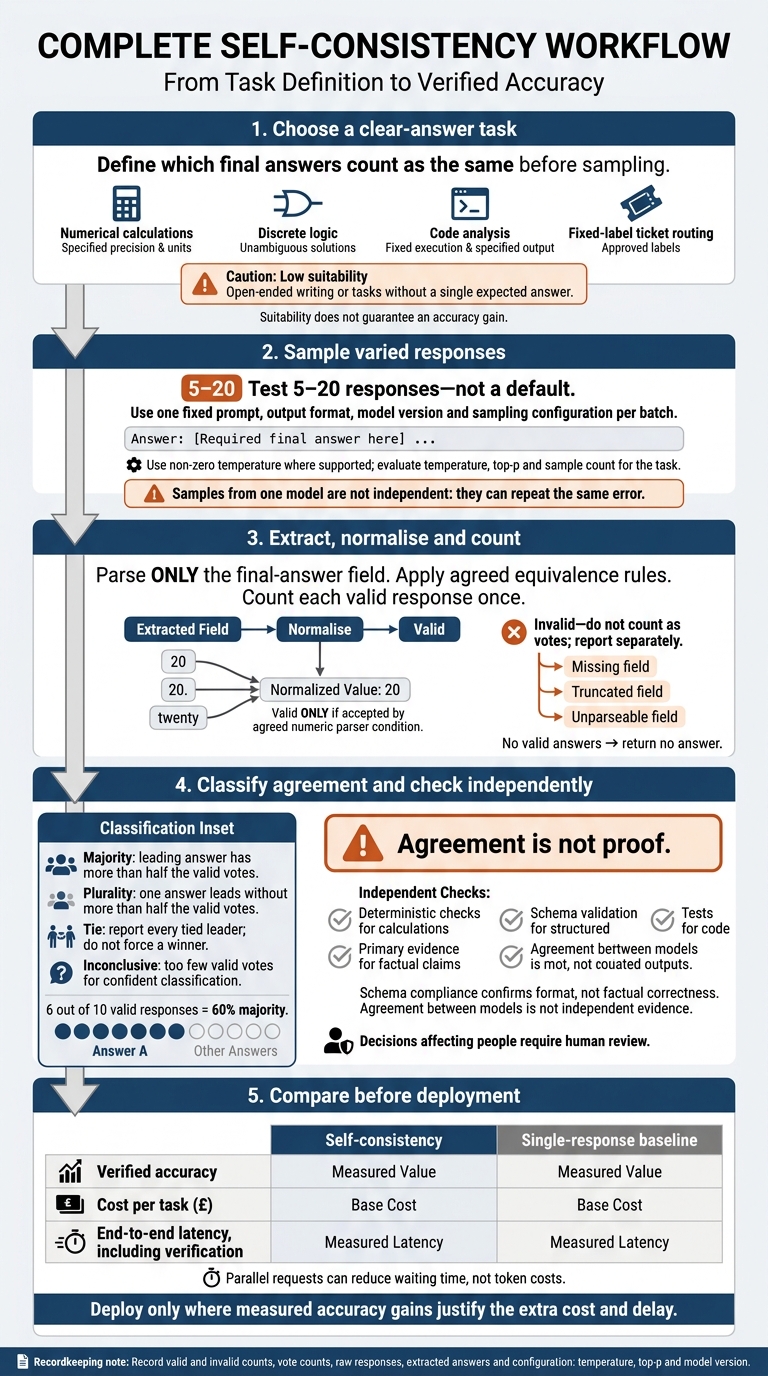 {Self-Consistency Prompts: From Samples to Checked Answers}
:::
{Self-Consistency Prompts: From Samples to Checked Answers}
:::
Self-Consistency Prompting: Majority Vote Over Multiple Reasoning Paths in LLMs.
1. Choose tasks with clear answers
Use majority voting only when every response can be reduced to one comparable final answer.
Check which tasks suit voting
Majority voting needs final answers that can be put into the same form. A task may suit voting without becoming more accurate as a result.
| Task | Answer space | Agreement method | Suitability |
|---|---|---|---|
| Numerical calculations | Numbers with defined precision and units | Exact match or predefined tolerance | High when precision is specified |
| Discrete logic problems | Boolean values, fixed options or final states | Exact final-answer match | High when the solution is unambiguous |
| Code analysis with a specific output | Standard output, return values or exit codes | Compare specified output | High when execution conditions are fixed |
| Fixed-label support-ticket routing | Agreed category labels | Match against the approved label list | High |
| Open-ended writing | Unrestricted text | Subjective judgement or text similarity | Low |
| Tasks without a single expected answer | Multiple valid outcomes | Separate evaluation rule needed | Low for majority voting |
Run a small pilot before increasing the number of samples. If several answers could be valid, clarify the task or define which answers count as equivalent first. Similar wording alone doesn't make two answers the same.
Define when answers count as the same
Set comparison rules before sampling. Specify decimal precision or numerical tolerance, require units, and allow conversions only if they preserve the value.
For text, decide which spelling variants count as equivalent. For structured labels, use an approved label list. Map variants only to an explicitly agreed label, and keep separate categories apart. Flag missing or unrecognised answers rather than guessing what they mean.
Score only the final answer; use the explanation only to extract it. Different reasoning paths can lead to the same result. Evaluation on maths tasks such as MATH and AIME24 focuses on answer accuracy, not whether the reasoning paths match [1]. Keep results with different meanings separate.
Once you've fixed the equivalence rules, sample several runs and count the final answers.
2. Sample responses and count answers
Set the prompt and answer format
Once you’ve fixed the answer-equivalence rules, lock the prompt and output format. Use the same task prompt, constraints, model version and sampling settings across samples. Request a single structured final field, such as Answer: ..., and parse ONLY that field.
Set sampling variation and limits
Use non-zero temperature, where supported, to introduce variation. Repeating deterministic outputs adds little. Treat 5–20 samples as a test range, not a default, and evaluate temperature, top-p and sample count for each task. Allow enough output tokens for the final-answer field.
Samples from one model are not independent: they can repeat the same error.
Measure total cost and elapsed time per task. Parallel requests can cut waiting time, but they won’t reduce token costs. Keep sampling settings fixed within each voting batch so you can compare configurations on equal terms.
Extract, normalise and count final answers
Parse the final field, apply your agreed comparison rules and count each valid answer once.
20,20.andtwentycount together only if your agreed numeric parser accepts all three as the same value; otherwise flag unsupported forms.
Mark missing, truncated or unparseable fields as invalid. They don’t count as votes.
counts = {}
records = []

repeat sample_count times:
    response = sample(prompt, fixed_config)
    parsed = parse_final_field(response)
    answer = normalise(parsed, agreed_rules) if parsed.valid else INVALID
    records.append(response, parsed, answer, fixed_config)
    if answer != INVALID:
        counts[answer] = counts.get(answer, 0) + 1

if counts is empty:
    result = NO_VALID_ANSWERS
else:
    leaders = answers_with_highest_count(counts)
    result = leaders[0] if length(leaders) == 1 else TIE

save(records, counts, result)
The most frequent answer is the mode, but it may have only a plurality - not a majority. It’s the leading answer, not proof that the answer is correct. Report ties explicitly rather than picking an answer arbitrarily. If every sample is invalid, return no answer.
Record valid and invalid counts, vote counts, raw responses, extracted answers and the configuration, including temperature, top-p and model version. Use the vote counts to assess agreement, then verify the winner separately.
3. Assess agreement and check correctness
Report majorities, pluralities and ties
After counting valid votes, classify the run as a majority, plurality, tie or inconclusive. Report invalid responses separately.
A majority means the leading answer has more than half the valid votes. A plurality means it leads without passing that threshold. If the top answers tie, report every tied leader - don’t force a single winner.
If too few valid votes remain to classify the result with confidence, mark it as inconclusive. Treat a majority as a confidence signal, not proof: the answer still needs an independent check.
Investigate disagreement and shared errors
When answers differ, check the prompt for missing constraints, ambiguity or a false premise. Several responses can agree because they share the same error.
Low agreement should prompt a review of the prompt or further checks - not automatic acceptance of the minority answer. If you revise the prompt, assess the new batch separately.
Verify high-stakes outputs independently
Once you have a leading answer, check it using methods suited to the task. Use deterministic checks for calculations, primary evidence for factual claims, schema validation for structured outputs and tests for code.
Schema compliance confirms format, not factual correctness. A second model can flag inconsistencies, but agreement between models is not independent evidence.
For decisions that affect people, require human review. Give reviewers the underlying evidence and check results, not just the winning answer.
Conclusion: Measure accuracy, cost and latency
Before deployment, check that tasks have clear answers, sampled responses vary, and equivalent answers normalise to the same final form.
Once the voting pipeline works, compare it with a single-response baseline on representative tasks. Measure verified accuracy, cost per task (£) and end-to-end latency, including verification.
Self-consistency is one control within AI evaluation and risk management - not proof of correctness. Deploy it where the measured accuracy gain justifies the extra cost and delay.
FAQs
How do I choose the right sample count?
Start with a small sample, then add more until the majority vote stabilises for your target task. Check whether the winning answer - and key fields in structured answers - stays the same as the sample count grows. This gives you a useful stopping point, but agreement does not prove correctness.
For higher-risk decisions, use more samples and require explicit review where mistakes would be costly. [1][2]
When should I reject a majority answer?
Reject the majority answer when response confidence falls below a preset threshold, typically around 0.85 [1]. Seek human oversight for high-risk actions, such as financial transactions, production configuration changes or access to regulated data, where mistakes can be costly [2].
Majority voting does not guarantee a correct answer. Flawed reasoning can lead to agreement on the wrong answer [1]. Hokstad Consulting helps organisations put validation checks and human-in-the-loop protocols in place.
How can I tell if voting improves accuracy?
Run controlled evaluations on the same dataset, comparing single-sample answer accuracy with majority-vote accuracy. Track changes in both accuracy and error rates.
Voting can help when models make independent mistakes. But agreement doesn’t prove an answer is correct: models may share faulty reasoning, and the most common answer may reflect a misconception. Treat votes as a reliability signal, not a correctness guarantee, and check results with automated tests and benchmarks.