
Cloud spending can be unpredictable, especially with the pay-as-you-go model. UK businesses face challenges like fluctuating usage, delayed billing data, and frequent pricing updates, making it hard to plan IT budgets. Scenario planning offers a practical way to manage this uncertainty by preparing multiple financial models - best-case, worst-case, and moderate scenarios. This approach helps businesses anticipate cost changes, avoid budget surprises, and make informed decisions.
Key Takeaways:
- Scenario planning prepares for traffic spikes, migrations, or new services.
- Collaboration between finance and engineering teams is essential.
- Tools like driver-based forecasting and what-if analysis improve accuracy.
- Regular reviews and alerts minimise financial risks.
For UK organisations, scenario planning isn't just about forecasting costs - it helps align cloud investments with business goals while reducing financial risks. By integrating these strategies, businesses can better control their cloud expenses and avoid surprises.
::: @figure 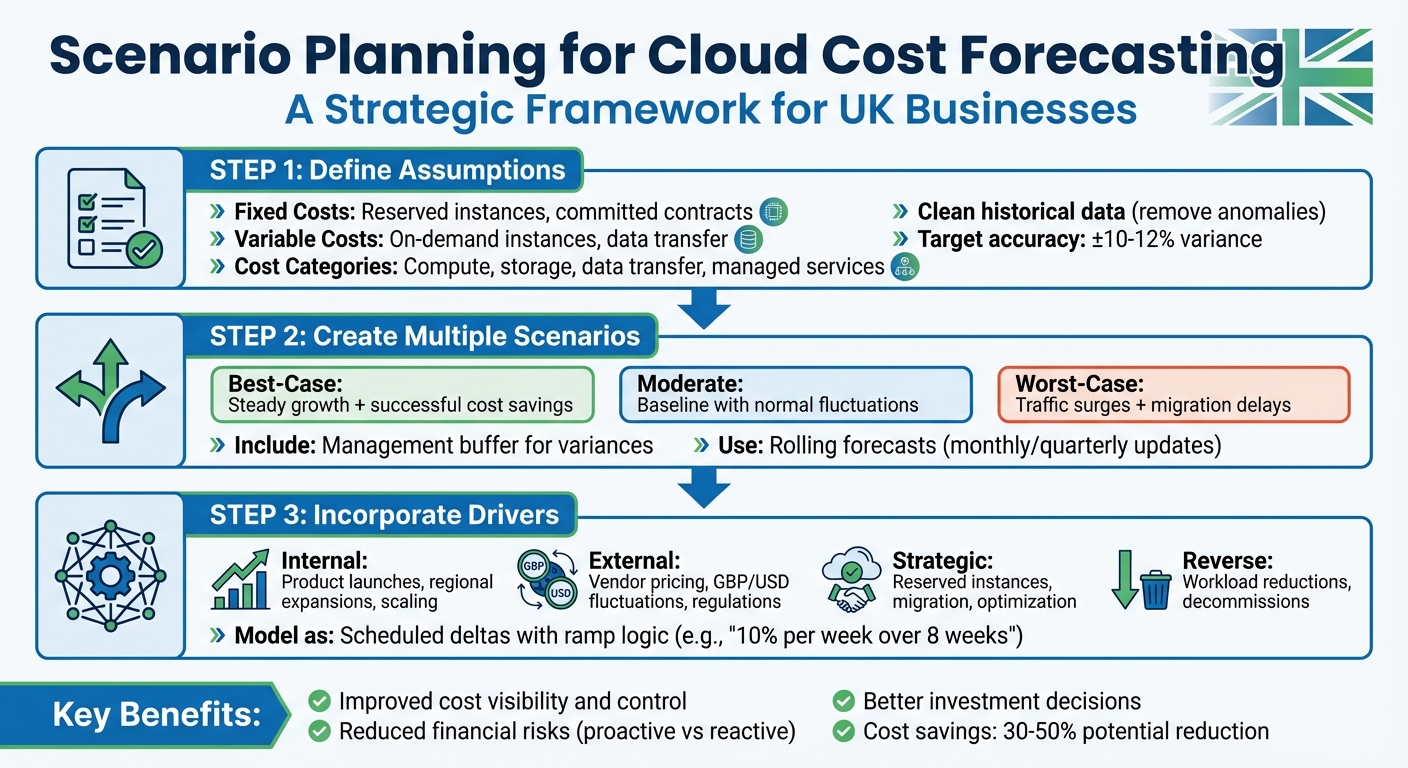 {Cloud Cost Scenario Planning Framework: 3-Step Process for UK Businesses}
:::
{Cloud Cost Scenario Planning Framework: 3-Step Process for UK Businesses}
:::
Cloud Cost Management | Cost Estimation
Key Elements of Scenario Planning
Building on earlier discussions about forecasting challenges, these elements lay the groundwork for successful scenario planning.
Defining Financial and Operational Assumptions
The first step is to identify key cost drivers by distinguishing between fixed costs (like reserved instances or committed contracts) and variable costs (such as on-demand instances or data transfer) [6]. This distinction is crucial because fixed costs are predictable, whereas variable costs can shift based on usage patterns.
Your assumptions should encompass the primary cost categories: compute, storage, data transfer, and managed services [6]. Engineers, with their in-depth understanding of architectural requirements, play a vital role in estimating costs for new workloads [2]. Additionally, shared costs - like networking, security, and platform egress - should be allocated to reflect the true expense of each workload [1].
Erik Peterson from the AWS Optics team offers this advice:
Start with a trend-based baseline to capture what's already in motion. Then layer in driver-based assumptions as they become known - ideally before they hit production [1].
It’s also essential to clean historical data by removing anomalies, deleted resources, and one-off charges [3]. Teams operating at the Run
maturity level of FinOps often achieve forecast variances within ±10–12% [1], but this level of accuracy relies on having strong foundational assumptions.
Once the assumptions are solid, you can begin structuring diverse scenarios to prepare for future uncertainties.
Creating Multiple Scenarios
Create three core scenarios - best-case, worst-case, and moderate - to reflect different market conditions. For example, the best-case scenario might assume steady traffic growth and successful cost-saving measures, while the worst-case scenario could include unexpected traffic surges or delays in migration projects.
Unlike static forecasts that lock in predictions for an entire fiscal year, rolling forecasts allow for monthly or quarterly updates based on new data or shifting economic conditions [2][5]. This adaptability is especially important for managing GBP/USD currency fluctuations, which can impact cloud vendor pricing. To safeguard budgets, include a management buffer - usually a small percentage reserve - to handle minor variances [4].
Incorporating External and Internal Drivers
Effective scenario planning requires considering both internal plans and external influences. Drivers can be grouped into four categories [1]:
- Internal drivers: These include product launches, regional expansions, and Kubernetes scaling adjustments.
- External drivers: Examples are vendor price changes, GBP/USD currency fluctuations, and regulatory updates.
- Strategic drivers: These cover decisions like reserved instance purchases, migrating to instance families (e.g., Graviton), or optimising storage tiers.
- Reverse drivers: These include workload reductions and decommissions.
Drivers should be encoded as scheduled deltas with ramp logic to reflect how changes roll out over time. For instance, instead of assuming an immediate switch, you might model a compute migration as 10% per week over 8 weeks
[1].
Incorporate regular what-if
analyses to explore different business decisions [4]. For example, you could model the cost implications of accelerating Project A while delaying Project B or assess how adopting a new AI service might affect monthly spending. These comparisons help technical and financial teams weigh trade-offs between costs, features, and performance.
Tools and Techniques for Scenario Planning
Once you’ve identified your key drivers and outlined potential scenarios, the next step is to choose the right tools and techniques to make your forecasts actionable. A good strategy combines driver-based forecasting, what-if simulations, and specialised management platforms. Together, these tools ensure your scenario planning remains practical and insightful at every stage.
Driver-Based Forecasting Models
Driver-based forecasting connects costs directly to business activities, providing a clearer picture of future expenditures. For example, you can model how customer growth or increased resource use impacts spending. This approach, when paired with causal forecasting [11], helps organisations understand the cause-and-effect relationships behind costs. The FinOps Foundation highlights this point with a simple but critical reminder: Good forecasts drive good business decisions
[4].
Using What-If Analysis for Cost Simulations
What-if analysis allows businesses to test various scenarios before committing resources. Tools like the AWS Pricing Calculator can help estimate costs for architectural changes before they are implemented [5][9]. Many modern platforms now include AI-driven features that provide natural language summaries of forecast drivers [8]. For instance, AWS Cost Explorer uses machine learning to explain whether a spending increase is due to seasonal trends, specific service changes, or shifts in usage patterns. It operates with an 80% prediction interval, although its accuracy can vary depending on how volatile historical spending has been [8].
To stay proactive, you can set up forecast-based alerts that notify you of projected overspending rather than waiting for actual spending to exceed limits [5]. This approach helps businesses address potential issues before they escalate.
Cloud Cost Management Tools
After running simulations to identify cost drivers, cloud cost management tools can help consolidate this data into actionable insights. These tools often feature dashboards that transform raw billing data into more digestible formats, enabling clearer decision-making. When building annual forecasts, it’s a good idea to include a management reserve - a small financial buffer to absorb minor variances and reduce the need for frequent budget adjustments [4].
Collaboration is key here. Finance, Engineering, and Operations teams should work together to define forecast assumptions [4][10]. This cross-functional alignment ensures that technical decisions support financial goals. For UK businesses, this approach is especially valuable for managing both predictable workloads and dynamic environments where auto-scaling and rapid changes require constant updates to forecasts.
Need help optimizing your cloud costs?
Get expert advice on how to reduce your cloud expenses without sacrificing performance.
Benefits of Scenario Planning for Cloud Cost Management
Scenario planning elevates cloud cost management from a reactive process to a forward-thinking strategy. It empowers organisations to make informed decisions while minimising financial risks, offering greater clarity and flexibility in managing expenses.
Improved Cost Visibility and Control
By grounding forecasts in well-defined financial assumptions, scenario planning enables more precise predictions. Unlike relying solely on historical trends, driver-based forecasting ties specific business events - such as regional rollouts, feature launches, or seasonal campaigns - to projected cloud spending [1]. When combined with a Configuration Management Database (CMDB), this approach becomes even more insightful. A CMDB links costs to detailed business contexts like application ownership, environments, and lifecycle stages [1]. This level of detail provides a clear picture of where money is being spent and why.
Disciplined planning can reduce forecast variance, which is a key marker of effective cost management [1][7]. To achieve this, model optimisation efforts as time-specific changes. For example, treat rightsizing or Reserved Instance purchases as distinct events. Establish a regular FinOps review process, such as weekly variance checks, to compare actual spending against scenario-based forecasts. This helps refine assumptions and catch any deviations early [1].
Reducing Financial Risks
Scenario planning shifts the focus of risk management from reacting to problems to preventing them. Integrating forecasts with budget alerts allows teams to receive early warnings of potential breaches, providing time to act before costs spiral out of control [9][1]. As Erik Peterson, AWS Optics Team Lead, explains:
Run Budgets and Anomaly Detection together. One shows the trend. The other flags the surprise [1].
This proactive approach is particularly useful for managing commitments like Reserved Instances and Savings Plans. By predicting future spending patterns, scenario planning helps determine the right level of commitment, reducing the risk of underutilised resources [4]. Versioning forecast models to track assumption changes also aids in explaining variances to finance teams, avoiding unnecessary blame [1]. Clearly defining and quantifying forecast drivers ensures more accurate risk measurement, forming the foundation for sound financial decisions.
Supporting Cloud Investment Decisions
Reliable data is essential for strategic decision-making, and scenario planning provides just that. It enables leaders to evaluate projects, delay non-critical initiatives, and compare the financial impact of various options [4]. The FinOps Foundation underscores this point:
Good forecasts drive good business decisions [4].
For new workloads that are still in the planning phase, cloud provider calculators can be used to model high-level designs. These estimates can then be integrated into broader scenario plans [4]. When assessing optimisation efforts, the dated delta approach mentioned earlier can project savings over time. This ensures that architectural changes, efficiency initiatives, and business expansions are weighed against their financial implications before committing resources.
| Scenario Type | Focus Area | Benefit |
|---|---|---|
| Business Scenarios | Market expansion, product launches, user growth | Aligns cloud spending with revenue-generating activities |
| Technical Scenarios | Cloud migrations, disaster recovery plans | Evaluates the financial impact of architectural changes |
| Optimisation Scenarios | Rightsizing, Graviton shifts, storage tiering | Projects long-term returns from efficiency improvements |
| Stress Tests | Viral surges, economic downturns | Ensures financial stability during unexpected challenges |
How Hokstad Consulting Can Support Cloud Cost Forecasting
Hokstad Consulting takes the concept of scenario planning and turns it into a powerful tool for businesses looking to manage their cloud costs more effectively.
Tailored Scenario Planning Services
Hokstad Consulting creates scenario planning frameworks specifically designed to tackle challenges faced by businesses in the UK. They begin by examining key business drivers, such as seasonal demand fluctuations, upcoming product launches, or plans for market expansion. This helps build models that tie cloud spending directly to these operational triggers.
Using advanced tools like AI-driven predictive modelling and Monte Carlo simulations, they stress-test assumptions across various scenarios. This allows finance and engineering teams to see how decisions - like committing to Reserved Instances versus sticking with on-demand resources - could influence costs over time. By maintaining versioned models and tracking any changes in assumptions, teams gain better clarity over cost variances. This approach works hand in hand with the driver-based forecasting models discussed earlier.
Cloud Cost Engineering Expertise
Hokstad Consulting has a proven history of cutting cloud costs by 30–50% through targeted optimisation strategies. They achieve this by employing detailed cost tagging, unified multi-cloud reporting, and real-time monitoring dashboards. These tools make scenario planning more actionable, while audits uncover inefficiencies and lead to tailored rightsizing recommendations and purchasing strategies.
To ensure cost savings don’t come at the expense of reliability, they conduct ongoing security and performance audits. Automated guardrails are also put in place to prevent budget overruns. This combination of technical know-how and financial insight ensures businesses can forecast costs accurately without compromising system performance.
Customised Solutions for UK Businesses
For UK organisations, Hokstad Consulting recognises the need for hybrid solutions that blend the flexibility of public cloud services with the security of private infrastructure for handling sensitive data. They develop bespoke strategies to address these challenges, offering services like seamless cloud migrations with zero downtime and managed hosting setups tailored to compliance requirements.
Their No Savings, No Fee
model ties their fees to a percentage of the savings they achieve, ensuring their goals align with yours and minimising financial risk while maximising cost efficiency.
For companies venturing into AI, Hokstad Consulting integrates AI strategies into DevOps workflows and cost forecasting processes. By using machine learning, they refine cost predictions and automate repetitive tasks, freeing up teams to focus on more strategic initiatives.
Conclusion
Navigating the complexities of cloud costs in today’s tech-driven world calls for more than just sticking to a budget - it requires a forward-thinking approach that equips businesses to handle a variety of potential futures. Scenario planning transforms cloud cost management into a strategic advantage, enabling organisations to test their assumptions and make well-informed decisions about cloud investments before committing significant resources. This shift helps UK businesses achieve the financial flexibility needed to thrive.
Unlike basic forecasting, which typically predicts a single cost path, scenario planning dives deeper. It explores how unexpected events - like rapid viral growth, service outages, or sudden market changes - could influence cloud spending. By accounting for multiple scenarios, businesses can reduce forecasting errors and make smarter choices.
As discussed earlier, proactive scenario planning helps mitigate the risks tied to fluctuating cloud expenses. UK businesses that seek expert advice can turn unpredictable costs into streamlined investments. For example, Hokstad Consulting leverages its technical and financial expertise to align cloud strategies with business goals. Their approach has delivered cost savings of 30–50% while maintaining system performance and security. Plus, with their No Savings, No Fee
model, clients face minimal financial risk while maximising efficiency.
The key to mastering cloud cost management lies in preparation, not reaction. By establishing strong scenario planning frameworks now, businesses can confidently tackle future challenges - whether scaling up to meet unexpected demand or fine-tuning resources during slower periods. The organisations that view cloud cost forecasting as a strategic, ongoing effort - not just a quarterly task - will be the ones best prepared to adapt and succeed.
FAQs
How can scenario planning enhance the accuracy of cloud cost forecasting?
Scenario planning plays a key role in improving the accuracy of cloud cost forecasting by preparing businesses for a variety of possible outcomes. Using methods such as Monte Carlo simulations, organisations can create models that explore different scenarios, helping them better predict changes in costs and demand.
This forward-thinking strategy empowers companies to make smarter decisions, fine-tune their budgets, and adjust to shifts in cloud usage or new technological developments. It’s an effective way to navigate uncertainty while maintaining financial stability in ever-changing cloud landscapes.
How does combining driver-based forecasting with scenario planning benefit cloud cost management?
Integrating driver-based forecasting with scenario planning allows businesses to navigate changes in cloud costs more effectively by zeroing in on key factors and assumptions. This method gives organisations the tools to examine various possible outcomes, helping them stay prepared for fluctuations and uncertainties.
When these techniques are combined, businesses gain the ability to make smarter, more flexible decisions. This not only helps in managing cloud budgets more efficiently but also ensures that strategies stay aligned with future needs. Such a forward-thinking approach is particularly useful in fast-changing environments where cloud usage and costs can shift dramatically.
How can scenario planning help UK businesses manage cloud costs and support their goals?
Scenario planning offers UK businesses a practical way to anticipate shifts in cloud costs and align their investments with long-term objectives. By considering various potential scenarios - like currency changes, new regulations, or advancements in technology - organisations can develop strategies that remain flexible in the face of uncertainty. This method not only highlights risks but also uncovers opportunities, ensuring that cloud spending aligns with wider business goals.
With this approach, companies can assess different cloud models - whether public, private, or hybrid - and analyse their financial and operational implications across various scenarios. This leads to more precise budgeting, smarter resource allocation, and better cost control, all while maintaining the ability to adapt as needed. Planning ahead in this way helps businesses keep their cloud strategies efficient, resilient, and ready for whatever the future holds.