
CDN egress costs can consume up to 35% of your cloud budget, but there are practical ways to reduce these expenses. Here’s how you can lower your costs:
- Aggressive Caching: Serve more content from your CDN’s edge locations to reduce origin server requests. Aim for a 90%+ cache hit rate.
- Data Compression: Use efficient formats like Brotli for web assets and WebP for images to minimise data transfer sizes.
- Multi-CDN Strategy: Leverage multiple providers to optimise regional pricing and avoid overage fees.
- Regional Optimisation: Align your infrastructure with user locations to cut inter-region transfer fees.
- Offload Static Assets: Move static content to specialised storage services integrated with CDNs to save on egress charges.
These methods can cut egress traffic by up to 40% and significantly reduce costs. For instance, a 45% reduction for a company spending £8,000 monthly could save £43,200 annually. Regular audits and careful implementation ensure long-term savings and improved performance.
::: @figure 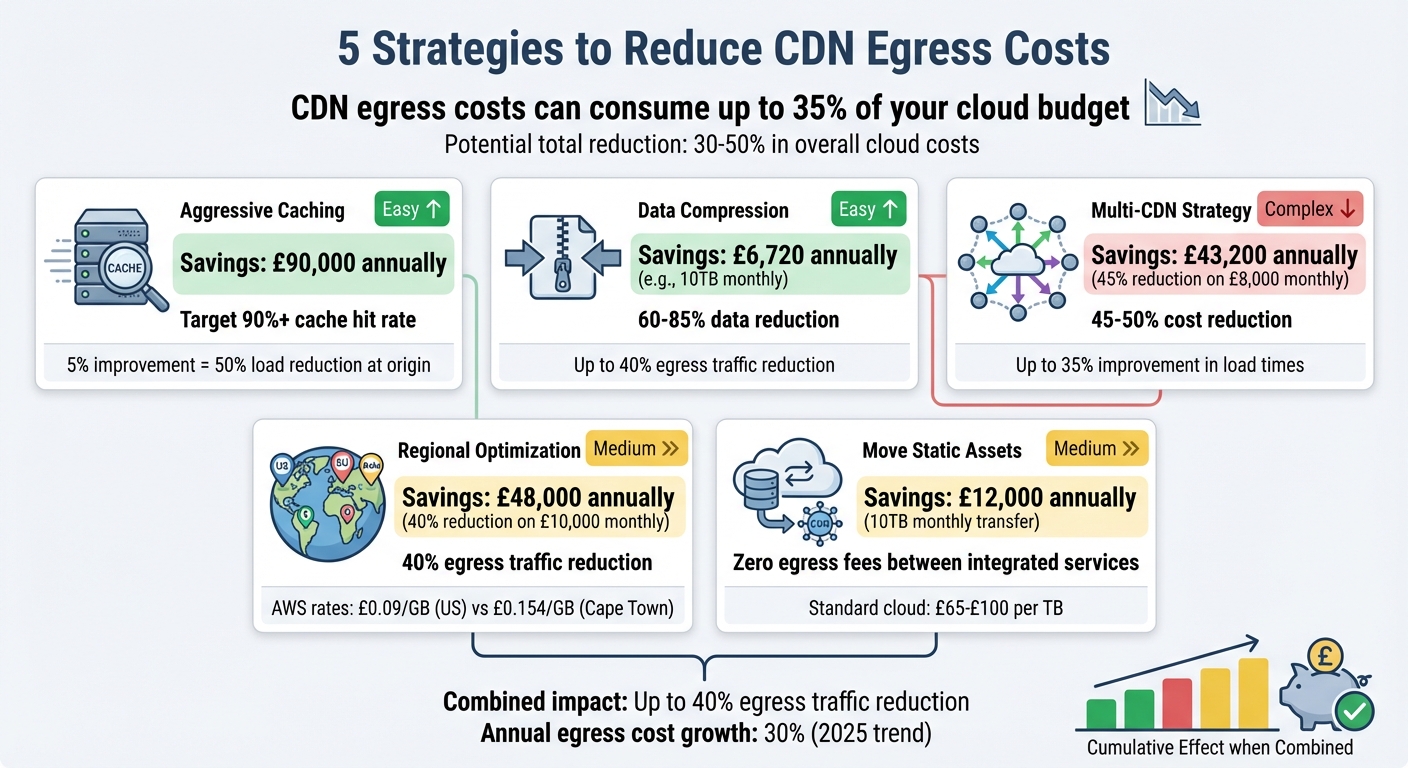 {5 Strategies to Reduce CDN Egress Costs: Savings Potential and Implementation Complexity}
:::
{5 Strategies to Reduce CDN Egress Costs: Savings Potential and Implementation Complexity}
:::
CDNs vs S3/GCS direct transfer: Why you should use CDNs for lower data transfer costs
1. Use Aggressive Caching
Aggressive caching is one of the most effective ways to tackle egress costs. By serving more content directly from your CDN's edge locations, you reduce the amount of data pulled from your origin server - and with that, your egress fees.
The key metric to focus on here is Origin Offload, which measures how much of your total traffic is served from the cache. For example, increasing your offload rate from 90% to 95% reduces the cache miss rate from 10% to 5%. That means for a site handling 100 GB of traffic, only 5 GB would hit your origin server instead of 10 GB, cutting egress costs in half [7].
A 5% improvement in CDN offload performance can mean a 50% load reduction at origin!- Fastly [7]
Modern CDNs come equipped with advanced tools to help maximise offload. Features like Origin Shielding and Request Collapsing minimise direct requests to your origin server by rerouting traffic through a shield, which is particularly useful during traffic spikes [2]. Additionally, features like Instant Purge - which clears cache globally in just 150 milliseconds - enable you to safely cache even highly dynamic content like APIs or event-driven data [7]. These strategies not only reduce egress traffic but also pave the way for further cost optimisation by fine-tuning your CDN setup.
Cost Savings Potential
The potential savings are striking. For example, with a 90% offload rate, egress costs of £0.04 per GB, and an average request size of 1 MB at 5 requests per second, you could save approximately £90,000 annually [7]. Gaming platforms often achieve caching efficiency above 90%, while video streaming and e-commerce sites should aim for at least 70% [6]. Even for data updated as rapidly as every 200 milliseconds, a 50% offload rate is achievable with just 10 requests per second [7].
Implementation Complexity
Setting up aggressive caching is relatively simple. Start by configuring Cache-Control headers with long max-age values for static assets [6]. Use versioned file paths (e.g., /img/logo.v3.png) to ensure you can instantly refresh cached files when updates occur, allowing you to set extended TTLs without risking stale content [3]. Keep an eye on Least Recently Used (LRU) metrics to make sure your cache isn't prematurely evicting important content due to limited capacity [2]. Most modern CDNs also support automation via tools like Terraform or APIs, making it easier to manage these configurations at scale [3].
2. Enable Data Compression
Data compression is a smart way to lower CDN egress costs by shrinking file sizes, which directly reduces the amount of billable data. Many modern CDNs handle compression automatically, so it's worth choosing the right compression algorithm. For web assets like HTML, CSS, and JavaScript, Brotli often outperforms Gzip, offering 10% to 20% better compression while maintaining similar decompression speeds on the client side [10]. When it comes to images, switching to WebP can boost compression efficiency by 25% to 34% compared to JPEG [6]. Like caching, compression is a simple yet effective way to cut costs.
Cost Savings Potential
Dynamic compression can significantly reduce network data usage - by 60% to 85% in most cases, and even over 90% for certain JSON payloads or video manifests [10]. A well-optimised compression setup can lower egress traffic by up to 40% [5]. For example, if you’re transferring 10 TB of data monthly at £0.08 per GB, a 70% reduction in data through compression could save you around £560 per month, or £6,720 annually.
Implementation Complexity
Setting up compression is relatively simple. Most CDNs allow you to enable an Automatic mode, where the edge server determines the best compression algorithm based on the client's Accept-Encoding header [10]. Focus on compressing high-impact MIME types such as text/html, application/javascript, application/json, and application/x-mpegURL. Avoid compressing already compressed formats like JPEG, PNG, or MP4 [10][6]. Additionally, CDNs often skip compressing files smaller than 1 KB to prevent unnecessary processing [10].
Compatibility with Existing Infrastructure
While compression is largely straightforward, there are a few technical factors to keep in mind. For instance, dynamic compression is typically not compatible with byte-range requests on most CDNs [10]. Although this rarely causes problems with modern browsers, it’s a good idea to test your setup, especially if your application relies on partial content delivery.
3. Use Multiple CDN Providers
A multi-CDN strategy allows traffic to be routed based on factors like regional cost, performance, and network health. Much like caching and compression, this approach focuses on strategic cost management. Since CDN pricing can differ drastically depending on the region, you can direct traffic to the provider offering the best rates in a specific area [11]. It also helps you meet minimum contractual commitments across multiple providers without overspending on unused capacity or facing costly overage fees [11]. By tapping into regional price variations, this method complements other optimisation efforts.
Cost Savings Potential
Regional pricing differences offer a real opportunity to cut expenses. For example, data transfer rates in North America are often lower, while Asia-Pacific regions tend to have higher charges [5]. By directing traffic to the most economical provider in each region, organisations have achieved egress cost reductions of 45% to 50% within a year [5]. For a company spending £8,000 monthly on egress, a 45% reduction translates to saving approximately £3,600 per month - or £43,200 annually.
The secret lies in implementing cost-aware routing. This process prioritises constraints in a specific order: jurisdiction and allowlist come first, followed by network health, then performance relative to service objectives, and finally cost - staying within predefined limits [11]. This ensures user experience is not compromised in the pursuit of lower costs.
Implementation Complexity
Deploying a multi-CDN strategy isn’t without its challenges. You’ll need to standardise configurations, such as TLS settings, WAF rules, and cache keys, to avoid potential security or performance hiccups [12]. Coordinating origin shielding is also crucial - one CDN should act as the primary shield for all others in your stack [2].
Selecting a CDN that helps coordinate the shielding between your origin and ALL of the CDNs that are a part of your strategy is key to maximising both your performance and cost efficiency.- Fastly [2]
To streamline vendor management, align contract renewal dates, allowing you to shift traffic volumes during negotiations [11]. Automation tools can also simplify invoice reconciliation and help map costs to specific telemetry metrics and regions [11].
Impact on Performance
A multi-CDN setup not only reduces costs but can also improve load times by up to 35%. However, spreading traffic across multiple providers might lower overall cache hit ratios [5][12]. To address this, ensure consistent cache keys across all providers and use an origin shield to prevent thundering herd
scenarios when multiple CDNs experience cache misses simultaneously [12][2].
Compatibility with Existing Infrastructure
To maintain compatibility across your infrastructure, unified observability is essential. Standardise log fields - such as request IDs, PoP locations, and cache statuses - to confirm that steering decisions are enhancing performance and cutting costs [12]. Additionally, synchronise signed URL protocols and key rotations to avoid authentication failures during failovers [12]. Start small by piloting a single region or traffic slice, measuring cache hit ratios and latency, and then scale globally based on results [12].
4. Optimise Content Delivery by Region
Building on caching and choosing the right providers, regional content delivery optimisation focuses on managing cost differences based on where your content is delivered. CDN providers often charge varying rates depending on the location of their edge servers. For instance, AWS fees are £0.09 per GB in most US regions, but increase to £0.12 per GB in Asia Pacific and £0.154 per GB in Cape Town [1]. For UK businesses, hosting services in nearby regions like London or Dublin helps keep data local and avoids international egress fees.
The goal is to align your infrastructure with your users' locations to minimise costly inter-region data transfers. These transfers may seem minor but can accumulate quickly [1]. By keeping origin servers and CDN ingest points in the same region, you can eliminate unnecessary intermediate costs. Additionally, storing assets within the same Availability Zone helps reduce transfer fees even further [1].
Cost Savings Potential
A well-implemented regional caching plan can cut egress traffic by as much as 40% [5]. For a company with a monthly egress cost of £10,000, this could mean monthly savings of £4,000 - or roughly £48,000 a year. These savings come from routing traffic through less expensive regions and using origin shielding to consolidate requests, which can improve cache hit ratios to around 90% [4].
Standard object storage providers typically charge between £65 and £100 per TB in egress fees [3]. However, some providers waive these costs entirely when you use their integrated services. For example, Gcore Storage and Gcore CDN offer free egress traffic between their services [3].
Implementation Complexity
Setting up regional optimisation involves some initial effort. You'll need to configure geo-routing rules within your DNS or CDN platform to ensure users are directed to cost-effective edge nodes while maintaining acceptable latency. Additionally, enabling origin shielding can further reduce costs, and most major CDNs - like Cloudflare, Fastly, and Gcore - offer this feature as standard.
For businesses operating in multi-cloud environments, using VPC endpoints allows private connections, avoiding extra public Internet and NAT gateway fees [8][14]. AWS CloudFront also provides Price Classes, which let you restrict content delivery to lower-cost regions if the slight performance trade-off is acceptable [13].
Impact on Performance
Regional optimisation doesn’t just save money - it also enhances performance. Delivering content from servers closer to users reduces Time to First Byte (TTFB) and overall latency [3]. Regularly reviewing regional traffic is key to ensuring data transfers from high-cost regions, like Latin America or Africa, are absolutely necessary [6][9]. Moreover, CDN edge points of presence (POPs) can combine multiple client connections into a single persistent connection to the origin, reducing the overhead of individual TCP/TLS handshakes for dynamic content [4]. This regional strategy fits seamlessly with earlier cost-saving approaches, ensuring efficient and localised content delivery.
If you need tailored advice to align your CDN strategy with your user base, Hokstad Consulting can provide expert guidance (https://hokstadconsulting.com).
5. Move Static Assets Away from Cloud Origins
Hosting static assets directly on major cloud platforms like AWS or Azure can get pricey. These providers often charge between £65 and £100 per TB in egress fees when data leaves their network [3]. A smart way to cut these costs is by moving static assets to specialised object storage that integrates with your CDN. This approach not only saves money but also ensures performance remains intact.
For example, using an S3-compatible service with CDN integration can significantly reduce egress fees. If both services are part of the same ecosystem - like Gcore Storage paired with Gcore CDN - egress fees between them are completely eliminated [3].
Most object storage providers charge $80–$120 per TB in egress fees. By fronting your storage with a CDN, you only pay egress once per edge location - then it's all cache hits after that. If you're using Gcore Storage and Gcore CDN, there's zero egress fee between the two.– Gcore [3]
Beyond cost savings, this setup also reduces the strain on your origin servers. By offloading static content to CDN-fronted storage, origin servers face fewer requests, which helps avoid rate limits and overage charges [3]. This means you can scale down the number of origin servers, cutting both capital expenses and maintenance costs [2].
Cost Savings Potential
Switching from cloud origins to CDN-integrated storage can lead to significant savings. For a business transferring 10 TB of data monthly, this change could save up to £12,000 annually. The migration process involves three key steps: preparing the new storage bucket (configuring public or private access), creating a CDN resource that links to the bucket, and setting up caching behaviours [3]. Thanks to S3-compatible APIs, most alternative storage providers make it easy to update the endpoint URL and credentials in your CDN configuration without requiring changes to your application logic [3].
Reducing the load on origin servers provides additional savings. Fastly points out that businesses can cut capital and maintenance costs when origin servers are shielded from most traffic [2]. Incorporating origin shielding - an intermediate cache layer that fetches content from the origin only once, even when requested from multiple global locations - further minimises egress events and boosts cache efficiency.
Implementation Complexity
Tools like Terraform can simplify the migration by managing CDN resources and storage buckets through Infrastructure as Code. For private assets, many CDNs support AWS Signature V4 authentication, ensuring secure access to restricted buckets. To maximise caching efficiency, you can set Cache-Control headers (e.g., public, max-age=2592000) in the object metadata and use versioned file paths (e.g., /img/logo.v3.png) for safe cache busting when assets are updated [3].
It's worth noting that, starting in 2024/2025, major providers like AWS have begun waiving egress fees for customers migrating data off their platform, lowering the exit toll
barrier [15]. AWS has also expanded its free data transfer tier from 1 GB to 100 GB per month in 2025 [15], making initial migrations more budget-friendly.
Impact on Performance
Moving static assets to CDN-fronted storage doesn’t just save money - it can also improve performance. Serving content from edge locations closer to users reduces Time to First Byte (TTFB) compared to fetching data from a distant cloud origin [3]. Optimised CDN networks can achieve global average latencies as low as 30 ms [16], ensuring fast delivery no matter where users are located.
Additionally, enabling compression (like Gzip or Brotli) at the edge reduces file sizes without altering the original storage, contributing to a smoother experience for users [3][6]. For businesses with a global audience, this combination of lower latency and efficient compression ensures high performance while keeping costs manageable.
If you’re looking for expert guidance on migrating your static assets to optimise costs and performance, Hokstad Consulting provides tailored cloud infrastructure and cost engineering services. Visit their website for more information: https://hokstadconsulting.com.
Conclusion
CDN egress fees can take up a hefty 25–35% of your cloud budget [1]. The strategies discussed in this guide are most effective when used together, creating a ripple effect that far exceeds the impact of any single adjustment. By combining compression, aggressive caching, and migrating static assets, you can significantly cut down on expensive data transfers. Adding regional optimisation and a multi-CDN setup helps to avoid unnecessary cross-region transfers and cache churn, all while maintaining top-notch performance.
These methods don’t just streamline your infrastructure - they also bring tangible cost savings. With the potential to slash egress traffic by up to 40%, boost compression efficiency by 20–25%, and achieve cache hit ratios nearing 90% [5][6][4], your overall cloud costs could drop by 30–50% when properly audited and fine-tuned. For businesses handling large volumes of data, these savings can make a huge difference.
That said, egress costs are far from predictable. As of 2025, cloud egress expenses have been climbing by an average of 30% each year [5]. On top of that, new features or services can unintentionally create inefficient data transfer patterns due to infrastructure drift [1]. With rising costs, regular audits are essential. This is where expert guidance becomes invaluable - professionals can pinpoint inefficiencies that automated tools might overlook, ensuring your optimisation efforts have lasting impact.
Hokstad Consulting focuses on addressing these challenges through cloud cost engineering and DevOps transformation. They help businesses cut cloud expenses with tailored audits and custom optimisation plans. Their services range from strategic cloud migration to infrastructure monitoring and ongoing cost management, all aligned with your business objectives. Plus, their No Savings, No Fee
model means you only pay a percentage of the savings they help you achieve, making it a risk-free way to uncover hidden inefficiencies in your cloud setup.
Ready to take charge of your CDN egress costs and optimise your cloud infrastructure? Visit Hokstad Consulting at https://hokstadconsulting.com to explore their cloud cost audits and bespoke optimisation services.
FAQs
How does aggressive caching help reduce CDN egress costs?
Aggressive caching helps boost the cache-hit ratio, which means more content is delivered straight from edge servers instead of pulling it from the origin. This not only speeds up content delivery but also slashes the amount of data leaving your servers, leading to lower egress costs.
By limiting the number of origin requests, businesses can cut down on outbound data transfer while offering a smoother experience for users. Setting up caching rules correctly can make this process even more efficient, ensuring lower costs and quicker content delivery.
What are the advantages of using a multi-CDN strategy?
Using a multi-CDN strategy combines the strengths of several content delivery networks to deliver improved reliability, reduced latency, and better cost control compared to sticking with a single provider. By intelligently routing traffic to the CDN that offers the best performance or most competitive pricing at any given moment, you can avoid outages, reduce bottlenecks during high-traffic periods, and ensure faster content delivery for your users.
This method also boosts resilience. With independent caches and Points of Presence (PoPs) spread across different networks, a failure in one CDN won’t bring your service to a halt. Plus, by steering traffic based on cost metrics, you can cut egress charges by shifting more data away from your origin servers, helping to manage hosting expenses more effectively.
Hokstad Consulting specialises in creating and implementing custom multi-CDN solutions. They can help you achieve seamless traffic management, reliable performance monitoring, and streamlined operations to maximise both savings and delivery speeds.
Why is regional optimisation crucial for reducing CDN costs?
Regional optimisation plays a key role in cutting CDN costs by ensuring data transfers stay within the same geographic region. This approach helps you sidestep the steep inter-region egress fees that can quickly drive up expenses.
It also brings the added benefit of reducing the likelihood of unexpected pricing differences between zones. This means your CDN usage becomes not only more economical but also more predictable. With thoughtful planning around how your data is distributed, you can save a considerable amount without compromising on performance.