
Choosing between open-source and proprietary CI/CD tools for Kubernetes depends on your team's expertise, budget, and priorities. Here's a quick breakdown:
- Open-Source Tools: Examples include Jenkins, Argo CD, Tekton, and Flux CD. These tools offer flexibility, no licensing fees, and community support but require significant maintenance, infrastructure management, and technical expertise.
- Proprietary Tools: Examples include Codefresh, CircleCI, and Harness. These tools provide managed infrastructure, faster setup, and vendor support but come with subscription costs and potential vendor lock-in.
Key Differences
- Cost: Open-source tools are free but demand higher internal resources. Proprietary tools have predictable subscription fees but can be expensive at scale.
- Customisation: Open-source tools allow full control, while proprietary tools are limited to vendor features.
- Ease of Use: Proprietary tools are easier to set up and maintain, while open-source tools often have a steep learning curve.
- Support: Proprietary tools offer SLA-backed support, while open-source relies on community forums.
Quick Comparison
| Factor | Open-Source Tools (e.g., Jenkins, Argo CD) | Proprietary Tools (e.g., Codefresh, Harness) |
|---|---|---|
| Cost | Free (licence), higher internal costs | Subscription fees, lower internal costs |
| Setup Time | Longer (weeks/months) | Shorter (hours/days) |
| Customisation | High | Limited |
| Support | Community-based | Vendor-backed, SLA-guaranteed |
| Scalability | Manual | Automatic |
| Security | Managed internally | Vendor-managed |
Your choice should align with your organisation’s goals, compliance requirements, and resource availability. If you prioritise control and customisation, open-source tools may be suitable. If you need simplicity and support, proprietary tools could be the better fit.
::: @figure 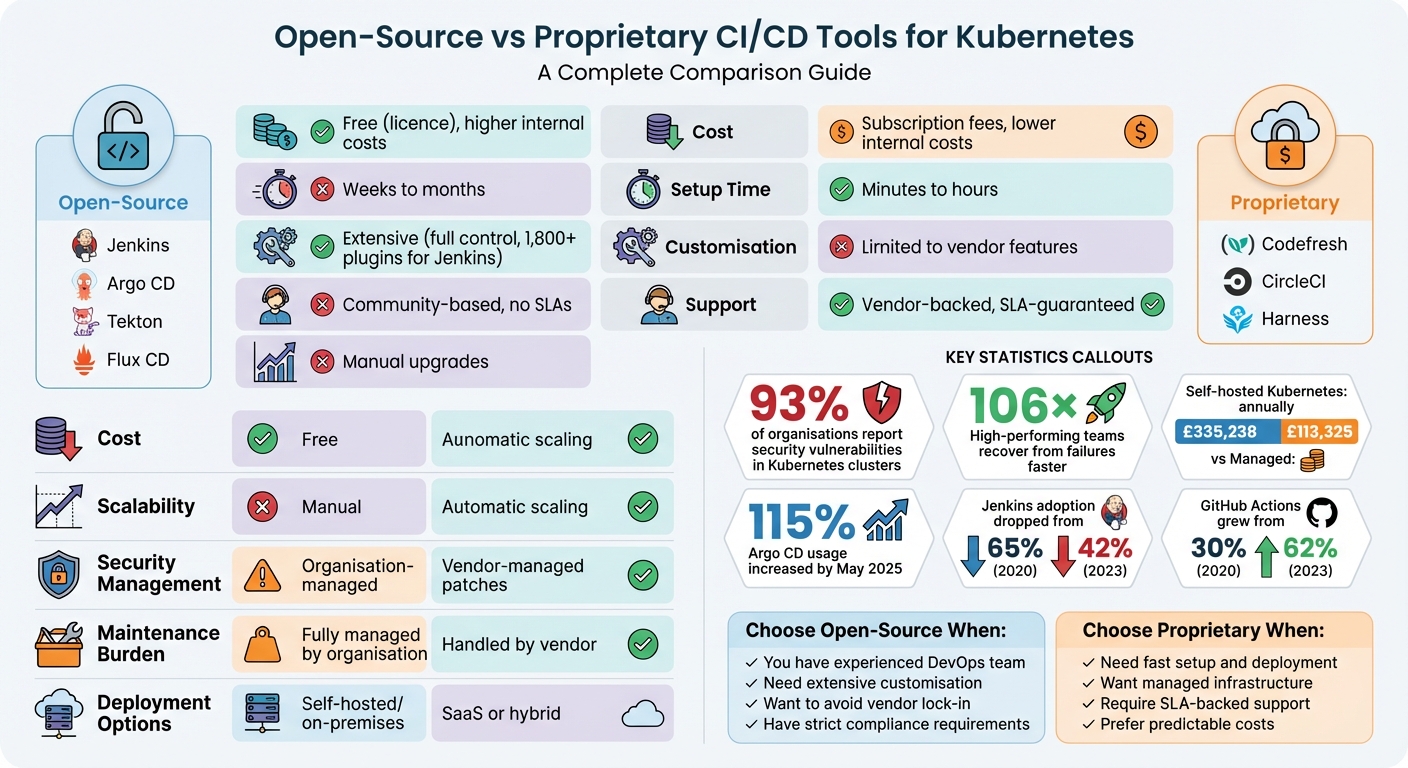 {Open-Source vs Proprietary CI/CD Tools for Kubernetes: Complete Comparison}
:::
{Open-Source vs Proprietary CI/CD Tools for Kubernetes: Complete Comparison}
:::
CI vs. CD vs. GitOps vs. State Management: What's the Real Difference?
Open-Source CI/CD Tools for Kubernetes
Open-source CI/CD tools offer a way to manage Kubernetes deployments without the need for licensing fees. Popular options include Argo CD, Jenkins, Tekton, and Flux CD. Each tool interacts with Kubernetes in its own way, ranging from GitOps-native controllers to plugin-based automation servers.
Argo CD, for instance, experienced a 115% increase in usage by May 2025 [3]. It functions as a Kubernetes controller, syncing Git configurations (like YAML, Helm, or Kustomize) with live clusters. Major companies such as Intuit, Adobe, and Capital One rely on Argo CD to handle thousands of applications across vast node networks. However, its focus is strictly on continuous deployment. As Bryan Reynolds, CEO of Baytech Consulting, puts it:
Argo CD focuses exclusively on continuous deployment of applications to Kubernetes. It doesn't build or test code; instead, it ensures that the final artifacts... are correctly deployed to the cluster.[3]
Meanwhile, Jenkins - a long-standing automation server - uses plugins and Declarative Pipelines to support hybrid environments involving both virtual machines and containers. Tekton, on the other hand, is a Kubernetes-native framework that employs Custom Resource Definitions (CRDs) to create modular, containerised pipeline steps. As of February 2023, Argo CD had 12,200 stars on GitHub, Tekton 7,700, and Jenkins X 4,300 [4]. These numbers highlight the range of options and customisation possibilities offered by open-source tools.
Features and Benefits of Open-Source Tools
One of the standout qualities of open-source tools is their adaptability. Jenkins, for example, boasts over 1,800 plugins, catering to a wide array of integrations. Similarly, Tekton's modular approach allows developers to create reusable Tasks and Pipelines, which can then be shared across multiple projects.
Another major advantage is the pull-based GitOps deployment model. Tools like Argo CD and Flux operate directly within the cluster, pulling updates from Git repositories. This eliminates the need to expose cluster credentials, enhancing security. These tools also offer continuous reconciliation and self-healing capabilities. By comparing the live cluster state with the desired state in Git, they automatically revert any unauthorised manual changes. Argo CD, for instance, can scale to manage up to 50,000 applications and 1,000 clusters, provided its UI is adjusted for pagination.
Community support is another strong point. Open-source tools come with comprehensive documentation, active forums, and regular updates thanks to contributions from thousands of developers. Additionally, all these tools are available under the free Apache 2.0 licence.
Drawbacks of Open-Source CI/CD Tools
Despite their strengths, open-source tools can present some challenges. Operational overhead is one such issue. For example, Jenkins requires ongoing server maintenance, frequent security updates, and constant plugin management. Organisations also need to maintain the underlying infrastructure, which can increase costs related to computing resources and engineering time.
Another challenge is the steep learning curve. Tekton, for instance, demands a solid understanding of CI/CD concepts and Kubernetes CRDs, while Jenkins requires familiarity with Groovy scripting. Older tools that weren’t originally designed for Kubernetes might also need extensive customisation or scripting to work effectively with container orchestration.
Scope limitations can also be problematic. Argo CD, for example, is focused solely on Continuous Delivery, meaning it lacks features for code testing and building. As a result, additional tools are needed to handle other stages of the CI/CD pipeline, potentially complicating workflows. Moreover, while Argo CD’s web UI is powerful, it can slow down when managing between 3,000 and 5,000 applications.
Comparison Table: Open-Source CI/CD Tools
| Tool | Primary Focus | Deployment Model | Interface | Best For | Key Limitation |
|---|---|---|---|---|---|
| Argo CD | Continuous Delivery (CD) | Pull-based (GitOps) | Web UI & CLI | Visualising deployment health in multi-cluster environments | Lacks built-in CI capabilities; potential UI slowdowns for very large setups |
| Flux CD | Continuous Delivery (CD) | Pull-based (GitOps) | CLI-centric | Lightweight, modular GitOps with minimal overhead | Limited UI, often requiring third-party tools |
| Tekton | CI/CD Pipelines | Kubernetes-native (CRDs) | CLI & Dashboard | Building custom internal developer platforms | High complexity and a steep learning curve |
| Jenkins | General Automation (CI) | Push-based | Web UI & Pipeline Code | Hybrid environments with both legacy VMs and containers | High maintenance and extensive plugin management |
Proprietary CI/CD Tools for Kubernetes
Proprietary CI/CD platforms, like Codefresh, CircleCI, and Harness, take a different approach compared to open-source tools by managing infrastructure and streamlining user experiences. These tools handle tasks like installation, monitoring, and upgrades, reducing operational burdens for teams.
One standout feature of these platforms is unified observability. Teams using GitOps through tools like Codefresh have reported up to 25% faster deployments, with some achieving deployment speeds up to 12 times faster after adopting next-generation proprietary CI/CD platforms [7].
Another benefit is streamlined pipeline management. For example, Codefresh offers DRY
(Don't Repeat Yourself) pipelines, enabling teams to share templates across multiple repositories and reduce manual YAML configuration. Bryan Lokey, Director of Engineering at Kandji, praised the platform:
I would describe Codefresh as the holy grail of CI/CD solutions. It's Kubernetes focused and uses GitOps.[5]
In 2023, Crux Informatics made the switch to Codefresh Argo CD to manage its microservices. Under the leadership of Ryan Haggerty, Head of Infrastructure, the company cut costs by 40% compared to its previous vendor and now deploys 100% of its services through the platform. This move eliminated manual deployment delays, allowing engineers to focus on development rather than pipeline management [8].
Features and Benefits of Proprietary Tools
Proprietary tools excel in providing managed infrastructure. Platforms like Codefresh and Harness offer SaaS or hybrid runtimes, where updates, security, and monitoring are handled by the vendor. This contrasts with tools like self-managed Argo CD, which requires teams to configure elements such as Ingress, TLS, SSO, and backups on their own [9].
Professional support is another major advantage. While open-source tools often rely on community forums or Slack channels, commercial platforms provide SLA-backed email and priority support. Stacey Snyder, Senior Director of Engineering at Recurly, shared her experience:
We had more Jenkins errors in a week than we have Codefresh in a year.[5]
Additionally, proprietary tools often feature intuitive user interfaces. Codefresh, for example, holds a 4.6/5 rating on G2, with users praising its ease of use and Kubernetes-focused capabilities [7]. These platforms combine CI pipeline statuses, CD deployment health, and GitOps timelines into a single dashboard, often including built-in DORA metrics for tracking deployment frequency, lead times, and recovery times - no need for additional tools like Prometheus or Grafana. CircleCI, on the other hand, offers a free tier with 1,000 build minutes per month, making it an appealing option for smaller teams [6].
Another highlight is the availability of pre-built integrations. Codefresh, for instance, offers an Argo-powered GitOps runtime and a marketplace of steps for common tasks. Adam Hawkins, Director of Site Reliability Engineering at Skillshare, highlighted the platform's adaptability:
Codefresh gives us the flexibility and extensibility to meet our current requirements, and anything else we come up with in the future.[7]
However, these advantages come with their own set of challenges.
Drawbacks of Proprietary CI/CD Tools
One of the most prominent downsides is cost. Proprietary tools often involve licensing fees and can lead to vendor lock-in. For example, Codefresh's GitOps Cloud Professional plan starts at £3,300 per year (around $4,170) for up to five destination clusters and 200 Argo CD applications. Additional clusters or applications cost £1,200 each [5]. While some lightweight open-source tools might require only 0.25 full-time equivalents (FTEs) for setup and maintenance, Codefresh typically demands 2 FTEs [11]. CircleCI, though offering a free tier, can become costly for complex projects due to parallel execution and resource class charges [10].
Vendor lock-in is another concern. Once workflows are built around a proprietary platform, migrating to another tool can be both time-consuming and expensive. Additionally, some cloud environments may lack support for specialised hardware or unique operating system needs for Kubernetes workloads [12].
As projects grow, configuration complexity can also become an issue. CircleCI, for instance, has been criticised for the complexity of its YAML configurations in large-scale projects. PeerSpot users gave it an average rating of 6.6/10 as of March 2026, frequently citing high costs and configuration challenges [10].
Finally, resource consumption can lead to unexpectedly high bills. Without careful monitoring, ephemeral build resources can spiral out of control. For example, Codefresh's GitOps Professional plan caps deployments at 4,500 Kubernetes resources across all Argo CD instances, which might not suffice for larger deployments [5].
These challenges highlight the importance of carefully evaluating proprietary tools before committing to their use in Kubernetes environments.
Comparison Table: Proprietary CI/CD Tools
| Tool | Licensing Model | Deployment Options | Starting Price | Key Managed Features | Common Limitation |
|---|---|---|---|---|---|
| Codefresh | Annual Subscription | SaaS, Hybrid, On-prem | £3,300/year (5 clusters, 200 apps) | Argo-powered GitOps, DORA metrics, Step Marketplace | Limited to 4,500 Kubernetes resources |
| CircleCI | Usage-based | SaaS, Self-hosted runners | Free tier (1,000 build mins/month) | Concurrent builds, resource classes, pre-built orbs | Expensive for complex projects; YAML complexity |
| Harness | Custom Enterprise | SaaS, Hybrid, On-prem | Custom pricing | AI-driven deployments, multi-cloud cost controls, comprehensive metrics | High cost; requires dedicated onboarding |
Differences Between Open-Source and Proprietary CI/CD Tools
Choosing between open-source and proprietary CI/CD tools often boils down to balancing flexibility with convenience. Open-source tools like Jenkins and Argo CD offer extensive customisation through plugins and full system control. On the other hand, proprietary tools are typically confined to their vendor’s ecosystem and APIs, although some provide options for self-managed runners [13][15].
Cost Considerations
The cost structure differs significantly between the two. Open-source tools don’t have licensing fees but can demand substantial operational resources. Proprietary tools, while subscription-based, eliminate the need for dedicated infrastructure teams. Open-source solutions can also drastically cut cloud expenses. For instance, transitioning from managed public cloud Kubernetes to a private cloud setup using tools like Rancher has been shown to reduce cloud costs by around 50% [16].
Security Responsibilities
Security management is another key distinction. Open-source tools require organisations to handle patches and vulnerability scans independently. In contrast, proprietary platforms follow a shared responsibility model, where the vendor manages patches. This is particularly relevant given that 93% of organisations report security vulnerabilities in their Kubernetes clusters, and 61% have exposed secrets in their environments [14][16].
Support and Reliability
Support models also differ. Open-source tools rely on community forums and resources, while proprietary solutions offer SLA-backed support. Thierry Carrez, General Manager of the OpenInfra Foundation, highlighted the widespread adoption of open infrastructure:
More than two-thirds of OpenStack deployments leverage the integration of OpenStack and Kubernetes, with tens of millions of cores globally implementing that open infrastructure blueprint[16].
The choice of CI/CD tools can have a direct impact on operational performance. High-performing teams with optimised CI/CD pipelines recover from failures 106 times faster than their lower-performing counterparts [2]. This underscores the importance of aligning tool selection with organisational goals.
Open-Source vs Proprietary CI/CD Tools: Key Differences
| Factor | Open-Source (e.g., Argo CD, Jenkins) | Proprietary Options |
|---|---|---|
| Licensing Cost | Free | Subscription/usage fees |
| Operational Cost | High (staff, infrastructure) | Lower (vendor-managed infra) |
| Customisation | Extensive via plugins/root access | Limited to vendor features |
| Ease of Use | Steep learning curve | Intuitive GUIs, AI tools |
| Support Model | Community-driven, no SLAs | Vendor-backed, SLA-guaranteed |
| Security Management | Organisation-managed | Vendor-managed patches |
| Deployment Options | Self-hosted/on-premises | SaaS or hybrid |
| Setup Time | Weeks to months | Minutes to hours |
| Scalability | Manual upgrades | Automatic scaling |
| Maintenance Burden | Fully managed by organisation | Handled by vendor |
Each organisation must weigh these factors carefully to ensure their CI/CD tool aligns with their DevOps priorities and operational resilience.
Choosing the Right CI/CD Tool for Your Kubernetes Environment
Picking a CI/CD tool for Kubernetes isn't a one-size-fits-all decision. The right choice depends on your team's expertise, infrastructure, and priorities. What works for one organisation could be a headache for another.
When to Use Open-Source Tools
Open-source tools like Jenkins or Argo CD are great for teams with experienced DevOps professionals who can handle infrastructure and troubleshoot issues. These tools shine in environments that need a lot of customisation, offering flexibility for teams managing diverse systems.
Budget-conscious organisations often lean towards open-source options, especially when avoiding vendor lock-in is a concern. But don’t be misled by the free
label. As Dmitry Shevrin, Senior Solutions Architect at Spectro Cloud, points out:
The software licence might be free on paper, but if you need to pay to upgrade to unlock features, or to get a basic support contract, you might not be saving anything at all versus a commercial product[19].
While open-source tools allow for extensive customisation, they come with a cost in engineering time to maintain and manage them.
The adoption landscape is shifting. Jenkins, for example, saw its usage drop from 65% in 2020 to 42% in 2023, while Argo CD grew from 10% to 30% during the same period [18]. This reflects the increasing popularity of GitOps workflows, where Git serves as the single source of truth for cluster states [17].
When to Use Proprietary Tools
Proprietary tools like GitHub Actions, CircleCI, or Azure DevOps are designed to get you up and running quickly. They come with managed infrastructure and built-in support, making them ideal for organisations that want to focus on deploying applications rather than maintaining the CI/CD platform. These tools also handle compliance requirements like SOC 2 or ISO 27001 certifications, saving you the hassle.
GitHub Actions, for instance, saw its adoption rise from 30% in 2020 to 62% in 2023 [18], driven by organisations prioritising speed over customisation. Managed services take care of patches, scaling, and uptime, but there is a trade-off - 55% of Kubernetes practitioners express concerns about feeling locked in
to specific vendors [19].
These pros and cons highlight the importance of carefully evaluating your options.
Factors to Consider
Team Maturity: If your engineers can handle manual upgrades and troubleshooting, open-source tools could be a good fit. On the other hand, proprietary tools allow your team to focus on delivering features instead of maintaining the CI/CD system.
Infrastructure Portability: Open-source tools like Terraform and Kubernetes rely on standardised APIs that work across different clouds. Proprietary tools, however, can introduce vendor-specific dependencies [20]. If you go the proprietary route, audit these dependencies - such as AWS IAM or Route53 - and consider portable alternatives.
Total Cost of Ownership: The cost isn't just about licence fees. The time engineers spend building and maintaining a custom stack can outweigh subscription costs. Conversely, running Kubernetes on a private cloud can save 50–70% compared to managed services like EKS or GKE [20].
Ecosystem Alignment: Integration complexity matters. For instance, GitHub Actions integrates seamlessly with GitHub-hosted code, while Azure DevOps is a better fit for Microsoft-heavy environments. Kubernetes-native tools like Argo CD and Tekton are built for scalability and use Custom Resource Definitions, whereas older tools like Jenkins may require a more intricate setup.
Exit Strategy: For proprietary tools, ensure they use standard objects so you can still manage your Kubernetes clusters with tools like kubectl if you switch platforms. Open-source projects also carry risks - fewer than 50% of new GitHub repositories remain actively maintained after five years, which could leave you dealing with abandonware
[19].
Cost Considerations for Kubernetes CI/CD Solutions
Cost Breakdown: Open-Source vs Proprietary Tools
When comparing open-source and proprietary tools, it's important to look beyond licence fees. Open-source solutions often come with hidden costs, especially in staffing and infrastructure. For instance, self-hosting Kubernetes can cost around £335,238 annually, compared to £113,325 for managed solutions. The difference comes down to staffing - self-hosted setups typically require three times the DevOps personnel of managed services, according to a 2024 Gcore analysis [23]. These figures highlight the financial impact of operational choices.
Take Jenkins as an example. Running it at scale for a team of 100 engineers can result in AWS infrastructure costs of approximately £16,200 per month [22]. On the other hand, proprietary tools shift these costs into subscription fees, sparing you the infrastructure headaches. Managed Kubernetes control planes, for instance, cost about £0.10 per hour (roughly £72 monthly) on services like EKS and GKE, while AKS offers a free tier for non-production environments [24]. Cloud providers also offer discounts - Reserved Instances or Savings Plans can reduce costs by up to 72% [24]. The trade-off? Fewer staffing demands but ongoing subscription expenses.
Another consideration is how much time senior engineers spend on maintenance rather than product development. Research shows 81% of organisations lose an hour or more recovering from failed deployments [22]. Additionally, self-hosted runners on Kubernetes only become cost-efficient when usage exceeds 50,000 CI minutes per month. For smaller workloads, managed runners are often the more economical choice [25].
How to Reduce Costs
Reducing costs starts with smarter resource allocation. For self-hosted runners, using spot instances can cut node expenses by 60–70%. AWS Spot and Azure Spot VMs are great options, provided you have interruption-handling mechanisms in place [25]. Pair these with autoscalers like KEDA or the Horizontal Pod Autoscaler to dynamically adjust runner replicas based on demand, minimising idle costs [25].
Optimising resource usage is another effective strategy. For example, caching can generate immediate savings. CircleCI's Docker layer caching, for instance, reduces build times by over 50%, which directly lowers per-minute compute costs [21][1]. For self-hosted setups, local registry mirrors or shared Persistent Volume Claims can help you avoid data transfer fees from services like S3 or GCS [25][21]. Regular housekeeping - such as clearing orphaned volumes and outdated container images - is equally critical. Cloud storage, like AWS EBS, costs roughly £0.10 per GB per month, and these charges can add up quickly [24].
Monitoring expenses is also key. Services like Azure Monitor charge based on data volume, so be selective about the logs and metrics you track [24]. Over-provisioning and idle resources are common culprits for inflated costs [24]. If managing cloud costs across multiple tools feels overwhelming, consulting services like Hokstad Consulting can help. Their audits and optimisation strategies claim to deliver savings of 30–50% by identifying inefficiencies.
For proprietary tools, negotiating licensing terms based on actual usage can lead to better pricing. Another approach is to adopt a hybrid model - using managed services for production while running development pipelines on self-hosted infrastructure. This balance can help you manage costs without compromising on convenience.
Conclusion and Recommendations
Deciding between open-source and proprietary CI/CD tools for Kubernetes comes down to aligning the tool's capabilities with your organisation's specific needs. Open-source tools like Jenkins, Argo CD, and Flux CD provide extensive customisation and complete control, which can be ideal for industries with strict regulations or data sovereignty requirements. However, these benefits come with hidden costs, including staffing, infrastructure, and ongoing maintenance. On the other hand, proprietary tools such as Harness and CircleCI offer faster setup, consistent subscription pricing, and reduced operational overhead, though they tend to be less flexible and may lead to vendor lock-in.
When evaluating your options, consider factors like your team's technical expertise, compliance obligations, and budget. For small and medium-sized enterprises (SMEs) or startups, proprietary cloud-based tools often make sense. They require less upfront investment and simplify operations. Conversely, if your organisation operates in a highly regulated environment - especially one with GDPR or UK data residency concerns - self-hosted, open-source solutions may be necessary to maintain tight control over sensitive data.
A hybrid approach can also be worth considering. For instance, you could use a proprietary CI tool like GitHub Actions for build processes while leveraging an open-source GitOps solution like Argo CD for Kubernetes deployment. This setup combines the simplicity of proprietary tools with the control offered by open-source solutions.
It's essential to assess the total cost of ownership. Even though open-source tools are free
in terms of licensing, they can demand significant engineering resources and maintenance efforts. These indirect expenses often make managed solutions - with their predictable pricing - an appealing alternative.
Ultimately, the best choice depends on your organisation's expertise, budget, compliance requirements, and growth plans. Carefully evaluate all factors, including hidden costs, and if the decision feels overwhelming, seeking expert advice can be invaluable. For example, Hokstad Consulting offers professional guidance to optimise your DevOps infrastructure and reduce cloud spending through targeted audits and strategic cloud migration.
FAQs
Which option is cheaper long-term for Kubernetes CI/CD?
When weighing the long-term costs of open-source versus proprietary CI/CD tools for Kubernetes, several factors come into play, such as infrastructure, staffing, and specific organisational requirements.
Open-source tools are generally free to use, which can help reduce licensing expenses. However, they often demand more internal resources, including skilled personnel to manage, customise, and maintain them. On the other hand, proprietary tools come with licensing fees but provide integrated support and built-in scalability. These features can help minimise operational overhead and simplify management.
For organisations with highly skilled teams and a preference for flexibility, open-source tools might be the better choice. Meanwhile, proprietary tools are often a better fit for those seeking ease of use and streamlined efficiency.
Can I combine a managed CI tool with open-source GitOps CD?
Yes, pairing a managed CI tool with an open-source GitOps CD solution is a popular and practical approach. This combination takes advantage of the user-friendly and scalable nature of managed CI platforms while incorporating GitOps principles through tools like Argo CD or Flux CD. The result is a CI/CD pipeline that's adaptable and well-suited for Kubernetes environments, aligning seamlessly with modern DevOps workflows.
How do I avoid vendor lock-in with proprietary CI/CD?
To reduce the risk of being tied down by proprietary CI/CD tools, it’s essential to adopt practices that prioritise flexibility and control. Regularly export configurations to ensure you have backups independent of the tool. Opt for solutions that support open standards, such as YAML-based configurations, rather than relying solely on proprietary APIs. It’s also a good idea to include clear exit terms in vendor contracts and maintain thorough documentation. These steps can help your organisation stay agile and make transitions smoother if you need to switch tools in the future.