
Choosing between open source and proprietary CI/CD tools comes down to balancing costs with your team's resources and expertise. Here's the key takeaway:
- Open source tools like Jenkins have no licensing fees but demand significant investment in infrastructure (£12,700/month for 100 engineers) and engineering time (3–4 full-time staff for maintenance). They work best for teams with Kubernetes expertise running over 1,000 jobs per month.
- Proprietary platforms like Azure DevOps or GitHub Actions charge subscription fees (e.g., £4.70/user/month or £0.0047/min for Linux runners) but reduce maintenance overhead and offer vendor support. They're ideal for smaller teams or those without DevOps expertise.
Quick Comparison:
| Aspect | Open Source (e.g., Jenkins) | Proprietary (e.g., Azure DevOps) |
|---|---|---|
| Licensing | £0 | £4.70/user/month (after 5 free) |
| Infrastructure Costs | £12,700/month (self-hosted) | £31/month per hosted job |
| Maintenance | 3–4 engineers required | Vendor-managed |
| Security | Manual patching | Built-in tools (£24/committer/month) |
For small UK startups, proprietary tools offer predictable costs and minimal setup. Larger enterprises may find open source cost-effective at scale but must manage complexities like security and maintenance.
::: @figure 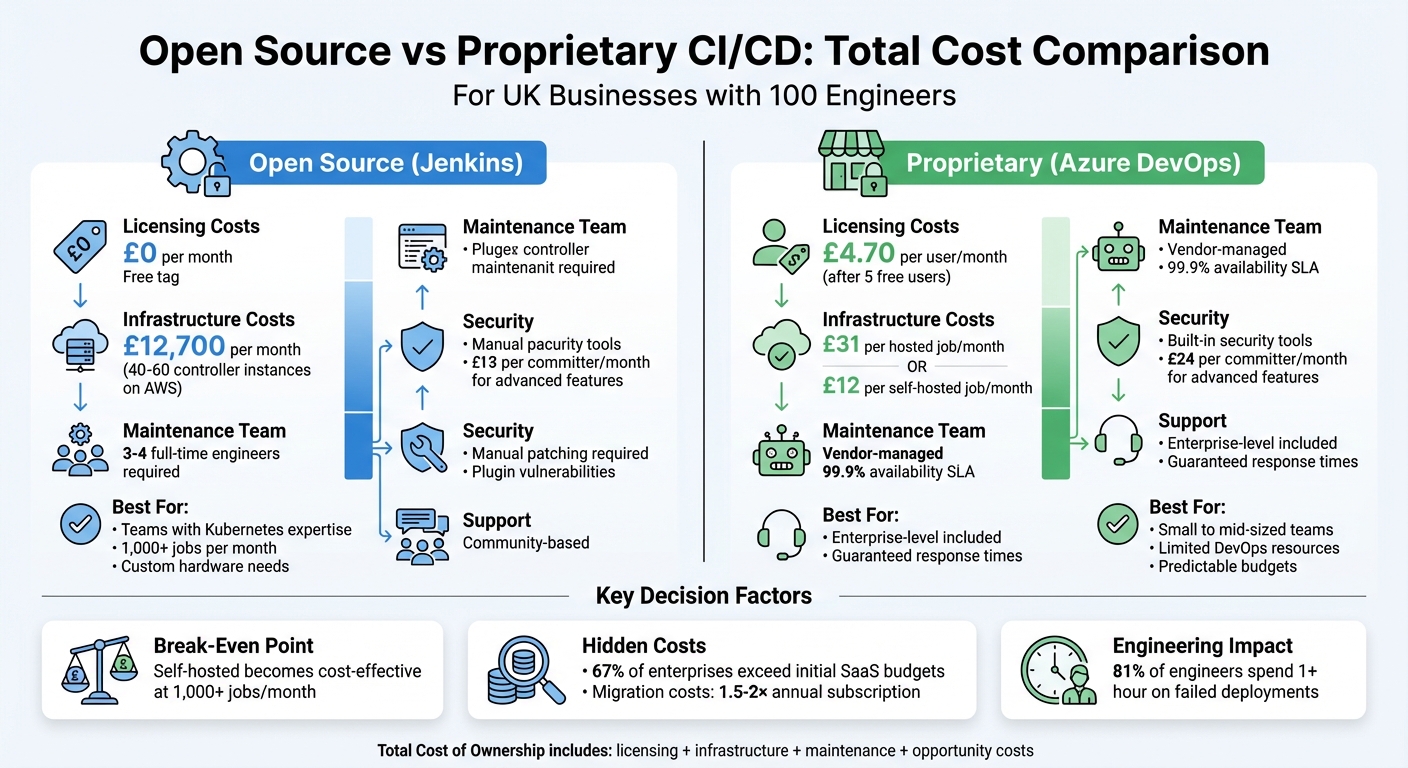 {Open Source vs Proprietary CI/CD Cost Comparison for UK Businesses}
:::
{Open Source vs Proprietary CI/CD Cost Comparison for UK Businesses}
:::
GitHub Actions Is NOT Free | Pricing Explained + Self-Hosted Runners & Jenkins Comparison
Cost Model for CI/CD Tooling
This section breaks down the cost model for CI/CD tools, addressing both straightforward expenses and less obvious hidden costs.
Direct Cost Components
Direct costs are the most visible and predictable expenses. For proprietary platforms, these include subscription or usage fees. For instance, GitHub Actions charges approximately £0.0047 per minute for Linux runners and £0.0079 per minute for Windows runners [5]. Similarly, Azure DevOps costs around £31 per month for each additional Microsoft-hosted parallel job [2].
When it comes to open source solutions, the focus shifts to infrastructure expenses. Running a tool like Jenkins at scale requires significant cloud resources, such as virtual machines operating around the clock to handle peak loads. Additional costs include storage for build artefacts and logs, billed per GB/month, and network egress fees, which are often underestimated. For example, a team of 100 engineers managing 20 repositories might need 40–60 Jenkins controller instances on AWS. This setup could lead to monthly infrastructure costs of approximately £12,700 (around $16,200) for compute, storage, and data transfer, even before factoring in engineering labour [1][4]. These explicit costs form the foundation of the overall expenditure, but they don’t tell the whole story.
Indirect and Hidden Cost Components
Indirect costs, while harder to quantify, can have a significant impact on budgets. Open source tools, for example, often demand substantial engineering time. Setting up and maintaining these tools is resource-intensive, requiring ongoing attention from engineers [1][4].
Security and compliance work introduce additional overheads. Open source solutions often require manual integration of security scanners and secret management systems. When infrastructure issues arise - such as build failures - senior engineers may need to step away from product development to troubleshoot, further increasing costs.
Proprietary platforms, on the other hand, offload much of the maintenance burden to the vendor. But this convenience comes with its own hidden costs. Vendor lock-in is a major factor, with migration expenses often reaching 1.5× to 2× the annual subscription fees when switching enterprise systems [6]. Additionally, scaling requirements can lead to unexpected costs, with 67% of enterprises exceeding their initial SaaS budgets [6]. Premium features and services, like GitHub Advanced Security, can also add up quickly, costing £24 per committer per month [2].
Together, these hidden and indirect costs can significantly influence the total cost of ownership for CI/CD tooling, making it essential to weigh all factors carefully.
Open Source CI/CD: Cost Structure
Licensing and Infrastructure Costs
While open source CI/CD tools spare you upfront licensing fees, they come with notable self-hosting costs that are passed directly to cloud providers. For example, some services charge on a per-seat basis or for additional self-hosted jobs [8][2].
Infrastructure expenses can pile up quickly. Compute costs depend on factors like build concurrency and duration, and you may also face charges for idle capacity [4]. Storage costs, such as those for artefacts and build caches, can grow unpredictably. For instance, GitHub Actions charges £0.055 per GiB per month once usage exceeds the included 10 GB [7]. Network egress fees add another layer of cost when transferring artefacts between self-hosted runners and external services. CircleCI, for instance, charges 420 credits per GB (about £0.20/GB) for network and storage usage beyond plan limits [3]. These infrastructure expenses often lead to hidden engineering costs.
Next, let’s explore the engineering time and effort involved in managing self-hosted systems.
Engineering and Maintenance Overhead
One of the biggest hidden costs is the time and expertise required to set up and maintain these systems. Tools like Jenkins demand advanced knowledge of Kubernetes, container orchestration, and distributed systems. As CircleCI puts it:
Getting self-hosted runners working isn't a weekend project. Self-hosted runners often mean Kubernetes, and Kubernetes has a steep learning curve.
Beyond the initial setup, ongoing maintenance - like updating plugins and applying security patches - diverts engineers from core product development. Some organisations dedicate 3–4 engineers solely to maintaining their Jenkins infrastructure [1]. When builds fail, senior engineers are often pulled away from other priorities to troubleshoot, which can lead to high opportunity costs. In fact, research shows that 81% of engineers spend an hour or more recovering from failed deployments [1].
Long-Term Cost Flexibility
Managing costs over the long term is essential for a sustainable CI/CD strategy. Open source tools can offer flexibility in this regard. Self-hosting becomes more cost-effective at scale - typically when running over 1,000 jobs per month - because the savings on compute can start to balance out the operational costs [4]. For teams that need specialised hardware, such as GPUs or high-core machines, customising infrastructure can help avoid the premium rates charged by proprietary platforms [4][8].
However, this flexibility comes with a trade-off: cost unpredictability. Infrastructure expenses can fluctuate with build frequency and artefact retention. Additionally, delaying updates to avoid breaking complex configurations can lead to technical debt and unpatched security vulnerabilities [1]. Without proper autoscaling, organisations may end up paying for idle capacity around the clock, eroding any potential savings. Ultimately, the total cost of ownership depends heavily on team expertise - organisations without strong Kubernetes skills may find that engineering costs outweigh any infrastructure savings [4].
Proprietary CI/CD: Cost Structure
Licensing and Subscription Costs
Proprietary CI/CD platforms typically charge based on user count and compute usage. For instance, Azure DevOps provides free access for the first five users, then charges approximately £4.70 per user per month for additional seats. For CI/CD jobs, Microsoft-hosted options cost around £31 per parallel job, while self-hosted jobs are priced at approximately £12 per parallel job [2].
CircleCI's Performance Plan operates on a credit-based system, starting at £12 per month for 30,000 credits and five users [3]. Credit consumption varies depending on resource types: a Linux Medium instance (2 CPU, 4GB RAM) uses 10 credits per minute, whereas a macOS M4 Pro Medium instance consumes 200 credits per minute [3][9]. Adding extra users generally costs 25,000 credits per month (around £12) per user [3].
Premium features come with additional charges. For example, GitHub Advanced Security costs approximately £24 per committer per month for code scanning [2]. CircleCI applies extra fees for network egress and storage beyond plan limits, charging 420 credits per GB (about £0.20/GB). These fees are converted from USD to GBP using the London closing spot rates at the end of the prior month [2]. This transparent pricing structure often simplifies budgeting compared to the operational complexity of self-hosted solutions.
Lower Maintenance and Platform Overhead
Proprietary platforms reduce the burden of maintaining CI/CD infrastructure by managing tasks like state management, upgrades, scaling, and ensuring availability. For example, Azure DevOps guarantees a minimum 99.9% availability for build and deployment operations [2], freeing organisations from the responsibility of managing uptime themselves.
This managed approach can result in significant cost savings. While subscription fees apply, organisations save on the expense of maintaining full-time teams to manage CI/CD infrastructure. Additionally, these platforms often include built-in security, compliance features (such as GDPR support), and automated rollback functions - features that would otherwise demand custom development and ongoing maintenance in self-hosted setups. The reduced maintenance requirements contribute to more predictable long-term costs.
Support and Long-Term Predictability
Proprietary platforms also offer enterprise-level support and fixed subscription tiers, providing financial stability and simplifying budget planning. For instance, Azure records an average of just 0.76 price changes per month, making costs relatively stable [2]. Service-level agreements (SLAs) further ensure reliability and financial certainty, which open source tools may not consistently provide.
CircleCI adds to cost predictability with a credit rollover feature, allowing unused credits to remain valid for up to 12 months [3]. This helps prevent wasted budget and smooths out usage spikes over different billing periods. These predictable pricing and support structures mitigate potential migration risks while offering stable, long-term cost management.
Need help optimizing your cloud costs?
Get expert advice on how to reduce your cloud expenses without sacrificing performance.
Cost Comparison and UK Scenarios
Cost Component Comparison
When comparing the financial aspects of open source and proprietary CI/CD tools, it's clear that the differences extend well beyond licensing fees. Open source platforms like Jenkins come with £0 licensing costs, but they demand considerable investment in infrastructure, ongoing maintenance, and engineering resources. On the other hand, proprietary solutions such as Azure DevOps charge subscription fees but can significantly lower internal operational overhead.
| Cost Component | Open Source (Jenkins) | Proprietary (Azure DevOps) |
|---|---|---|
| Licensing | £0 | £4.70 per user/month (after the first 5 free)[2] |
| Infrastructure | Self-managed; approximately £12,700/month for 100 engineers[1] | £31/month per hosted job or £12/month self-hosted[2] |
| Maintenance | Requires 3–4 dedicated engineers[1] | Vendor-managed with a 99.9% availability SLA[2] |
| Support | Community-based or third-party | Included with guaranteed response times[2] |
| Security | Manual patching and plugin vulnerabilities[1] | Integrated security features; around £24 per committer for advanced security[2] |
For instance, scaling Jenkins for 100 engineers working across 20 repositories can lead to infrastructure costs exceeding £12,700 per month, even before factoring in personnel expenses[1].
UK Business Scenarios
Small startups with 5–15 developers often benefit from free tiers, such as Azure DevOps' five free users, and predictable monthly expenses under £100. This aligns well with their limited budgets and lean technical teams.
Mid-sized companies with 50–150 developers may struggle with the integration challenges posed by open source solutions like Jenkins. Proprietary tools can deliver tangible advantages, such as reducing wait times and boosting engineering efficiency. For example, Faire's engineering team reported a 50% or greater reduction in pull request wait times after transitioning from Jenkins to Buildkite, enabling their developers to focus more on product development rather than maintaining tools[1].
Large enterprises with 200+ developers face more intricate trade-offs. Self-hosted CI/CD runners can become cost-effective, but only when managing over 1,000 jobs per month[4]. Companies in heavily regulated industries, such as financial services or healthcare, often adopt hybrid models. These combine proprietary platforms for general workloads with self-hosted runners to meet compliance requirements.
How Hokstad Consulting Can Help with Cost Optimisation
Navigating these varied scenarios can be challenging, but Hokstad Consulting offers tailored solutions to help UK businesses optimise costs effectively.
Their expertise lies in cloud cost engineering and DevOps transformation. By modelling the total cost of ownership for different CI/CD setups, they help businesses uncover hidden expenses and design hybrid solutions that balance cost savings with operational needs.
Through in-depth cloud cost audits, Hokstad Consulting reviews infrastructure spending, licensing models, and engineering time allocation to identify areas for improvement. For companies considering a switch between open source and proprietary platforms, they provide strategic advice on timing, implementation, and risk management. With their skills in custom development and automation, Hokstad Consulting can craft CI/CD configurations that cut costs by 30–50% while maintaining speed and reliability. For more details, visit Hokstad Consulting.
How to Choose Between Open Source and Proprietary CI/CD
Cost Questions to Ask
When deciding between open source and proprietary CI/CD solutions, UK organisations need to carefully evaluate the total cost of ownership (TCO). This includes expenses like migration, training, and the ongoing engineering effort required to maintain infrastructure [11][12]. It's also important to assess whether internal resources could be better allocated to core product development. For public sector organisations, the shift from capital expenditure (CAPEX) to operational expenditure (OPEX) is particularly relevant [12].
Consider the engineering time required for tasks such as plugin updates, applying security patches, and managing incident responses. Don't forget to account for productivity losses caused by build failures, which can lead to significant downtime [1][4][10]. Additionally, there are often hidden costs to factor in, such as network egress charges, storage for artefacts, and the opportunity cost of senior developers being diverted from product-focused work [4][10].
Understanding these cost dynamics is key to determining which approach makes the most financial sense for your organisation.
When Open Source Reduces Costs
For teams with Kubernetes expertise, open source solutions like Jenkins become more economical when running over 1,000 jobs per month [4]. Self-hosting provides complete control, especially when specialised hardware, custom software configurations, or strict data isolation are required. However, this approach demands a skilled team. Notably, 75% of organisations cite a lack of internal expertise as the primary barrier to successfully adopting open source [13]. Without dedicated DevOps professionals to handle setup, autoscaling, and on-call responsibilities, the free
nature of open source software can quickly translate into high engineering costs [4].
When Proprietary Solutions Reduce Costs
Proprietary solutions can help alleviate the maintenance burden on internal teams [4]. These platforms are often more cost-effective for organisations running fewer than 1,000 jobs per month, especially when DevOps resources are limited, or rapid deployment is a priority [4]. For example, Azure DevOps offers 1,800 free minutes per month for Microsoft-hosted pipelines. Beyond that, additional parallel jobs cost around £31 for hosted runners and approximately £12 for self-hosted runners [2].
A practical example of cost savings can be seen in the UK Home Office, which managed to cut its cloud expenses by 40% in July 2021 by aligning technical choices with financial considerations [12]. Proprietary platforms also reduce the internal workload by transferring maintenance and operational responsibilities to the service provider [2].
Conclusion
Key Takeaways
When deciding between open source and proprietary CI/CD systems, it all boils down to the total cost of ownership. While licensing fees might seem like the most obvious expense, they’re often just the tip of the iceberg. The real costs emerge from the time your engineering team spends troubleshooting configurations, maintaining infrastructure, and applying security patches. As Buildkite aptly puts it:
The real cost of CI isn't primarily about the monthly bill... It's about the accumulated time spent on configuration, debugging, and rewrites
[14].
Looking deeper into these costs, operational overheads play a major role. Open source solutions might save you on licensing fees upfront, but they demand a significant investment in skilled professionals. For instance, self-hosting only starts to make financial sense when you’re processing over 1,000 jobs per month, and even then, it requires a team with Kubernetes expertise [4].
On the other hand, proprietary platforms come with predictable pricing models and less maintenance hassle. However, they aren’t without drawbacks - vendor lock-in is a real concern, and scaling can lead to unexpected costs. In fact, 67% of enterprises report exceeding their initial SaaS budgets due to unforeseen scaling needs [6]. For UK businesses, there’s an added layer of complexity: cloud services are often priced in USD, with conversions based on London closing spot rates, which can fluctuate [2].
As your workload grows, the best option for your organisation can shift. A system that works well for 100 jobs per month may no longer be efficient once you scale to 1,000 jobs or more. For example, in a scenario involving 300–400 engineers, the upfront implementation costs could differ drastically: roughly £395,000 for open source versus £22,000 for proprietary solutions. Annual expenses also reflect this gap, with open source solutions costing around £187,000 compared to £14,000 for proprietary platforms [15].
FAQs
What hidden costs should I consider with open-source CI/CD tools?
While open-source CI/CD tools might seem like a cost-effective choice at first glance, they often come with hidden expenses that can catch you off guard. For instance, keeping self-hosted runners up to date, applying security patches, and ensuring compliance can demand a lot of time and effort. And as your infrastructure grows, the expenses tied to hardware and cloud usage can escalate quickly.
There’s also the challenge of managing plugin compatibility and keeping tools updated. These tasks can lead to unexpected downtime or unstable builds, which can ultimately hinder developer productivity. But perhaps the biggest cost isn’t financial - it’s the opportunity cost. Senior engineers might find themselves tied up with maintaining the CI/CD pipeline instead of focusing on building and improving the core product. Taking a closer look at these factors is crucial to grasp the full picture of what open-source solutions might actually cost.
What are the maintenance benefits of proprietary CI/CD platforms compared to open-source tools?
Proprietary CI/CD platforms come with some clear maintenance perks. They typically provide managed hosting, automatic updates, and dedicated vendor support. This means organisations don’t have to worry about tasks like patching servers, upgrading plugins, or handling infrastructure scaling themselves.
On the other hand, open-source tools often demand continuous upkeep. Teams need to regularly update controllers and plugins, which can quickly eat up resources - especially as operations grow. Proprietary solutions simplify these processes, allowing teams to spend more time on what really matters: delivering results, not managing infrastructure.
When is it more cost-effective to use open-source CI/CD tools over proprietary solutions?
Choosing open-source CI/CD tools can be a smart way to save money, especially if your organisation has the in-house expertise to handle their setup and upkeep. By managing these tools on your existing infrastructure, you can sidestep recurring licence fees and avoid extra costs that often come with proprietary platforms, like per-user charges, compute usage fees, or storage expenses.
That said, open-source solutions aren’t entirely free of costs. You’ll need to consider the time and effort required for setup, regular maintenance, and troubleshooting. If your team has the skills and resources to manage these tasks, open-source tools can offer substantial savings over the long run compared to proprietary options.