
When choosing between managed and self-hosted databases, it boils down to control, cost, and convenience. Managed databases are great if you want minimal upkeep, predictable costs, and easy scaling. Self-hosted databases, however, give you full control, customisation options, and potential long-term savings but require significant expertise and effort.
Key Points:
- Managed Databases: The provider handles maintenance, updates, and backups. Ideal for small teams or those without in-house database expertise. Costs are subscription-based but can escalate for complex workloads.
- Self-Hosted Databases: You control everything, from hardware to configurations. Best for organisations needing customisation or with strict compliance needs. However, it demands skilled staff and higher upfront costs.
Quick Comparison:
| Feature | Managed Databases | Self-Hosted Databases |
|---|---|---|
| Control | Limited (provider manages infrastructure) | Full (you manage everything) |
| Maintenance | Automated by provider | Manual, requires expertise |
| Scalability | Simple, often one-click | Manual, may need downtime |
| Cost | Subscription-based, higher for large setups | Upfront investment, lower for large-scale |
| Security | Provider-managed | Fully customisable, requires internal effort |
For startups or teams prioritising ease of use, managed databases are a better choice. For organisations with technical resources and specific requirements, self-hosted databases offer more flexibility and control.
::: @figure 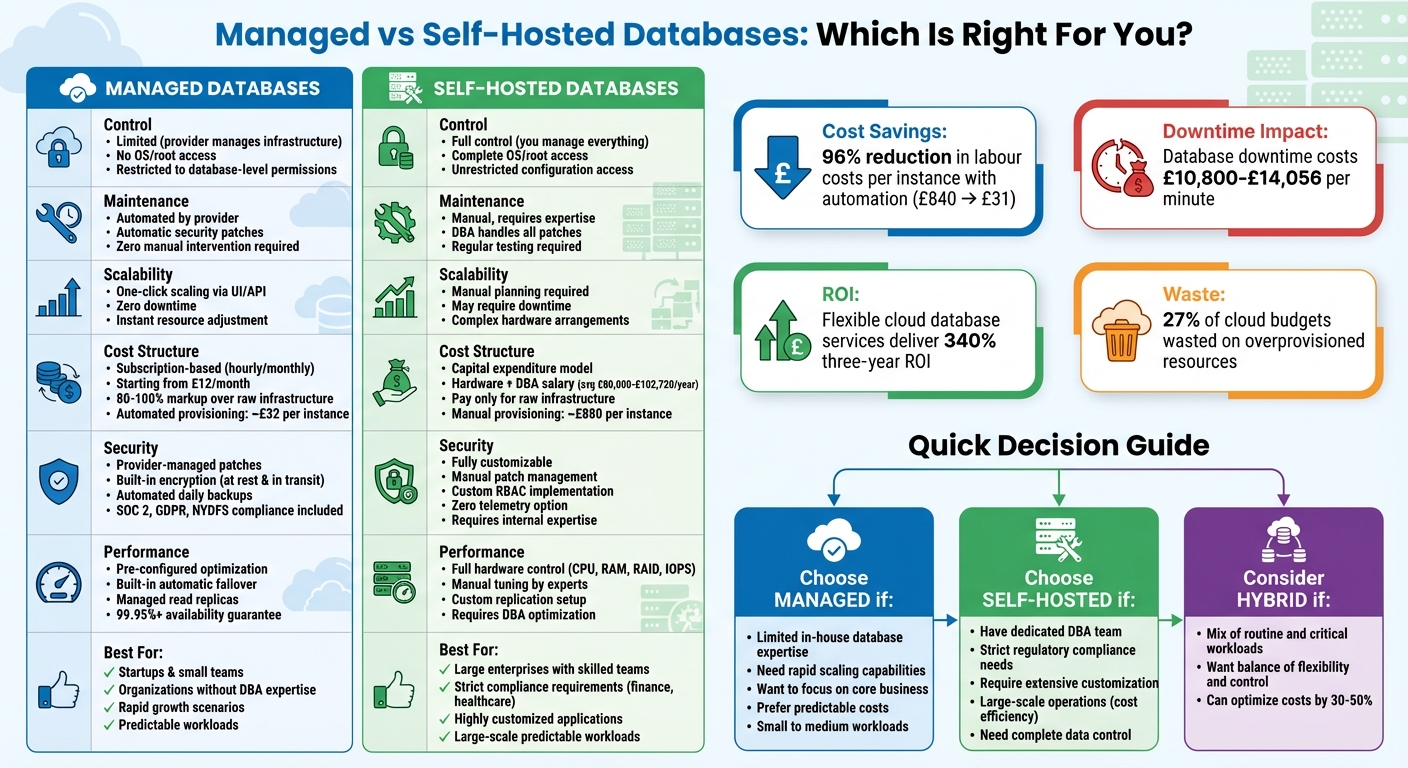 {Managed vs Self-Hosted Databases: Complete Comparison Guide}
:::
{Managed vs Self-Hosted Databases: Complete Comparison Guide}
:::
Benefits of Managed Databases
Less Administrative Work
Managed databases take care of the time-consuming tasks like hardware maintenance, operating system updates, and database patching. This allows IT teams to focus on innovation instead of routine upkeep. Features like daily backups and point-in-time recovery mean there’s no need for manual scripting or stressful recovery drills. Automated security updates, applied during maintenance windows, also minimise the chances of human error. For UK startups and SMEs with limited resources, this means engineers can dedicate more time to developing products rather than managing infrastructure[9]. By reducing these manual responsibilities, businesses can scale more efficiently.
Easy Scaling Options
Scaling with a managed database is quick and straightforward - what used to take days can now be done in minutes. Providers handle compute power and infrastructure adjustments, often with just a simple API call or a click in the user interface. This eliminates the need for complex hardware arrangements typical of self-hosted systems[3].
Anson Hwang, Technical Cofounder at Chatsheet AI, highlights this ease of use:
With DigitalOcean's Managed Databases, scaling as we grow has been seamless. We can move stuff around between databases without a ton of work. [1]
For businesses facing seasonal fluctuations, serverless managed databases automatically adjust capacity to match demand, ensuring costs align with actual usage[10]. Research shows that flexible cloud database services can deliver an impressive 340% three-year ROI[3].
Included Monitoring and Security
Managed databases don’t just simplify scaling; they also come with built-in monitoring and security, reducing operational overhead. Integrated tools for monitoring, logging, and performance insights eliminate the need for additional setups or custom integrations[8]. For instance, Google Cloud SQL offers a global availability guarantee of over 99.95%[8].
Security is another area where managed databases shine. Features like encryption (both at rest and in transit), firewall management, and compliance with industry standards are included as default. This makes it easier for UK businesses to meet regulatory requirements, especially when dealing with sensitive data[2][8]. Additionally, autonomous database services, powered by machine learning, can handle routine security tasks and cut operational costs by up to 90%[2].
Need help optimizing your cloud costs?
Get expert advice on how to reduce your cloud expenses without sacrificing performance.
Cloud SQL vs Self Managed RDBMS
Drawbacks of Managed Databases
While managed databases offer convenience, they come with a set of challenges that can’t be ignored.
Limited Control and Customisation
One of the main drawbacks is the lack of full control. Managed databases often restrict access to the underlying operating system and hardware, which limits the ability for experienced administrators to fine-tune performance [2]. Without superuser privileges or root access, implementing custom operating system optimisations is off the table. This can pose a problem if your application relies on specific extensions or tools that aren’t approved by the provider, as many managed database providers enforce strict limitations on supported plugins [7].
Another issue is the provider-controlled update schedule. Automated patching and updates happen when the provider deems it necessary, not necessarily when it’s convenient for your operations. This can lead to unexpected pauses or disruptions, especially if updates coincide with critical production workloads [2].
Beyond these control limitations, there’s also the challenge of being tied to a specific vendor.
Vendor Lock-In Risks
Dependence on a single vendor can make switching to another provider a costly and risky endeavour [12].
Vendor lock-in is really about switching costs which make it prohibitively difficult or risky to move away from a vendor, rather than being explicitly blocked from doing so.- AWS Whitepaper [12]
For example, while uploading data to a managed database is typically free, extracting large datasets can result in hefty charges. For businesses managing terabytes of data, these fees can act as a significant deterrent to migration [13]. Doug Ortiz from EnterpriseDB highlights that many organisations moving away from legacy providers cite frustrations over rising costs, restrictive contracts, and the feeling of losing control over their own data [7].
Higher Costs for Complex Requirements
Managed databases can also be expensive, especially for organisations with complex or large-scale workloads. Pricing isn’t limited to a straightforward monthly fee. Costs can quickly escalate depending on factors like the instance type, storage options (e.g., General Purpose vs. Provisioned IOPS), data transfer fees, backup schedules, and deployment configurations like Multi-AZ setups [11] [13].
Unpredictable expenses often stem from unoptimised workloads. Without detailed visibility into system performance, engineering teams may resort to increasing instance sizes to address performance issues. As database experts at Ottertune describe, this approach is akin to throwing money at the problem
[13]. Unfortunately, simply upgrading to a larger instance rarely results in proportional performance improvements, and poorly optimised queries can trigger automated scaling, leading to unexpected and sometimes steep costs [13].
Even though automated backups are often included, many organisations still choose to maintain additional backups outside their primary provider. This adds extra storage costs, transfer fees, and requires engineering resources. A case in point is Basecamp, which began migrating away from managed cloud solutions in 2023–2024, citing cost as the main reason. Their experience underscores how managed solutions can become prohibitively expensive for certain workloads [13].
Benefits of Self-Hosted Databases
Self-hosting databases provides organisations with unparalleled control and cost savings, making it an attractive option for those ready to invest in infrastructure and expertise. While managed services simplify operations, they often come with limitations and higher costs that self-hosted solutions can bypass.
Complete Administrative Control
With self-hosted databases, you get full OS access and root-level privileges, allowing for extensive customisation. This level of control means database administrators can fine-tune everything - from file system operations and background processes to memory usage, query planning, and connection handling. Unlike managed services, which often restrict configuration options, self-hosted setups offer unrestricted access to configuration files, enabling precise adjustments for optimal performance.
You also gain the freedom to install third-party or custom extensions and schedule maintenance on your terms. Whether it’s applying patches, testing updates in a staging environment, or deferring changes to avoid disruptions, the timing is entirely up to you. For organisations requiring detailed audit trails, self-hosting allows for custom trigger implementations, adding another layer of flexibility.
Lower Costs for Large Workloads
For organisations with high-scale, predictable workloads, self-hosting often proves far more cost-effective. Managed services typically include hefty markups on infrastructure, driving up expenses. For instance, running a high-availability PostgreSQL setup on a managed service can cost 111% more than deploying the same configuration on Kubernetes with open-source tools [15].
Self-hosting also enables scaling that aligns directly with usage, avoiding the rigid pricing tiers imposed by many managed services. Automating database operations through GitOps workflows on Kubernetes can further slash operational costs. For example, labour costs per instance can drop from £840 to just £31 - a 96% reduction in manual effort [15].
Managed database services often appear to be the fastest path forward... Over time, the trade-offs surface. Managed services can obscure the true cost of scaling, complicate forecasting, and limit the flexibility of data movement.- David Quilty, Percona [15]
Custom Security and Compliance
Self-hosting offers unmatched control over security and compliance, making it ideal for industries with strict regulatory requirements. You can implement host-based firewalls, tailored RBAC (Role-Based Access Control), and other bespoke security measures to meet specific needs. This is especially critical in sectors like finance, where regulations often prohibit storing sensitive data with third-party providers [5][16].
Additionally, self-hosted environments can operate in complete isolation, with zero telemetry, ensuring no data is sent back to vendors [17]. Custom backup retention policies are another advantage, allowing organisations to go beyond the typical 14-day limits set by managed services. This flexibility helps meet unique business continuity or legal requirements [14].
These advantages highlight why self-hosted databases remain a compelling choice for organisations prioritising control, cost efficiency, and customisation.
Drawbacks of Self-Hosted Databases
Self-hosting databases gives you control and flexibility, but it also comes with hefty operational challenges.
High Management Requirements and Expertise Demands
Managing a self-hosted database means taking responsibility for everything - hardware, operating systems, network security, and more. This requires not only specialised skills but also a significant time commitment [14]. Advanced systems like PostgreSQL or MySQL often need a dedicated Database Administrator (DBA) to oversee tasks like installation, configuration, authentication, and proxy services [7, 25]. To put it into perspective, the average annual salary for a DBA in the U.S. is around £80,000 [18].
DBAs are also responsible for critical tasks such as scheduling and testing backups, fine-tuning performance (including schema design, query optimisation, and indexing), patching software, managing major version upgrades, and ensuring services recover automatically after restarts [19, 11]. The stakes are high - database downtime costs businesses an average of £10,800 per minute [18].
Maintaining a self-managed system may allow for control, but that control can present drawbacks such as increased costs over time, along with the need to devote time and staff to such tasks as managing schema design, patches, security, and access rather than to innovation and product design.- Oracle [2]
This highlights a key issue: time and resources that could be spent on innovation are instead tied up in maintenance [2, 11]. Adding to the challenge, finding and retaining skilled DBAs isn't easy. High turnover can create knowledge gaps, slowing down projects [18]. For example, manual database provisioning costs around £880 in labour per instance, compared to just £32 for automated workflows [15]. Moreover, without built-in dashboards, teams must integrate tools like Prometheus or Grafana themselves to monitor performance effectively [19, 11]. While self-hosting provides unmatched control, these complexities explain why many organisations in the UK are turning to managed database solutions.
And that's not the end of the story. Scaling a self-hosted database is another significant hurdle.
Scaling Difficulties
Scaling self-hosted databases is far from straightforward. It’s a manual process that often involves downtime. For example, adding more CPU or RAM to a virtual machine typically requires taking the instance offline [3]. Unlike managed services that offer easy, one-click scaling, self-hosted setups demand detailed planning for infrastructure, storage upgrades, and manual tasks like sharding and replication [6, 1].
Budget approvals and the time needed to procure new hardware can also slow down growth [25, 9]. On top of that, manual scaling increases the risk of misconfigurations, which can hurt performance or even compromise security [14]. As Doug Ortiz from EnterpriseDB puts it:
Scaling a database requires work, time, and money. While you may avoid paying Oracle for the opportunity to grow, you will still need to spend.[4]
These challenges stand in sharp contrast to managed databases, where scaling is often automated and hassle-free.
| Management Area | Self-Hosted Requirement | Managed Alternative |
|---|---|---|
| Patching & Updates | Manual (handled by DBA) | Automated by provider |
| Backups | Manual setup and regular testing | Automated snapshots included |
| Scaling | Requires detailed planning | Often one-click scaling |
| Monitoring | Requires manual tool integration | Built-in dashboards provided |
The high level of expertise, operational complexity, and hidden labour costs make self-hosting a tough choice for organisations that lack dedicated database teams.
Side-by-Side Comparison
This section breaks down the differences in cost, performance, and security for UK businesses considering managed versus self-hosted databases.
Cost and Total Ownership Expenses
Costs can vary greatly depending on workload and the technical skills available. Managed databases use a subscription-based model, billed either hourly or by the minute. Entry-level clusters start at around £12 per month [16]. This pricing includes infrastructure, automated maintenance, and support, but typically comes with a markup of 80–100% compared to the underlying infrastructure costs [15].
Self-hosted databases, on the other hand, require upfront investment in hardware or virtual machines alongside the cost of skilled labour [3, 23]. While open-source database software is free, the overall cost is heavily influenced by the need for experienced database administrators and site reliability engineers. As Dewan Ahmed from Aiven points out:
The cost of technical talent is the biggest chunk of the operational costs [3].
For larger setups, the cost gap becomes even more pronounced. High-availability configurations tend to magnify these differences. Additionally, many organisations struggle with overprovisioning or idle resources, wasting an estimated 27% of their cloud budgets - a challenge more common with managed databases due to fixed pricing tiers [15].
| Cost Factor | Managed Database | Self-Hosted Database |
|---|---|---|
| Pricing Model | Subscription (hourly/monthly); bundled services | Capital expenditure plus ongoing maintenance |
| Infrastructure Markup | 80–100% above raw IaaS costs [15] | Pay only for raw infrastructure [15] |
| Labour Costs | Minimal (automated maintenance) | High (specialised technical talent required) |
| Provisioning Cost | ~£32 per instance (automated) [15] | ~£880 per instance (manual setup) [15] |
| Scaling Costs | Fixed tiers; may pay for unused capacity [15] | Scales more granularly with actual usage [15] |
Next, we explore how each option tackles performance and scalability challenges.
Performance and Scaling
Managed databases simplify scaling by offering one-click
solutions via an interface or API, often with no downtime [1, 3]. Providers also optimise performance with pre-configured defaults, removing the need for manual tuning [3, 19]. Anson Hwang, Technical Cofounder at Chatsheet AI, shares:
With DigitalOcean's Managed Databases, scaling as we grow has been seamless. We can move stuff around between databases without a ton of work [1].
Self-hosted databases, meanwhile, provide full control over the operating system and hardware, allowing for precise tuning of CPU models, RAID configurations, and disk IOPS. This level of control is ideal for specialised workloads [14]. However, scaling in self-hosted setups is often manual and can require downtime to increase computing power [3].
| Performance Factor | Managed Database | Self-Hosted Database |
|---|---|---|
| Scaling Method | Instant via API/UI; zero-downtime [1, 3] | Manual; may require downtime [3] |
| Hardware Control | Limited to predefined instance tiers [14] | Full control over CPU, RAM, RAID, and IOPS [14] |
| Optimisation | Automated defaults by provider [14] | Manual tuning by experts [3] |
| High Availability | Built-in automatic failover [1] | Must be manually architected [1] |
| Read-Heavy Workloads | Managed read replicas available [1, 19] | Custom replication setup required |
Lastly, let’s delve into the security and control aspects of each approach.
Security and Control Levels
The security responsibilities differ significantly between managed and self-hosted databases. Managed services handle security patches, system updates, and end-to-end encryption automatically. They also include features like daily backups with point-in-time recovery and compliance with standards such as SOC 2, GDPR, and NYDFS [14].
Self-hosted databases, by contrast, offer full OS and root access, allowing for complete customisation [14]. However, this flexibility means organisations must take full responsibility for monitoring threats and applying patches, which can increase vulnerability if not managed effectively. In fact, 37% of organisations increased their cybersecurity budgets in 2023 to invest in advanced security tools [16].
Managed environments often limit administrative permissions and restrict extensions to an approved list [14]. Self-hosted setups, on the other hand, support tailored security measures to meet specific industry requirements, though this demands significant internal expertise.
| Security Factor | Managed Database | Self-Hosted Database |
|---|---|---|
| OS/Root Access | Restricted to database level [14] | Full access to host and OS [14] |
| Security Patches | Automated by provider [14] | Manual; internal monitoring required [14] |
| Backups | Automated daily with point-in-time recovery [14] | Manual scripts and storage management [14] |
| Extensions | Limited to approved list [14] | Any compatible extension or plugin [14] |
| Compliance | Built-in (SOC 2, GDPR, NYDFS) [2] | Fully customisable, requires expertise |
| Vendor Lock-In | High risk; proprietary tools may hinder migration | Low; complete control over architecture |
Choosing the Right Option
The choice between managed and self-hosted databases hinges on your organisation's resources, budget, and workload. Each option has its strengths, as outlined earlier, and understanding these differences is key to making the right decision for your needs.
When Managed Databases Work Best
Managed databases are a great fit for organisations without in-house database expertise. For example, startups and small teams can sidestep the hefty cost of hiring a Database Administrator - averaging around £102,720 annually [18] - by opting for managed clusters, which start at approximately £12 per month [1].
For businesses experiencing rapid growth, managed services shine with their one-click
scaling capabilities. These services handle unpredictable workloads seamlessly, eliminating the need for manual hardware provisioning. Experts agree that managed databases simplify scaling and reduce operational complexity.
Another key advantage is the ability to focus on core business goals rather than the nitty-gritty of database maintenance. As Dewan Ahmed, Senior Developer Advocate at Aiven, puts it:
Many businesses find database management neither a core strength nor a competitive advantage. [3]
While managed databases prioritise ease of use, self-hosted solutions cater to organisations requiring extensive customisation and control.
When Self-Hosted Databases Work Best
Industries like finance and healthcare often choose self-hosted databases due to stringent regulatory requirements and the need for detailed audit trails [6] [18]. Self-hosting provides full OS-level access, enabling tailored security configurations to meet specific compliance standards [14].
For large enterprises with skilled database teams, self-hosting can result in significant cost savings. Managed services typically include an 80–100% markup over raw infrastructure costs - a premium that in-house expertise can help avoid [15]. Additionally, highly customised applications benefit from self-hosting, offering the flexibility to fine-tune RAID setups, disk IOPS, CPU models, memory allocation, and query planning [14].
How Hokstad Consulting Can Help
Hokstad Consulting specialises in navigating the trade-offs between cost and control to optimise your database strategy. Their Total Cost of Ownership (TCO) analyses weigh managed subscription fees against expenses like hardware, software licences, and DBA salaries, helping businesses avoid the staggering £14,056 per minute cost of database downtime [18].
They also design hybrid solutions, combining managed services for routine workloads with self-hosted setups for critical or highly customised tasks [1] [6]. Their cloud cost engineering services can cut expenses by 30–50%, addressing waste from overprovisioned resources - a problem that consumes an estimated 27% of cloud budgets [15]. By integrating database management with automated processes aligned to ITIL best practices, their DevOps strategies further boost operational efficiency [18].
Whether you're considering a move to managed services or seeking to optimise a self-hosted environment, Hokstad Consulting offers performance audits and resource assessments to identify the most cost-effective approach. Visit hokstadconsulting.com to explore tailored solutions for your database needs.
Conclusion
The analysis above highlights a crucial truth: there’s no one-size-fits-all database solution for every organisation. Managed databases stand out for their ability to reduce administrative tasks, scale effortlessly, and offer predictable subscription pricing. These qualities make them particularly appealing for startups and teams lacking dedicated database expertise. However, they come with limitations, such as reduced OS-level control, potential vendor lock-in, and rising costs as requirements become more complex.
On the other hand, self-hosted databases give organisations full control, allowing for extensive customisation and potentially lower costs for large-scale operations. They’re often the best fit for businesses with strict compliance needs or specialised applications. That said, they demand significant in-house expertise, ongoing security management, and a substantial time investment for maintenance.
Given that database downtime can cost thousands per minute [18], the stakes are high. As the global data market is expected to hit £226 billion by 2030 [1], your choice of database infrastructure plays a direct role in ensuring uptime, safeguarding data, and empowering your team to focus on innovation rather than firefighting.
Many organisations are finding success by adopting hybrid solutions. These combine the strengths of managed databases for everyday workloads with self-hosted systems for mission-critical applications. This approach strikes a balance between flexibility and control, helping to optimise costs while meeting complex demands.
To make the best decision, conduct a thorough TCO analysis, evaluate your team’s technical capabilities, and determine whether you need OS-level control. Hokstad Consulting specialises in tailored database strategies and cloud cost engineering services, which can help cut expenses by 30–50%. Learn more at hokstadconsulting.com.
FAQs
How do I estimate total cost of ownership for each option?
To get a clear picture of the total cost of ownership (TCO), you need to factor in both direct and indirect expenses throughout the system's lifecycle. Here's what to consider:
- Upfront costs: These include initial expenses like licensing fees, hardware purchases, or cloud setup charges.
- Ongoing expenses: Think about recurring costs such as resource usage, storage, backups, and the need for scaling as your system grows.
- Operational costs: Don't overlook expenses tied to personnel, system management, and routine maintenance.
- Hidden costs: These can include compliance requirements, the risks of vendor lock-in, or potential impacts from system failures.
By taking all these into account, you can make a well-rounded comparison of long-term expenses.
How can I reduce vendor lock-in with a managed database?
To reduce the risk of vendor lock-in with a managed database, look for services that prioritise open standards and widely-used data formats. Steer clear of solutions that rely heavily on proprietary APIs, as these can make switching providers much harder down the line. Instead, opt for providers that offer clear exit strategies, such as standardised data export options and thorough migration guides.
Another way to maintain flexibility is by adopting multi-cloud or hybrid cloud strategies. These approaches help spread your operations across multiple platforms, ensuring your organisation retains greater control over its data and infrastructure while avoiding over-reliance on a single vendor.
When does a hybrid database approach make sense?
A hybrid database approach works well for organisations that need to blend on-premises and cloud environments. This setup is particularly useful for addressing concerns like data governance, security, or performance. It allows for a gradual transition to the cloud, helps maintain compliance with regulations, and can be more cost-effective.
This approach is also a good fit for situations where resilience is critical, multi-region deployments are needed, or legacy systems need to be integrated with modern solutions. It provides the flexibility and scalability required to handle complex and large-scale environments effectively.