
Immutable audit logs are a game-changer for DevOps. They ensure logs cannot be altered or deleted, even by administrators, solving critical issues like tampering, compliance challenges, and inefficiencies. Here’s why they matter:
- Security: Logs are tamper-proof, using cryptographic methods to detect any changes.
- Compliance: They meet strict regulations (e.g., GDPR, HIPAA) by providing unalterable records.
- Efficiency: They simplify audits and incident response by offering a trustworthy, chronological timeline of events.
Unlike traditional logs, which are vulnerable to manipulation, immutable logs offer a permanent, secure record of system activities. This makes them essential for maintaining data integrity, speeding up audits, and reducing risks from insider threats or cyberattacks.
Quick Overview:
- Key Features: Write Once, Read Many (WORM) storage, cryptographic hashing, hash-based chaining.
- Benefits: Stronger security, faster audits, improved recovery from incidents.
- Implementation: Use tools like OpenTelemetry, Amazon S3 (with Object Lock), and cryptographic methods to secure logs.
In short, immutable audit logs provide the reliability and security modern DevOps teams need to operate effectively while meeting regulatory demands.
Problems with Traditional Audit Logs in DevOps
Traditional audit logs pose serious challenges in DevOps environments because they're mutable - meaning anyone with elevated access can modify, delete, or overwrite them [7][10]. Jason Berwanger, Former EVP of Finance/Data, puts it succinctly:
Think of a regular log as a document written in pencil - anyone with access can erase or change the details
[7].
Security Risks and Tampering
The mutability of traditional logs creates a significant vulnerability, opening the door for both external attackers and malicious insiders. If someone gains administrative access, they can manipulate logs to cover up unauthorised actions. Ransomware attacks often target logs and backups first, encrypting or deleting them to erase evidence and hinder recovery efforts [2][8][10]. A recent survey revealed that 75% of security professionals have observed an increase in cyberattacks over the past year, and 69% of decision-makers now view immutable data storage as a cornerstone
of their cybersecurity strategy [8].
Another issue is configuration drift, where incremental manual updates gradually introduce inconsistencies, creating security gaps that traditional logs fail to track effectively [9][11]. Additionally, logs are often dispersed across various tools - Okta, cloud APIs, CI/CD pipelines - making it difficult to piece together a coherent timeline during a security incident [12][13]. Compounding the issue, many DevOps tools have insufficient retention periods, meaning critical historical data may be unavailable when investigations are initiated [13].
These vulnerabilities not only undermine data integrity but also complicate compliance with regulatory standards.
Compliance and Regulatory Difficulties
Traditional audit logs fall short of meeting the tamper-proofing standards required by regulations such as GDPR, HIPAA, SOX, and PCI DSS [2]. These frameworks demand audit records that are resistant to modification or deletion, but traditional logs lack the cryptographic verification needed to prove their integrity to auditors [13][14]. For instance, the NIST Cybersecurity Framework specifies Detect
and Respond
functions that require tamper-resistant storage - something mutable logs cannot deliver [3].
The problem is worsened by fragmented data sources. DevOps teams often need to manually export and reconcile logs from multiple systems, which is both time-consuming and prone to errors. This manual process also lacks the legal defensibility required for compliance audits [2][13]. For example, HIPAA mandates six years of log retention, while ISO 27001 requires three years [12]. Traditional systems struggle to meet these requirements while ensuring data normalisation across platforms. Collecting evidence for compliance audits can take days or even weeks [2][14].
Workflow Inefficiencies
Beyond security and compliance challenges, traditional logs also hinder operational efficiency. Missing or altered log entries force teams to rely on guesswork, delaying the identification of unauthorised changes by days [13][3]. This issue, often referred to as a delay in accessing accurate log data
, creates a gap between identifying a problem and obtaining the necessary information to fix it [2][6].
As a result, engineers waste valuable time verifying the accuracy of logs instead of resolving incidents, increasing cognitive load and slowing down decision-making [6]. Recognising these inefficiencies, 94% of organisations have either adopted or plan to implement immutable data storage solutions within the next year [8], acknowledging that traditional methods can no longer keep up with the demands of modern DevOps workflows.
What Are Immutable Audit Logs?
::: @figure 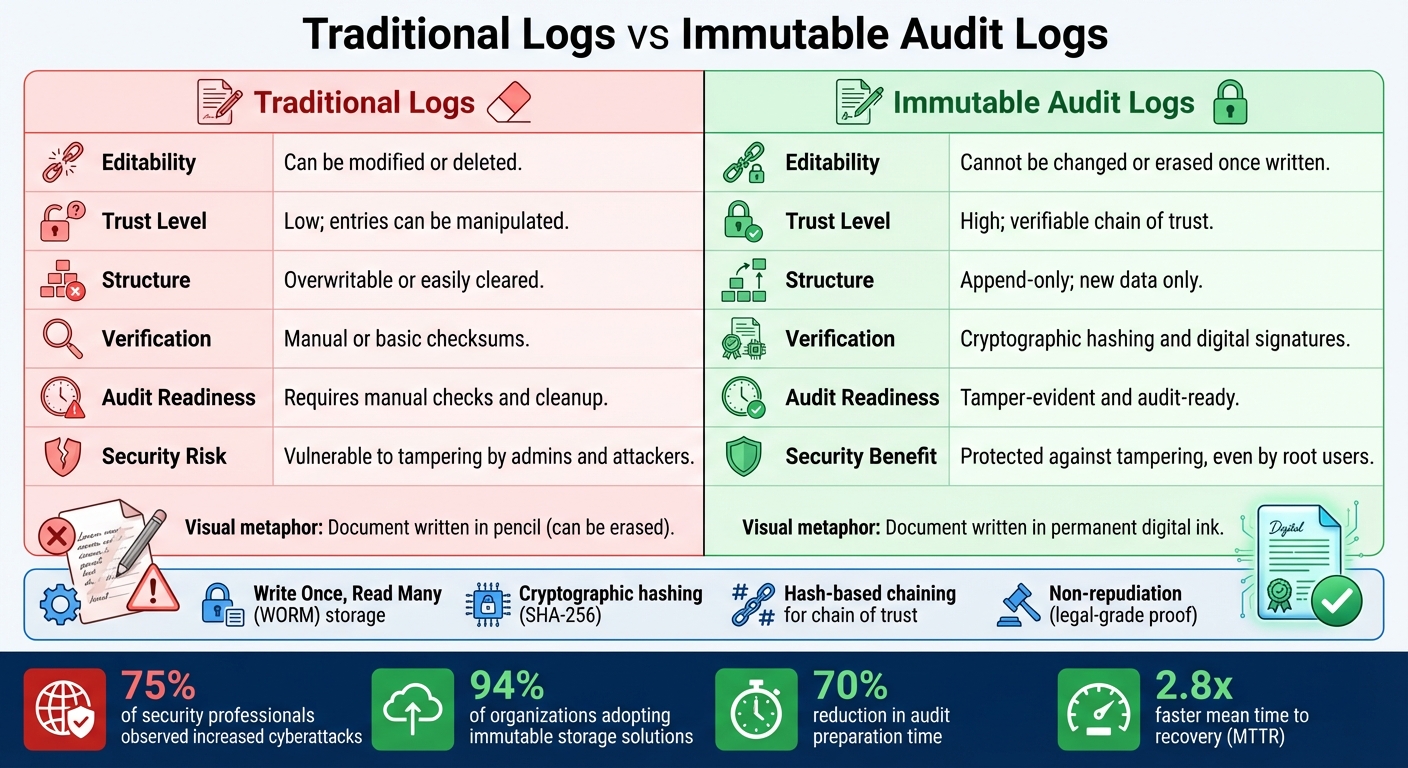 {Traditional vs Immutable Audit Logs: Key Differences for DevOps}
:::
{Traditional vs Immutable Audit Logs: Key Differences for DevOps}
:::
Immutable audit logs are unchangeable records of system activities, designed to remain intact and unaltered - even by system administrators [1]. These logs provide clear answers to critical questions such as who performed an action, what was done, when it occurred, and where it happened.
Jason Berwanger, Former EVP of Finance/Data, describes their importance:
An immutable audit log ensures your company's story can never be altered. It creates a permanent, cryptographically secured record of every event, written in digital ink that can't be erased.
This permanence not only strengthens the security of audit trails but also supports compliance efforts and improves workflow efficiency.
Immutable logs operate with an append-only structure, meaning historical data is preserved without any risk of overwriting [1]. This design represents a shift towards creating reliable, tamper-proof records. As hoop.dev puts it, This is not logging for convenience. This is logging for proof
[5].
Key Features of Immutable Audit Logs
To address the vulnerabilities of traditional logs, immutable logs incorporate advanced features that make them tamper-proof. These features include:
- Write Once, Read Many (WORM) storage: Ensures data cannot be modified after it’s written, either physically or logically [1].
- Cryptographic hashing: Generates a unique digital fingerprint (commonly using SHA-256 or stronger algorithms) for each log entry. Any alteration to the data invalidates the hash, immediately exposing tampering [1].
- Hash-based chaining: Links each log entry to the hash of the previous one, creating a continuous chain of trust. This structure allows for quick and reliable verification [1].
Additionally, synchronised timestamps ensure logs maintain a trustworthy chronological order, which is especially important for forensic investigations [1]. These features collectively provide non-repudiation - legal-grade proof that actions occurred exactly as recorded. This capability makes immutable logs invaluable for compliance and simplifies audits in DevOps environments [1].
How Immutable Logs Differ from Traditional Logs
The differences between traditional and immutable logs are striking. Traditional logs are vulnerable to tampering, as they can be overwritten or deleted by attackers or even administrators. In contrast, immutable logs preserve data integrity, even in the event of a system breach [1]. Traditional logs often require manual checks and cleanup during audits, whereas immutable logs are inherently tamper-evident and ready for audits without additional effort [2]. This reduces the burden on DevOps teams, allowing them to focus on resolving issues rather than questioning the reliability of log data [6].
| Feature | Traditional Logs | Immutable Audit Logs |
|---|---|---|
| Editability | Can be modified or deleted [1] | Cannot be changed or erased once written [1] |
| Trust Level | Low; entries can be manipulated [5] | High; verifiable chain of trust [5] |
| Structure | Overwritable or easily cleared | Append-only; new data only [1] |
| Verification | Manual or basic checksums | Cryptographic hashing and digital signatures [1] |
| Audit Readiness | Requires manual checks and cleanup [2] | Tamper-evident and audit-ready [2] |
How Immutable Audit Logs Solve DevOps Problems
Immutable audit logs tackle the weaknesses of traditional logging systems head-on. By ensuring records are tamper-proof and cryptographically secure, they address critical issues like security vulnerabilities, compliance hurdles, and operational inefficiencies that DevOps teams often face.
Better Security Against Tampering
Immutable logs provide a strong defence against tampering by leveraging advanced cryptographic methods. Using SHA-256 hashing and digital signatures, they create a chain of trust
where each log entry is linked to the previous one. If someone tries to alter an entry, the chain breaks, immediately exposing the tampering attempt [5][15]. This makes it nearly impossible for attackers - even those with administrator access - to rewrite history and cover their tracks [5].
The append-only structure ensures that records can only be added, never modified or deleted - not even by system administrators [1][15]. This approach also offers non-repudiation, as digital signatures provide irrefutable proof of authenticity. When a signature matches, it confirms the entry is genuine and its origin cannot be denied.
By centralising logs from various sources like CI/CD pipelines, identity providers (e.g., Okta or Entra ID), and cloud APIs, immutable logs create a single, chronological ledger. This eliminates potential blind spots where tampering could go unnoticed, providing a reliable, comprehensive record crucial for forensic investigations and mitigating insider threats [13][2][3].
Simpler Compliance and Audit Processes
Immutable logs don’t just secure data - they simplify regulatory compliance. They meet the stringent standards of frameworks like GDPR, HIPAA, SOX, PCI DSS, SOC 2, and the NIST Cybersecurity Framework, all of which require tamper-proof records [2][14][3]. Instead of piecing together fragmented exports from multiple systems, investigators can query a unified, trusted ledger [13]. This shift can cut audit times from days to mere hours [6].
The cryptographic integrity of these logs also satisfies non-repudiation requirements, enabling auditors to quickly verify the entire chain of custody [5][14]. Automated evidence collection replaces manual processes, reducing errors and the stress of last-minute scrambles for proof during audits [2][14]. As hoop.dev aptly puts it:
In regulated industries, the truth isn't what someone remembers; it's what the audit log can prove [2].
Additionally, modern tools enhance compliance by offering indexed, searchable logs. This allows teams to respond to auditor requests in minutes rather than weeks [14][16]. By automating compliance tasks, these logs turn audits from a reactive headache into a seamless part of DevOps workflows [13][8].
Better Workflow Efficiency
Immutable logs also improve operational efficiency, especially during incidents. Engineers no longer have to second-guess data, as these logs provide real-time, trusted information to resolve issues quickly [6][13].
Research highlights that using immutable backup and recovery tools can reduce incident recovery times to under an hour [8]. When integrated with CI/CD pipelines, these logs enable real-time alerts for policy violations and automate evidence collection, turning compliance into a continuous, hands-off process [13][8]. Their detailed, chronological records allow incident response teams to reconstruct events and pinpoint root causes immediately, significantly speeding up resolution times [18][6]. These efficiency gains not only streamline workflows but also bolster security and compliance efforts across the board.
Benefits of Immutable Audit Logs for DevOps Teams
Immutable audit logs bring a host of advantages that go far beyond just security improvements. They reshape the way DevOps teams function, simplifying processes and reinforcing infrastructure reliability.
Better Security
Tamper-proof logs act as a robust shield against cyber threats. By leveraging cryptographic hashing, each log entry is locked in place, creating a permanent record that even top-level administrators cannot alter. This provides legal-grade evidence and ensures non-repudiation [5][4]. The WORM (Write Once, Read Many) model guarantees that once a log is written, it cannot be changed or erased [2][1]. This feature directly counteracts sophisticated attacks where hackers attempt to erase or manipulate audit trails to hide their activities.
Faster Audit Preparation
Immutable logs can cut audit preparation times by as much as 70% [21]. Instead of piecing together data from various sources, teams can rely on a single, trustworthy ledger [13]. As hoop.dev points out:
Regulatory audits reduce audit times from days to hours because the source is trusted by design.
[6]
These logs meet the strict requirements of regulations like GDPR, HIPAA, SOX, and PCI DSS. Their cryptographic integrity simplifies the verification of the chain of custody, making compliance audits quicker and more efficient [2]. For example, in October 2020, British Airways faced a €22 million GDPR fine from the ICO - the largest in the UK at the time - highlighting the importance of strong auditability [21].
Better Disaster Recovery
When disaster strikes, immutable logs significantly improve recovery outcomes. Organisations using immutable logs report a mean time to recovery (MTTR) that is 2.8 times faster than those relying on traditional methods [19]. This speed is critical, especially considering that 60% of businesses fail within 3 to 5 years following major data loss [19].
Immutable storage also protects backups from ransomware attacks, which often target backups first to encrypt or corrupt them. With immutability, once a backup is created, it cannot be altered or deleted - even by attackers with elevated privileges [19]. This approach reduces the risk of catastrophic data loss by a factor of 200 [19]. By ensuring backups remain intact, businesses can recover quickly and maintain trust in their audit trails.
Implementing Immutable Audit Logs in DevOps Pipelines
This section dives into the practical steps to deploy immutable logs in your DevOps pipeline. Modern cloud platforms and open-source tools make this process manageable, even for teams without a deep understanding of cryptography.
Steps to Enable Immutable Logs
Start by setting up a three-stage architecture: collection, processing, and storage [17]. Instrument your applications with an SDK like OpenTelemetry to generate structured log entries in JSON or Protobuf formats [15][17]. Each log should detail the actor, action, and resource involved.
Next, route these logs through a processing layer, such as an OpenTelemetry Collector. This step ensures cryptographic integrity by linking each log entry to the previous one using a hash, forming a tamper-evident chain [15][5].
For storage, enable WORM (Write Once, Read Many) capabilities. If you're using Amazon S3, activate Object Lock in Compliance Mode. This prevents even root users from deleting logs during the retention period, which is typically 7 years to meet regulatory requirements [17]. Synchronise all system clocks to a reliable time source to ensure precise timestamps, and enforce strict IAM policies to control access to the log repository [2][23].
Nawaz Dhandala of OneUptime highlights the importance of this approach:
Audit logs are only useful if you can prove they haven't been tampered with. In regulated industries, auditors want evidence that log entries were never modified or deleted after creation.
To complete the setup, implement automated verification scripts. These scripts periodically download logs and recheck their hashes to confirm they haven't been corrupted during transit or storage [17][2].
Once the basic framework is in place, the next step is choosing the right tools to streamline and secure your immutable log setup.
Tools and Technologies for Immutable Logs
A variety of tools can support immutable logging across different environments. The OpenTelemetry Collector acts as a central hub, receiving logs via OTLP and routing them to multiple destinations - such as S3 for compliance needs and Elasticsearch for daily operations [17]. This dual-exporting method balances regulatory requirements with operational efficiency.
For long-term archival, Amazon S3 with Object Lock is a cost-efficient choice. Alternatives like Azure Immutable Blob Storage and Google Cloud Storage retention policies offer similar features for their respective platforms [17][24]. If you need cryptographically verifiable audit trails for high-frequency transactions, Amazon Quantum Ledger Database (QLDB) is a solid option [15].
For CI/CD pipelines, GitHub Actions can log every commit, merge, and deployment event in an append-only, tamper-proof ledger [22][25]. On Linux systems, the chattr +i command can be used to set log files as immutable, making them unmodifiable even by root users [23].
| Tool/Technology | Immutability Feature | Best Use Case |
|---|---|---|
| Amazon S3 | Object Lock (Compliance Mode) | Long-term, cost-efficient regulatory storage [17][24] |
| OpenTelemetry Collector | Integrity hashing and dual exporting | Standardising logs across multi-cloud environments [17] |
| Amazon QLDB | Cryptographically verifiable logs | High-integrity application state audits [15] |
| GitHub Actions | Append-only workflow logs | Tracking software delivery history [22][25] |
Linux chattr |
+i immutable filesystem flag |
Securing local log files on individual servers [23] |
Once the tools are in place, a checklist can help ensure every security and compliance requirement is met.
Implementation Checklist
Before deploying your system, confirm that the following elements are in place:
- Structured Format: Use JSON or Protobuf schemas for consistent log structure [15].
- SDK Instrumentation: Leverage OpenTelemetry to emit structured attributes [17].
- Source-Level Hashing: Configure SHA-256 hashing at the application layer [17].
- Persistent Queue: Set up the OpenTelemetry Collector with file-based queuing to handle up to 50,000 batches, ensuring resilience during system restarts or network issues [17].
- WORM Protection: Activate Object Lock or its equivalent on storage buckets [17].
- Time Synchronisation: Sync all systems to a reliable time source [2].
- Access Controls: Apply strict IAM policies to limit log repository access [23][2].
- Key Isolation: If using digital signatures, isolate private keys securely to prevent tampering [5].
- MFA Delete: Enable MFA Delete for AWS S3 buckets for added protection [24].
- DevOps Integration: Link log collection to pull request merges, workflow runs, and deployment events [22].
- Automated Visualisation: Use reporting tools to simplify compliance audits for frameworks like SOC 2 or HIPAA [15][14].
For transferring logs to offsite storage, the rsync -av --partial --inplace command is recommended to maintain both integrity and efficiency [23].
Hoop.dev underscores the risks of skipping immutability:
The cost of ignoring immutability is high. Without it, you cannot fully trust your CI/CD outputs. Every build could be a liability.
Conclusion
Immutable audit logs are a game-changer for securing operations by preventing tampering and ensuring compliance. Unlike traditional logs, which can be liabilities due to their vulnerability to manipulation, immutable logs create a tamper-proof chain of custody that even root users cannot alter [3].
Without these logs, organisations risk hefty fines and legal complications [20]. Immutable logs provide non-repudiation - irrefutable evidence of who did what and when - which is crucial for forensic investigations and legal defence [5]. While regulatory compliance is a key driver, the operational benefits of these logs are equally compelling.
Beyond compliance, immutable logs enhance operational efficiency by streamlining incident response and troubleshooting. By consolidating logs from scattered sources, such as CI/CD pipelines, cloud APIs, and identity providers, into a single, queryable ledger, teams can eliminate delays and guesswork [13]. Jeff Darrington, Director of Technical Marketing at Graylog, sums it up perfectly:
Audit logs are the shopping list that helps organisations with compliance readiness
[26]. This operational edge directly ties into stronger security and compliance outcomes, making the case for immutable logging even clearer.
The setup is straightforward: enable WORM (Write Once, Read Many) storage, apply cryptographic hashing to build tamper-evident chains, and automate integrity checks [7]. These steps not only simplify audit preparation but also speed up incident handling and bolster legal defensibility. The result? Tangible improvements in security, compliance, and overall efficiency.
As cyber threats grow more advanced, cryptographically verified logging is no longer optional - it’s becoming the industry standard [5]. DevOps teams that embrace this approach will be better equipped to meet regulatory demands, counter evolving threats, and maintain high levels of operational performance.
FAQs
Do immutable logs increase cloud storage costs?
Immutable logs are designed to be cost-efficient when it comes to cloud storage. These logs are stored in systems that are append-only and tamper-resistant, ensuring data integrity while preventing any modifications. This setup not only enhances security but also optimises storage use, making them an affordable option for maintaining compliance and ensuring reliable audits.
How can you prove an immutable log hasn’t been tampered with?
You can check the integrity of an immutable log by using cryptographic techniques such as hashing and signing each entry. These methods form a tamper-evident chain, meaning any attempt to alter the log becomes detectable, helping to keep the log secure and reliable.
What’s the quickest way to add immutable logging to an existing CI/CD pipeline?
The quickest way to set up immutable logging is by combining append-only storage with cryptographic sealing. Here's how to do it:
- Pinpoint the crucial points in your pipeline where logs need to be captured.
- Apply cryptographic sealing, such as hashing and signing, to guarantee the integrity of the logs.
- Save the logs in append-only or immutable storage. This could involve using WORM (Write Once, Read Many) media or enabling filesystem immutability settings, like the
chattr +icommand on Linux.
This method provides tamper-resistant logs with minimal effort.