
Federated Identity and Single Sign-On (SSO) simplify user access across platforms, but ensuring compliance is critical to avoid security risks and regulatory penalties. Here's what you need to know:
- Federated Identity and SSO Basics: SSO allows users to log in once to access multiple systems. Federated Identity extends this across organisations using protocols like SAML 2.0, OpenID Connect (OIDC), and OAuth 2.0.
- Why Compliance Matters: Non-compliance can lead to data breaches, fines, and operational inefficiencies. Regulations like GDPR, PCI DSS, and HIPAA require robust audit logs, Multi-Factor Authentication (MFA), and secure access management.
- Key Compliance Steps:
- Define trust policies between Identity Providers (IdPs) and Service Providers (SPs).
- Use secure protocols (e.g., TLS 1.3, PKCE) and automate certificate rotation.
- Enforce MFA to protect against credential-based attacks.
- Monitor and audit access events regularly to detect suspicious activity.
Organisations must align their Identity and Access Management (IAM) systems with standards like GDPR and ISO 27001. Following a structured checklist ensures secure, compliant access while reducing risks.
How to Build a Compliance Ready IAM Program #youtubeshorts #shorts
Need help optimizing your cloud costs?
Get expert advice on how to reduce your cloud expenses without sacrificing performance.
IAM Compliance Checklist
Setting up federated identity and Single Sign-On (SSO) requires careful planning to meet security and regulatory standards. Below is a checklist of actionable steps organisations can take to create a strong Identity and Access Management (IAM) framework while avoiding common mistakes that can lead to federation failures.
Define Policies for Federated Identity Trust
Building trust between Identity Providers (IdPs) and Service Providers (SPs) is the backbone of federated identity. Start by choosing the right protocol for your needs. SAML 2.0 is ideal for enterprise web SSO and legacy applications, while OpenID Connect (OIDC) works well for modern web, mobile, and API-driven setups [1][6]. Use OAuth 2.0 primarily for API access delegation rather than authentication.
Establishing trust involves exchanging metadata and certificates between IdPs and SPs. This includes sharing Entity IDs, Assertion Consumer Service (ACS) URLs, and public keys. Avoid common pitfalls such as typos in Entity IDs, expired certificates, and mismatched attribute names, as these are frequent causes of federation issues [4]. Certificates should be rotated yearly, and metadata exchange should be managed carefully to prevent trust breakdowns [2][4].
Formalise federation agreements to document trust parameters, attribute sharing (e.g., email or roles), protocol versions, and security measures like encryption and signature algorithms [7]. Security baselines should include Multi-Factor Authentication (MFA) at the IdP level and TLS 1.3 for securing data in transit [7][3]. Synchronise clocks on IdP and SP servers using Network Time Protocol (NTP) to avoid clock skew
errors, which can lead to rejected assertions due to timing discrepancies [4]. These measures help maintain compliance with regulations governing federated access.
Implement Secure SSO Protocols
Once trust policies are in place, securing SSO protocols is crucial. Service Providers should validate digital signatures using public certificates, verify timestamps to account for clock skew (typically 60–120 seconds), and defend against Assertion Wrapping Attacks
by ensuring the signed section of the XML tree is properly parsed [8]. For OAuth 2.0, implement Proof Key for Code Exchange (PKCE) to protect mobile and public clients [2].
Session security is critical. Set cookies with HttpOnly and Secure flags to prevent cross-site scripting (XSS) and interception over unencrypted connections [4]. Automate certificate rotation by dynamically pulling metadata from the IdP's metadata URL, ensuring new certificates are adopted before expiration [8]. Consider enabling Just-In-Time (JIT) user provisioning during login and using SCIM 2.0 for automated user lifecycle management, including de-provisioning [2][8]. If you support IdP-initiated flows, add extra validation for recipients and timestamps since these flows lack an InResponseTo ID [8]. During testing, use tools designed for SAML tracing to spot metadata or assertion errors before they disrupt production environments [4].
With secure protocols, enforcing MFA adds another layer of protection to federated logins.
Enforce Multi-Factor Authentication (MFA)
MFA is a critical component of federated identity security. By implementing MFA at the IdP level, you can secure all connected Service Providers. Modern MFA methods include biometric logins (e.g., fingerprints or facial recognition), FIDO2 hardware tokens, and magic links sent via email [2][4]. These approaches help mitigate credential-based attacks and support the move towards passwordless authentication, reducing one of the most common attack vectors.
Monitor and Audit Access Events
Continuous monitoring and auditing are essential for detecting unauthorised access attempts and ensuring compliance. Regulations like GDPR, SOX, PCI DSS, and HIPAA require detailed audit logs that track who accessed what data, when, and for what purpose. Set up a regular review schedule that aligns with these compliance requirements while also supporting operational security.
Be alert to high-risk indicators, such as impossible travel
(logins from geographically distant locations within an unrealistic timeframe), MFA bypass attempts, disabled logging, and unusual access patterns from regions where your organisation doesn’t operate. These events often signal potential security breaches.
As Prayag Sangode, Cloud & DevSecOps Enthusiast, puts it:
IAM ensures the right entities (users, systems, or services) have the right level of access to the right resources at the right time - and nothing more[9].
| Audit Activity | Recommended Frequency | GDPR Alignment |
|---|---|---|
| Review last accessed data | Monthly | Data minimisation; least privilege |
| Validate policy documentation | Quarterly | Accountability; Article 30 records |
| Test emergency access procedures | Bi-annually | Integrity & confidentiality |
| Cross-functional policy review | Annually | Data protection by design |
Regular monitoring and audits are vital for maintaining compliance with the regulations that govern federated identity systems.
Regulatory Compliance Mapping for Federated IAM
::: @figure 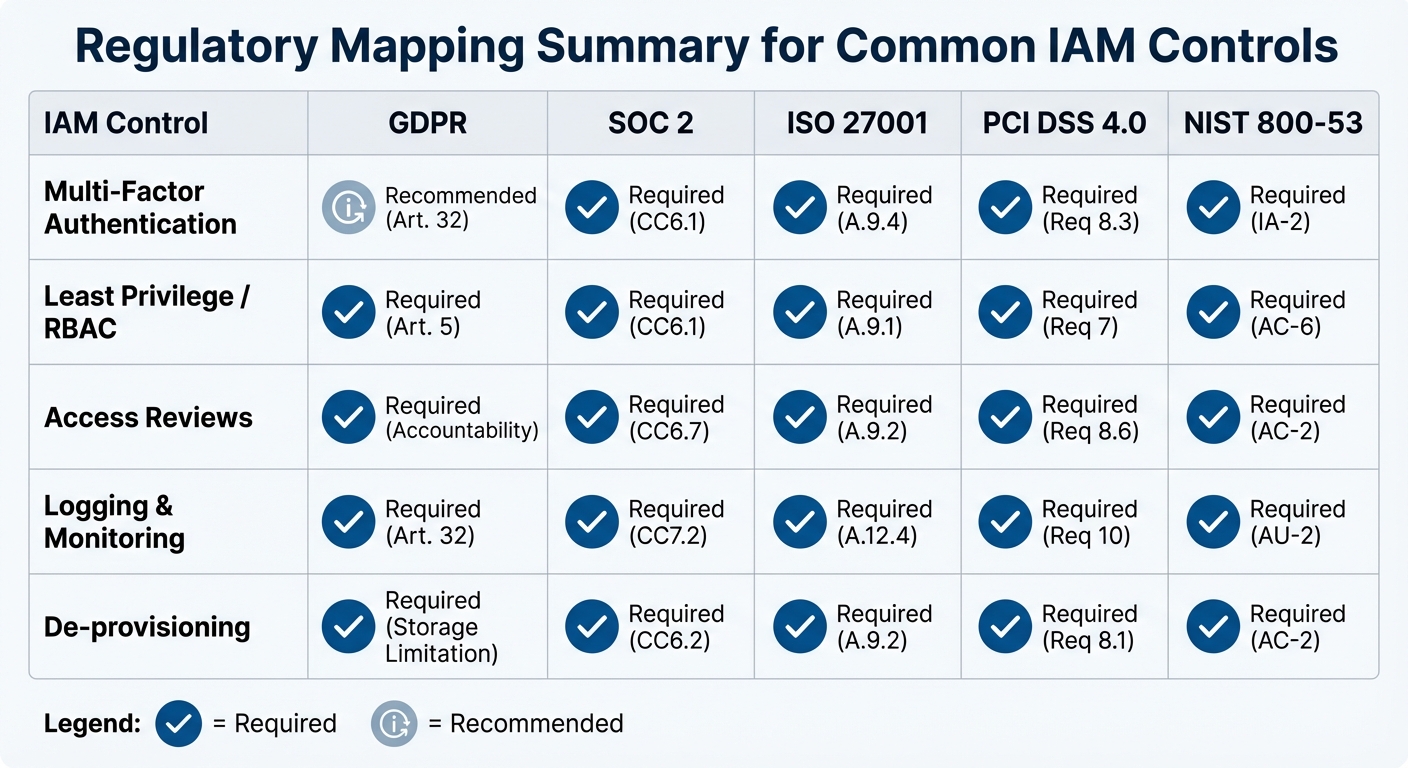 {IAM Compliance Requirements Across Major Regulatory Frameworks}
:::
{IAM Compliance Requirements Across Major Regulatory Frameworks}
:::
Key Regulations and Their IAM Requirements
To maintain compliance, organisations need to align their Identity and Access Management (IAM) systems with the requirements of relevant regulations. Many of these controls overlap across frameworks, making it essential to map them effectively.
NIST SP 800-63C introduces Federation Assurance Levels (FAL), which range from bearer assertions to holder-of-key binding. FAL1 permits bearer assertions, FAL2 requires encrypted assertions, and FAL3 demands holder-of-key binding for maximum security. This framework is particularly critical for government contractors and organisations managing federal data. By mapping these requirements, organisations can better understand how each regulatory framework shapes specific IAM measures [10].
For healthcare organisations, HIPAA enforces strict IAM requirements under 45 C.F.R. § 164.312. These include unique user identification and robust audit controls. Single Sign-On (SSO) systems must protect Protected Health Information (PHI) through centralised controls. Additionally, organisations must secure a Business Associate Agreement (BAA) with cloud providers before migrating healthcare data to federated systems [10][11]. Emergency break-glass
access procedures should also be well-documented and regularly tested to ensure readiness.
Financial institutions face equally rigorous standards. SOX requires tested internal controls and the implementation of Separation of Duties (SoD) to safeguard the integrity of financial reporting. Organisations must also provide audit evidence of user permissions when requested [11]. The PCI DSS 4.0 framework mandates multi-factor authentication (MFA) under Requirement 8.3 and regular access reviews under Requirement 8.6, including vendor access management in federated environments [12]. Similarly, the GLBA enforces least privilege
policies and MFA to protect consumer data [11].
| Regulatory Mapping Summary for Common IAM Controls | GDPR | SOC 2 | ISO 27001 | PCI DSS 4.0 | NIST 800-53 |
|---|---|---|---|---|---|
| Multi-Factor Authentication | Recommended (Art. 32) | Required (CC6.1) | Required (A.9.4) | Required (Req 8.3) | Required (IA-2) |
| Least Privilege / RBAC | Required (Art. 5) | Required (CC6.1) | Required (A.9.1) | Required (Req 7) | Required (AC-6) |
| Access Reviews | Required (Accountability) | Required (CC6.7) | Required (A.9.2) | Required (Req 8.6) | Required (AC-2) |
| Logging & Monitoring | Required (Art. 32) | Required (CC7.2) | Required (A.12.4) | Required (Req 10) | Required (AU-2) |
| De-provisioning | Required (Storage Limitation) | Required (CC6.2) | Required (A.9.2) | Required (Req 8.1) | Required (AC-2) |
In the UK, organisations must also consider GDPR enforcement. Regulators imposed fines exceeding €114 million in the first 20 months of implementation [2]. UK regulators typically expect systems to retain logs for at least 12 months, with accurate UTC timestamps for audit purposes [13]. Systems should also meet appropriate assurance levels, often IAL2/AAL2 or higher, depending on the associated risk [14].
These regulatory requirements provide a clear framework for developing and refining IAM measures, ensuring compliance and enhancing security across sectors.
Best Practices for Federated Identity and SSO
Building on the compliance checklist, these practices strengthen your federated identity and access management (IAM) framework while staying aligned with regulations.
Adopt the Principle of Least Privilege (POLP)
Granting users only the access they absolutely need reduces security risks and simplifies compliance audits. Instead of basing roles on job titles, focus on specific tasks and permissions. For instance, a role like Finance-Admin
could provide access to financial systems, avoiding assumptions tied to titles like Finance Manager
, which might not always reflect actual access requirements [16].
Just-in-Time (JIT) access is another effective measure. It temporarily provides elevated permissions only when necessary, lowering the risks associated with permanent privileged accounts [3][5]. In multi-cloud setups, workload identity federation enables services to exchange native identity tokens for short-term credentials, eliminating the need for long-lived API keys [1].
Pair these methods with continuous refinement of user profiles to create a secure and seamless user experience.
Use Progressive Profiling
Progressive profiling collects user information gradually instead of requiring all details upfront. This strategy can reduce login-related friction by up to 99%, improving both user satisfaction and trust [15]. Start with basic details like an email address and password, postponing additional data collection until it’s genuinely required.
This approach aligns directly with GDPR Article 25, which emphasises Data Protection by Design and Default
[15]. By limiting data collection to what’s necessary, progressive profiling not only improves the user experience but also supports GDPR’s principles of data minimisation.
How Hokstad Consulting Can Support Your IAM Compliance
Setting up federated identity and SSO systems that meet compliance standards requires both technical know-how and a solid understanding of regulations. Hokstad Consulting offers expertise in cloud security, DevOps transformation, and IAM implementations, helping UK organisations tackle these challenges while cutting cloud costs.
Partner with Experts for Custom IAM Solutions
Hokstad Consulting tackles IAM compliance issues across a range of frameworks, including UK GDPR, ISO 27001, and PCI DSS. By combining cloud security audits with compliance-focused IAM configurations, they align both security needs and regulatory requirements. This approach ensures that technical solutions are implemented with compliance in mind, delivering IAM setups tailored to your organisation's needs.
They specialise in implementing secure SSO, multi-factor authentication (MFA), and workload identity federation for platforms like AWS, Azure, and Google Cloud. Their solutions include the seamless integration of SSO and MFA protocols, along with DevOps tools such as AWS Config Rules, Azure Policy, and Cloud Asset Inventory. These tools automate compliance monitoring, reducing manual workload while maintaining comprehensive audit trails.
Hokstad Consulting also brings cost optimisation into the mix. Their expertise in cost engineering allows them to enhance compliance while trimming cloud expenses, often achieving savings of 30-50%. This balanced approach ensures you don’t have to compromise between maintaining compliance and managing budgets.
For organisations needing ongoing assistance, Hokstad Consulting offers flexible engagement options, including retainer-based services. These include continuous infrastructure monitoring, security audits, and performance improvements. Their No Savings, No Fee
model ensures you get value for money, with cost optimisation working hand-in-hand with robust IAM frameworks to keep your cloud spend efficient and secure.
Conclusion
Federated identity and SSO systems simplify access management, but they come with responsibilities. Strict adherence to regulations is essential to avoid security breaches and hefty penalties. Without proper governance and ongoing monitoring, even advanced SSO systems can leave your organisation vulnerable.
Here’s a quick recap of the key actions discussed earlier. From defining trust policies and enforcing MFA to auditing access activities, each step plays a crucial role in staying compliant with standards like UK GDPR, ISO 27001, and PCI DSS. Together, these steps create a strong and compliant IAM framework.
As organisations move towards passwordless authentication and adopt Zero Trust principles, they’re strengthening their security measures even further [2].
However, implementing these strategies requires both technical know-how and a solid grasp of regulatory requirements. Hokstad Consulting offers customised IAM solutions designed to balance top-notch security with cost efficiency. Their expertise ensures your federated identity systems align with regulations while also optimising cloud infrastructure costs.
Whether you’re rolling out SSO for the first time or fine-tuning an existing setup, focusing on compliance from the start can save you time, money, and the hassle of dealing with regulatory challenges.
FAQs
Which should we use: SAML, OIDC or OAuth 2.0?
Choosing the right protocol - SAML, OIDC, or OAuth 2.0 - depends heavily on your specific needs and setup.
- SAML works best for enterprise single sign-on (SSO) scenarios, especially in legacy systems or industries with strict regulations.
- OIDC, which builds on OAuth 2.0, is a better fit for modern SaaS platforms and mobile applications, focusing on user authentication.
- OAuth 2.0 is primarily designed for delegated authorisation, making it ideal for granting limited access to third-party applications.
Your choice should align with your existing infrastructure and the requirements of your use case.
What logs must we keep for compliance, and for how long?
To stay compliant with regulations, it's essential to keep thorough audit logs that track user activities, system events, and any configuration changes. Make sure these logs include timestamps and user identities for accuracy. The retention period for these logs should align with legal requirements, such as those outlined by GDPR. Depending on your industry and the specific regulations, you may need to store logs for several years.
How can we automate certificate rotation without disrupting SSO?
To keep Single Sign-On (SSO) running smoothly during certificate rotation, it's crucial to ensure uninterrupted trust between your systems. Start by preparing a new certificate and updating it within your Identity Provider (IdP). Then, adjust your Service Provider (SP) configuration to recognise the new certificate. Testing the setup thoroughly can help you avoid any unexpected downtime.
You can also use scripts or automation tools to handle metadata and certificate updates. This approach reduces the chances of disruptions. Additionally, make it a habit to update your SAML metadata regularly. This practice helps prevent parsing errors and makes future certificate rotations much easier to manage.