
Managing encryption keys in hybrid cloud setups is critical for database security. Here's why: databases often span on-premises systems and public clouds, making encryption key management complex. Without proper controls, sensitive data like customer records and financial transactions are at risk.
Key challenges include:
- Keys being exposed during transit between environments.
- Poor key rotation policies increasing vulnerabilities.
- Compliance requirements (e.g., GDPR, PCI DSS, HIPAA) demanding strict key control.
Solutions to these challenges:
- Use a mix of on-premises HSMs (for high security) and cloud-based KMS (for scalability).
- Automate key lifecycle tasks like generation, rotation, and deletion across environments.
- Implement unified identity and access management (IAM) with role-based access control (RBAC) and just-in-time (JIT) access.
- Centralise audit logging to track key usage and ensure compliance.
Best practices include:
- Applying granular key policies (e.g., database or column-level encryption).
- Ensuring consistent key rotation and access control across all systems.
- Using Infrastructure as Code (IaC) to standardise and automate key management.
These strategies balance security, performance, and compliance in hybrid cloud environments, protecting your databases while maintaining operational efficiency.
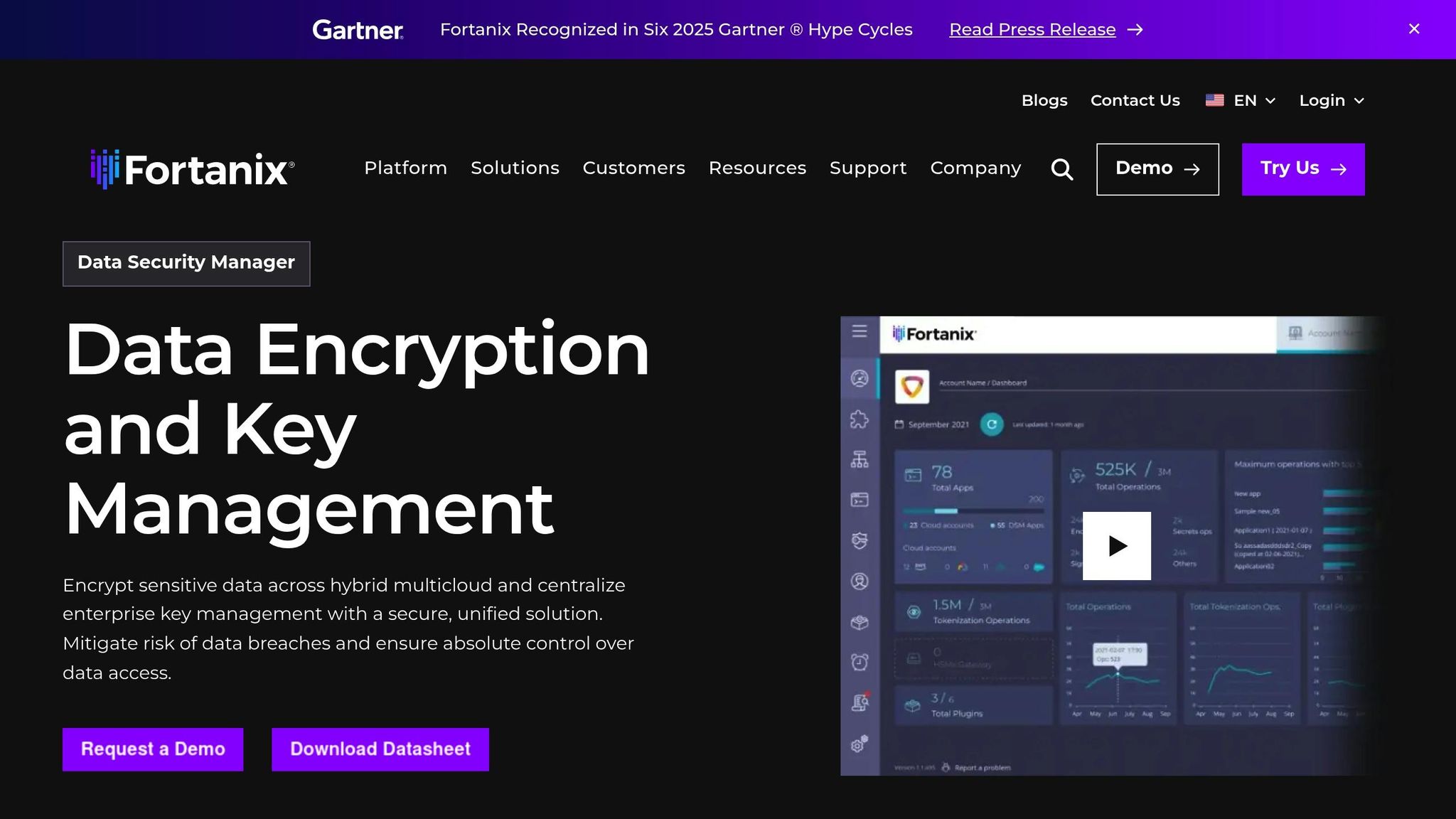
Multi-cloud Key and Policy Management with Fortanix Data Security Manager
Core Components of Hybrid Cloud Key Management
A secure hybrid key management setup integrates both hardware and cloud-based systems to safeguard database encryption keys. This architecture brings together hardware security modules (HSMs), cloud-native key management services (KMS), integration layers, and unified access controls to create a seamless and secure system.
On-Premises and Cloud-Based Key Management Systems
In hybrid architectures, on-premises HSMs and cloud-based KMS solutions complement each other. Knowing their differences helps organisations choose the right solution for specific needs.
On-premises HSMs provide full control over keys and meet FIPS 140-2 Level 3/4 standards, offering top-tier physical security. These devices are designed to automatically erase all data if tampered with, providing a level of protection that software alone cannot achieve. They also deliver consistent, low-latency performance and can be customised to meet specific operational demands.
Cloud-based KMS solutions, on the other hand, are managed services that handle key generation, storage, and management in remote HSM clusters or isolated environments. These services are highly scalable, allowing organisations to provision new key servers quickly and replicate keys across multiple regions for redundancy. KMS solutions integrate easily with cloud services via APIs, enabling encryption for databases, storage, and applications without requiring complex customisations.
The key difference between HSM and KMS lies in their deployment and functionality. HSMs are hardware appliances with superior tamper-resistance, while KMS operates as virtual appliances with broader integration capabilities for public clouds and applications. Both systems manage the entire key lifecycle, including generation, rotation, deletion, and importing.
Some cloud providers are advancing their offerings with innovations like Azure Integrated HSM. Microsoft has embedded HSM chips directly into its Azure server hardware (e.g., AMD D and E Series v7 Preview), achieving FIPS 140-3 Level 3 compliance. These chips ensure encryption keys remain within secure hardware boundaries, reducing latency and exposure risks.
In hybrid setups, organisations often use both approaches strategically. On-premises HSMs are ideal for sensitive, regulated data requiring direct control, while cloud-based KMS is well-suited for cloud-native applications that benefit from scalability and multi-region redundancy. This combination allows organisations to align key management systems with data sensitivity, compliance needs, and performance requirements.
To connect these systems, organisations rely on key brokers and integration layers.
Key Brokers and Integration Layers
Key brokers and integration layers address the challenge of linking on-premises and cloud environments. They simplify key management by providing unified access control and secure credential handling.
A key broker acts as a middleman, eliminating the need for shared credentials. Instead of database administrators dealing with raw encryption keys, the broker securely connects to databases, servers, and clusters without exposing sensitive secrets. This ensures consistent security and governance, whether systems are hosted on AWS, Azure, or on-premises Kubernetes clusters.
Modern integration layers use Zero Trust principles, ensuring access is time-limited and context-aware. For example, access permissions automatically expire after use, reducing potential attack surfaces. These layers also support APIs, SDKs, and CLI tools, enabling seamless integration of cloud-native, containerised, and serverless systems with on-premises infrastructure. This flexibility allows organisations to automate workflows, incorporate key management into CI/CD pipelines, and apply consistent security policies across all environments.
Google Cloud’s Cloud KMS Autokey is a great example of how automation can simplify key provisioning. It automatically assigns key rings, keys, and service accounts during resource creation, removing the need for manual setup. When paired with a key broker, this automation can extend across hybrid environments, ensuring encryption keys are provisioned and assigned according to predefined policies.
Once systems are connected, unified identity and access management (IAM) ensures consistent control over who can access encryption keys.
Unified Identity and Access Management (IAM)
Unified IAM ensures consistent authentication and authorisation across all platforms. Without it, organisations face challenges in maintaining security when users access encryption keys from multiple environments.
Federated identity allows users to authenticate once for all systems. By integrating IAM with providers like Okta, Azure AD, or Google, organisations can implement Single Sign-On (SSO) and federated authentication. This means a database administrator logs in once and gains appropriate access to keys across all environments based on their role and context.
Role-Based Access Control (RBAC) further refines permissions, defining who can access, rotate, or revoke encryption keys. In hybrid setups, RBAC ensures that key administrators handle lifecycle operations, database administrators use keys for encryption, and security officers audit key usage - all with minimal permissions. This separation of duties ensures that no single user has excessive access, reducing security risks.
Just-in-Time (JIT) access enhances security by granting temporary access that expires automatically. For instance, a database administrator might request access to rotate encryption keys for a specific database. The IAM system grants access for a set duration, logs all actions, and revokes access once the task is complete, reducing the risk of unauthorised access.
Dual control mechanisms add another layer of security by requiring two authorised individuals to approve sensitive operations, such as key generation or rotation. This ensures no single person can compromise encryption keys or access sensitive data. In hybrid environments, these controls must be consistently enforced across all platforms to prevent vulnerabilities.
IAM systems also maintain detailed audit trails, capturing key access attempts, actions performed, and user details. These logs are vital for detecting anomalies, investigating incidents, and meeting compliance standards like SOC 2, HIPAA, and ISO 27001. By ensuring visibility and consistency, organisations can uphold robust security policies regardless of where their keys or users are located.
Best Practices for Secure Key Management
Securing encryption keys in hybrid cloud environments demands a mix of strategies that ensure security, meet compliance requirements, and maintain operational efficiency. Below are key practices to safeguard database encryption keys across both on-premises and cloud systems.
Key Granularity and Rotation Policies
Key granularity refers to how encryption keys are distributed within your database setup. The right level of granularity depends on your organisation's security goals, compliance requirements, and operational needs.
For most workloads, using database-level keys is a practical choice. This approach limits the impact of a breach since each database operates with its own key. For data subject to stricter regulations, such as GDPR, column-level keys may be necessary, though they may require additional performance optimisation. This method ensures that if one key is compromised, others remain secure.
Compliance obligations often dictate the level of granularity. For example, under PCI DSS, payment card data must have separate encryption keys from other business data. A hybrid approach works well - use database-level keys for general workloads and apply finer granularity for sensitive or regulated data types.
Automating key rotation is another critical step. Automated systems reduce human error and minimise the risk of prolonged exposure if a key is compromised. Services like Azure Key Vault and Google Cloud KMS can rotate keys seamlessly, ensuring new keys protect fresh data while older keys still decrypt existing records.
Industry standards recommend different rotation frequencies based on data sensitivity. For instance:
- Rotate keys annually for standard data.
- Rotate quarterly for sensitive data like payment card information (as per PCI DSS).
- Rotate monthly for highly sensitive or classified data.
Hybrid environments require consistent rotation policies across on-premises and cloud systems. Ensure your key management infrastructure supports key versioning, so older encrypted data remains accessible even after a key is rotated. Without versioning, encryption systems could fail to decrypt historical data.
Beyond rotation and distribution, strict access controls are vital for effective key management.
Separation of Duties and Access Control
The principle of least privilege is a cornerstone of secure key management. This means granting users and systems only the permissions they need to perform their tasks. For example, database administrators should not have access to encryption keys, and key administrators should not access encrypted data.
Role-based access control (RBAC) is an effective way to implement this principle. Define roles with precise permissions:
- Key administrators manage key lifecycle operations.
- Database administrators use keys for encryption but cannot modify or destroy them.
- Security officers monitor and audit key usage.
Critical operations should involve multiple levels of authorisation. For instance, actions like key destruction or export should require approval from two authorised individuals. Many hardware security modules (HSMs) include dual-control features to enforce this.
Just-in-time (JIT) access further strengthens security by providing temporary permissions. For example, if a database administrator needs to rotate a key, they receive access for a limited time, and their actions are logged. Once the task is complete, access is revoked automatically, reducing the risk of standing privileges being exploited.
In hybrid setups, unified identity and access management (IAM) systems are essential to enforce consistent policies. Integration with services like Okta, Azure AD, or Google Identity enables single sign-on and federated authentication, ensuring users have appropriate access across all environments.
Documenting roles, approval workflows, and audit trails is key for compliance. Maintain immutable logs that record every key operation, including the user, time, and action taken. These records are invaluable for audits and incident investigations.
Compliance with Regulatory Frameworks
Regulations often dictate specific practices for managing encryption keys. Here’s how some of the major frameworks address key management:
GDPR: Requires organisations to protect personal data using encryption and pseudonymisation. While it doesn’t prescribe specific encryption standards, it mandates secure key management and auditable access to encrypted data.
PCI DSS: Specifies strong cryptography for payment card data, requiring keys to be stored in secure HSMs with annual rotation. Compliance also demands FIPS 140-2 Level 3 validation (or equivalent) and formal acknowledgment of responsibilities by key custodians.
HIPAA: Focuses on safeguarding protected health information (PHI). While it doesn’t enforce specific encryption standards, secure key management with access controls and audit capabilities is necessary to meet its requirements.
ISO 27001: Outlines comprehensive information security practices, including generating keys with strong entropy, securing them with restricted access, and rotating them regularly. Risk assessment is emphasised to identify and mitigate threats to key management systems.
SOC 2 Type II: Audits verify the effectiveness of key management controls over time. This includes ensuring hardware-backed entropy for key generation, implementing least-privilege access controls, and maintaining detailed audit logs.
In hybrid environments, it’s crucial to meet the most stringent standard relevant to your data. For instance, if handling both payment card and health data, PCI DSS requirements often take precedence due to their specificity.
Cloud services like Azure Key Vault Premium and Google Cloud HSM are designed to meet these regulatory standards. For example:
- Azure Key Vault Premium offers FIPS 140-3 Level 3 validation with PCI compliance using Marvell LiquidSecurity HSMs. It also supports single-tenant control for organisations with strict data sovereignty needs.
- Google Cloud KMS provides both software-based keys (FIPS 140-2 Level 1) and hardware-backed keys (FIPS 140-2 Level 3) with customer-defined rotation and access policies.
When choosing a key management service, confirm that providers maintain up-to-date compliance certifications. Regular assessments ensure your infrastructure stays aligned with evolving regulations and emerging security threats.
Need help optimizing your cloud costs?
Get expert advice on how to reduce your cloud expenses without sacrificing performance.
Database-Specific Operational Considerations
Managing databases securely requires customised workflows for key management that strike a balance between safeguarding data and maintaining operational efficiency. Unlike general encryption practices, database operations need extra attention to processes like provisioning, performance, and automation to ensure security measures don’t hinder functionality.
Provisioning Keys for Databases
When it comes to provisioning encryption keys for databases, the process must be meticulously designed to prevent any exposure of keys in plaintext. Whether you’re creating new databases or migrating to hybrid cloud setups, a structured and secure approach is essential.
Automating key generation and assignment is a critical step. Using tools like Azure Key Vault, Google Cloud KMS, or on-premises HSMs ensures keys remain encrypted throughout the process, eliminating the risks associated with manual handling. For migration scenarios, envelope encryption is a best practice. Here, data encryption keys (DEKs) secure the database content, while these DEKs are wrapped with key encryption keys (KEKs) stored securely in your key management service. This layered approach ensures that even if DEKs are compromised during migration, the master keys remain protected.
Database administrators shouldn't have direct access to encryption keys. Instead, they should use APIs to request key operations, with strict authentication and authorisation controls in place. For example, a database administrator setting up a payroll database should only be able to use keys designated for payroll data, not for other systems.
Maintaining detailed audit trails is equally important. Keep records of key creation, usage, and access, noting who created the keys, when, and for which databases. These logs are invaluable for meeting compliance requirements and conducting forensic investigations if security incidents occur.
Performance and Cost Optimisation
Performance is a top concern in database environments, where encryption and decryption operations happen continuously. Latency in key management can directly affect query performance, especially in hybrid cloud setups where databases interact with cloud-based key management services.
To address this, local key caching can be implemented. By temporarily storing frequently used keys locally with secure expiration policies, you can reduce round-trip latency to the key management service. However, caching should be carefully managed to minimise security risks - keys should only be cached for as long as absolutely necessary.
Cost management is another vital consideration. For instance, Google Cloud KMS charges £0.04 per key version for customer-managed software keys, with additional fees for cryptographic operations and hardware key instances [2]. Azure Key Vault offers a range of pricing options, with its Standard Tier being more cost-effective for basic encryption needs, while the Premium Tier and Managed HSM come with higher costs due to their hardware security features [1].
For organisations managing numerous databases, costs can escalate quickly under a per-key-version pricing model. To keep expenses under control, consider data tiering strategies. Use software-based encryption for less sensitive data and reserve hardware-protected keys for critical information. This approach allows you to allocate resources effectively without compromising security where it matters most.
Consolidating your key management infrastructure can also help. By leveraging on-premises HSMs for sensitive keys and cloud-based solutions for less critical databases, you can balance capital expenditure with operational costs. Regular audits of key usage and retiring unused keys are essential to avoid unnecessary expenses.
Hokstad Consulting, for example, has helped organisations cut cloud spending by 30–50% while improving performance through strategies like automation, resource optimisation, and right-sizing. Their principles of balancing cost, performance, and security are equally applicable to key management decisions.
These optimisations pave the way for seamless automation, which is explored further in the next section on Infrastructure as Code (IaC).
Automation and Infrastructure as Code (IaC)
Infrastructure as Code (IaC) allows organisations to standardise key management policies, ensuring consistency across hybrid setups and reducing errors caused by manual configurations. Tools like Terraform and Azure Resource Manager (ARM) templates can define Key Vault instances, key creation policies, and access controls for Azure environments. Similarly, Google Cloud users can rely on Terraform, Google Cloud Deployment Manager, or Pulumi to declaratively manage Cloud KMS key rings, keys, and IAM policies.
IaC isn’t just about defining infrastructure - it’s about embedding security into your workflows. This includes codifying key rotation schedules, access policies, and audit logging configurations. For hybrid environments, tools like Terraform can manage infrastructure across both on-premises and cloud setups, ensuring that key management policies are applied consistently, no matter where the database resides.
Version control systems play a critical role in IaC. Storing templates in repositories with change tracking allows teams to review and approve changes before deployment. This not only ensures compliance but also provides a clear audit trail of modifications.
Automated testing of IaC templates is another must. Before deploying to production, validate that key management policies are correctly applied. This prevents configuration drift and ensures every database deployment aligns with security standards.
IaC also supports rapid disaster recovery. If your key management infrastructure fails, you can quickly rebuild it from code, avoiding the pitfalls of outdated or incomplete documentation.
For databases, IaC should go beyond infrastructure definitions to include the integration points where databases request keys. This ensures that key access permissions are configured correctly every time a database is provisioned, streamlining the entire workflow while maintaining robust security.
Monitoring and Auditing Key Usage
Keeping a close eye on how encryption keys are used is essential for maintaining a strong security posture. Without proper monitoring across hybrid cloud databases, organisations risk compliance issues, undetected breaches, and operational blind spots. This continuous oversight ensures that security policies are consistently applied and upheld. However, hybrid environments add complexity, as they involve diverse systems - each with unique logging mechanisms and data formats.
Key Usage Tracking and Reporting
To effectively track cryptographic operations across hybrid setups, every key interaction must be logged. Services like Google Cloud KMS and Azure Key Vault come equipped with APIs and logging features that automatically record key access, encryption and decryption activities, and administrative actions. For on-premises systems, a dedicated logging infrastructure integrated with Hardware Security Modules (HSMs) is necessary to capture similar events.
Cloud platforms often replicate logs across regions to ensure redundancy, while on-premises systems store logs locally to maintain full control. When it comes to databases, your tracking system should detail key access per database instance, include timestamps of each operation, identify the user or service account making the request, and note whether the operation succeeded or failed.
This level of detail is crucial for compliance reporting. Logs must meet regulatory requirements, particularly for data protected by encryption. For databases, this includes logging who accessed the key, when it was accessed, which key was used, the operation performed (e.g., encryption, decryption), the database or application making the request, the result of the operation, and the IP address or network location involved.
Real-time dashboards can provide an overview of key management health and security across hybrid environments. Important metrics to track include key rotation compliance, patterns of key access (e.g., encryption and decryption operations per hour), failed authentication attempts, and key lifecycle events like creation, rotation, or destruction. For databases, additional metrics such as encryption and decryption latency, the percentage of queries using hardware-based versus software-based keys, and key usage distribution across cloud and on-premises systems are critical.
Dashboards should also include configurable thresholds for alerts - for example, flagging when key access latency surpasses 100 milliseconds, which might suggest HSM performance issues or network delays. Geographic data on key usage can help identify potential data sovereignty problems or unusual access patterns. Integration with tools like Azure Monitor (for Azure Key Vault) and Google Cloud Console (for Cloud KMS) allows for unified visibility, while on-premises HSM metrics can be monitored via SNMP or specific agents.
Alerting for Sensitive Operations
Detailed tracking is just the start - alerting ensures that suspicious or unauthorised activities are addressed immediately. Key events that should trigger alerts include unauthorised access, key destruction or revocation, policy changes, unexpected service account activity, bulk operations outside normal patterns, and failed HSM authentications.
In hybrid setups, alerts should be centralised using a Security Information and Event Management (SIEM) system, which consolidates logs from platforms like Azure Key Vault, Google Cloud KMS, on-premises HSMs, and database systems. For example, if a database server accesses a key at an unusual time or from an unexpected location, the system should raise an alert immediately.
Time-based thresholds help fine-tune alerts. For instance, alerts for key destruction should be instant, while routine key rotations might allow a 24-hour window to reduce false positives. Integration with incident response workflows ensures that alerts automatically generate tickets and notify security teams through channels like email, SMS, or Slack.
Correlating key management events with database activity logs creates a complete picture of data access. For example, if a database query involves encrypted data, the system should trace which user initiated the query, the database connection used, the encryption key accessed, and what data was decrypted. This correlation can uncover sophisticated attacks, such as an attacker bypassing encryption by accessing keys through unexpected methods.
Consider a scenario where a database administrator accesses encryption keys at 3 AM - outside normal hours - and this aligns with unusual database queries targeting sensitive data. Such behaviour should trigger immediate investigation. Correlation rules can also flag service accounts accessing keys outside scheduled times, significant changes in key access patterns, or database queries involving encrypted data without corresponding key access logs (indicating potential caching or bypass attempts).
For accurate correlation, synchronising timestamps across systems is crucial. All systems should use Network Time Protocol (NTP) to maintain clock accuracy within 100 milliseconds. Enriching events with context - such as user roles, database permissions, and network locations - further enhances anomaly detection.
Centralised Audit Logging
Centralised audit logging is the backbone of effective oversight. Instead of maintaining separate logs for Azure Key Vault, Google Cloud KMS, on-premises HSMs, and databases, organisations should aggregate all key management events into a unified, tamper-proof repository.
This approach ensures consistent timestamps, simplifies compliance reporting, and speeds up incident investigations. A centralised logging architecture should include several layers: native logging from each system, a log aggregation layer to normalise and enrich events, long-term storage with immutable retention (often seven years for financial data), and a query layer for compliance and forensic analysis.
For databases, logs should capture details like user activity, timestamps, and operation outcomes, providing full traceability from data access to key usage. To protect these logs, organisations should use write-once-read-many (WORM) storage and encrypt logs with separate key hierarchies to ensure operational keys and audit logs remain distinct.
Retention strategies must balance compliance needs, storage costs, and performance. Regulatory requirements often mandate retention periods ranging from three to seven years, with some financial data requiring indefinite storage. A tiered retention approach works best: hot storage (immediately accessible logs) for 90 days, warm storage (slower but searchable logs) for one to two years, and cold storage (archived logs) for three to seven years.
For hybrid environments, consistent retention policies across systems like Azure Key Vault, Google Cloud KMS, on-premises HSMs, and database logs are essential. Archived logs should be compressed to reduce costs and verified for integrity using cryptographic hashes.
Centralised logging also helps track administrative activities across multiple environments. Both Azure Key Vault and Google Cloud KMS offer integrations with their respective cloud ecosystems, enabling encryption-at-rest and detailed audit capabilities. These tools provide control over key rotation schedules, IAM roles, and permissions, ensuring comprehensive oversight.
Conclusion and Key Takeaways
Hybrid cloud key management reshapes database security by striking a balance between protecting data, meeting compliance requirements, and maintaining performance. Successfully managing encryption keys across on-premises systems, public cloud platforms like Azure and Google Cloud, and private infrastructures demands a carefully structured integration of these environments.
Summary of Key Strategies
To manage hybrid cloud keys effectively, focus on three key areas:
Unified key management infrastructure: A single, centralised system for managing encryption keys across all environments ensures consistent control and avoids fragmented management. This approach supports seamless key lifecycle management, whether databases operate in Azure, on-premises, or hybrid setups.
Separation of duties and access control: Implement granular role-based access controls (RBAC) alongside multi-factor authentication to prevent any single individual from compromising key security. Use Just-in-Time (JIT) access controls to grant temporary permissions that expire automatically, which is critical for meeting regulations like PCI DSS, GDPR, and HIPAA.
Automated key rotation and lifecycle management: Use Infrastructure as Code (IaC) tools such as Terraform to automate key rotation schedules. This reduces the risk of human error and ensures consistency across environments.
For organisations handling sensitive data, hardware security is essential. Validated Hardware Security Modules (HSMs) like those certified to FIPS 140-2 Level 3 or FIPS 140-3 Level 3 provide tamper-resistant storage for encryption keys. For instance, Azure Key Vault Managed HSM ensures keys remain confidential, even from Microsoft, by operating within Azure's Confidential Compute Infrastructure. If your needs are less demanding, software-based solutions validated to FIPS 140-2 Level 1 can offer a cost-effective alternative while maintaining compliance.
Another factor to consider is network latency, especially when on-premises databases rely on cloud-based key management services. Using intelligent key caching with well-defined time-to-live values can reduce delays, while batch operations help minimise the number of service calls.
Next Steps for Implementation
With these strategies in mind, the next step is to translate them into actionable measures:
Assess regulatory requirements: Begin by evaluating your compliance obligations under standards like PCI DSS, GDPR, and HIPAA. This will help you determine whether cloud-based, on-premises, or hybrid solutions best align with your needs. Document existing practices to identify gaps in areas like key rotation, access control, and audit processes.
Unify identity and access management (IAM): Fragmented key control increases security risks and complicates compliance. A unified IAM system across Azure, Google Cloud, and on-premises environments simplifies security management and reduces vulnerabilities.
Centralise audit logging: Set up an audit logging infrastructure that consolidates key management events from all systems. Log details such as timestamps, user identities, operation types, and outcomes. Store these logs in immutable storage with appropriate retention periods (e.g., seven years for financial institutions) to support compliance and forensic needs.
Adopt Infrastructure as Code (IaC): Manage all key operations through IaC, storing configurations in version control systems with change tracking and approval workflows. This ensures consistency across environments, simplifies disaster recovery, and reduces configuration drift.
Test thoroughly: Validate the implementation by testing key rotation, failover scenarios, and encryption performance. Identify and address any bottlenecks to ensure smooth operation across database types.
How Hokstad Consulting Can Help

Hokstad Consulting specialises in optimising DevOps and cloud infrastructure, offering tailored solutions for robust key management systems. They bring expertise in cloud migration and custom development, helping UK organisations navigate the complexities of hybrid cloud environments.
Their services focus on balancing stringent security requirements with cost efficiency, particularly for HSM deployments. Whether you need to meet regulatory standards or optimise performance, their team designs solutions that align with your organisation's goals while reducing operational overhead.
Hokstad Consulting also provides DevOps transformation services, including automated CI/CD pipelines and monitoring systems that integrate seamlessly with key management infrastructure. For organisations dealing with legacy systems, they offer custom development to enable specialised workflows and integrations. If you're unsure about your current key management maturity, their cloud cost audits and strategy services can guide you toward improvement.
With flexible engagement models and a no savings, no fee
guarantee, Hokstad Consulting makes their expertise accessible to organisations at all stages of hybrid cloud adoption. To learn more about how they can help secure your encryption keys and streamline operations, visit hokstadconsulting.com.
FAQs
How can on-premises HSMs and cloud-based KMS solutions work together in a hybrid cloud setup?
On-premises Hardware Security Modules (HSMs) and cloud-based Key Management Services (KMS) work well together by blending the strong security of physical hardware with the adaptability of cloud-based systems. This combination allows organisations to keep sensitive encryption keys secure on-premises, while taking advantage of the cloud's scalability and ease of use for less critical tasks or distributed environments.
For instance, on-premises HSMs can be used to manage encryption keys for highly sensitive data or to meet strict regulatory requirements. Meanwhile, cloud-based KMS solutions are ideal for handling encryption keys tied to cloud-native applications. This approach strikes a balance between tight data security and operational efficiency, enabling organisations to comply with regulations without compromising on scalability or performance.
How can I automate key management tasks, such as generation, rotation, and deletion, in hybrid cloud databases?
Managing keys effectively in hybrid cloud databases is essential for keeping security tight and meeting compliance requirements. One of the smartest approaches is to use centralised key management systems that work smoothly with your database platforms. These systems handle tasks like key generation, rotation, and deletion automatically, which helps to cut down on mistakes caused by human error.
It's also a good idea to implement role-based access controls so that only authorised individuals have permission to manage keys. Regularly rotating keys and securely retiring old ones can significantly reduce potential security gaps. By using tools designed for hybrid cloud setups, you can maintain consistent key management across both on-premises and cloud environments. This ensures your security practices remain strong, no matter where your data resides.
How can organisations ensure compliance with regulations like GDPR and PCI DSS when managing encryption keys in hybrid cloud environments?
To meet regulations like GDPR and PCI DSS in hybrid cloud setups, organisations need to prioritise strong encryption key management. This means securely storing keys, restricting access to authorised personnel, and rotating keys regularly to reduce potential risks.
It's also important to use tools that enable auditing and monitoring of key usage. These tools can provide the necessary evidence during regulatory inspections. Alongside this, keeping detailed documentation of encryption processes and following established security practices for hybrid cloud environments are crucial for safeguarding sensitive data and staying compliant.