
Building your own Infrastructure as Code (IaC) solution may seem like a cost-effective way to gain control and flexibility, but it often leads to unexpected financial and operational challenges. Here's what you need to know:
- High Costs: DIY IaC setups can cost £250,000–£400,000 over three years, including salaries, maintenance, and recruitment fees. Maintenance alone can consume 20–40% of a team’s capacity.
- Lost Productivity: Diverting engineers to infrastructure tasks reduces focus on product development, costing ~£13,400 per engineer per month.
- Operational Risks: DIY systems can cause issues like misconfigurations or outages. Spotify's 2024 Kubernetes cluster deletion incident is a cautionary example.
- Scalability Problems: Custom systems struggle to scale and require constant manual intervention, leading to inefficiencies and knowledge silos.
To avoid these pitfalls, consider alternatives like hybrid IaC solutions, automated pipelines, and regular cloud cost audits. These approaches can save time, cut costs, and improve reliability without the burdens of a fully DIY setup.
::: @figure 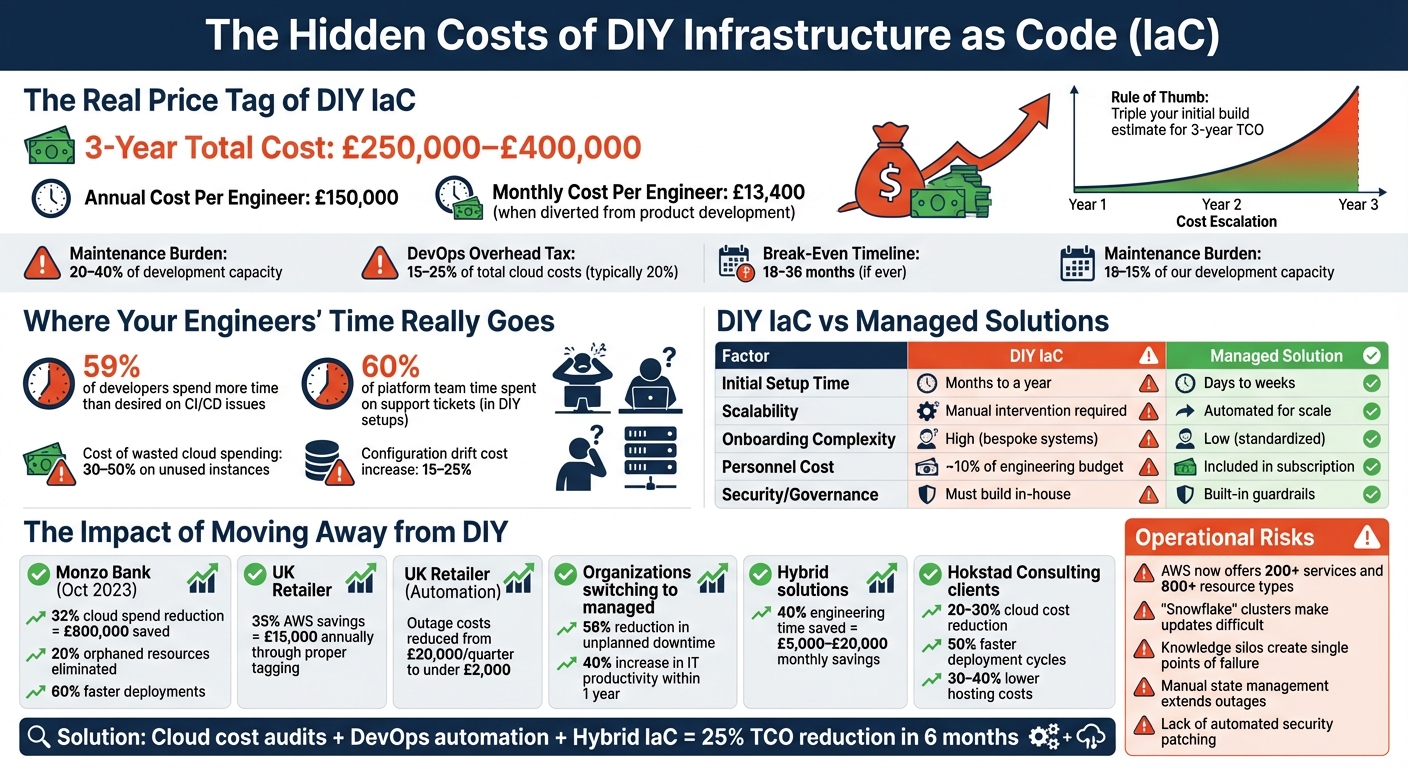 {Hidden Costs of DIY IaC: Financial Impact and Comparison with Managed Solutions}
:::
{Hidden Costs of DIY IaC: Financial Impact and Comparison with Managed Solutions}
:::
The Financial Burden of DIY IaC
Engineering Time and Opportunity Costs
Building your own Infrastructure as Code (IaC) solution demands a significant investment of engineering time, with costs reaching around £150,000 annually per engineer [2]. This commitment directly impacts product development, as every hour spent maintaining infrastructure is an hour not spent on creating features that drive revenue. To put it into perspective, the cost of diverting just one engineer-month to infrastructure maintenance is approximately £12,500 [2].
This isn't just about numbers - it’s about priorities. A staggering 59% of developers admit they spend more time than they’d like resolving CI/CD issues [5]. These hours add up, creating a visible financial strain. But the problem doesn’t stop there. These time losses also feed into an ever-growing issue: technical debt. Let’s dig into that.
Maintenance Costs and Technical Debt
Keeping a DIY IaC system running smoothly is no small task. Between security patches, compliance updates, and code refactoring, maintenance alone can consume 20% to 40% of your development capacity [2]. Quick fixes might seem like a solution in the moment, but they often lead to tangled, fragile pipelines that only grow harder to improve over time [3].
Then there’s the 1:5 tax
- a term that highlights how DevOps overhead, including IaC management, typically accounts for 15% to 25% of total cloud costs, with most organisations landing around 20% [5]. This means the financial commitment doesn’t just stop at the initial build. For a more realistic picture, it’s recommended to triple your initial build estimate to calculate the three-year total cost of ownership [2].
Here’s the kicker: most custom infrastructure takes anywhere from 18 to 36 months to break even against commercial solutions - if it ever does [2]. So, while a DIY approach might seem appealing at first, the long-term costs and complexities often paint a very different picture.
Operational Challenges of DIY IaC
Onboarding and Knowledge Silos
Getting new engineers comfortable with a DIY Infrastructure as Code (IaC) system is no easy task. These custom solutions often depend on internal documentation and informal training, which can vary greatly in quality and consistency [1]. For engineers, learning tools like Terraform or Ansible involves shifting from imperative to declarative programming styles - a hurdle even for experienced developers [7].
The real strain, however, falls on senior engineers. Instead of focusing on creating new, revenue-driving features, they spend a significant portion of their time guiding colleagues through the intricacies of these internally built systems [1].
Knowledge silos make things even trickier. Custom-built pipelines often tie the organisation’s delivery process to the engineers who developed them. If those individuals leave, the entire system can be at risk [4]. In fact, in DIY setups, platform teams can spend as much as 60% of their time handling support tickets, leaving little room for innovation [8]. Onboarding new developers also becomes a lengthy process compared to environments with standardised solutions.
As companies grow, these onboarding and knowledge-sharing challenges become even more pronounced, exposing the organisation to greater risks and inefficiencies.
Scalability and Risk Exposure
The challenges of scaling a DIY IaC solution only grow with time. For example, cloud providers like AWS now offer over 200 services and 800 resource types [7]. Without standardised tools, new engineers face a steep learning curve to gain the infrastructure expertise they need. This lack of consistency often leads to snowflake
clusters - environments where each setup is slightly different. These inconsistencies make global updates and enforcing security policies a nightmare [8][9].
State management is another area where DIY solutions falter, particularly at scale. Past incidents, such as Spotify's struggles with state file repairs, highlight how manual intervention can extend outages and increase risks [1]. Additionally, custom solutions often lack automated security patching, leaving organisations exposed to vulnerabilities [1].
Take the BMW Group as an example. In December 2024, they moved away from a DIY Terraform setup to support over 11,000 developers. Their initial approach couldn’t keep up with the speed of development required. As Jan-Peter Alten, a DevOps Engineer at BMW Group, explained:
When we started to use Terraform to deploy our first cloud services with AWS, it didn't scale quickly enough for our needs. With Pulumi we're really speeding up development.[1]
The comparison below highlights how DIY and managed IaC solutions differ when it comes to scaling:
| Factor | DIY IaC | Managed IaC Solution |
|---|---|---|
| Initial Setup Time | High (months to a year) [4] | Low (days to weeks) [4] |
| Scalability | Manual; requires frequent intervention | Automated; designed for scale |
| Onboarding Complexity | High (bespoke systems) [1][4] | Low (standardised/documented) [1] |
| Personnel Cost | ~10% of engineering budget [1] | Included in subscription fees [4] |
| Security/Governance | Must be built in-house [4] | Built-in guardrails and policies [4] |
The takeaway? Without a managed platform, the platform team often grows in proportion to adoption, turning into a cost centre rather than a driver of efficiency [8].
Infrastructure as Code: The Hidden Cost of Doing It Yourself
How to Avoid Common DIY IaC Pitfalls
Tackling the financial and operational challenges of DIY Infrastructure as Code (IaC) requires practical strategies and solutions.
Conduct Cloud Cost Audits
Regular audits of cloud expenses can help identify inefficiencies often seen in DIY IaC setups. Start by collecting billing data, categorising expenses (e.g., compute, storage, networking), and analysing usage patterns to spot over-provisioned or idle resources. Tools like AWS Cost Explorer or Google Cloud Billing are particularly helpful, revealing that 30–50% of cloud spending is often wasted on unused instances in DIY environments [10][12].
More advanced audits can uncover IaC-specific problems, such as configuration drift, which can increase costs by 15–25%. These audits also provide actionable remediation plans - like implementing automated governance policies - and can forecast future costs with up to 90% accuracy [10][11]. For example, a UK retailer saved 35% on its AWS bills (£15,000 annually) by auditing and correctly tagging resources provisioned through DIY IaC [12][13].
In October 2023, Monzo Bank demonstrated the impact of IaC audits by reducing its cloud spend by 32%, saving £800,000. Under the leadership of James Hyde, Head of Infrastructure, the team eliminated 20% of orphaned resources and improved deployment speed by 60% [Monzo Engineering Blog, October 2023].
This improved visibility into costs lays the foundation for further streamlining through DevOps automation.
Adopt DevOps Transformation and Automation
Switching to automated pipelines and processes can significantly cut down on the manual effort and operational hurdles of DIY IaC. A DevOps transformation typically involves creating CI/CD pipelines, following best practices for IaC (like using Terraform modules with version control), and employing automation tools such as Ansible for orchestration. These changes can reduce deployment times from days to minutes and cut manual fixes by up to 70% [10][11][12][14].
For instance, a UK retailer automated its IaC pipelines and managed to reduce outage-related costs from £20,000 per quarter to under £2,000. Similarly, Hokstad Consulting has helped clients halve their deployment cycles and lower hosting costs by 30–40%, addressing common DIY challenges like knowledge gaps and scalability issues.
By reducing the need for manual intervention, automation also makes it easier to adopt hybrid solutions for better control and scalability.
Use Customised Hybrid IaC Solutions
Hybrid IaC solutions combine the adaptability of open-source tools like Terraform with the scalability of managed services such as AWS Proton or Azure Blueprints. This approach can save engineering teams up to 40% of their time while avoiding the maintenance burden of full DIY setups, translating to monthly savings of £5,000–£20,000 [11][12].
Hokstad Consulting offers a 'No Savings, No Fee' model, which charges clients only when verified savings are achieved. This approach has helped companies reduce cloud bills by 20–30%. In one instance, transitioning to a hybrid solution resulted in £100,000 in annual savings without upfront costs - a particularly appealing option for UK businesses wary of the risks of DIY IaC.
To get started, assess your current DIY IaC setup, choose the right tools (e.g., Pulumi for multi-cloud hybrid deployments), and run pilot projects in non-production environments. Track key metrics like cost per deployment and mean time to recovery. Success is often defined by achieving a 25% reduction in total cost of ownership within six months [12][13].
Conclusion
Building Infrastructure as Code (IaC) in-house often comes with hidden costs that go far beyond the initial setup. As discussed, taking a DIY approach to IaC pulls vital resources away from product development, which can put both finances and operational stability at risk. On top of that, relying on reactive security measures can lead to expensive compliance issues[6]. As infrastructure becomes more complex, maintaining a DIY model can overwhelm teams, leaving them spending more time fixing issues than creating new value.
The numbers speak for themselves: organisations transitioning from DIY IaC to managed cloud operations have seen a 56% reduction in unplanned downtime and a 40% increase in IT productivity within just one year[6]. By leveraging automation, expert advice, and established frameworks, businesses can eliminate much of the operational stress tied to in-house IaC.
For companies in the UK grappling with the escalating costs and risks of managing IaC internally, expert support is a smart solution. Hokstad Consulting offers tailored services like DevOps transformation, cloud cost engineering, and hybrid IaC solutions. Their No Savings, No Fee
model ensures clients only pay when real, verified savings are delivered. This approach has already helped businesses cut cloud costs and significantly speed up deployment cycles.
With strategies like cloud cost audits, automated pipelines, and hybrid solutions, engineering teams are freed to focus on what matters most: innovation.
FAQs
When does DIY IaC actually make financial sense?
When considering DIY Infrastructure as Code (IaC), it can make financial sense if the upfront investment is justified by the need for long-term control, strict compliance requirements, or highly customised solutions. This approach often suits organisations with large, dedicated teams capable of managing intricate infrastructures that off-the-shelf tools might struggle to address effectively. However, it's essential to thoroughly assess any hidden costs and potential risks before committing to this path.
What are the biggest operational risks with DIY IaC?
The primary risks of managing Infrastructure as Code (IaC) yourself include unexpected costs tied to provisioning and maintaining resources, greater complexity that can slow down deployments, and the potential for downtime due to limited automation or a lack of expert guidance. If these issues aren't addressed properly, they can result in inefficiencies and escalating expenses over time.
How can we reduce IaC costs without losing control?
To manage Infrastructure as Code (IaC) costs effectively while maintaining control, prioritise automation and efficiency. Leverage tools like autoscaling, scheduling, and AI-powered analysis to maximise resource use and minimise waste. Conduct regular audits to identify and eliminate unused resources, automate lifecycle management, and fine-tune your Terraform configurations for better performance.
Additionally, adopting cost visibility tools - such as implementing tagging standards and using cost estimation features - helps you track and manage expenses more effectively. These practices not only improve spending oversight but also prevent inefficiencies that can arise from poorly optimised IaC setups.