
Managing costs in a multi-cloud environment can be challenging due to inconsistent billing formats, tagging rules, and pricing models across providers like AWS, Azure, and GCP. These differences often lead to billing errors, unexpected expenses, and inefficiencies. Here’s what you need to know:
- Billing Discrepancies: Each provider uses unique pricing structures, making cost reconciliation complex and prone to errors.
- Tagging Issues: Inconsistent tagging rules across platforms result in misallocated costs and hidden expenses.
- Lack of Centralised Oversight: Without a unified cost management tool, forgotten resources and anomalies can inflate budgets.
Key Solutions:
- Normalise Billing Data: Standardise cost data from all providers to streamline reconciliation and reduce errors.
- Enforce Consistent Tagging: Use a core set of tags and automated policies to ensure accurate cost tracking.
- Set Up Real-Time Monitoring: Implement alerts to catch anomalies early and prevent unexpected costs.
- Optimise Commitments: Track and manage usage commitments to avoid paying for unused resources.
- Control Data Transfers: Map data flows to minimise egress charges and inefficiencies.
By adopting these strategies and leveraging tools like Cloudability or Datadog, organisations can reduce billing errors, improve cost visibility, and save up to 40% on cloud expenses. Consulting experts in multi-cloud cost management can further refine processes and uncover additional savings.
::: @figure 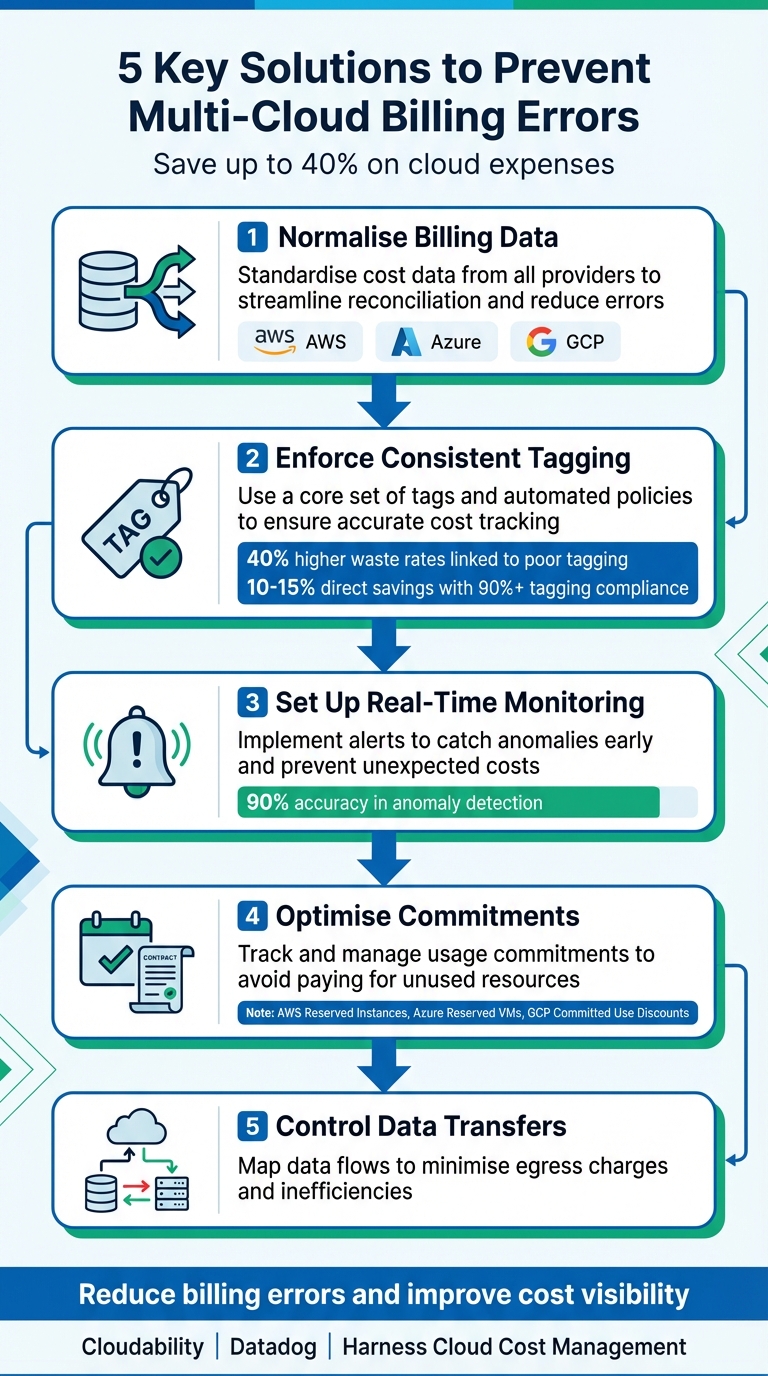 {5 Key Solutions to Prevent Multi-Cloud Billing Errors}
:::
{5 Key Solutions to Prevent Multi-Cloud Billing Errors}
:::
This Is Why Your Cloud Bill Keeps Exploding (And How To Fix It Fast)
Common Causes of Multi-Cloud Billing Errors
Understanding the root causes of billing errors in multi-cloud environments is crucial to addressing them effectively. The structural complexities of these systems often lead to discrepancies that go far beyond simple formatting issues.
Different Billing Formats Across Providers
Each cloud provider operates with its own unique billing structure, pricing model, and metadata format. This lack of standardisation creates a significant hurdle for teams, forcing them to spend more time reconciling data than analysing it for insights. Teams are often required to duplicate allocation logic and rebuild dashboards to adapt to each provider's schema [1]. As Javier Cuartero and Valeria Hernández aptly put it:
When each cloud provider speaks a different billing 'language,' collaboration becomes a translation exercise[1].
The situation becomes even more complicated in containerised environments. While nodes can still be tracked, ephemeral pods and shared ingress controllers make it difficult to attribute costs accurately [2]. Answering basic questions like how much was spent on compute?
often requires separate queries for AWS CUR, Azure Cost Details, and GCP BigQuery. This approach not only increases the workload but also raises the likelihood of logic errors during manual aggregation [1].
Missing Centralised Cost Management
The absence of a unified cost management system adds another layer of complexity. Isolated data, each with its own taxonomy, field structure, and level of detail, makes oversight challenging [2]. The consequences can be severe. For instance, one enterprise faced a sixfold increase in AWS Lambda costs overnight due to a deployment loop. Without real-time alerts, this anomaly only came to light in the monthly cost report, by which point it had resulted in approximately £32,550 in unplanned expenses [2].
Another example highlights the risks of fragmented oversight. An enterprise discovered an unclaimed egress bill of £31,000 per month. Upon investigation, it was found that three separate teams were routing machine learning training traffic through the same VPC endpoint without any tracking or centralised cost management [2]. With 89% of enterprises now operating in multi-cloud environments [2], maintaining a single, cohesive view of costs has become increasingly difficult.
Manual Errors and Misconfigurations
Human error is a persistent issue in multi-cloud billing. Developers may make infrastructure changes without fully understanding their financial implications, such as mistyping parameters or neglecting to enable cost protection settings [3]. Additionally, orphaned or overprovisioned resources often remain active after projects conclude, quietly accumulating unnecessary costs. When combined with tagging inconsistencies, these manual oversights create a perfect storm for billing errors that can go unnoticed for months.
Best Practices for Preventing and Managing Billing Errors
Once you’ve identified the root causes of billing errors, the next step is to put measures in place to prevent them. This involves focusing on data normalisation, consistent tagging, and real-time monitoring to avoid costly mistakes.
Normalising Billing Data Across Providers
When dealing with multiple cloud providers, each with its own billing formats, creating a unified view of costs can feel like piecing together a puzzle. Providers like AWS, Azure, and Google Cloud use different field names, pricing models, and metadata structures, making it essential to standardise this data into a single, consistent format. By mapping fields from AWS CUR, Azure Cost Details, and GCP BigQuery exports to standardised categories, you can eliminate duplicate logic, streamline reconciliation, and avoid manual aggregation errors. Once you’ve unified the data, the next step is to align resource tags, ensuring consistent cost attribution across platforms.
Using Consistent Tagging Policies
Tagging might seem like a small detail, but it can have a big impact on cost management. Poor tagging practices are linked to 40% higher waste rates in cloud environments. On the flip side, achieving 90% or higher tagging compliance can lead to 10–15% direct savings by improving accountability [4]. For example, in 2023, a UK-based SaaS company partnered with Hokstad Consulting to automate tagging across its multi-cloud setup. This initiative saved the company £120,000 annually and reduced downtime by 95% within a year (Source: Hokstad Consulting, 2025).
To get started, focus on a core set of 5–7 essential tags, such as environment, owner, cost-centre, project, and managed-by. Use tools like AWS Service Control Policies or Azure Policy to enforce compliance. When designing your tagging taxonomy, make sure it adheres to the strictest provider limits - like Google Cloud’s 63-character restriction - and use lowercase letters with hyphens to prevent fragmentation. Beyond tagging, real-time alerts are essential for catching anomalies before they escalate.
Setting Up Centralised Monitoring and Alerts
Real-time monitoring is your safety net for catching billing anomalies before they spiral into financial headaches. Without automated alerts, issues like deployment loops or unclaimed egress charges can go unnoticed for weeks, potentially racking up tens of thousands of pounds in unexpected costs.
A centralised monitoring system should track spending patterns across all providers and flag deviations from expected baselines. For simpler setups or predictable spending patterns, statistical methods like Z-scores or moving averages work well. For more complex or high-volume environments, machine learning models can provide deeper insights. The key is to set thresholds that strike a balance - sensitive enough to catch genuine anomalies without overwhelming your team with false alarms.
Advanced Cost Management Techniques
Once you've tackled billing errors, it's time to refine your multi-cloud cost management strategy further. By adopting advanced techniques, you can optimise value and minimise unexpected charges. Here’s how to handle commitments, licences, and data transfers effectively across multiple cloud platforms.
Maximising Commitment and Discount Usage
Cloud providers often offer discounts in exchange for committing to specific usage levels over one or three years. However, managing these commitments across various platforms can be tricky. AWS Reserved Instances, Azure Reserved VM Instances, and Google Cloud Committed Use Discounts all come with different terms, coverage scopes, and expiry dates. Without careful monitoring, you might end up paying for both on-demand resources and unused reservations.
To stay on top of this, maintain a centralised record of all commitments, including their coverage, expiry dates, and utilisation rates. Review this regularly to ensure nothing slips through the cracks. For workloads with predictable usage patterns, consider a layered strategy: use committed discounts for steady, baseline needs and on-demand pricing for occasional spikes. This approach helps you avoid over-committing while still taking advantage of available discounts.
Checking Licensing and Contract Terms
Managing software licences in a multi-cloud setup can be a minefield. If not handled correctly, you could face duplicate licence costs when moving workloads between providers or fail to track bring-your-own-licence (BYOL) arrangements properly. Beyond managing usage commitments, keeping your licence inventory in order is just as crucial.
Create a single, reliable source of information that tracks cloud account coverage, renewal dates, and licensing types. Conduct regular audits - ideally every quarter - to ensure your deployed resources align with your licence agreements. This helps avoid unnecessary licence extensions or unplanned costs.
Controlling Data Transfer Costs Across Clouds
Data transfer charges are one of the least predictable and most frustrating costs in multi-cloud environments. While compute and storage costs are usually straightforward, egress fees can sneak up on you. For example, AWS cross-region transfers may seem minor on a per-GB basis but can quickly add up with large data volumes.
Start by mapping your data flows across clouds, regions, and zones to pinpoint high-volume transfers and identify inefficiencies in your architecture. Whenever possible, colocate services that need to communicate frequently within the same region or availability zone. For transfers that must cross cloud boundaries, explore options like dedicated network links or direct connect services, which are often more cost-effective for large-scale data movement. Lastly, set up alerts for unexpected spikes in transfer costs. These can help you catch configuration errors or potential security issues before they spiral out of control.
Selecting Tools and Services for Multi-Cloud Billing Management
Choosing Multi-Cloud-Aware Tools
When managing multi-cloud billing, it's crucial to select tools that simplify reconciliation and provide instant visibility across platforms. Look for platforms that offer broad support for different providers, low-latency API integration, and the ability to normalise discounts and reservations effectively. For example, Cloudability excels in delivering normalised reports with GBP dashboards and VAT handling tailored for UK businesses. Meanwhile, Harness Cloud Cost Management aligns seamlessly with FinOps practices, charging £0.02 per £1 of cloud spend, with a minimum annual fee of £5,000 [6].
AI-driven anomaly detection is another must-have feature. Tools like Datadog Cloud Cost can identify irregularities, such as an unexpected £5,000 spike from untagged resources, with a 90% accuracy rate when baselines are set over 30 days [7]. This is particularly vital, as a 2024 Flexera survey revealed that 89% of organisations struggle with inaccurate billing, and tools that normalise data can resolve 75% of these errors.
Real-world examples highlight the impact of these tools. In Q1 2024, Siemens Energy integrated AWS and Azure billing through Cloudability, reducing forecast errors by 35% and saving €4.2 million annually. Markus Lehmann, their Cloud FinOps Lead, spearheaded the normalisation of £150 million in annual cloud spend [9]. Similarly, in 2023, Paddy Power Betfair partnered with Harness, cutting multi-cloud costs by 32% - a saving of £2.8 million in just six months - by automating reservations and optimising resources across GCP and Azure [9].
These tools are essential for maintaining financial control in multi-cloud environments and can be further enhanced with expert consulting services.
Working with Expert Consulting Services
While tools provide a strong foundation, expert consulting services can significantly accelerate and optimise multi-cloud billing management. Consultants evaluate your specific requirements, recommend the best platforms, and handle complex normalisation tasks, cutting implementation time by up to 60% and preventing over £100,000 in annual errors [5].
Hokstad Consulting is one example of a provider offering tailored cloud cost engineering for multi-cloud setups. Their services include normalising billing data, creating custom automation for alerts, and integrating cost management into DevOps workflows. For UK clients, they ensure compliance with GBP and VAT requirements, use metric units in reports, and apply en-GB localisations to manage errors effectively in hybrid environments [10].
Engaging consultants early also helps establish clear KPIs, such as measuring cost per workload and reducing error rates. For organisations with annual cloud expenditures exceeding £10 million, this expertise is invaluable. Consultants often identify savings opportunities that automated tools might overlook and ensure teams are equipped with the necessary training to maintain long-term performance [8].
Conclusion
Tackling multi-cloud billing errors effectively requires a combination of normalised billing data, consistent tagging, centralised monitoring, and advanced cost management strategies. By addressing common issues like inconsistent billing formats, manual errors, and fragmented cost tracking, UK organisations can cut 20–40% of unnecessary cloud expenses while maintaining predictable budgets across AWS, Azure, and Google Cloud [11][12].
For example, UK companies that enforce consistent tagging policies and use centralised alert systems have saved up to £150,000 annually by uncovering hidden misconfigurations. Others have achieved savings of around 25% through commitment-based cost planning [14]. These results highlight how proactive management can deliver measurable financial improvements within just 3–6 months of implementation [12][13].
Looking beyond immediate savings, adopting these strategies also builds long-term resilience against the complexities of evolving cloud pricing models. Experts suggest that AI-driven anomaly detection can predict up to 80% of billing issues, allowing teams to resolve them before they lead to significant financial losses [15][16]. This proactive approach ensures sustained efficiency as cloud environments grow more intricate, creating opportunities for targeted expert intervention.
For UK organisations spending over £10 million annually on cloud services, bringing in cloud cost engineers can speed up implementation and uncover additional savings. Companies like Hokstad Consulting offer tailored solutions for multi-cloud environments, including custom automation for alerts, billing data normalisation, and seamless DevOps integration. They also ensure compliance with GBP and VAT requirements, addressing the unique needs of UK clients.
To get started, conduct a tagging audit, implement multi-cloud-aware tools, and seek expert advice. These steps can help secure quick wins and establish a foundation for ongoing cost optimisation across your cloud infrastructure.
FAQs
What’s the quickest way to spot a multi-cloud billing error?
Real-time cost anomaly detection is the quickest way to spot a multi-cloud billing error. By analysing historical spending patterns, it can identify unusual cost spikes. When such anomalies occur, alerts are sent immediately, allowing you to address issues before they escalate into financial headaches.
Which tags should we standardise across AWS, Azure and GCP?
Standardising tags across AWS, Azure, and GCP is crucial for maintaining clarity and control in multi-cloud environments. Key tags to include are:
- Cost centre
- Project
- Team
- Environment
- Usage-based identifiers
By sticking to consistent naming conventions and enforcing them through automated policies, you can achieve better cost allocation and streamline management across platforms.
How can we reduce unexpected data egress charges between clouds?
To keep unexpected data egress charges in check, focus on smarter transfer strategies and take advantage of private network connections such as AWS Direct Connect or Azure ExpressRoute for more predictable pricing. Group your transfers into batches to cut down on frequency, ensure data stays within the same region or provider, and make use of CDNs (Content Delivery Networks) to cache frequently accessed content closer to users.
Additionally, keep a close eye on expenses by using tools like AWS Cost Explorer or Azure Cost Management. These can help you monitor your spending regularly, allowing you to address potential cost spikes before they become an issue.