
AI output terms should state what customers can use, what they must check and who pays if a claim arises. For UK providers, the first rule is simple: grant only rights the provider holds or can lawfully pass on. Permission to use an output does not prove copyright ownership or clear third-party rights.
The terms should cover:
- Output rights: ownership, licensing, commercial use, resale and rights after cancellation.
- Inputs and data: permitted processing, training choices, confidentiality, retention and deletion.
- Customer duties: checks for errors, protected material, personal data and unsafe use.
- Claims and costs: reporting, remedies, warranties, indemnities and liability limits.
- Product controls: recorded acceptance, version history and settings that match the contract.
Section 9(3) of the Copyright, Designs and Patents Act 1988 does not guarantee copyright in every AI output. Before launch, UK legal, product, engineering and security teams should check that each contractual promise matches the service.
::: @figure 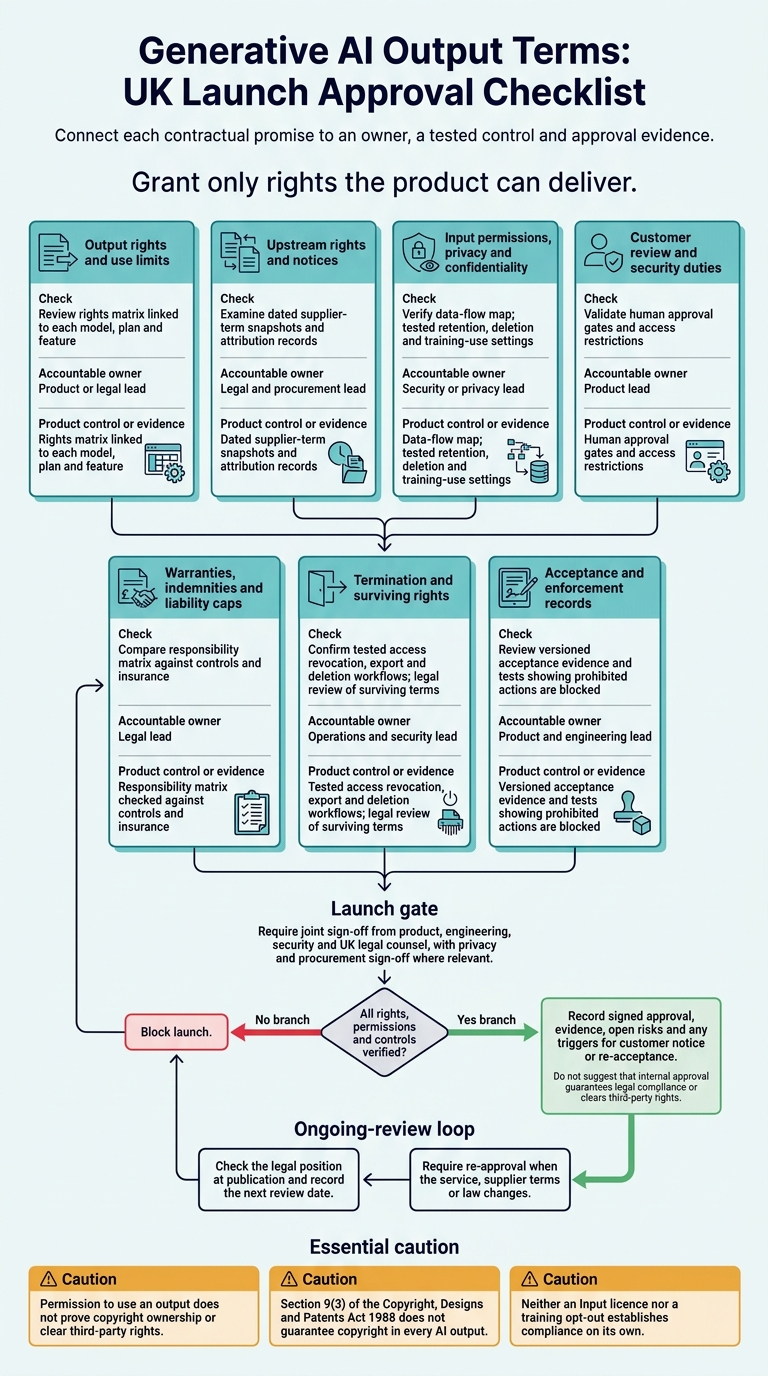 {Generative AI Output Terms: UK Launch Approval Checklist}
:::
Who Owns the Output? AI Copyright & IP Explained w/ Chris Paniewski | Startup Legal Basics
Define Output Rights and Allowed Uses
Define Output as material generated and returned through authorised use of the service. Exclude Inputs, service software, system prompts, model weights, templates, telemetry and third-party material unless expressly included. Clarify whether edits, transformed versions and combined works count as Output, and which parts the rights grant covers. Then turn that definition into a specific grant.
Choose Assignment, Licensing or Contractual Permission to Use
Choose the arrangement that matches how the customer needs to use the Output. Use assignment only for rights the provider can transfer. Use an exclusive or non-exclusive licence where the provider retains ownership, or contractual permission where copyright status is uncertain.
| Arrangement | Scope | Enforceability | Commercial use and limits |
|---|---|---|---|
| Assignment | Transfers specified rights owned by the provider | Must be in writing and signed by or on behalf of the assignor[4] | Suits bespoke deliverables; cannot transfer rights in third-party or unprotected material |
| Exclusive licence | Gives the customer exclusive rights within an agreed scope; the provider retains ownership | Must be in writing and signed by or on behalf of the copyright owner[4] | Supports defined exclusivity; specify acts, territory, duration and reserved rights |
| Non-exclusive licence | Permits specified uses while allowing the provider to grant similar rights to others | Usually requires no particular formalities, though a written record is preferable | Suits standard subscriptions; does not promise that Output will differ from material supplied to others |
| Contractual permission to use | Gives limited contractual authorisation for stated activities | Enforceable according to the contract | Useful where copyright status is uncertain; does not itself confer ownership or broad sublicensing rights |
Set Permissions, Conditions and Restrictions
Don’t stop at “commercial use permitted”. Spell out territory, duration, subscription tier, user limits and attribution, plus rights to modify, translate and combine Output. Treat customer assignment or transfer separately from sublicensing.
State whether rights in previously generated material survive cancellation. Ending platform access need not end contractual permission to use an existing deliverable.
Turn the Output definition into specific permissions, conditions and prohibitions.
| Permission | Conditions | Prohibited or restricted uses |
|---|---|---|
| Internal business use, publication, marketing, modification, combination, software development and incorporation into products | Comply with law, subscription limits, confidentiality duties, attribution rules and human review requirements; hold the necessary rights in Inputs and verify Output before release | Unlawful, defamatory, fraudulent or infringing use; circumventing access controls or security safeguards |
| Employee, contractor and affiliate access | Limit access to authorised personnel covered by confidentiality and security obligations | Credential sharing or access outside the permitted group |
| Resale, distribution or sublicensing | Require the relevant plan and express contractual permission | Resale or sublicensing where the provider has not granted that right |
| Model training, fine-tuning, benchmarking or evaluation | Require separate consent, documented data rights and restrictions on retaining or redistributing Output | Training or evaluation that conflicts with upstream model terms, privacy duties or third-party rights |
| Regulated or high-impact deployment | Require human oversight, validation, records, monitoring and any required approvals | Solely automated decisions or safety-critical deployment without appropriate controls |
Before offering these permissions, check model-provider terms, retrieval sources, licensed datasets and plug-ins. Keep a rights matrix for each model and feature, covering commercial use, resale, training, attribution, territory and post-termination use. Clearly pass on any unavoidable restrictions: customer-facing rights must not exceed those available upstream.
State the Limits of Ownership and Exclusivity
Limit each grant to rights the provider owns or can lawfully grant. Explain that other users may receive similar or identical material. Contractual exclusivity cannot create ownership of unprotected ideas, facts or styles.
Define the scope of any exclusive commitment and put workable controls in place. Reserve service-delivery and improvement rights separately. Keep warranties about accuracy, originality, non-infringement and fitness out of the rights clause.
Define input rights and customer handling duties separately from Output rights.
Define Input Permissions and Customer Duties
Limit Input Licences to Named Purposes
Output rights depend on clear Input rights and handling duties. State that customers keep their existing rights in Inputs. Grant only the non-exclusive rights needed to host, store, reproduce, transmit, format, adapt and process Inputs for named purposes.
Treat service delivery, security monitoring, support, human review, product improvement and model training as separate purposes. Explain how each uses identifiable Inputs, de-identified data, aggregated telemetry and synthetic data. State whether customer content is excluded from training by default, used only with opt-in, or used under a documented improvement programme. Record each choice and enforce it across workspaces, APIs and sub-processors. Explain which security, abuse-prevention, debugging and legal-compliance processing still takes place when training is switched off.
Set retention periods, deletion triggers and deletion methods for active systems, logs, caches and support copies. Distinguish deletion of source Inputs from deletion of derived telemetry, embeddings and evaluation records. Explain how deletion works for backups, disaster-recovery copies and legal holds. Do not promise removal from trained models unless the provider can perform and verify it.
Protect Personal Data and Confidential Information
Require customers to hold the rights, permissions and lawful basis needed to submit personal data, confidential information and third-party content. Identify controller and processor roles under the UK GDPR and Data Protection Act 2018. Customer warranties do not transfer the provider’s statutory duties. Special-category data requires both an Article 6 lawful basis and an Article 9 condition.
Link the terms to a data-processing addendum covering instructions, confidentiality, security, sub-processors, rights requests, breach support, audits, deletion and international transfers. Identify processing locations and safeguards for restricted international transfers. Make sure confidentiality promises match the access allowed for support and human review.
Neither an Input licence nor a training opt-out establishes compliance on its own. Require customers to put these data-use rules into practice.
Require Output Checks and Secure Use
Set customer duties covering legal compliance, intellectual property, sector rules and acceptable use. Require customers to protect credentials, apply least-privilege access, use multi-factor authentication (MFA) and report incidents promptly.
Before generated material is published, distributed or used in operations, require checks of facts, calculations and safety claims, plus labelling where law or policy requires it. If the material incorporates Inputs containing personal data or confidential information, require checks for unauthorised disclosure. Provide a reporting route for exposed or inaccurate personal data. These duties must add to, not replace, the provider’s own obligations.
If a third party later objects, the claims process and liability limits determine the response.
Manage Third-Party Claims and Enforce Terms
Set Procedures for Third-Party Rights Claims
If a customer’s checks leave a rights dispute unresolved, the contract needs a clear notice and response process. These clauses assign responsibility when Outputs lead to disputes. Permission to use an Output does not clear third-party rights. Cover copyright, database rights, trade marks, registered and unregistered design rights, confidentiality, privacy, contractual restrictions, accidental reproduction and open-source or open-content licence terms. Do not imply that the UK has a general standalone publicity right. Any disclaimer about originality or non-infringement must preserve express warranties and indemnities.
Require written notice identifying the disputed Output, any relevant prompt or input, the generation date and time, account identifier, intended use, claimed right, supporting evidence and urgent court or platform deadlines. The provider should acknowledge the notice, assess whether the allegation has support, review logs and available source information, and tell the customer whether to pause use.
Preserve relevant records without changing evidence copies during the investigation. Protect confidentiality and privilege. Allow urgent suspension, followed by modification, replacement, feature restrictions or an agreed refund. State when customers must withdraw existing copies or notify downstream users.
| Responsibility | Provider | Customer | Shared |
|---|---|---|---|
| Investigate claims | Review relevant logs, model configuration and available source information | Supply notice, context and evidence | Preserve records and communicate promptly |
| Suspend or replace | Apply proportionate service controls and offer any agreed remedy | Stop publication or distribution where required | Assess urgency and downstream impact |
| Open-licence compliance | Communicate known licence requirements where identified | Follow attribution, share-alike and notice obligations | Record source and licence information where possible |
| Defence and settlement | Defend or settle only within the agreed indemnity scope | Cooperate and avoid admissions without authority | Agree an approach where rights or facts overlap |
Make these responsibilities subject to applicable law, the service architecture and any negotiated indemnity. State that the provider cannot control third-party platforms or confirm unknown or untraceable provenance. Exclude from any indemnity losses caused solely by customer use without permission.
The claim process should also establish who defends, who pays and when liability shifts.
Align Warranties, Indemnities and Liability Limits
Keep the three mechanisms separate: a warranty makes a promise; an indemnity allocates specified claim costs; and a liability cap limits recovery.
Define the claims covered, who controls the defence, who must consent to settlement, how costs are allocated and which fees can be recovered. Set out notice and mitigation requirements, deductibles, sub-limits and whether replacement or refund is the only remedy.
Tie exclusions to customer inputs, instructions, modifications, third-party material, prohibited use, ignored takedown instructions, post-notice use and open-licence breaches. Check whether upstream protection extends to customers, and set recovery limits for Output-related claims.
Distinguish business terms from consumer terms. Under the Unfair Contract Terms Act 1977, liability for death or personal injury caused by negligence cannot be excluded or restricted. Restrictions on other negligence liability must satisfy the reasonableness test.[6] Under the Consumer Rights Act 2015, unfair consumer terms are not binding. Consumer-facing terms should use plain, intelligible language and preserve mandatory consumer rights.[5][7]
Avoid broad consumer indemnities covering the provider’s negligence or breach. Have qualified advisers check every exclusion against the applicable statutory rules.
Product settings must match the terms for enforcement to work.
Link Acceptance and Terms Versions to Product Controls
Present terms clearly before account creation, purchase, API activation or first paid use, and require explicit acceptance. Record the customer’s identity, workspace, plan, accepted version, timestamp in UK format and relevant settings. Retain historical versions so the permitted use of Outputs and downstream distribution can be established during a claim.
Give advance notice of material changes and explain how they affect existing Outputs. Align download, sharing, training, retention and deletion controls with contractual promises, without implying control over exported copies.
Keep proportionate records of Output identifiers, model versions, retrieval references and claim decisions to support claim responses. Name the people responsible for escalations across legal, security, engineering and support. Review the arrangements after model or source changes, entry into new jurisdictions, major claims, insurance changes or custom-agent deployment.
Conclusion: Check Rights, Duties and Controls Before Launch
Define rights, duties and claims handling before launch. Then check that the contract matches the product’s controls. Grant only rights the product can deliver.
Use the checklist below as a launch gate.
Complete the Output Terms Checklist
Keep one launch register that links each contractual position to an accountable owner, a tested product control and approval evidence.
| Check | Accountable owner | Product control or evidence |
|---|---|---|
| Output rights and use limits | Product or legal lead | Rights matrix linked to each model, plan and feature |
| Upstream rights and notices | Legal and procurement lead | Dated supplier-term snapshots and attribution records |
| Input permissions, privacy and confidentiality | Security or privacy lead | Data-flow map; tested retention, deletion and training-use settings |
| Customer review and security duties | Product lead | Human approval gates and access restrictions |
| Warranties, indemnities and liability caps | Legal lead | Responsibility matrix checked against controls and insurance |
| Termination and surviving rights | Operations and security lead | Tested access revocation, export and deletion workflows; legal review of surviving terms |
| Acceptance and enforcement records | Product and engineering lead | Versioned acceptance evidence and tests showing prohibited actions are blocked |
Require joint sign-off from product, engineering, security and UK legal counsel, with privacy and procurement sign-off where relevant. Block launch if any right, permission or control remains unverified.
Check the legal position at publication and record the next review date. Require re-approval when the service, supplier terms or law changes. Store the evidence, open risks and any triggers for customer notice or re-acceptance with the signed approval.
FAQs
Can human editing make AI output copyright-protected?
Yes - human editing can help, but the editor must make enough original choices for the work to reflect their own input.
For UK end-user terms, Hokstad Consulting advises separating rights to customer materials and prompts, bespoke deliverables and third-party components. Avoid vague promises of “ownership of outputs” without defining which inputs were provided and which rights were actually acquired.
How can we check AI outputs for third-party rights?
Maintain an ownership matrix for models, datasets and software. During procurement or development, record every third-party dependency, its licence, commercial-use limits, attribution requirements, and restrictions on modification or distribution [1].
Keep audit logs with timestamps, model versions and source retrieval data so you can trace outputs back to their inputs and sources [2]. Check these records against contractual terms, pass on all upstream obligations, and address intellectual property risks before deployment [3][1].
When must customers accept updated AI output terms?
Get customers’ acceptance of updated terms before they access or download the service or model weights [1]. For material changes to functionality, data use or pricing, the contract should require at least 30–90 days’ advance written notice [2][3].
Keep existing terms in place during the notice period where safe and lawful [2]. Record the exact version each customer accepts to maintain a clear audit trail [1].