
AI and automation are transforming CI/CD pipelines, making software delivery faster, smarter, and more reliable. Traditional pipelines often lag behind the rapid pace of AI-driven code creation, but new advancements are bridging this gap. Key trends include:
- AI-powered predictive analytics: Tools like XGBoost predict build failures with 89.7% accuracy, saving time and resources.
- Self-healing pipelines: AI agents diagnose and fix issues automatically, cutting Mean Time to Recovery (MTTR) by over 50%.
- Generative AI: Automates tasks like test creation, pipeline configuration, and documentation through natural language prompts.
- Zero-touch deployments: Fully autonomous systems monitor, verify, and roll back changes without manual intervention.
These innovations reduce downtime, boost efficiency, and lower costs. However, challenges like AI model drift and hallucinations require careful management. Combining automation with human oversight ensures pipelines remain effective as they evolve. By 2030, AI-driven CI/CD is expected to dominate, with natural-language infrastructure replacing complex configurations.
::: @figure 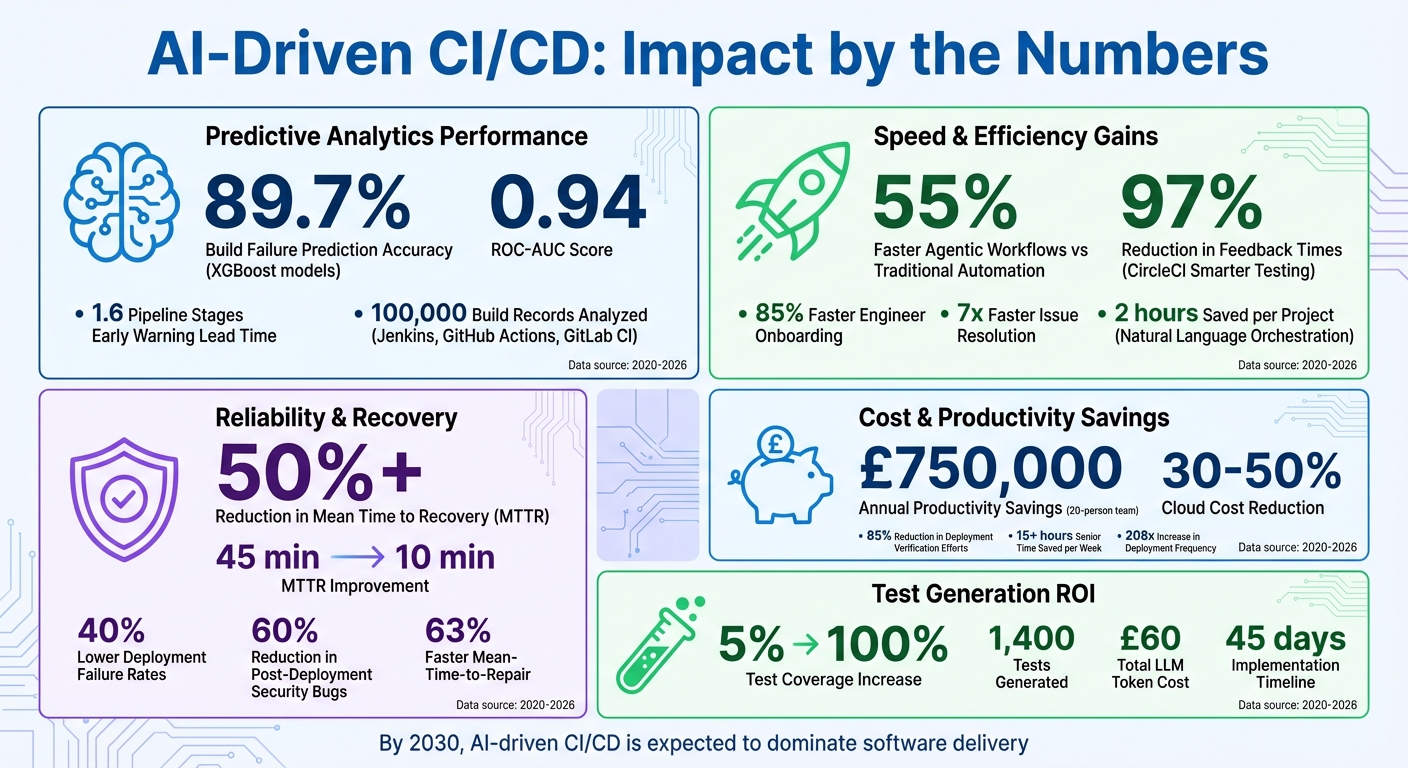 {AI-Driven CI/CD Impact: Key Statistics and Performance Metrics}
:::
{AI-Driven CI/CD Impact: Key Statistics and Performance Metrics}
:::
Prompting Productivity: Integrating AI into CI/CD Pipelines - Marcos Lilljedahl
Need help optimizing your cloud costs?
Get expert advice on how to reduce your cloud expenses without sacrificing performance.
AI-Powered Predictive Analytics in CI/CD
Predictive analytics takes CI/CD from being reactive to proactive. Using AI models like XGBoost, teams can analyse commit metadata, past test results, and pipeline metrics to predict build failures before they happen. These models uncover complex patterns in build data, providing what researchers call an Early Warning Lead Time
(EWT). This EWT gives teams a chance to address potential issues several stages before a complete build failure occurs[8].
The impact of this approach is backed by data. In a study of 100,000 build records from Jenkins, GitHub Actions, and GitLab CI (2020–2024), researchers Rajesh Kumar and Divya Naga Deepika Kollipara showed that XGBoost models achieved 89.7% accuracy and a 0.94 ROC-AUC in predicting build failures[8]. Even more crucially, these models provided an Early Warning Lead Time of about 1.6 pipeline stages, enabling teams to halt problematic builds early, saving both time and compute resources[8]. This proactive detection significantly boosts pipeline efficiency and reliability.
Benefits of Predictive Analytics in CI/CD
AI-driven predictive analytics directly improves DORA metrics. By identifying risky code changes during the Pull Request phase, AI tools can suggest unit tests for untested paths and flag potential null pointer issues before code is merged[4]. Self-healing pipelines equipped with anomaly detection can also sense production issues and initiate automated rollbacks, cutting Mean Time to Recovery (MTTR) by over 50%[9].
The resource savings are equally impactful. Early failure detection reduces wasted build cycles, allowing organisations to optimise deployment times and focus on delivering features instead of debugging failed builds[8].
AI in Failure Detection: Practical Applications
In September 2025, Guruprasad Raghothama Rao, a Senior Software Engineer at Wiser Solutions Inc., implemented an AI assistant into a cloud-native CI/CD pipeline. The AI generated a test case (test_empty_input_payload) that caught a critical regression involving a transformation function failing on empty lists - an edge case overlooked by human reviewers[4]. By shifting to an asynchronous AI integration, the system maintained high reliability while preserving safety benefits[4].
AI-driven build failure prediction enhances CI/CD efficiency by enabling earlier detection of failures and reducing wasted build efforts.– Rajesh Kumar, Lead Author, Spectrum of Engineering Sciences[8]
Another example comes from GitLab Duo Root Cause Analysis. In June 2024, the tool diagnosed a ModuleNotFoundError in a Python application by identifying that a newly added Redis caching client was missing from the environment. When the job failed again due to a missing service, the AI pinpointed the issue: no Redis service was running. It even provided the correct .gitlab-ci.yml configuration to fix the problem[10]. These examples highlight how intelligent CI/CD pipelines are evolving to not just report failures but actively reason through them, making them far more effective.
Automation Advances in CI/CD Pipelines
Automation in CI/CD pipelines has taken a major leap forward with the integration of AI, transforming static scripts into dynamic, goal-driven workflows. These workflows, powered by autonomous AI agents, can adapt to changing contexts and optimise processes on the fly, marking a significant shift in how pipelines are managed [2].
Research highlights the impact of this shift: agentic workflows are 55% faster than traditional automation [17]. For example, CircleCI's Smarter Testing
feature has reduced feedback times by 97%, as it uses AI to run only the tests relevant to specific code changes rather than executing the full suite [3]. By autonomously assessing code changes and their implications, AI minimises manual intervention while maintaining pipeline health. These advancements pave the way for even more sophisticated implementations, such as zero-touch deployments and case studies showcasing AI's potential in software delivery.
AI Agents for Pipeline Orchestration
AI agents are now fully integrated into CI/CD pipelines, functioning as core components of the workflow. Platforms like Harness have introduced agents that operate within the pipeline's ecosystem, inheriting its execution context, security parameters, and governance protocols [11]. These agents utilise an Engineering Knowledge Graph
, which provides a detailed understanding of service configurations, historical data, and infrastructure states. This allows them to make precise, data-informed decisions rather than relying on generic recommendations [11][15].
The results speak for themselves. In July 2025, Harness reported that its AI-driven agents enabled organisations to onboard new engineers 85% faster and resolve issues seven times quicker [15].
When we founded Harness, we believed AI would be a core pillar of modern software delivery. These new capabilities bring that vision to life… This is AI built for the real world of software delivery, governed, contextual, and ready to scale.– Jyoti Bansal, CEO and co-founder of Harness [15].
Specific agents like AutoFix
and Manifest Remediator
are already making an impact. They can analyse logs, diagnose failed Kubernetes deployments, and autonomously generate and propose fixes through pull requests [11][12]. CircleCI has also introduced Chunk
, an agent designed to identify and resolve flaky test patterns by suggesting fixes directly through pull requests, enhancing pipeline reliability with less manual effort [3].
Another exciting development is natural language orchestration. With this feature, engineers can configure pipelines and stages using conversational prompts instead of manually editing YAML files. This innovation has saved developers an average of two hours per project by automating repetitive tasks [13][15].
Zero-Touch Deployments
The evolution of CI/CD automation is heading towards zero-touch deployments, where pipelines become entirely self-managing. These systems use AI-driven Continuous Verification
to monitor deployments against critical metrics like performance, quality, and revenue. If anomalies are detected, they can automatically roll back changes [14]. Studies show this approach reduces deployment verification efforts by 85% [14].
At the heart of zero-touch deployments are self-healing feedback loops. When a pipeline encounters a failure, AI agents diagnose the issue, create a fix in a new branch, and open a pull request for human review. This process keeps pipelines in a stable state with minimal downtime [16].
However, implementing zero-touch systems requires a phased approach. Teams are advised to begin with a suggestion-only
mode, where agents provide recommendations rather than making direct changes [2]. Over time, as confidence in the system grows, organisations can allow agents to push fixes to forked branches and eventually grant full autonomy, with human oversight at key points [17]. Tools like Open Policy Agent (OPA) help enforce security and compliance boundaries, ensuring agents operate within pre-defined limits [11][15].
Self-Healing Pipelines: Improving Reliability
Self-healing pipelines bring automation to error diagnosis, fix generation, and validation, cutting down on the need for developers to step in manually. When a build fails, an AI agent analyses logs and metadata to categorise the issue - whether it's a flaky test or infrastructure drift. From there, it generates a code fix, tests it in a replicated environment, and even creates a pull request for review, all without human intervention [16][19][20][21].
It's important to distinguish between suggestion tools and healing engines. While suggestion tools simply point out problems, healing engines handle the entire cycle - from identifying the issue to implementing and validating a fix. This level of automation reduces the constant task-switching developers face, allowing them to focus on higher-value work. By integrating AI-driven predictive analytics and orchestration, these systems enhance the reliability of modern CI/CD pipelines.
The results speak for themselves: AI-powered self-healing systems have shown a 55% reduction in Mean Time to Recovery (MTTR). For example, a financial SaaS platform cut its pipeline reruns by 65% and brought its MTTR down from 45 minutes to under 10 minutes. By eliminating repetitive debugging - often consuming up to 30% of a developer's time - a 20-person team could save around £750,000 annually in productivity losses [19][20][22].
Reinforcement Learning for Self-Healing
Reinforcement learning (RL) is playing a key role in advancing self-healing capabilities. By analysing historical deployment data, RL agents can automatically address infrastructure failures and configuration drift. Unlike static rule-based systems, these agents adapt and improve their strategies based on outcomes, refining processes like rollback triggers and canary releases over time [6][23].
The technical setup often blends various AI techniques. Large language models (LLMs) are used for precise log analysis - frameworks like LogParser-LLM have achieved up to 98% accuracy in identifying root causes. Meanwhile, unsupervised methods such as autoencoders and isolation forests establish baseline behavioural models, enabling real-time anomaly detection. Multi-agent systems further enhance performance by coordinating remediation efforts across different areas, achieving up to 5.76 times the efficiency of manual debugging [22][23].
Different types of failures require specific healing strategies. For flaky tests, auto-retry mechanisms with exponential backoff are triggered. Infrastructure drift is handled through workflows powered by reinforcement learning, while Docker pull failures might switch to mirrored registries. Merge conflicts, on the other hand, often initiate auto-rebase sequences followed by validation reruns. With the market for AI-driven self-healing DevOps projected to grow from $942.5 million in 2022 to $22.1 billion by 2032, it's clear that these technologies are reshaping the field [19][23].
Cost Reduction Through Self-Healing
Self-healing systems don’t just improve reliability - they also deliver significant cost savings by reducing downtime and avoiding redundant processes. For a 20-person engineering team, automating even one extra hour of focused work per developer each day could translate into annual productivity gains of about £750,000 [20][21]. These systems address common failure types - like linting errors or formatting issues - automatically, preventing the need for repeated job executions.
Pre-merge CI phases, for instance, have been found to fail at a rate of 5:3 compared to post-merge phases, with 15 times more checks run annually [20]. Self-healing automation tackles these repetitive issues without human input. Additionally, cloud infrastructure costs benefit from asynchronous AI diagnostics, which avoid delays in the main build pipeline. Circuit breakers also help control spending by disabling AI stages when costs or latency exceed set thresholds [4]. Organisations with advanced DevOps practices using AI have reported a 208-fold increase in deployment frequency, resulting in faster delivery times and lower holding costs [22].
Generative AI in CI/CD Toolchains
Generative AI is reshaping Continuous Integration and Continuous Delivery (CI/CD) by enabling the creation of complete pipelines, automated test writing, and documentation through plain language prompts. This shift builds on earlier advancements in predictive analytics and pipeline orchestration, highlighting AI's expanding role in modern development workflows. Instead of relying on YAML configuration files, teams can now use conversational instructions that AI translates directly into production-ready code.
Improved Efficiency with Generative AI
In July 2025, Harness introduced AI capabilities that allowed engineers to describe pipeline requirements in plain English. Early adopters saw impressive results, including 85% faster pipeline onboarding and 7x faster issue resolution compared to traditional manual configuration methods [15]. Rohan Gupta, Product Lead at Harness, showcased how the platform leverages templates and governance policies to ensure pipelines meet organisational standards, eliminating the need for extensive YAML expertise.
Google Cloud adopted a similar strategy in November 2024 with the friendly-cicd-helper
tool, developed by Giovanni Galloro and Daniel Strebel. Integrated into Cloud Build pipelines, this tool uses Gemini models to analyse Git diffs and automatically generate code reviews and release notes within GitLab merge requests [24]. By automating tasks that once required manual review, developers can now dedicate more time to implementation.
Generative AI has also transformed test generation. In February 2026, GitHub Next, under Idan Gazit's leadership, ran an experiment where an AI agent increased a repository's test coverage from 5% to nearly 100% over 45 days. The AI generated 1,400 tests for just £60 in LLM token costs [1]. These tests were delivered as small, incremental pull requests, making it easier for developers to review and integrate them without being overwhelmed by large code changes.
| Capability | Specific Task | Impact Metric |
|---|---|---|
| Pipeline Generation | Natural language to YAML config | 85% faster onboarding [15] |
| Automated Review | PR risk flagging and summaries | 68% reduction in cycle time [25] |
| Test Creation | Edge-case and unit test generation | 92% coverage achieved [25] |
| Troubleshooting | Log analysis and root cause ID | 7x faster resolution [15] |
Faster Deployment Times
These advancements don’t just improve efficiency - they also speed up deployment. AI-enhanced pipelines have been shown to reduce deployment failure rates by 40% without requiring additional engineering resources [18]. Organisations using automated anomaly detection have also reduced post-deployment security bugs by 60% and achieved a 63% faster mean-time-to-repair (MTTR) [18]. These gains come from AI's ability to prioritise testing based on historical defect patterns and change impact, rather than treating all test paths equally.
The time savings extend beyond deployment. By automating code reviews, test generation, and documentation updates, teams save an estimated 15+ hours of senior engineering time per week [18]. This freed-up time allows developers to focus on creating new features instead of being bogged down by maintenance. However, integrating AI into CI/CD pipelines requires careful planning. For instance, when Wiser Solutions Inc. added an LLM assistant to their pipeline in September 2025, runtime initially increased from 8 minutes to 22 minutes. Moving the AI to an asynchronous path resolved the slowdown while retaining its benefits [4]. This example highlights the importance of thoughtful implementation as AI becomes an integral part of CI/CD processes.
Challenges and Solutions in AI-Driven CI/CD
With advancements in automation and AI, new challenges have emerged that could undermine their potential benefits. Incorporating AI into CI/CD pipelines introduces technical hurdles that might disrupt efficiency. While tools like generative AI and predictive analytics bring powerful capabilities, they also come with issues like model drift, hallucinations, and integration difficulties. Tackling these challenges with practical solutions is key to ensuring pipelines remain reliable and cost-effective.
AI Model Drift and Maintenance
AI models used in CI/CD systems can degrade over time as codebases change and data distributions shift - a phenomenon known as model drift. This drift can create inconsistencies, especially when floating aliases (like latest
) are used instead of fixed versions. Consequently, AI-generated patches might pass initial tests but fail later, leading to a loss of trust among developers.
Hallucinations are another issue, where models incorrectly flag problems, such as marking valid imports as unused or suggesting incompatible testing frameworks. Guruprasad Raghothama Rao, a Senior Software Engineer at Wiser Solutions Inc., highlighted this concern:
AI output is untrusted input. I built cheap, layered checks to keep noise out[4].
To address this, his team implemented layered validation using static analysis tools and linters before presenting AI outputs to developers.
To manage drift effectively, organisations can adopt strategies like prompt and model pinning - versioning prompts alongside dated model snapshots (e.g., gpt-4o-2024-08-06). Setting temperature=0 ensures deterministic decoding, producing consistent outputs. These methods have led to measurable improvements in analytics-powered pipelines: MTTR dropped from 6.2 hours to 2.1 hours, anomaly detection accuracy rose from 68.2% to 92.4%, hallucination rates decreased from 12.3% to 6.1%, and response accuracy climbed from 84.7% to 91.6% [26].
Combining Human Expertise with AI Automation
To address challenges like drift and hallucinations, blending AI automation with human expertise is crucial. The most effective pipelines don't replace human judgement; they complement it. Idan Gazit, Head of GitHub Next, captured this idea perfectly:
Any time something can't be expressed as a rule or a flow chart is a place where AI becomes incredibly helpful[1].
Building trust-tier frameworks is key. Start by using AI as a suggestion tool, gradually moving towards autonomous actions as trust grows. This can include policy-as-code guardrails using tools like Open Policy Agent to define clear, machine-readable boundaries for AI decisions. Circuit breakers can also be added to disable AI stages if costs or latency exceed acceptable limits. For performance, asynchronous integration allows builds to finish deterministically while AI provides feedback separately. Labelling AI feedback as '[Advisory]' ensures developers see it as recommendations, keeping critical decisions in human hands.
This balanced approach - where AI focuses on pattern recognition and repetitive tasks, while humans handle validation and judgement - helps maintain the stability and efficiency of CI/CD pipelines, even as codebases evolve and models adapt.
The Future of AI in DevOps: Hokstad Consulting's Perspective
The trends highlighted in this article suggest a major transformation in how organisations will build and deploy software by 2030. Traditional YAML-based pipelines are expected to give way to natural-language infrastructure, where developers can specify high-level intents like flag performance regressions in critical paths
, and AI agents will handle the execution [1]. This evolution promises faster deployments and systems that improve continuously through learning [7].
The statistics driving this shift are striking: nearly 30% of engineers lose a third of their workweek to repetitive infrastructure tasks, 62% of DevOps teams cite security and compliance as their biggest challenge in 2026, and 80% of engineering leaders support agent-based automation with human oversight [28]. By 2030, cost and capacity metrics will take centre stage, with pipelines assessing rollout plans based on cost-to-validate
and cost-to-rollback
rather than just speed [27]. These changes frame Hokstad Consulting's approach to integrating AI into DevOps as both timely and essential.
Hokstad Consulting's Expertise in AI Agents
Hokstad Consulting specialises in bridging the gap between speed and strategy with their AI-driven solutions for DevOps and broader business processes. Their approach is built on the four core principles of agentic CI/CD: well-defined workflow triggers and permissions, isolated sandboxes for execution, safe operation defaults (like read-only access), and human oversight for critical decisions [2]. This framework aligns with the AI-powered pipeline advancements discussed earlier, ensuring that technical progress translates into operational improvements.
Their expertise also extends to cloud cost efficiency. Hokstad Consulting helps organisations optimise pipelines for both speed and resource usage, cutting cloud costs by 30–50% through smarter resource allocation based on historical data [5]. With capabilities in custom development and automation, they also deploy specialised agents for tasks like monitoring dependency drift and conducting performance audits [1].
Preparing for AI-Driven CI/CD
Transitioning to AI-driven CI/CD requires a thoughtful, step-by-step approach. Start with assist
rather than auto
, treating autonomy as a spectrum. Begin by piloting AI in low-risk tasks - such as generating release notes or triaging issues - before moving to roles that require write access [27][2]. Next, examine workflows to pinpoint recurring, judgement-heavy tasks that distract developers, and focus on automating these areas [27][1]. Use predictive and self-healing capabilities to prioritise automation opportunities. Additionally, it’s crucial to implement policy-as-code guardrails with tools like Open Policy Agent to enforce strict operational limits for AI agents [6].
Working with experts like Hokstad Consulting can help streamline this transition. Their DevOps transformation services, which include automated CI/CD pipelines, advanced monitoring tools, and ongoing infrastructure support, provide a strong foundation for safely adopting AI agents. With flexible engagement options - from project-based consulting to retainer agreements - they help organisations scale AI adoption at a pace that matches their technical readiness. As Shubha Govil, Chief Product Officer at Sauce Labs, remarked:
In 2026, infrastructure is not going to be about automation; it's going to be about adaptability[7].
Hokstad Consulting’s deep knowledge of AI strategy and cloud infrastructure positions businesses to achieve self-scaling, autonomous delivery systems, setting them up for a competitive edge by 2030.
FAQs
How do AI models predict CI/CD build failures?
AI models leverage machine learning to anticipate CI/CD build failures by examining historical data, including commit metadata, test outcomes, and pipeline metrics. By recognising patterns tied to past failures, these models provide valuable insights. Methods like root cause analysis and advanced frameworks, such as Graph Neural Networks, refine this process by pinpointing issues and mapping intricate dependencies. The result? Early warnings, quicker problem-solving, and stronger, more reliable CI/CD pipelines.
What’s the safest way to start with self-healing pipelines?
To kick off with self-healing pipelines safely, start by leveraging AI agents to automatically diagnose and fix build failures. A good first step is adding a promotion trigger that activates a self-healing pipeline whenever a failure occurs. This pipeline can then deploy an AI agent to review logs, pinpoint problems, and propose or implement fixes.
It’s essential to have a thorough grasp of your CI environment before diving in. Carefully integrate AI tools and introduce autonomous fixes step by step. This gradual approach helps ensure a smoother transition and builds trust in the system's capabilities.
How can teams prevent AI drift and hallucinations in CI/CD?
Teams can reduce the risks of AI drift and hallucinations in CI/CD pipelines by implementing several key strategies. Using oracles and baselines helps establish a reference point for AI performance, while running AI systems in shadow mode allows teams to monitor their behaviour without impacting live operations. Additionally, introducing strict gates and audit processes ensures a higher level of oversight and accountability.
To maintain consistency and reliability, it's crucial to control prompts, manage seed models, and track traceable artefacts. These practices support reproducibility and make it easier to audit AI outputs, which is vital for building trust in the system's results.