
In multi-cloud setups, organisations often juggle complex pricing structures across providers like AWS, Azure, and Google Cloud. This complexity can lead to overspending by 28–35%. To avoid this, here’s what you need to know:
- Key Challenges: Hidden costs (data egress fees), difficulty comparing pricing, and overcommitting to cloud resources.
- Common Mistakes: Misaligned usage forecasts, ignoring transfer/networking costs, and poor cost visibility.
- Effective Strategies: Consolidate spend data, optimise usage before negotiating, and secure contract flexibility (e.g., termination clauses, ramp schedules).
- Governance: Use consistent tagging, automated tools, and regular cost reviews to prevent waste (up to 35% in multi-cloud environments).
Procurement in a Mature FinOps Organization: Multi-cloud Discounting, Contracting, Invoicing at Uber

Need help optimizing your cloud costs?
Get expert advice on how to reduce your cloud expenses without sacrificing performance.
Common Mistakes to Avoid in Multi-Cloud Contracts
::: @figure 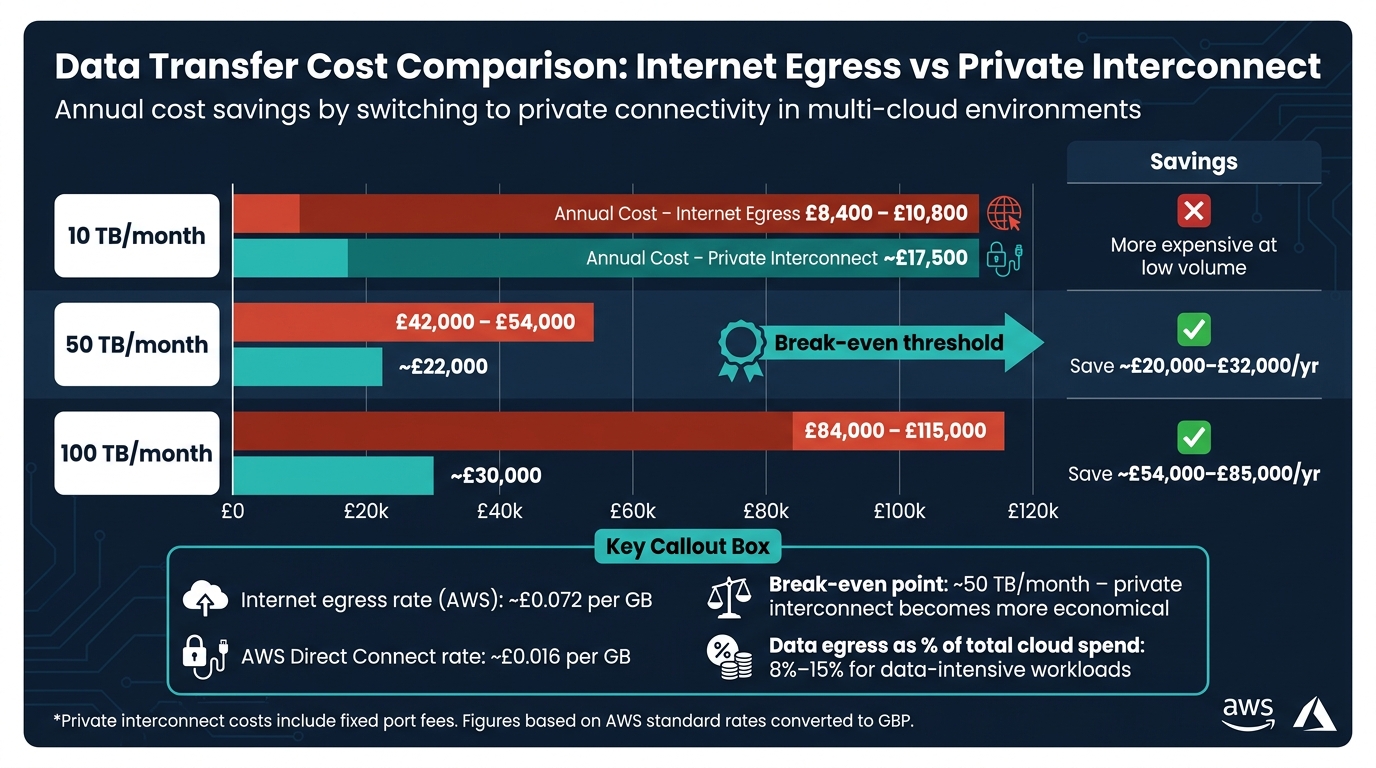 {Multi-Cloud Pricing: Data Transfer Costs – Internet vs Private Interconnect}
:::
{Multi-Cloud Pricing: Data Transfer Costs – Internet vs Private Interconnect}
:::
Even organisations with highly skilled technical teams often stumble when navigating the commercial aspects of multi-cloud contracts. These mistakes usually become apparent months into the agreement, making renegotiation a difficult and costly endeavour. Below are some key pitfalls to watch out for and how to sidestep them.
Misaligned Commitments and Usage Patterns
One of the most expensive mistakes is overcommitting to cloud resources. Companies often make optimistic forecasts about their needs and end up paying for unused capacity. On the flip side, undercommitting can lead to missed opportunities for discounts.
A practical approach to avoid this is the 70–75% rule: commit to only 70–75% of your forecasted consumption during the first year of a new contract [1]. This provides flexibility for unexpected changes, such as workload adjustments, architecture updates, or sudden growth surges. Negotiators sometimes refer to overcommitting as landing in the penalty box
- paying for resources you don’t use.
The strongest commitment base is usually 60–80% of the truly stable workload, not 100% of current spend. Leave headroom for releases, growth spikes, and architecture drift.- IT Negotiations [5]
Additionally, be cautious of best effort
clauses in contracts. These clauses can mean providers are not obligated to deliver your committed resources during peak demand, even if you’ve paid for them at a discounted rate [2]. To protect yourself, negotiate for specific instance families, regions, and delivery windows, and secure financial remedies for any shortfalls. Aligning commitments with realistic forecasts can save you from costly penalties and resource shortages.
Underestimating Data Transfer and Networking Costs
Networking costs are another area where organisations often miscalculate, particularly when it comes to data transfer fees. Data egress charges - the cost of moving data out of a cloud environment - can make up 8% to 15% of total cloud spend for data-intensive workloads [3].
These costs add up quickly. For example, transferring 1 petabyte (PB) of data each month at AWS’s standard rates costs around £72,000 [3]. To reduce these expenses, consider switching from public internet connections to private interconnects like AWS Direct Connect or Azure ExpressRoute. Private interconnects significantly lower the per-gigabyte cost - AWS Direct Connect charges approximately £0.016 per GB, compared to £0.072 per GB over the public internet [8].
Here’s how the costs compare annually:
| Monthly Transfer Volume | Annual Cost (Internet Egress) | Annual Cost (Private Interconnect) |
|---|---|---|
| 10 TB | £8,400 – £10,800 | ~£17,500 |
| 50 TB | £42,000 – £54,000 | ~£22,000 |
| 100 TB | £84,000 – £115,000 | ~£30,000 |
Note: Private interconnect costs include fixed port fees in addition to reduced egress rates [8].
Private connectivity becomes more economical at around 50 TB per month. However, these costs should not be left to chance. Providers may offer egress fee waivers or caps, but only if you negotiate them explicitly. These concessions can often be included in Enterprise Discount Programmes (EDP) or Microsoft Azure Consumption Commitments (MACC) [3].
Lack of Governance and Unified Cost Visibility
Disparate billing formats across cloud providers can make it nearly impossible to gain a clear view of your spending. AWS, Azure, and Google Cloud all use different systems for reporting costs - AWS provides Cost and Usage Reports (CUR), Azure uses Cost Management Exports, and GCP processes billing data through BigQuery [6]. Without additional tools, directly comparing these reports is a headache.
This lack of unified visibility puts organisations at a disadvantage during negotiations, especially when cloud providers have detailed insights into your consumption patterns. As FinOps expert Kelsey Rosen explains:
Cloud cost visibility at scale refers to an organisation's ability to track, attribute, and act on cloud spending across distributed infrastructure... in near real time and without manual reconciliation.[10]
To address this, implement a unified tagging strategy across all providers. Use automated policy engines to enforce consistent tagging by environment, team, project, and cost centre. This approach allows you to track spending accurately and catch anomalies early [9][10]. Consistent tagging not only improves cost allocation but also strengthens your position during pricing discussions. The FinOps Open Cost and Usage Specification (FOCUS) offers a practical framework for standardising billing data across providers, making it easier to manage multiple contracts [6].
Practical Strategies for Multi-Cloud Pricing Negotiation
Use Consolidated Multi-Cloud Spend Data
When it comes to negotiation, having strong, consolidated data is essential. AWS, Azure, and Google Cloud all report costs differently, making direct comparisons tricky unless you first normalise the data. By converting everything into GBP and aligning equivalent services - such as AWS EC2 instances with Azure Virtual Machines or GCP Compute Engine - you create a clear, unified view of your total spend. This clarity, combined with a primary plus secondary
cloud strategy, can give you a stronger position at the negotiation table.
For example, in March 2026, a global manufacturing company used its ongoing evaluation of AI workloads between Azure OpenAI and GCP Vertex AI as leverage during an AWS contract renewal. AWS, aiming to retain its position as the company’s primary cloud
, offered a 19% better discount rate on an EDP renewal than in their previous agreement [4].
Optimise Before You Negotiate
Once your spend data is consolidated, the next step is to clean up unnecessary infrastructure. Negotiating discounts on wasteful resources is a common and costly mistake. If you commit to a contract before rightsizing your workloads, you’re effectively paying discounted rates on resources you don’t need. The priority should always be usage optimisation before rate optimisation.
Start by identifying and removing unused or orphaned
resources, which often linger from past projects or proof-of-concepts that were never fully decommissioned. These overlooked resources can account for 20–35% of secondary provider costs [7]. Tools like AWS Compute Optimizer, Azure Advisor, and GCP Recommender can help pinpoint areas for improvement. By rightsizing your workloads and eliminating waste beforehand, you establish a lean, accurate baseline for negotiation. Discounts applied to this optimised baseline are far more meaningful than those applied to inflated costs.
Negotiate for Flexibility as Needs Change
Long-term, rigid commitments can be risky, especially for organisations that experience rapid changes in workloads, team sizes, or architecture. The solution lies in negotiating flexibility directly into your contracts.
Include 90–180 day termination and flex-down clauses to adjust commitments as your needs evolve [1][11]. GCP’s spend-based Committed Use Discounts (CUDs) are a good example, offering up to 46% savings over three years across a service family, rather than tying discounts to specific resources [1]. On the data egress front, leverage the EU Data Act and portability obligations to negotiate waivers or caps on egress fees, which can make up 5–15% of total cloud costs in data-heavy environments [1][3].
It’s also wise to set initial commitment levels at 70–75% of your projected stable consumption for the first year. This approach leaves room for growth, architectural changes, and any forecasting errors, while avoiding penalties for unused capacity. Establishing flexible terms early on creates a foundation for better cost management across your entire multi-cloud setup.
Aligning Contracts with DevOps and Transformation Goals
Integrating DevOps processes with customised pricing models and adaptable contracts can effectively support the demands of a multi-cloud strategy as it evolves.
Match Pricing Models to DevOps Pipelines
Pricing models should reflect the specific requirements of each workload. For example, CI/CD pipelines, which are often bursty and interruptible, work well with Spot or Preemptible instances. These options can deliver savings of up to 60–91% compared to on-demand rates [12]. On the other hand, production workloads need consistent and reliable capacity, making Reserved Instances or Savings Plans more suitable. Meanwhile, dev and test environments benefit from the flexibility of a pay-as-you-go model.
| Workload Type | Recommended Pricing Model | Key Benefit |
|---|---|---|
| CI/CD Pipelines | Spot / Preemptible | Significant cost reductions |
| Production | Reserved / Savings Plans | Stability and guaranteed capacity |
| Dev / Test | Pay-As-You-Go | Usage flexibility |
| Batch Processing | Spot / Scheduled | Cost efficiency via arbitrage |
By aligning pricing models with workload characteristics, organisations can optimise costs and avoid unnecessary expenses.
Build Flexibility for Modern Architectures into Contracts
Modern cloud architectures, driven by Kubernetes, serverless technologies, and hybrid cloud setups, are constantly changing. To accommodate this, consider opting for Convertible Reserved Instances or Savings Plans instead of standard reservations. These options allow adjustments to instance families or regions as your needs evolve [1]. Additionally, negotiating a 24–36 month deprecation notice gives your team time for necessary refactoring [1].
Standardising tools like Kubernetes and Terraform, along with using open data formats such as Parquet or PostgreSQL, can help maintain portability between cloud providers. This approach reduces the risk of vendor lock-in and avoids steep commercial penalties [12]. Furthermore, securing clear data-export SLAs ensures protection against rising egress fees [12][2].
Such contractual flexibility ensures your agreements remain aligned with the rapid changes in modern cloud environments.
Align Contract Milestones with Transformation Phases
Cloud transformation is rarely linear and can bring unexpected shifts - whether phases extend, accelerate, or uncover new requirements. To stay aligned with these changes, structure your contracts around transformation phases, leveraging optimised spending data and adaptable terms.
For instance, request ramp schedules that adjust spending based on projected growth. Spend could start at 70–75% of projected consumption in the first year and rise to 80–85% in the second year as your trajectory becomes clearer [1]. Additionally, tie migration credits and architectural support to critical milestones, such as moving from pilot testing to full-scale deployment [5].
Including drawdown flexibility in contracts allows spending to shift between commitment periods if your transformation phases progress at an unexpected pace [3]. If your organisation anticipates structural changes like mergers, acquisitions, or major restructuring, ensure your contracts include material change provisions. This ensures your infrastructure commitments remain aligned with your evolving business needs [1][3].
Governance and Continuous Cost Management in Multi-Cloud
Negotiating good multi-cloud contracts is just the beginning; without ongoing governance, those hard-won savings can quickly slip away. Studies show that unmanaged cloud contracts lead to a 30–50% waste in cloud spending, with multi-cloud setups experiencing up to 35% more waste [14][13]. To prevent this, a solid governance framework is crucial.
Build a Multi-Cloud Cost Governance Framework
At the heart of effective governance is a cross-functional group, often called a FinOps Guild or Cloud Cost Council. This team, which includes representatives from engineering, finance, and platform leadership, meets weekly to review spending and ensure policies are upheld - not just reported [15].
One key area to tackle is tagging. Consistent tagging across providers like AWS, Azure, and GCP is vital, yet 46% of companies struggle with tagging accuracy for cost allocation [14]. Tools such as Open Policy Agent (OPA) or AWS Service Control Policies (SCPs) can enforce tagging compliance directly in the CI/CD pipeline [9][14]. Here’s a quick look at the core tags every organisation should standardise:
| Tag Key | Purpose | Example Values |
|---|---|---|
cost-centre |
Assigns costs to business units | CC-1234, Marketing, Engineering |
environment |
Tracks the lifecycle stage | production, staging, development |
owner |
Assigns accountability for resources | team-payments, [email protected] |
project |
Links resources to business initiatives | checkout-v2, data-migration-2026 |
managed-by |
Tracks infrastructure management tools | terraform, pulumi, manual |
A unified tagging system combined with cost normalisation strategies (like FOCUS) enables organisations to compare spending across providers in standardised units, such as £ per vCPU-hour [6][13].
Monitor and Optimise Costs Regularly
Using machine learning for anomaly detection can help identify cost spikes within 24–48 hours, cutting down the typical 31-day delay in spotting waste [9][13][14].
Take this example: in February 2026, a Series C SaaS company with a £1.6M annual cloud spend implemented a 90-day FinOps framework. By introducing unified tagging (98% compliance), a centralised Grafana dashboard, and OPA cost guardrails, they reduced their monthly spend from £133,000 to £96,000 - a 28% reduction. This saved them approximately £444,000 annually while increasing their commitment coverage from 15% to 75% [13].
Pairing anomaly detection with monthly cost reviews ensures a steady focus on unit economics, such as cost per customer, transaction, or API call. This shifts discussions from raw spending to business value [6][15]. Regular reviews also create a strong foundation for smarter contract renegotiations.
Take a Long-Term Approach to Contract Negotiation
Contract renewals are more than just administrative tasks - they’re opportunities to apply lessons learned and refine your strategy. Insights from continuous governance can give you a stronger position at the negotiation table. Instead of simply renewing terms, treat renewals as part of a long-term cost management plan, using data from previous contracts to adjust commitments.
Keeping a credible presence across multiple cloud providers can lead to better discounts. Multi-cloud buyers often secure 8–15% higher discounts than single-cloud buyers [4]. A good rule of thumb is to maintain a 70% commitment across providers, rebalancing quarterly as usage patterns evolve [15]. Use independent 12- and 36-month baseline models rather than relying on vendor projections [3][1]. Firms like Hokstad Consulting specialise in cloud cost engineering and audits, helping businesses approach renewals with accurate data and clear strategies.
Conclusion: Getting Multi-Cloud Pricing Negotiations Right
Multi-cloud pricing negotiation isn't a one-off task - it’s an ongoing process that requires careful planning and execution. The strategies discussed earlier work hand-in-hand: consolidating your spending data strengthens your position, optimising usage before entering negotiations ensures you're not overcommitting, and building flexibility into contracts safeguards against changing needs. Aligning these contracts with your organisation's DevOps and transformation goals ensures that your agreements support operational realities.
The numbers speak for themselves: without disciplined negotiation and strong governance, organisations risk overspending and losing out on potential discounts and efficiencies. A structured approach to multi-cloud management ensures that costs remain under control while taking full advantage of the benefits.
As Maya Thompson puts it:
The strongest lever you have is not charm, but evidence: usage telemetry, credible forecasts, and a well-structured commitment plan.- Maya Thompson, Senior Cloud Procurement Editor [5]
When it comes to renewing contracts or implementing a new multi-cloud strategy, start with accurate data and a clear framework for commitments. Use the commitment strategies outlined earlier, and begin renewal negotiations 6–9 months before contracts expire. This allows time for proper benchmarking and technical audits [5].
For organisations looking for expert support, Hokstad Consulting offers services like cloud cost optimisation, audits, and DevOps transformation. Their no savings, no fee model ties their success directly to results, making it a practical and low-risk option for businesses aiming to bridge the gap between current spending and optimal costs.
FAQs
How do I calculate a safe cloud commitment level?
To determine an appropriate cloud commitment, you’ll need to assess your past usage, predict future growth, and evaluate how stable your workloads are. By factoring in these elements, you can add a cautious buffer - typically around 60-80% of your projected stable consumption - to avoid committing to more than you need.
Here’s a quick breakdown of the process:
- Analyse historical spend: Look at 12-24 months of cloud usage data to identify patterns.
- Divide workloads: Separate stable workloads from those that fluctuate.
- Project growth: Use historical trends to forecast future needs.
- Account for changes: Consider any upcoming migrations or new deployments that might affect usage.
This approach strikes a balance between reducing costs and maintaining the flexibility to adapt as your needs evolve.
When is a private interconnect cheaper than internet egress?
Private interconnects start to make financial sense when you're transferring more than about 5–10TB of data each month. Take AWS Direct Connect, for instance - it can reduce costs to roughly £0.016 per GB, whereas internet egress charges sit at around £0.07 per GB. For businesses handling large data volumes, this kind of private connection offers a much more economical solution.
What tagging rules give the best multi-cloud cost visibility?
To improve multi-cloud cost visibility, it's crucial to use consistent and standardised key–value pairs for tagging across all cloud providers. Tags like cost centre, environment, owner, and workload should be mandatory. You can enforce compliance by automating tagging during resource deployment using tools like AWS Tag Policies, Azure Policy, and GCP Organisation Policy. This approach simplifies tracking and governance of cloud expenses across different platforms.