
Cloud costs are spiralling, with many UK businesses losing 30-50% of their budgets to idle resources or overprovisioning. Granular tracking tools help solve this by offering detailed insights into cloud spending - down to Kubernetes pods, individual services, or team allocations. This enables smarter decisions, such as rightsizing and anomaly detection, leading to savings of up to 70%.
Here’s a quick look at seven cloud cost tools - Cloudability, Datadog, Harness, Kubecost, CloudZero, Finout, and Nutanix - and their key features:
- Cloudability: Advanced cost allocation and forecasting for AWS, Azure, and GCP.
- Datadog: Combines cloud costs with performance metrics for real-time insights.
- Harness: Links costs to deployments and automates resource optimisation.
- Kubecost: Focused on Kubernetes environments with detailed pod-level tracking.
- CloudZero: Tracks unit economics like cost per customer or feature.
- Finout: Consolidates multi-cloud and SaaS costs into a single dashboard.
- Nutanix: Tailored for hybrid setups, offering private and public cloud cost management.
Each tool suits different needs, from Kubernetes-heavy setups to multi-cloud environments. Proper tagging, clear allocation models, and integration with workflows are essential to maximise savings. Start with a pilot to identify the best fit for your organisation.
Optimize Cloud Costs with Datadog Cloud Cost Management
Cloud Cost Tools and Their Tracking Features
Here are seven tools that UK businesses can use to manage and monitor their cloud spending effectively. These include Cloudability by Apptio, Datadog, Harness, Kubecost, CloudZero, Finout, and Nutanix. Each offers different levels of detail, from resource-level tracking across multiple clouds to Kubernetes-specific insights. The best tool for your needs depends on your infrastructure, whether you're running containerised workloads, hybrid setups, or need to align costs with business metrics.
What these platforms have in common is their ability to allocate costs accurately to teams, products, or cost centres, detect anomalies and waste before they lead to unexpected bills, and provide near real-time data for finance and engineering teams to act within the same billing cycle. They often support tagging strategies and integrate with CI/CD pipelines and monitoring systems. For companies managing AWS, Azure, GCP, or private cloud setups, having multi-cloud support and unified dashboards is vital.
However, success with these tools hinges on consistent tagging and detailed billing exports. Without clean metadata, even the most advanced tools can't allocate costs correctly. Many UK businesses start by testing granular tracking in one department, refining their tagging approach, and then scaling the process across the organisation. Consultancies like Hokstad Consulting can assist with designing tagging strategies, integrating tools with existing DevOps workflows, and training teams in FinOps practices tailored to mixed public/private cloud environments.
Below is a closer look at the tracking features of each tool.
Cloudability by Apptio
Cloudability provides resource-level cost visibility for AWS, Azure, and GCP by using advanced tagging to map spending to specific business units, applications, teams, accounts, or environments [4][2]. It combines billing, usage, and monitoring data to support budgeting, forecasting, rightsizing recommendations, and anomaly detection [4]. For instance, a UK retailer could allocate £250,000 in monthly multi-cloud expenses to product lines using tag-based mappings, while a tech scale-up might use Cloudability's reports to evaluate costs per customer or transaction. The platform also offers container cost tracking, allocating Kubernetes expenses back to squads or namespaces. Integration with tools like PagerDuty and Datadog [4] ensures unified governance across diverse cloud environments.
Datadog
Datadog excels at combining infrastructure and application metrics with cloud cost data, making it possible to view costs by service, tag, team, environment, or deployment [7][4]. Its real-time dashboards and alerts help teams quickly identify cost spikes, such as those caused by a misconfigured auto-scaling group or a chatty microservice, often within minutes instead of waiting for monthly invoices. For example, a UK SaaS company might track costs per host or request in real time and set alerts to flag when a service's cost per 1,000 requests exceeds a set threshold. While cost features are secondary to Datadog's core observability tools [1][6], the ease of having cost insights alongside logs, metrics, and traces makes it a popular choice.
Harness

Harness offers detailed workload-level cost tracking across clusters, namespaces, and services, along with utilisation breakdowns that separate data into used, idle, and unallocated resources [8]. By linking costs to deployments and pipelines, teams can assess the financial impact of new releases and benefit from recommendations for rightsizing, scheduling, and Cloud Autostopping
, which shuts down non-production workloads outside business hours. Harness claims savings of up to 70% through these insights and automation [3]. For instance, a UK fintech firm could improve Kubernetes cluster utilisation from 45% to 70%, saving tens of thousands of pounds annually, or implement policies to prevent overspending.
Kubecost
Kubecost focuses on Kubernetes environments, providing cost allocation at the namespace, deployment, service, and pod levels, with support for multiple clusters and clouds in a single view [8][2]. It maps infrastructure expenses - covering nodes, storage, and networking - back to Kubernetes concepts, enabling precise showback and chargeback for teams or products [8]. Its open-source foundation is particularly appealing to engineering-driven organisations looking for in-cluster cost visibility without vendor lock-in [2]. For example, a UK media company could allocate £60,000 in monthly EKS and GKE expenses across feature teams using namespace labels and identify a noisy neighbour
deployment causing disproportionate costs. Historical cost trends also aid in capacity planning and budgeting, though Kubecost's focus is primarily on containerised workloads.
CloudZero
CloudZero specialises in creating views of unit economics, such as costs per customer, feature, environment, or transaction, by combining billing data, telemetry, and detailed tagging [4]. Its anomaly detection and cost event attribution features go beyond simply flagging increased spending - they identify which team, feature, or deployment caused the spike. For instance, a UK subscription business might monitor cost per customer per month to ensure this metric stays within target ranges, helping justify price adjustments to investors. Finance teams can also use its dashboards to guide budgeting and forecasting. This focus on aligning costs with business metrics makes it especially useful for SaaS companies and product-led organisations.
Finout
Finout consolidates billing data from various sources - AWS, Azure, GCP, Kubernetes, SaaS, and data platforms - into a single cost hub. It then allocates expenses to cost centres, teams, or business units using tags, labels, and virtual tags or hierarchies [6][5]. Shared costs, like those from an EKS cluster or data warehouse, can also be split across product teams, and the platform provides fine-grained, usage-based cost metrics [6]. For example, a UK e-commerce company could combine cloud, CDN, and payment processing invoices to calculate the total cost per order or split platform expenses between UK and EU regions. By unifying diverse billing data, Finout reduces the manual effort of reconciling invoices and provides a centralised view for cost allocation.
Nutanix
Nutanix (formerly Beam) is designed for hybrid and multi-cloud cost management, offering detailed metering of compute, storage, and network resources across public and private clouds [4]. Its features include cost allocation, chargeback, budget tracking, rightsizing, discount management, and anomaly alerts [4]. For example, a UK public sector organisation might allocate private cloud usage to specific departments, while a large enterprise could compare the cost per VM between on-premises Nutanix clusters and AWS to guide migration decisions. Nutanix's anomaly alerts can also catch runaway test environments before they inflate costs. For businesses with hybrid infrastructure, Nutanix provides a comprehensive solution for monitoring and optimising costs across both on-premises and cloud environments.
Granular Tracking Capabilities Compared
::: @figure 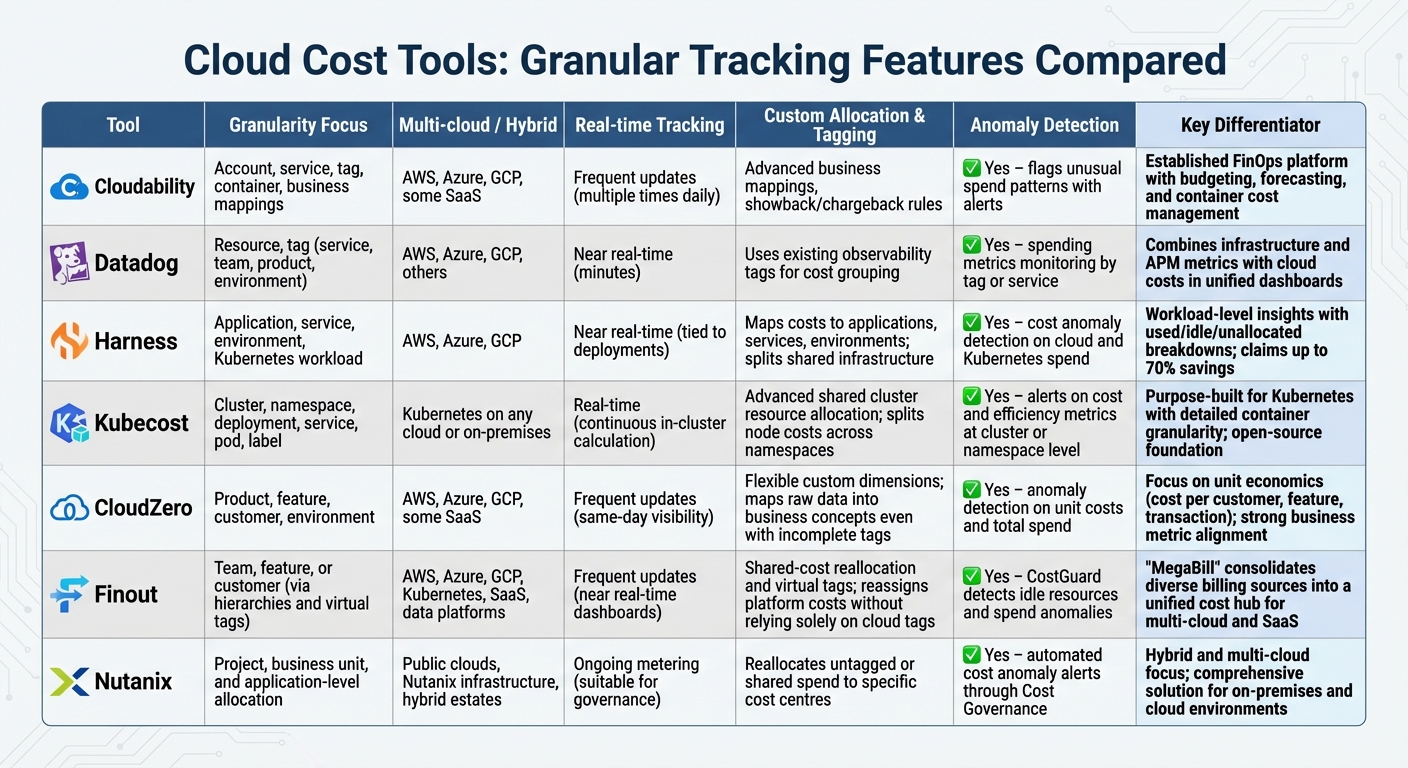 {Cloud Cost Management Tools Feature Comparison Chart}
:::
{Cloud Cost Management Tools Feature Comparison Chart}
:::
When it comes to tackling inefficiencies that drive up cloud costs, each tool offers tailored granular tracking features designed to meet specific business requirements. Here's how they stack up:
Cloudability zeroes in on account, service, tag, and business unit mapping. This setup enables precise cost allocation through showback and chargeback, aligning with FinOps best practices [4]. Datadog, on the other hand, links costs to hosts, containers, services, and tags. For teams already using Datadog for observability, this integration makes it easier to view spending alongside performance metrics [4]. Harness takes a different approach by focusing on applications, services, environments, and Kubernetes workloads, categorising resources as used, idle, or unallocated [8]. Meanwhile, Kubecost dives deep into Kubernetes environments, breaking down costs by cluster, namespace, deployment, service, pod, and label - ideal for container-heavy setups [8].
CloudZero uses tags, account data, and Kubernetes metadata to categorise costs by product, feature, customer, or environment [4]. Finout employs hierarchies and virtual tags, allowing teams to slice costs by team, feature, or customer - even without perfect native tagging [6]. Finally, Nutanix supports cost allocation by project, business unit, and application across public, private, and hybrid environments [4].
Multi-cloud Integration and Real-time Visibility
Beyond granular tracking, these tools differ in their ability to integrate with multi-cloud environments and provide real-time insights. Cloudability, CloudZero, Finout, and Nutanix all pull billing data from AWS, Azure, and GCP, with Finout and CloudZero also integrating SaaS costs to offer a unified financial overview [4][6]. Datadog supports AWS, Azure, GCP, and other providers, correlating usage and billing metrics across platforms [4]. Harness aggregates spend data for applications spanning AWS, Azure, and GCP [8]. Kubecost, designed for Kubernetes, runs in-cluster and supports multi-cloud or on-premises environments, presenting costs across clusters in a unified view [8].
Real-time visibility is another key differentiator. Tools like Datadog and Kubecost offer near real-time tracking, while Cloudability, CloudZero, and Finout update data several times daily, enabling same-day FinOps decisions [4][6][8]. Harness links cost data to deployments, offering near real-time insights into the financial impact of new releases [8]. Nutanix, meanwhile, provides ongoing cost metering, which is particularly useful for governance and capacity planning [4].
Key Features at a Glance
Here's a quick comparison of the tools to help you choose the best fit for your FinOps strategy:
| Tool | Granularity Focus | Multi-cloud / Hybrid | Real-time Tracking | Custom Allocation & Tagging | Anomaly Detection | Key Differentiator |
|---|---|---|---|---|---|---|
| Cloudability | Account, service, tag, container, business mappings | AWS, Azure, GCP, some SaaS | Frequent updates (multiple times daily) | Advanced business mappings, showback/chargeback rules | Yes – flags unusual spend patterns with alerts [4] | Established FinOps platform with budgeting, forecasting, and container cost management [4] |
| Datadog | Resource, tag (service, team, product, environment) | AWS, Azure, GCP, others | Near real-time (minutes) | Uses existing observability tags for cost grouping | Yes – spending metrics monitoring by tag or service [4] | Combines infrastructure and APM metrics with cloud costs in unified dashboards [4] |
| Harness | Application, service, environment, Kubernetes workload | AWS, Azure, GCP | Near real-time (tied to deployments) | Maps costs to applications, services, environments; splits shared infrastructure | Yes – cost anomaly detection on cloud and Kubernetes spend [8] | Workload-level insights with used/idle/unallocated breakdowns; claims up to 70% savings [3][8] |
| Kubecost | Cluster, namespace, deployment, service, pod, label | Kubernetes on any cloud or on-premises | Real-time (continuous in-cluster calculation) | Advanced shared cluster resource allocation; splits node costs across namespaces | Yes – alerts on cost and efficiency metrics at cluster or namespace level [8] | Purpose-built for Kubernetes with detailed container granularity; open-source foundation [8][2] |
| CloudZero | Product, feature, customer, environment | AWS, Azure, GCP, some SaaS | Frequent updates (same-day visibility) | Flexible custom dimensions; maps raw data into business concepts even with incomplete tags | Yes – anomaly detection on unit costs and total spend [4] | Focus on unit economics (cost per customer, feature, transaction); strong business metric alignment [4] |
| Finout | Team, feature, or customer (via hierarchies and virtual tags) | AWS, Azure, GCP, Kubernetes, SaaS, data platforms | Frequent updates (near real-time dashboards) | Shared-cost reallocation and virtual tags; reassigns platform costs without relying solely on cloud tags [6] | Yes – CostGuard detects idle resources and spend anomalies [6] |
MegaBillconsolidates diverse billing sources into a unified cost hub for multi-cloud and SaaS [6][5] |
| Nutanix | Project, business unit, and application-level allocation | Public clouds, Nutanix infrastructure, hybrid estates | Ongoing metering (suitable for governance) | Reallocates untagged or shared spend to specific cost centres | Yes – automated cost anomaly alerts through Cost Governance [4] | Hybrid and multi-cloud focus; comprehensive solution for on-premises and cloud environments [4] |
This breakdown highlights the unique strengths of each tool, making it easier to align your choice with your specific FinOps goals.
Need help optimizing your cloud costs?
Get expert advice on how to reduce your cloud expenses without sacrificing performance.
What Sets Each Tool Apart
Building on the detailed feature comparison, here’s a closer look at what makes each tool distinct.
When it comes to granular tracking, each tool has its own unique angle. Cloudability shines in precise cost allocation and forecasting across AWS, Azure, and GCP. It offers detailed department-level insights and policy-driven governance. For UK businesses navigating GDPR requirements and hybrid cloud complexities, enterprise case studies - particularly in regulated sectors like finance - highlight overspend reductions of up to 30% through automated recommendations [7][2]. Meanwhile, Datadog combines cost tracking with observability for real-time performance insights.
Datadog stands out by merging observability with cost tracking. Its integration of logs, metrics, and traces provides real-time breakdowns by service and resource. UK organisations benefit from its real-time anomaly detection, which has led to savings of 20–40% in Kubernetes environments [8]. Harness, however, pushes optimisation further by focusing on pipeline-level performance.
Harness takes a FinOps-native approach, enabling continuous optimisation at the pipeline and deployment level. For UK enterprises, it automates cost governance directly within CI/CD workflows, resulting in reported savings of 25% on engineering spend [8]. For container-heavy environments, Kubecost offers detailed cost tracking.
Kubecost provides precise cost breakdowns at the namespace, deployment, and pod level, spanning multi-cluster and multi-cloud setups via a single API. UK organisations running Kubernetes-heavy operations report 15–35% reductions in container costs thanks to accurate showbacks and chargebacks [8]. CloudZero, on the other hand, focuses on linking costs to business outcomes.
CloudZero delivers engineering-driven cost visibility by tracking unit economics, such as the cost per deployment or cost per customer, across AWS, Azure, and GCP. For UK SMEs struggling with unclear billing, it promotes accountability by tying spending to business metrics, achieving up to 30% cost optimisation. Its pricing - roughly £15 per £1,000 spend - makes it an attractive option for smaller businesses [7][9][4]. Finout complements this with unified visibility across platforms.
Finout excels in delivering unified cost visibility across clouds and Kubernetes. It features custom dashboards for resource-level allocation and forecasting. UK enterprises benefit from proactive anomaly alerts, which help prevent budget overruns. Case studies show savings of 20–50% through better budgeting practices [7][9][5]. Finally, Nutanix focuses on hybrid infrastructure management.
Nutanix offers intelligent metering and automated rightsizing with chargebacks across public, private, hybrid, and multi-cloud setups. For UK organisations with diverse hosting needs, it addresses governance gaps with anomaly alerts and untagged spend allocation, achieving 25%+ efficiency improvements in hybrid scenarios, according to enterprise benchmarks [4].
These tailored solutions enable UK businesses to streamline cloud management and achieve significant cost savings. Whether dealing with data sovereignty concerns or VAT-specific challenges, tools like Cloudability ensure VAT-compliant tracking, while Kubecost provides granular insights for Kubernetes environments. Additionally, Hokstad Consulting offers specialised advice on hybrid DevOps cost engineering for regulated sectors [7][8][2].
Conclusion and Recommendations
Based on the tool comparisons above, here are some practical steps to help you make the right choice.
The best cloud cost tool for your organisation will depend on your specific needs and priorities. For businesses with Kubernetes-heavy workloads, Kubecost stands out for its detailed tracking at the namespace and pod level. On the other hand, multi-cloud users will benefit from tools offering unified visibility across platforms. If you're a UK SME with an annual cloud spend under £250,000, look for tools that provide clear rightsizing recommendations and support reporting in GBP.
To ensure you're picking the right tool, run a 30-day pilot with your shortlisted options. Use identical scopes and set measurable goals, such as cutting monthly AWS costs by 15% or allocating 95% of expenses to specific teams. Compare the tools based on the quality of their recommendations, ease of implementation, and dashboard usability for both engineering and finance teams. Make sure the tools can handle GBP reporting and align with UK financial cycles, whether that's monthly, quarterly, or annually. Combining these insights with proper tagging and strong FinOps practices will help you achieve the best results.
It's worth noting that tools alone aren't enough to deliver savings. Consistent tagging, well-defined FinOps processes, and integration with CI/CD workflows are crucial to turning insights into actionable outcomes. For organisations in regulated sectors like financial services, platforms with advanced policy engines and compliance controls - such as Cloudability or Nutanix - can be especially useful. Meanwhile, businesses dealing with high data volumes or AI-driven workloads may need solutions like Finout or CloudZero, which are designed to handle fluctuating costs and allocate expenses across shared platforms effectively.
Be aware of common pitfalls. Inconsistent tagging often leads to unallocated spending, and focusing too much on advanced features can distract from straightforward rightsizing actions that typically yield the most savings. Integrating cost insights into sprint reviews and post-incident analyses can help engineers see cost management as part of their responsibility, rather than leaving it solely to the finance team.
For UK organisations looking for tailored support, Hokstad Consulting offers comprehensive solutions. Their services include assessing current cloud usage, designing tagging standards, building cost allocation models, running structured tool pilots, and automating cost signals into DevOps workflows. They also provide ongoing optimisation reviews aligned with UK budgeting cycles, ensuring continuous improvement rather than one-off fixes.
FAQs
How do granular tracking tools help optimise cloud costs?
Granular tracking tools are essential for managing cloud costs effectively. They offer detailed insights into how resources are being used, helping to pinpoint unused or underutilised assets. With this information, businesses can take targeted actions like resizing resources, automating workloads, or reallocating them where they're needed most.
By tackling inefficiencies head-on, these tools can lead to substantial cost savings - often cutting expenses by 30–50%. This detailed visibility ensures companies pay only for what they actually use, making cloud budgets easier to manage and far more predictable.
What is the best cloud cost tool for managing Kubernetes-focused environments?
For environments heavily reliant on Kubernetes, having cloud cost tools that provide detailed tracking and automation capabilities specifically designed for Kubernetes workloads is crucial. These tools enable you to closely monitor resource usage, manage expenses, and gain in-depth insights into your cluster operations, ensuring smoother and more efficient management.
Hokstad Consulting suggests using tools with robust Kubernetes integration to keep your infrastructure both cost-efficient and scalable. With their expertise in cloud cost engineering, they can help uncover savings opportunities and simplify your operations for better overall performance.
What should I consider when selecting a cloud cost management tool?
When choosing a cloud cost management tool, focus on features that allow for detailed cost tracking. This helps you identify inefficiencies and keep spending under control. Tools with automation capabilities can simplify processes and reduce the need for manual intervention, saving both time and effort. It's also important to ensure the tool can integrate smoothly with your existing systems to minimise any disruptions.
Another key feature to consider is real-time reporting. This enables you to monitor spending as it happens and respond quickly to any signs of overspending. Finally, opt for tools that highlight and eliminate unnecessary expenses, ensuring you're only paying for the resources you genuinely need.