
Kubernetes has transformed how teams deploy and manage applications, making CI/CD tools essential for streamlining workflows. Here's a quick rundown of the top 7 CI/CD tools for Kubernetes in 2025, focusing on their Kubernetes integration, GitOps capabilities, scalability, and cost-saving features:
- RazorOps: Kubernetes-first CI/CD with simple YAML pipelines and GitOps support, ideal for smaller teams.
- CircleCI: Strong Kubernetes integrations and GitOps workflows, with high scalability and cost management features.
- GitLab CI/CD: All-in-one platform with robust Kubernetes and GitOps support, designed for large-scale, multi-cluster environments.
- Argo CD: GitOps-native tool for continuous delivery with lightweight design and multi-cluster management.
- Codefresh: Kubernetes-focused CI/CD powered by Argo, offering enterprise-level features like deployment analytics.
- Harness: AI-driven Kubernetes deployments with GitOps principles and advanced cost tracking.
- Flux CD: GitOps-centric tool with Kubernetes-native architecture, great for managing large-scale, multi-cluster setups.
These tools cater to different needs, from small teams to enterprise-level operations. Choosing the right tool depends on your infrastructure size, team expertise, and budget priorities. For UK-based organisations, cost control is critical, and tools with built-in optimisation features, combined with expert consultancy, can help reduce cloud expenses by up to 50%.
Quick Comparison
| Tool | Kubernetes Integration | GitOps Support | Scalability | Cost Management |
|---|---|---|---|---|
| RazorOps | Kubernetes-first pipelines | Strong GitOps focus | SME-friendly | Affordable for small teams |
| CircleCI | Helm and kubectl support | Git-centric workflows | High throughput | Usage analytics, caching |
| GitLab CI/CD | Native Kubernetes tools | Full GitOps support | Multi-cluster enterprise | Unified platform savings |
| Argo CD | Lightweight Kubernetes CD | GitOps-native | Multi-cluster capable | Minimal resource overhead |
| Codefresh | Kubernetes-first CI/CD | Argo-powered GitOps | Enterprise-level | Performance metrics |
| Harness | AI-driven Kubernetes CD | GitOps workflows | Enterprise-scale | Advanced cost tracking |
| Flux CD | Kubernetes-native GitOps | Full GitOps support | Multi-cluster efficiency | Prevents over-provisioning |
Each tool offers unique strengths. For smaller setups, RazorOps and CircleCI are straightforward options. Larger enterprises may prefer GitLab CI/CD, Argo CD, or Harness for their scalability and governance features. Flux CD and Codefresh stand out for their GitOps focus and multi-cluster management.
::: @figure 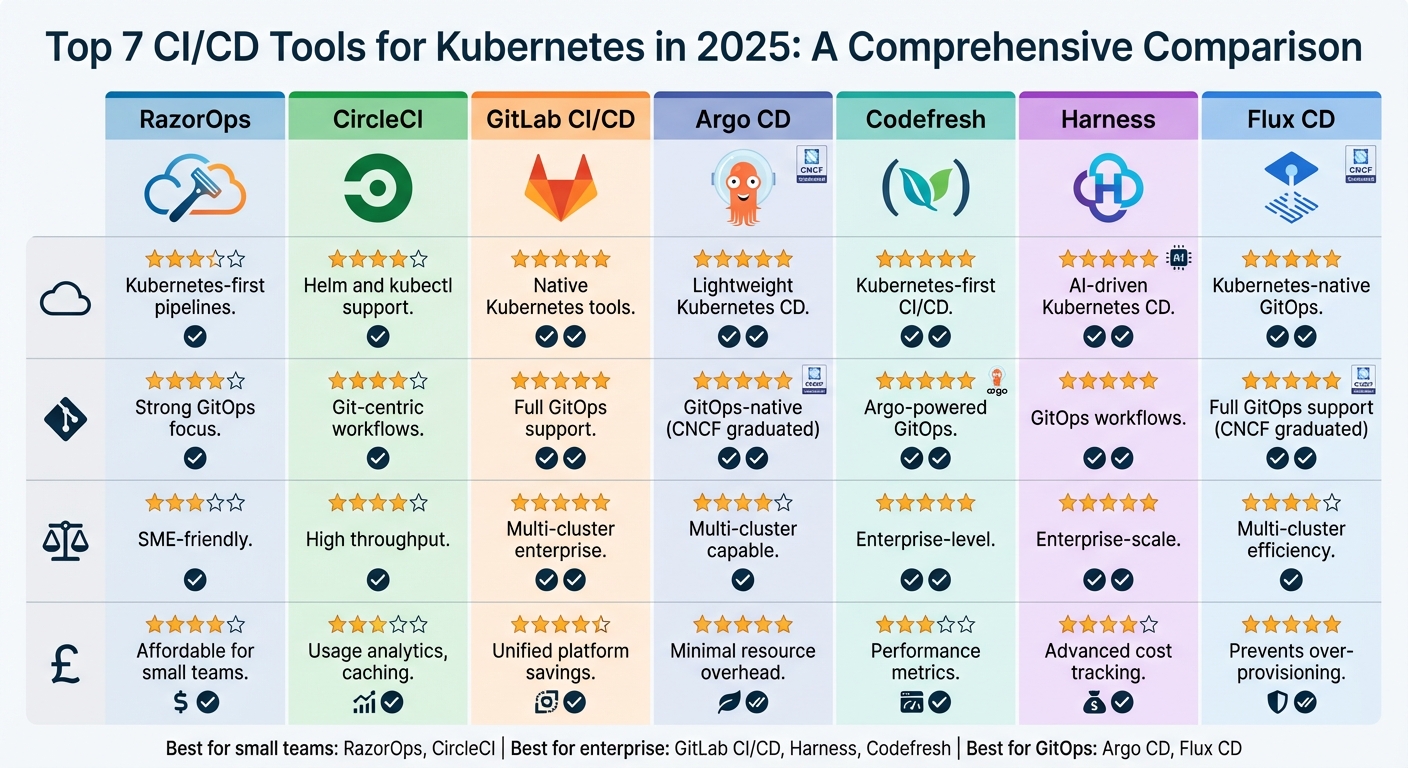 {Top 7 CI/CD Tools for Kubernetes 2025 Comparison Chart}
:::
{Top 7 CI/CD Tools for Kubernetes 2025 Comparison Chart}
:::
1. RazorOps
Kubernetes-native capabilities
RazorOps is a CI/CD platform specifically designed for Kubernetes environments. Built with containerised workflows in mind, it connects directly with Kubernetes APIs to manage pods, deployments, services, and Helm charts - all without needing additional plugins. This seamless integration cuts down on scripting requirements, making container management far simpler.
Its declarative pipeline approach relies on YAML configuration, which is particularly helpful for teams new to Kubernetes. By treating Docker images, Kubernetes manifests, and Helm charts as core components, RazorOps eliminates the need for a sprawling plugin ecosystem. This streamlined setup significantly reduces operational complexity for organisations moving away from platforms like Jenkins, while also providing a strong foundation for adopting GitOps practices.
Support for GitOps workflows
RazorOps takes GitOps principles to heart, treating Git repositories as the ultimate source of truth for both application and infrastructure configurations. Kubernetes manifests and Helm charts can be stored in Git, ensuring deployments are fully traceable and reversible. Every change is logged through Git commits, making rollbacks as straightforward as reverting to a previous commit.
This Git-based workflow encourages collaboration using standard branching strategies and ensures compliance with immutable audit trails. To maintain consistency across environments - whether development, staging, or production - essential pipelines are enforced. These pipelines cover builds, tests, security scans, and deployments to test namespaces, safeguarding main branches. For organisations requiring advanced GitOps capabilities, RazorOps integrates seamlessly with tools like Argo CD or Flux CD for progressive delivery.
Scalability for large-scale environments
For teams managing numerous microservices, RazorOps offers autoscaling build infrastructure through hosted runners and a unified control plane for multi-cluster deployments. This setup is particularly beneficial for UK organisations needing reliable disaster recovery, reduced latency, or efficient hybrid cloud management across their operations.
2. CircleCI
Kubernetes-native capabilities
CircleCI works seamlessly with Kubernetes using tools like kubectl and Helm. This integration allows teams to build container images, push them to registries, and deploy manifests with automated rollouts. By automating tasks such as applying manifests, conducting health checks, and coordinating service updates, CircleCI minimises the risk of manual deployment errors. It also supports thorough, automated testing for microservices, ensuring smoother workflows.
Support for GitOps workflows
CircleCI goes beyond Kubernetes integration by enabling GitOps practices. With version-controlled pipeline configurations, Git branches, pull requests, and tags, CircleCI makes it easy to trigger deployments through Git-centric workflows. By pairing these workflows with Helm charts stored in repositories and policy checks during pull requests, organisations can ensure that all cluster changes are reviewed, approved, and traceable to specific Git commits. Many teams use CircleCI for continuous integration, alongside tools like Argo CD and Flux CD, to handle continuous delivery.
Scalability for large-scale environments
CircleCI is built to handle large-scale operations with its flexible compute options and support for parallelism. This makes it possible for larger teams to run multiple jobs simultaneously - essential for testing and deploying a wide range of microservices. Its Insights dashboards offer valuable metrics, including build times, failure rates, and workflow trends. These insights help UK organisations managing multiple clusters make informed decisions about test suites, caching, and parallelisation strategies.
Cost optimisation features
CircleCI helps teams manage costs effectively through selective job execution, resource-class options, and caching. High-performance resources can be reserved for demanding tasks, while routine jobs run on more economical options. UK-based teams can save further by scheduling non-critical tasks during off-peak hours and cleaning up unused environments. For organisations with complex Kubernetes deployments, tailored cost-saving strategies from Hokstad Consulting provide an additional layer of support, complementing CircleCI's built-in cost management tools.
3. GitLab CI/CD

Kubernetes-native capabilities
GitLab CI/CD builds on the strengths of tools like RazorOps and CircleCI by offering seamless Kubernetes integration, thanks to its built-in tools and GitOps-centric approach. It connects directly with Kubernetes clusters using the GitLab Kubernetes Agent or traditional certificate-based methods. This setup allows teams to deploy workloads using kubectl, Helm, or GitLab's Auto DevOps features without needing extra plugins. GitLab's platform is designed to understand Kubernetes resources and namespaces, making it easier to manage deployments, rollbacks, and review apps within dedicated namespaces - all from the GitLab interface. By minimising the need for custom scripts, it simplifies the promotion of microservices across development, staging, and production clusters. This is particularly beneficial for enterprises handling multi-cluster and multi-namespace environments [2][3].
Support for GitOps workflows
GitLab takes a GitOps-first approach by treating Git as the central repository for Kubernetes manifests, Helm charts, and environment configurations. With the GitLab Kubernetes Agent, the platform continuously ensures cluster states align with their corresponding Git repositories. This enables teams to implement branch-based environments, complete with branch protection, merge approvals, and comprehensive audit trails. Configuration changes are version-controlled, and GitLab CI automates tasks like running kubectl apply or Helm upgrade whenever changes are merged into the main branch. Security scans also verify production manifests before deployment. Additionally, GitLab environments monitor deployments and rollbacks across regions, including the UK and EU, providing complete visibility [2][3].
Scalability for large-scale environments
GitLab CI/CD is designed to handle the demands of large-scale operations. Its parent–child pipeline structure breaks down complex microservice delivery into manageable, parallel tasks. With reusable pipeline templates, enterprises can standardise jobs across multiple projects, ensuring consistency. The platform supports both hosted and self-managed runners, including those deployed in UK-based clusters, allowing teams to scale build and deployment capacity independently. To manage workloads efficiently, users can set concurrency limits, resource groups, and prioritisation rules, preventing bottlenecks in shared clusters. Group-level policies further ensure uniform pipeline stages across thousands of services. This scalability is particularly valuable for managing intricate, multi-cluster deployments in the UK's fast-evolving cloud ecosystem [3].
Cost optimisation features
GitLab CI/CD provides tools to help teams manage costs effectively. Teams can fine-tune runner usage by scheduling or auto-scaling them on cost-efficient options like spot instances or low-cost Kubernetes node pools. Idle runners can also be shut down outside working hours to save on expenses. Features like caching, artefact expiry, and merge trains further reduce unnecessary work and storage costs. For UK enterprises, tailored consultancy services can assist in designing Kubernetes clusters, configuring auto-scaling rules, and developing cost-efficient environment strategies. These measures help reduce overall cloud and licensing costs while maintaining fast deployment cycles, all within GBP budgets. With these cost-saving features, GitLab CI/CD stands out as a strong choice for large-scale Kubernetes deployments [3].
4. Argo CD
Kubernetes-native capabilities
Argo CD stands out among CI/CD tools by seamlessly integrating GitOps with Kubernetes, offering a streamlined and efficient approach to managing resources. It uses a declarative configuration model based on Kubernetes-native resources and YAML manifests, while also supporting tools like Helm, Kustomise, Jsonnet, and YAML. Thanks to its lightweight design, it keeps resource usage to a minimum. As a CNCF graduated project, Argo CD has proven its reliability in production environments and benefits from strong community support [4]. These Kubernetes-native foundations make it a powerful tool for advanced GitOps workflows.
Support for GitOps workflows
Argo CD keeps a close eye on Git repositories to ensure that clusters remain in their desired state. By constantly monitoring and syncing, it provides complete audit trails through Git history, automatically corrects any drift, and simplifies rollbacks by reverting Git commits. These features not only reduce the need for manual intervention but also ensure applications maintain their intended state.
Scalability for large-scale environments
When it comes to managing multiple clusters, Argo CD truly shines. A single control plane can oversee deployments across numerous Kubernetes clusters, making it an ideal choice for large-scale operations. Its declarative approach scales smoothly without adding infrastructure complexity, while real-time syncing ensures consistency across all clusters. For enterprise deployments, Argo CD offers robust security measures, including SSO integration and fine-grained RBAC, to support secure, multi-tenant environments. Additionally, it integrates with Flagger for progressive delivery methods like canary, blue-green, and A/B testing, helping to minimise rollout risks [3].
Cost optimisation features
Argo CD is well-suited for organisations aiming to manage costs in large-scale deployments. Its lightweight architecture reduces infrastructure expenses, and the declarative approach eliminates the need for complex scripting, cutting down operational overhead. By focusing on continuous delivery and working seamlessly with CI tools, it helps teams streamline their toolchains. For UK-based organisations looking to optimise their Kubernetes deployments while keeping cloud spending in check, Hokstad Consulting offers tailored expertise to further enhance efficiency.
5. Codefresh
Kubernetes-native capabilities
Codefresh is purpose-built for Kubernetes and cloud-native workloads, offering strong support for containers, Helm, and serverless workflows [3][5]. Its design allows pipelines to directly handle Kubernetes objects like deployments, Helm releases, namespaces, and other cluster resources - eliminating the need for fragile custom scripts. This Kubernetes-first approach makes it particularly well-suited for managing microservices architectures at scale. Features like DRY pipelines, reusable steps, and parallel execution bring consistency to deployments across services, while also enabling smooth GitOps integration.
Support for GitOps workflows
Codefresh extends its Kubernetes-native design with comprehensive GitOps capabilities. By integrating with Argo for continuous delivery, it ensures that configurations stored in Git are always in sync with clusters [3]. This pull-based approach enhances drift detection, simplifies rollbacks, and separates build processes from runtime concerns. These benefits are especially valuable for regulated industries in the UK, such as financial services and public sector organisations, where compliance and operational clarity are critical.
Scalability for large-scale environments
Codefresh’s infrastructure and DRY pipeline model are designed to handle the demands of growing environments without compromising feedback speed [3]. By letting platform teams define reusable patterns, it reduces configuration sprawl and simplifies governance in large organisations. Its ability to support multi-cluster and multi-environment deployments ensures smooth coordination across staging, pre-production, and multiple production clusters. Built-in tools like DORA metrics and deployment analytics help teams track performance metrics such as throughput, lead time, and failure rates. Additionally, progressive delivery methods like canary and blue-green deployments minimise risks during critical updates.
Cost optimisation features
With features like caching, parallelisation, and container-based builds, Codefresh helps reduce unnecessary compute time and cloud expenses for large Kubernetes setups [3]. It promotes the use of ephemeral test environments and standardised pipelines, cutting down reliance on long-running, under-utilised build agents. This approach also prevents over-provisioning in non-production clusters, allowing organisations to maintain efficient and cost-effective deployments without sacrificing reliability or speed.
Need help optimizing your cloud costs?
Get expert advice on how to reduce your cloud expenses without sacrificing performance.
6. Harness

Kubernetes-native capabilities
Harness stands out with its deep integration into Kubernetes, working seamlessly with standard artefacts like manifests, Helm charts, and YAML configurations. It automatically detects services, namespaces, and workloads, mapping them to logical applications - eliminating the need for manual setup. Deployment manifests and Helm charts can be stored in Git, and Harness directly uses them to maintain a Kubernetes-native workflow. For UK businesses managing multiple clusters, Harness ensures consistent deployments while centralising governance and audit trails. Its strong Kubernetes focus also supports scalable deployments, ideal for enterprise-level needs. [1][6]
Support for GitOps workflows
Harness takes GitOps workflows to the next level by treating Git repositories as the single source of truth for Kubernetes manifests and environment definitions. It combines GitOps principles with enterprise-grade features like secrets management, policy-as-code, and multi-cloud cost controls. For organisations in sectors like UK financial services or the public sector, the platform offers mandatory release approvals for production changes, ensuring compliance with governance requirements. [3][6]
Scalability for large-scale environments
Harness is built with enterprise-scale operations in mind, supporting centralised rollouts across clusters and environments. Its hierarchical structure - spanning organisations, projects, environments, and services - allows large teams to divide responsibilities while maintaining consistent standards. By deploying agents close to clusters, Harness reduces latency and eliminates the need for inbound network access. It supports simultaneous deployments and environment-specific policies, enabling financial services firms to update multiple microservices in parallel while maintaining production stability. [1][6]
Cost optimisation features
Harness also addresses cloud cost management by attributing expenses to specific Kubernetes workloads, namespaces, services, and clusters. This transparency helps teams identify which applications are driving their monthly cloud bills in pounds sterling, making budget allocation and cost justification straightforward. The platform analyses resource requests, limits, and actual usage to recommend optimal CPU and memory configurations, avoiding over-provisioning. It can even detect underused or idle resources - like non-production clusters left running outside UK office hours - and automate scale-downs during off-hours. For large operations, these features can save tens of thousands of pounds annually. When paired with cost-engineering strategies from experts like Hokstad Consulting, Harness becomes a powerful tool for improving deployment efficiency. [1]
7. Flux CD
Kubernetes-native capabilities
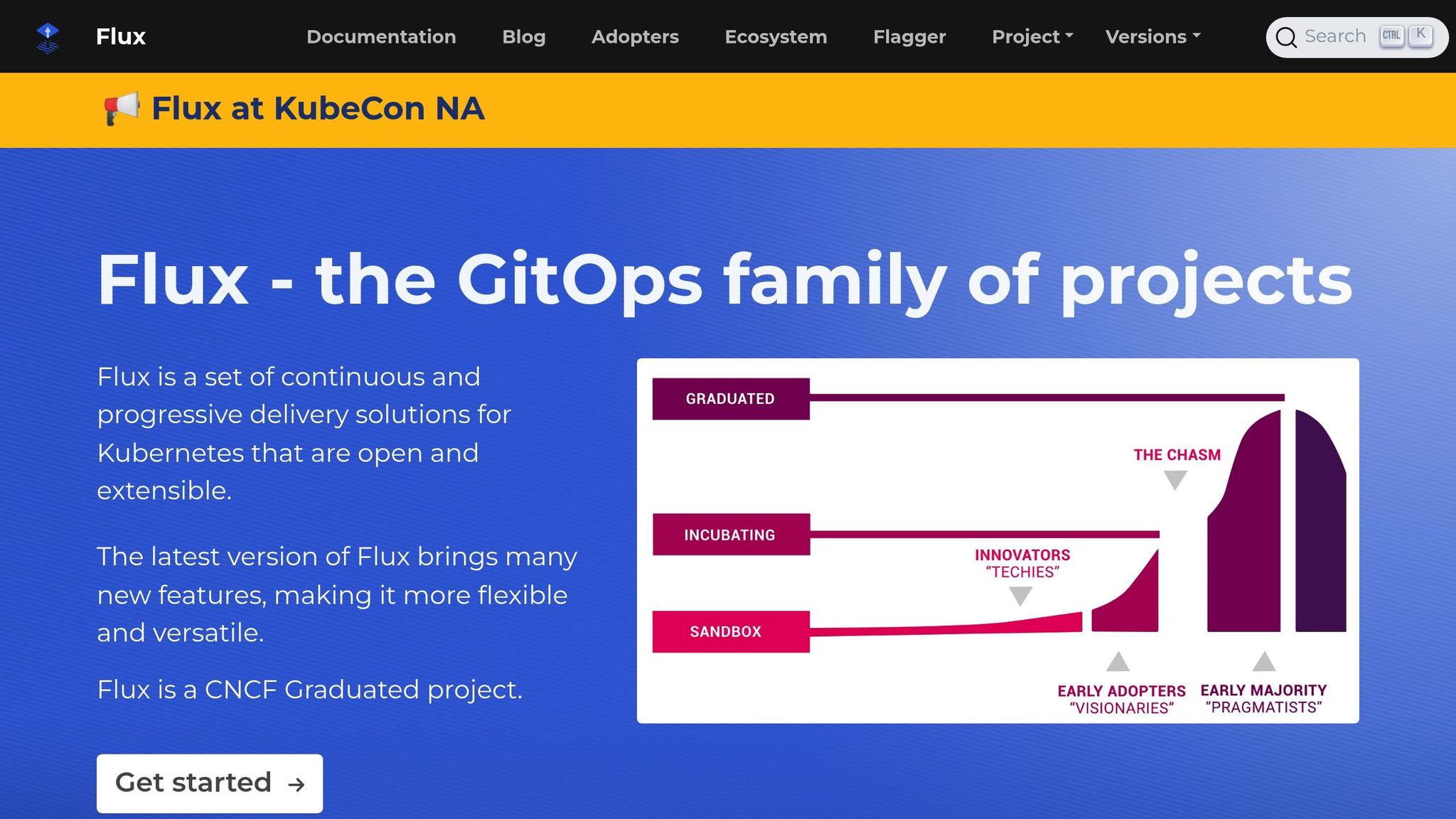
Flux CD is built from the ground up with Kubernetes in mind, making it a standout choice for teams embracing GitOps principles. As a CNCF-graduated tool, Flux CD is designed specifically for Kubernetes, rather than being retrofitted from older, VM-based workflows. It handles Kubernetes resources - whether it's applications, infrastructure, or monitoring setups - using YAML, Helm, and Kustomize. This native integration ensures Flux operates smoothly within the Kubernetes ecosystem, adhering to existing RBAC policies and security frameworks. It also supports multi-tenant setups, making it a great fit for teams working across different environments. For UK organisations managing production, staging, or geographically distributed clusters, Flux's hub and spoke
model is particularly useful. This approach allows a central management cluster to oversee deployments across multiple workload clusters without tying everything to a single control plane.
Support for GitOps workflows
Flux constantly keeps an eye on Git repositories that define the desired Kubernetes state and ensures clusters stay in sync. Teams in the UK often organise repositories by environment - for example, prod
and staging
- with Flux tracking specific branches or folders. When changes are merged into Git, Flux takes care of applying them automatically. This creates a clear and auditable history in Git, which is especially valuable for sectors like finance and healthcare that have strict compliance requirements. On top of that, Flux automates container image updates by scanning registries for new versions, updating image tags in Git, and applying those changes. This automation eliminates the need for manual updates and scales effortlessly as deployment needs grow.
Scalability for large-scale environments
Flux's pull-based GitOps model is ideal for scaling, as it allows teams to manage deployments via Git without needing direct access to clusters. This simplifies permissions management and helps prevent configuration drift. For organisations with multiple clusters spread across regions, Flux's declarative configurations ensure consistent deployments while avoiding over-provisioning. Flux also integrates with tools like Flagger to enable progressive delivery methods, such as canary deployments and A/B testing. These features help UK teams deploy updates during business hours with reduced risk, thanks to automated rollbacks triggered by performance metrics.
Cost optimisation features
Flux promotes consistent, version-controlled infrastructure definitions, which help reduce configuration drift and prevent over-provisioning - two common causes of inflated cloud costs. By automating rollbacks and supporting progressive delivery, it also reduces the likelihood of costly outages. Git-based workflows make it easier to review changes that impact resource usage, such as adjustments to replica counts or instance sizes. For UK organisations, these features align well with broader cost-saving strategies. Partnering with experts like Hokstad Consulting can further enhance these efforts. They provide GitOps-centric platform designs, establish cost-efficient defaults in Helm and Kustomize templates, and integrate cost reporting into Flux-driven workflows to help cut down on hosting and cloud expenses.
CI vs. CD vs. GitOps vs. State Management: What's the Real Difference?
Comparison Table
The table below summarises the standout features of seven CI/CD tools for Kubernetes, focusing on Kubernetes-native integration, GitOps support, scalability, and cost optimisation in £. It condenses the key points from the earlier discussions, offering a quick reference for comparing these tools.
| Tool | Kubernetes-native capabilities | GitOps support | Scalability | Cost optimisation features |
|---|---|---|---|---|
| RazorOps | Designed for Kubernetes-first CI/CD; built around container images and Kubernetes deployments | GitOps support through integrations | Scales from small teams to departmental use; ideal for SMEs | Efficient pipelines and affordable pricing for smaller teams |
| CircleCI | Kubernetes-ready with strong integrations for kubectl and Helm | Supports GitOps through integrations | Handles enterprise-scale workloads with high throughput via parallel execution and caching | Fast feedback loops and usage analytics help minimise compute costs in £ |
| GitLab CI/CD | Fully integrated with Kubernetes, offering native cluster support and Auto DevOps patterns | GitOps-ready with infrastructure-as-code and environment definitions stored in Git | Multi-cluster enterprise capabilities with RBAC and SSO for multi-tenant environments | Reduces licence sprawl with a unified platform and provides pipeline insights for improved efficiency |
| Argo CD | Built for Kubernetes-native CD; reconciles manifests from Git with multi-cluster management | Fully GitOps-native, treating Git as the single source of truth for continuous reconciliation | Multi-cluster enterprise management using declarative configurations | Lightweight agent reduces cluster overhead and prevents configuration drift |
| Codefresh | Kubernetes-native CI/CD with strong support for Kubernetes, Helm, and serverless workflows | GitOps-native, powered by Argo, with embedded workflows | Enterprise-scale service with advanced caching, parallelism, and DORA metrics | Performance metrics and caching reduce compute costs and improve operational efficiency |
| Harness | Strong Kubernetes support with AI-driven deployment verification and rollback features | Supports GitOps-style pipelines and configuration-as-code | Enterprise-level multi-cluster scalability, leveraging ML for large-scale deployments | Dashboards track and optimise cloud spend in £ |
| Flux CD | Kubernetes-native GitOps, managing resources declaratively | Fully GitOps-native with continuous Git-to-cluster synchronisation and CNCF-graduated status | Multi-cluster enterprise scalability using a hub-and-spoke model | Lightweight control plane prevents over-provisioning and reduces costs |
Both Argo CD and Flux CD stand out with their CNCF-graduated status, highlighting their reliability and readiness for production environments. Codefresh, on the other hand, markets itself as the enterprise-grade Argo platform
, offering a managed service that enhances governance and observability within the Argo ecosystem.
Harness takes a slightly different approach with its machine learning-driven deployment verification, aiming to reduce failed deployments and automate rollbacks for smoother operations.
For UK teams looking to optimise costs, partnering with experts like Hokstad Consulting can provide valuable support. They help establish cost-efficient defaults in Helm and Kustomize templates and integrate cost reporting into GitOps workflows, ensuring both efficiency and transparency in Kubernetes deployments.
Conclusion
Selecting the right CI/CD tool for Kubernetes involves aligning its features with your organisation's specific requirements. If you're looking for straightforward CI pipelines with Kubernetes deployment capabilities, RazorOps and CircleCI are solid options. For those aiming to consolidate tools into a single DevSecOps platform, GitLab CI/CD offers an all-in-one solution. Teams invested in GitOps workflows will find Argo CD and Flux CD particularly appealing, thanks to their Kubernetes-native, declarative delivery and robust multi-cluster management. Meanwhile, Codefresh enhances the Argo experience with an enterprise-grade interface and built-in DORA metrics. For larger enterprises, Harness provides advanced features like AI-assisted rollouts, automated rollbacks, and cost optimisation, making it a strong contender for managing complex environments.
The scale of your infrastructure plays a critical role in this decision. Smaller setups with just a few clusters often benefit from hosted solutions like CircleCI or RazorOps, which minimise operational overhead. On the other hand, larger environments - such as those managing dozens of clusters across multiple UK regions or hybrid on-premises and cloud setups - are better served by tools like Argo CD, Flux CD, or Codefresh. These tools excel at treating clusters consistently, regardless of their location, ensuring smooth scalability.
Another key factor is your team's expertise. Developer familiarity with tools and concepts like YAML, Helm, and declarative infrastructure can make GitOps-centric solutions like Argo CD or Flux CD a natural fit. For teams newer to Kubernetes, platform-style tools such as Codefresh, GitLab CI/CD, or Harness offer user-friendly interfaces and pre-built templates, reducing the learning curve and minimising the risk of misconfigurations.
Cost is another consideration, and it varies depending on the scale and deployment of the tool. Many organisations in the UK find it beneficial to collaborate with specialist consultancies, such as Hokstad Consulting. These experts can help optimise cluster sizes, eliminate unnecessary environments, and design efficient pipelines, often leading to measurable monthly savings.
Ultimately, the right choice depends on your priorities - whether that's integrated governance, a pure GitOps approach, or a flexible CI tool with optional Kubernetes CD. In some cases, combining a dedicated CI tool with a GitOps CD solution can provide the best of both worlds. By evaluating your delivery model, compliance requirements, and team skill set, you can build a Kubernetes CI/CD pipeline that grows alongside your business.
FAQs
How do GitOps-native tools like Argo CD and Flux CD differ?
Argo CD and Flux CD are both GitOps-native tools designed to simplify Kubernetes deployments, but they each bring something different to the table.
Argo CD is all about ease of use and visibility. It offers a user-friendly web interface and detailed visualisation tools, making it easier to monitor and manage your deployments. It supports declarative GitOps workflows and integrates well with Kubernetes custom resources, giving teams a powerful way to handle complex setups.
Flux CD, in contrast, takes a more lightweight and straightforward approach. It works seamlessly with Kubernetes and supports a variety of Git repositories. Flux stands out for its flexibility and modular design, enabling teams to implement it step by step, tailoring it to their specific needs.
Choosing between the two often comes down to what your team values most: whether it's advanced visualisation and automation or a simpler, more adaptable setup.
How can organisations in the UK reduce cloud costs using CI/CD tools?
UK organisations can cut down on cloud expenses by using automated CI/CD pipelines. These pipelines simplify deployments and improve how resources are used, helping to reduce waste and enhance scalability. The result? Noticeable savings on cloud costs.
When paired with cloud cost engineering strategies and thoughtful cloud migration planning, businesses can lower their cloud spending by as much as 30–50%. This method ensures resources are used efficiently without compromising performance or reliability.
What is the best CI/CD tool for teams starting with Kubernetes?
For teams just starting out with Kubernetes, picking the right CI/CD tool can make all the difference. The ideal choice should be easy to use, integrate smoothly with Kubernetes, and support automation effectively. Tools like Argo CD and Jenkins X are popular recommendations for beginners because they are designed with Kubernetes in mind and are relatively straightforward to work with. These tools not only simplify deployment pipelines but also offer room to scale as your team's knowledge and needs expand.
When evaluating a tool, think about your team's current understanding of Kubernetes, the availability of community support, and how well the tool fits your project's specific requirements. Opting for a solution that allows for gradual adoption can ease the learning curve and help your team improve deployment workflows without feeling overwhelmed.