
Managing cloud costs across AWS, Azure, and GCP is now a top priority for organisations, with up to 50% of cloud spending wasted. Multi-cloud cost automation platforms help solve this by identifying unused resources, automating cost optimisation, and embedding financial controls into DevOps workflows. Here's what you need to know:
- Key Features: Unified billing dashboards, real-time cost recommendations, and Kubernetes cost tracking.
- Benefits: Automating tasks like resource shutdowns and rightsizing can save 30–60% on cloud expenses.
- Challenges Solved: Fragmented billing, siloed discounts, and
zombie
resources that inflate costs. - Leading Platforms:
- Ternary: Unified spend tracking and machine-learning cost alerts.
- IBM (Apptio, Turbonomic, Kubecost): Enterprise-grade tools for precise cost allocation.
- VMware Aria Cost: Automated policy enforcement and forecasting.
- Flexera: Hybrid environment cost insights.
- CloudZero: Links cloud costs to business outcomes.
For organisations with complex needs, Hokstad Consulting offers tailored solutions with a No Savings, No Fee
model, combining audits, CI/CD integration, and AI-driven tools to cut costs by 30–50%.
AWS re:Invent 2025 - Advanced multicloud cost reporting with FOCUS (COP419)
Need help optimizing your cloud costs?
Get expert advice on how to reduce your cloud expenses without sacrificing performance.
What to Look for in Multi-Cloud Cost Automation Platforms
The right platform should normalise billing data from sources like AWS Cost & Usage Reports, Azure Enterprise Agreements, and GCP BigQuery exports into a single, unified model [4][3]. This eliminates the need for engineers to manually reconcile different billing formats, paving the way for clear visibility and actionable insights.
Multi-Cloud Visibility
A unified dashboard is essential for mapping costs to teams, products, or business units. The most effective platforms achieve this through features like flexible tagging, account grouping, and virtual tags
that address gaps left by manual tagging [4][2]. Additionally, platforms offering hourly data refreshes - instead of daily updates - are invaluable for catching anomalies early, before they escalate into major budget issues [4][2].
For Kubernetes environments, look for tools that provide container-level granularity. These tools should break down costs by namespace, pod, and label, enabling accurate allocation of shared cluster expenses [4][5].
Automation and Real-Time Recommendations
Advanced platforms should include machine-learning-based anomaly detection to identify unusual spending patterns within hours [4][6]. Many also offer autonomous rate optimisation, which dynamically manages Reserved Instances, Savings Plans, and Committed Use Discounts based on real-time usage, eliminating the need for manual adjustments [4][6].
Features like AutoStopping
can significantly lower non-production cloud costs - by as much as 70% - by automatically shutting down idle resources [5]. As Jim D'Agostino, Senior DevOps Engineer at Synopsys, explained:
This is what makes this cloud cost management tool a game changer for us as we balance the speed of innovation with its cost. [5]
These real-time insights integrate naturally into DevOps workflows, ensuring proactive cost management.
DevOps Pipeline Integration
Integration with CI/CD pipelines shifts cost management from a reactive process to a proactive one. Platforms that support governance-as-code through YAML policies and Terraform providers can enforce budget limits during deployment [5][1], preventing overspending before it happens.
The most effective platforms also provide cost recommendations directly within developer workflows. This allows engineers to see the financial impact of their decisions in real time [5], supporting proactive cost control through automation.
Leading Platforms for Multi-Cloud Cost Automation
::: @figure 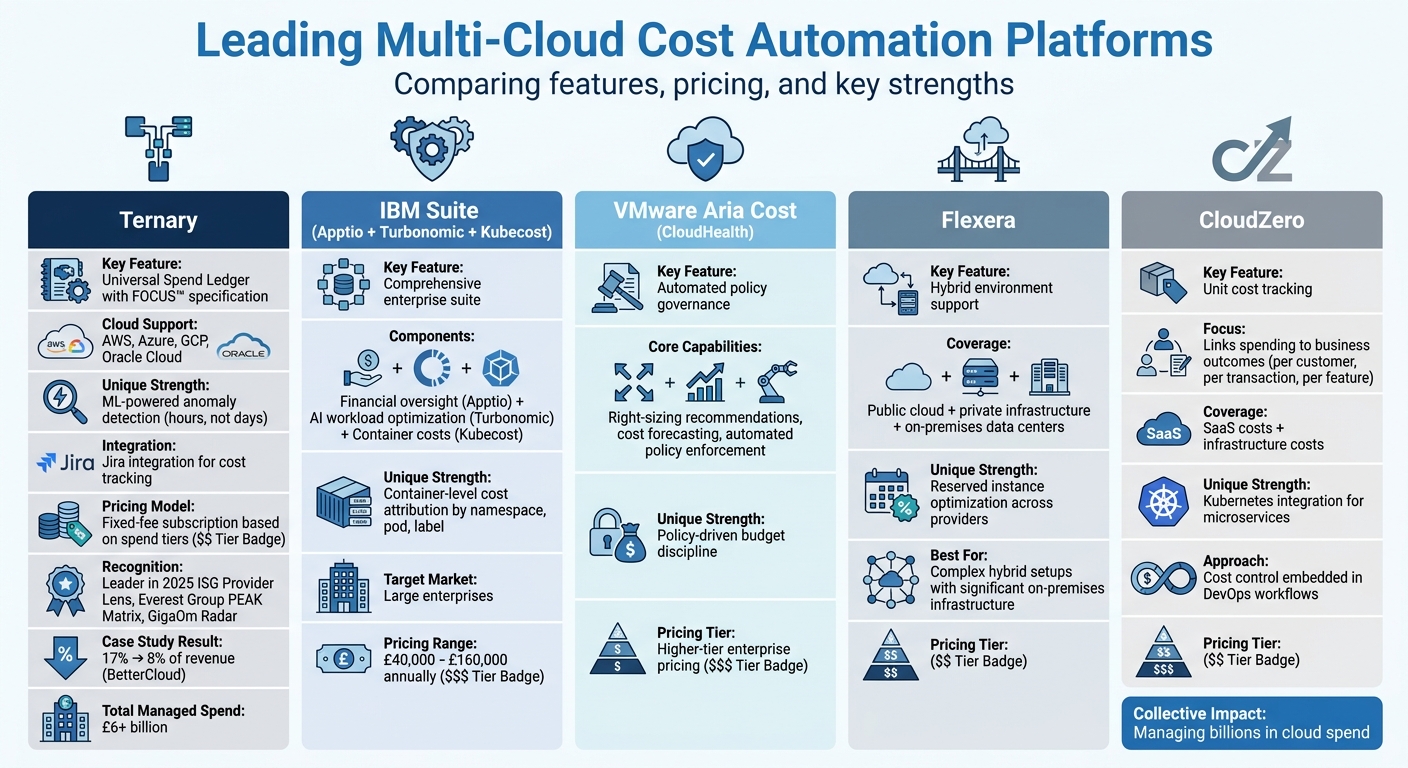 {Top 5 Multi-Cloud Cost Automation Platforms Comparison}
:::
{Top 5 Multi-Cloud Cost Automation Platforms Comparison}
:::
The platforms highlighted below are recognised as leaders in multi-cloud cost management. Each brings its own strengths to the table, offering unique tools and integrations that enhance visibility and streamline DevOps processes. Together, they manage billions in cloud expenditure – with Ternary alone overseeing over £6 billion across AWS, Azure, GCP, and Oracle Cloud Infrastructure [7].
Ternary
Ternary simplifies cloud cost management with its Universal Spend Ledger, which standardises billing data across AWS, Azure, GCP, and Oracle Cloud using the FOCUS™ specification [7]. By providing a unified view of spending, it eliminates the hassle of reconciling different billing formats manually.
The platform stands out with its machine learning-powered anomaly detection, which flags unusual spending patterns in just a few hours. It also integrates directly with Jira, allowing teams to manage and track cost investigations within their existing workflows [7].
Jamie Tischart, CTO of BetterCloud, shared:
Our cloud infrastructure costs were 17% of non-GAAP revenue. We reduced that down to 8% of non-GAAP revenue with Ternary. [7]
Ternary operates under a fixed-fee subscription model, determined by cloud spend tiers, which helps avoid unexpected overages or extra service charges. The platform has also earned recognition as a Leader in the 2025 ISG Provider Lens for FinOps Platforms, the 2025 Everest Group FinOps Cost Management PEAK Matrix, and the 2025 GigaOm Radar Report for Cloud FinOps [7].
IBM (Apptio Cloudability + Turbonomic + Kubecost)
IBM offers a comprehensive suite of tools designed for enterprise-level cost management. Apptio Cloudability provides financial oversight and multi-cloud visibility, supporting chargeback and showback reporting. Turbonomic uses AI-driven automation to optimise workload placement and resource allocation in real time. Meanwhile, Kubecost focuses on container-level cost attribution, breaking down Kubernetes expenses by namespace, pod, and label [8].
This suite is geared towards large enterprises and falls into the higher-tier pricing range, with annual costs between approximately £40,000 and £160,000 [8]. Its layered integration ensures seamless transitions into platforms that prioritise policy-driven governance.
VMware Aria Cost (CloudHealth)
VMware Aria Cost is known for its automated policy governance in multi-cloud setups. The platform offers features like right-sizing recommendations based on actual usage, cost forecasting to predict future expenses, and automated policy enforcement to maintain budget discipline [8]. As with other enterprise-grade solutions, it is priced in the higher-tier bracket [8].
Flexera
Flexera supports cost management across hybrid environments, aligning long-term financial planning with DevOps deployment cycles. Its dashboards provide insights into public cloud, private infrastructure, and on-premises data centres, making it a strong choice for organisations with complex setups. Flexera also excels in managing reserved instances, helping optimise long-term commitments across multiple cloud providers while accommodating significant on-premises infrastructure [8].
CloudZero
CloudZero focuses on tracking unit costs, linking cloud spending to specific business outcomes rather than just infrastructure usage. This enables organisations to understand the cost of serving individual customers, processing transactions, or delivering specific features [7]. It also extends its capabilities to SaaS cost visibility, going beyond traditional infrastructure costs. With Kubernetes integration, CloudZero provides the container-level detail needed for modern microservices architectures [7]. Its approach integrates cost control directly into DevOps workflows, offering a fresh perspective on cloud cost management.
How Multi-Cloud Cost Automation Supports DevOps
Multi-cloud cost automation platforms integrate seamlessly into DevOps workflows, embedding cost awareness directly into the development lifecycle. By adopting this shift-left
approach, teams can evaluate the financial impact of infrastructure changes early on - before they hit production. This not only reduces rework but also helps avoid unexpected expenses, fostering a culture of financial accountability throughout the development process [16].
Integration happens at crucial stages. For instance, tools like Infracost connect with platforms such as GitHub, GitLab, and Azure DevOps, presenting cost estimates alongside code quality and security metrics in pull requests [11][12]. This allows engineers to consider the financial implications of their infrastructure-as-code changes during peer reviews, making cost analysis a natural part of the approval process.
Automation takes this further with policy-as-code governance. Using YAML-based rules and Open Policy Agent (OPA), these tools enforce budget limits and compliance standards automatically [5][15]. If a breach is detected, the platform can generate pull requests to address the issue or trigger event-driven remediation - no manual intervention needed [10][11]. Jay Patel, Director of Platform Engineering-DevOps, commented:
That governance-as-code approach includes real-time enforcement and auto-remediation, and quite frankly achieved even greater savings [5].
By combining automated policy enforcement with precise budget controls, these platforms ensure cost efficiency remains a priority throughout deployment.
Budget Enforcement in CI/CD Pipelines
Pre-deployment checks are another layer of protection, validating infrastructure changes against budget thresholds before they go live [11][12]. This prevents bill shock
by halting costly deployments at the pipeline stage. Automated alerts track spending on a daily, monthly, and quarterly basis, triggering notifications or corrective actions if costs deviate from forecasts [5][10].
Intelligent scheduling tools further reduce waste in non-production environments. For example, platforms like Cloud Toggle (starting at £39/month) and Harness AutoStopping automatically detect idle resources in development and staging environments, shutting them down until they’re needed again [5][14]. Organisations using automated multi-cloud cost workflows have reported overall savings between 30% and 60%, with engineering teams reclaiming an average of 200 hours per month by automating cost reconciliation tasks [17].
Kubernetes Cost Management
Managing costs in containerised environments presents unique challenges. Traditional cloud billing lacks the granularity needed for Kubernetes, but specialised platforms can break costs down to the namespace, pod, label, and even individual workload level [5][9][13]. This level of detail enables accurate chargeback and showback in multi-tenant clusters, even when manual tagging is incomplete or inconsistent.
Take Relativity’s experience between late 2023 and early 2024: by using Harness Cloud Cost Management to analyse underutilised Kubernetes pods, they doubled pod density from 40 to 100 per node. This adjustment led to a 40% reduction in daily Kubernetes costs, saving millions of pounds over five months [20]. The analysis highlighted a widespread issue - CPU allocation in Kubernetes environments is often eight times higher than actual usage, with resource over-provisioning averaging 40% to 60% [18][19].
Workload rightsizing automation tackles this inefficiency. By analysing historical CPU and memory usage, these platforms recommend or automatically adjust resource requests and limits [18][19][9]. Some tools even export optimisation suggestions as Helm, Kustomize, or YAML patches, enabling DevOps teams to approve cost-saving adjustments through their usual Git workflows [19]. Solutions like OpenCost (free and open source) and IBM Kubecost (free for clusters up to 250 cores) go further, reconciling Kubernetes-specific usage with overall cloud bills from AWS EKS, Azure AKS, and GCP GKE [13][16]. This granular, proactive approach to cost management is a cornerstone of efficient DevOps practices.
Hokstad Consulting for Custom Multi-Cloud Solutions
While standard platforms offer automation benefits, some organisations face unique infrastructure challenges that demand tailored solutions. Hokstad Consulting steps in to address these needs by specialising in custom strategies for DevOps and cloud infrastructure. Their expertise helps organisations cut cloud costs by 30–50% while improving deployment cycles and operational efficiency across public, private, hybrid, and managed hosting environments. By complementing automated multi-cloud platforms, they help businesses maximise financial savings.
Custom Cloud Cost Engineering Services
Hokstad Consulting begins its cloud cost engineering process with detailed multi-cloud audits to identify inefficiencies. Instead of relying on one-size-fits-all recommendations, they create strategies tailored to an organisation’s specific architecture, workload patterns, and business goals.
One standout feature of their service is the No Savings, No Fee
model. This performance-based pricing ensures there’s no upfront financial risk. Fees are tied to a percentage of the savings achieved, aligning their success with the client’s measurable cost reductions. This approach gives organisations confidence that their investment will result in real, quantifiable benefits.
DevOps Transformation and Automation
Hokstad Consulting goes beyond basic cost management by embedding financial accountability directly into the DevOps pipeline. They achieve this through automated CI/CD pipelines, monitoring tools, and Infrastructure as Code (IaC) practices. These tools allow engineering teams to evaluate the financial impact of infrastructure changes during code reviews, avoiding costly mistakes before they reach production.
Their strategic cloud migration services ensure seamless transitions between providers or the adoption of multi-cloud architectures, all without downtime. This guarantees business continuity while optimising costs. For ongoing needs, Hokstad Consulting offers performance optimisation, security audits, and infrastructure monitoring through flexible hourly or retainer-based models.
AI-Driven Improvements
After integrating cost management into CI/CD pipelines, Hokstad Consulting takes it further with AI-driven solutions. These tools refine resource allocation and operational workflows, automating complex decisions like workload scheduling and resource distribution. This reduces manual intervention and improves cost efficiency.
Their AI capabilities also streamline operations by detecting anomalies and driving continuous improvements. By combining AI with their deep understanding of DevOps, Hokstad Consulting ensures that their solutions evolve alongside an organisation’s changing infrastructure requirements, delivering long-term benefits tailored to each client’s needs.
Conclusion
With nearly 90% of organisations now operating in multi-cloud environments, and up to 50% of cloud spending going to waste, multi-cloud cost automation has become more important than ever [3]. These platforms excel at identifying unused resources, automating fixes, and enforcing governance across AWS, Azure, and GCP - delivering measurable savings.
By embedding cost controls directly into CI/CD pipelines, organisations can shift cloud financial management from being reactive to proactive [3][2]. This approach helps teams avoid expensive deployments early in the process, making cost awareness a core part of daily development. Instead of addressing costs as an afterthought, this integration ensures that financial efficiency is embedded throughout the development lifecycle.
That said, not all infrastructure challenges can be solved with standard platforms. For organisations with unique needs, Hokstad Consulting offers tailored cloud cost engineering solutions. Their expertise has helped businesses achieve 30–50% cost reductions while also improving deployment cycles across public, private, hybrid, and managed hosting environments.
Hokstad Consulting’s approach is risk-free, thanks to their No Savings, No Fee
model, where fees are tied to verified savings. Combining AI-driven automation with DevOps transformation, they provide strategies that adapt to evolving infrastructure demands. Whether you're looking to maximise the potential of existing multi-cloud platforms or need customised solutions, Hokstad Consulting ensures long-term cost efficiency aligned with your business objectives.
FAQs
How do I choose the right multi-cloud cost automation platform?
To pick the best platform, focus on its compatibility with multiple providers like AWS, Azure, and GCP. It should offer unified visibility and real-time optimisation to manage your resources effectively. Key features to prioritise include automated rightsizing, policy-based cost controls, and smooth integration with DevOps workflows.
If your operations span across regions, the platform should also support currency conversion, aggregated billing data, and anomaly detection to keep things running smoothly. Finally, check user reviews and case studies to gauge its reliability and ability to scale with your needs.
What’s the best way to enforce cloud budgets in CI/CD pipelines?
To keep cloud budgets in check within CI/CD pipelines, it's important to embed cost governance tools directly into engineering workflows. Using features like automated alerts and anomaly detection, teams can track expenses in real time and avoid exceeding their budgets. Tools such as Infracost offer cost insights during code reviews, allowing developers to assess the financial implications of their changes before they go live. By pairing proactive monitoring with automated policy enforcement, you can maintain tight control over costs throughout the development and deployment process.
How can I accurately allocate Kubernetes costs to teams and services?
Accurately managing Kubernetes costs calls for an automated system that tracks usage metrics and applies a detailed pricing model. Tools such as OpenCost and cloud-native options like AWS Split Cost Allocation play a key role here. They monitor resource usage in real time across namespaces, pods, and labels, ensuring precise cost allocation.
By implementing these tools, teams gain transparency into shared costs, such as idle capacity and network resources. This not only promotes accountability but also helps in fine-tuning spending to avoid unnecessary expenses.