
Data transfer costs can significantly impact your cloud bill. While uploading data is free across AWS, Azure, and GCP, moving or downloading data - whether to the internet, across regions, or between availability zones - incurs charges that can quickly add up. Here's the core takeaway:
- AWS: Offers 100 GB free internet egress monthly. Costs start at £0.07/GB for the first 10 TB and decrease with higher usage. Cross-region transfers are £0.015/GB, and cross-zone transfers are £0.008/GB per direction.
- Azure: Matches AWS with 100 GB free egress. Internet egress starts at £0.065/GB for the first 10 TB and reduces to £0.032/GB for large volumes. Cross-zone transfers cost £0.0075/GB.
- GCP: Provides a more generous 200 GB free egress on the Standard Tier. Premium Tier egress starts at £0.09/GB but drops with usage. Cross-zone transfers cost £0.0075/GB, and inter-region transfers can be as low as £0.008/GB.
Quick Comparison
| Feature | AWS (£/GB) | Azure (£/GB) | GCP Premium (£/GB) | GCP Standard (£/GB) |
|---|---|---|---|---|
| Free Internet Egress | 100 GB | 100 GB | 1 GiB | 200 GiB |
| Internet Egress (1–10 TB) | £0.071 | £0.069 | £0.095 | £0.067 |
| Cross-Region Transfers | £0.015 | £0.016 | £0.008–£0.016 | £0.008–£0.016 |
| Cross-Zone Transfers | £0.008 | £0.0075 | £0.0075 | £0.0075 |
Key Insights:
- Azure is cost-effective for high-volume transfers, particularly above 50 TB.
- GCP Standard Tier offers savings for latency-tolerant workloads.
- AWS is straightforward but can become expensive for multi-zone architectures.
To manage costs, consider using CDNs, private networking, or dedicated connections like AWS Direct Connect, Azure ExpressRoute, or GCP Interconnect.
::: @figure 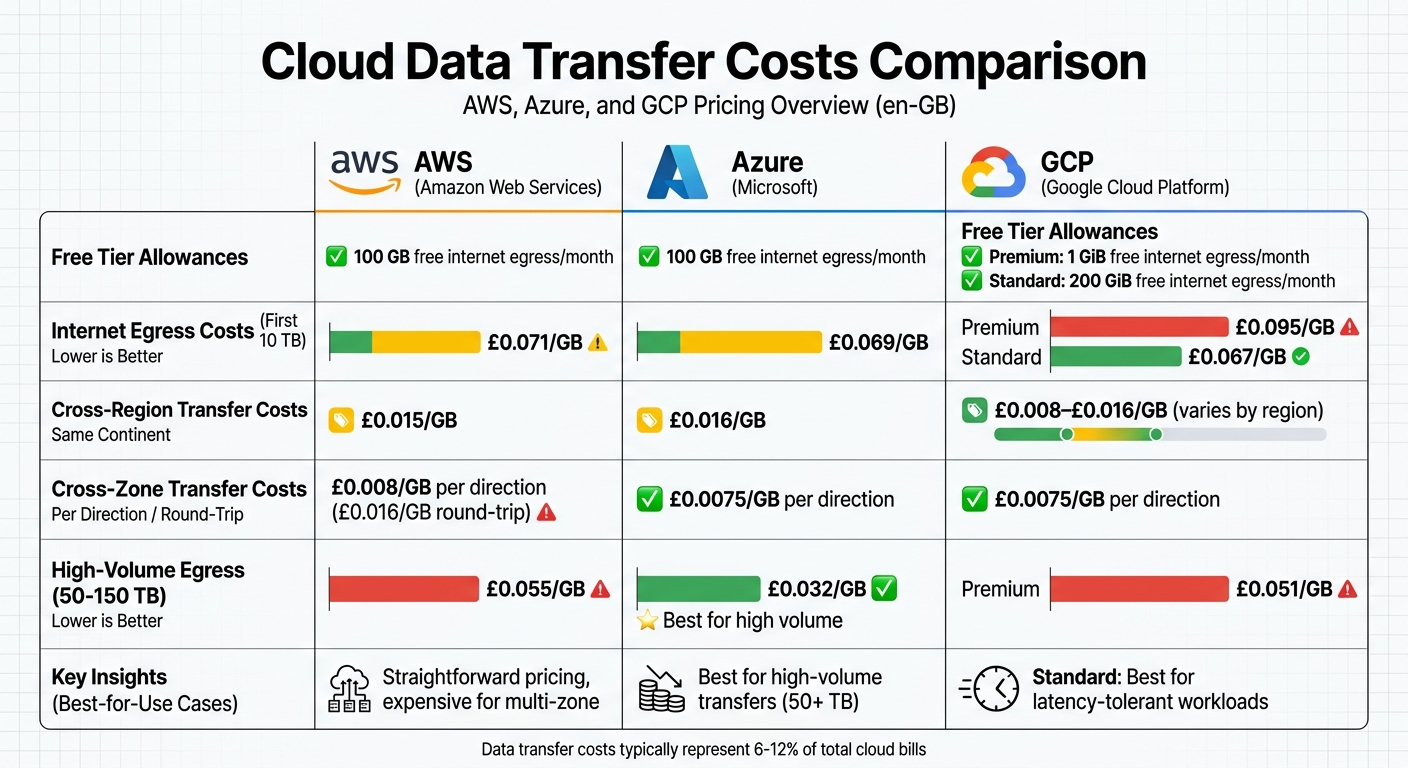 {AWS vs Azure vs GCP Data Transfer Costs Comparison 2026}
:::
{AWS vs Azure vs GCP Data Transfer Costs Comparison 2026}
:::
AWS Data Transfer Costs
Ingress and Egress Costs in AWS
AWS follows a simple rule: inbound data is free, while outbound data incurs charges [5]. Whether you're uploading to S3, EC2, or another AWS service, there's no cost for incoming data. However, costs start to pile up when data leaves the AWS network.
AWS provides a 100 GB monthly free tier for internet egress, which applies across all regions except China and GovCloud [6]. After exceeding this limit, tiered pricing kicks in:
- First 10 TB per month: £0.07/GB ($0.09/GB)
- Next 40 TB: £0.06/GB ($0.085/GB)
- Beyond 150 TB per month: £0.04/GB ($0.05/GB) [3]
Data transfer is the quietest budget killer in cloud computing.– SpendArk [3]
If you use a NAT Gateway, it adds an extra cost of £0.034/GB ($0.045/GB) on top of the standard egress rates [12, 15]. For high-traffic workloads, these NAT Gateway fees can sometimes exceed the actual data transfer charges.
Inter-Region and Inter-Zone Transfer Costs
Transferring data between AWS regions, such as from London to Frankfurt, costs £0.015/GB ($0.02/GB). This charge is applied only in the source region, while the destination region receives the data for free. However, your bill will show two entries: one for the charge and another for £0 [4].
For inter-zone transfers, the cost is £0.008/GB ($0.01/GB) each way. This means a round-trip (e.g., an API request and response) effectively costs £0.016/GB ($0.02/GB). In systems with frequent cross-zone communication - like Kubernetes clusters or microservice architectures - these costs can quickly add up, often accounting for 6% to 12% of total cloud expenses [3]. On the other hand, data transfers within the same availability zone using private IPs remain free [11, 15].
These pricing structures can have a noticeable impact on your AWS bill, especially in complex architectures.
AWS Pricing Examples
Here are some practical examples to put these costs into perspective:
Transferring 1 TB to the internet after the free tier: Costs approximately £63.70, and if routed through a NAT Gateway, an additional £30.60 is added. The total comes to £94.30.
Moving 1 TB of data from London to Northern Virginia: Costs about £15.30 at £0.015/GB [4].
Cross-zone transfers within London for 1 TB: A round-trip costs approximately £16.38 (calculated as £0.008/GB per direction for 1,024 GB).
To reduce these costs, using CloudFront can be a smart choice. Data transfers from AWS services to CloudFront are free, and CloudFront's egress rates are generally 30% to 70% lower than direct EC2 egress charges [5]. Plus, AWS offers a 1 TB monthly free tier specifically for CloudFront [6].
Need help optimizing your cloud costs?
Get expert advice on how to reduce your cloud expenses without sacrificing performance.
Azure Data Transfer Costs
Egress and Zone Transfer Pricing
Azure, like AWS, provides free inbound data transfers, charging only for outbound data. It also offers a global 100 GB monthly free tier for outbound transfers [10].
Once the free tier is exceeded, Azure applies a tiered pricing structure. For regions in North America and Europe, the rates are as follows:
- Next 10 TB per month: £0.065 per GB (approximately $0.087 per GB)
- Next 40 TB: £0.062 per GB (around $0.083 per GB)
- Next 100 TB: £0.052 per GB (about $0.07 per GB)
- Beyond 350 TB per month: £0.037 per GB (roughly $0.05 per GB) [10]
Azure also offers two routing preferences that impact costs significantly:
- Microsoft Premium Global Network: Routes traffic over private fibre for better performance but at higher costs.
- Routing Preference ISP Network: Exits Microsoft's network earlier via transit ISP networks, lowering egress charges by roughly 8–10% for workloads where latency isn't critical [10].
Transfers between availability zones within the same region are charged at around £0.0075 per GB ($0.01 per GB) in each direction. However, data transfers within the same availability zone remain free [20, 22]. Pricing may vary based on the region, as outlined below.
Regional Differences in Pricing
Azure's base rates are further influenced by regional variations, which can affect overall costs. For example:
- In North America and Europe, the first 10 TB is priced at about £0.065 per GB ($0.087 per GB).
- In Asia, Australia, and the Middle East, rates rise to approximately £0.09 per GB ($0.12 per GB).
- South America has the highest charges, at around £0.135 per GB ($0.181 per GB) [10].
Inter-region transfers within the same continent also vary:
- North America and Europe: About £0.015 per GB ($0.02 per GB).
- South America: Roughly £0.12 per GB ($0.16 per GB), which is around eight times higher [10].
Under the EU Data Act, customers in the UK, EEA, and EFTA can request at-cost
rates for transferring data to another cloud provider. This requires submitting a support request with their Subscription ID and meeting specific criteria [7].
Azure Pricing Examples
Here are some practical examples to demonstrate how Azure's pricing tiers apply in real-world scenarios:
- Transferring 500 GB to the Internet: Using the Microsoft Premium Global Network from a UK-based Azure region, this costs about £26.00 after the free tier is used up [10].
- Moving 1 TB Between Regions: A transfer between London and Frankfurt costs approximately £15.36, based on a rate of £0.015 per GB [10].
- Cross-Availability Zone Transfers: Sending 1 TB within the same region costs around £7.68 each way, totalling £15.36 for a round trip [20, 22].
The documentation for Azure is not great. You probably need specialised DevOps that knows Azure, how to set it up, and how to maintain that– Gim Wee, CTO of Sans Paper [10]
In 2023, Sans Paper, an Australian construction software company, shifted from Azure to another provider. Led by CTO Gim Wee and CEO Marcus van Enk, the company achieved a 30% reduction in infrastructure costs, with egress charges being a key factor in the decision [10].
GCP Data Transfer Costs
Free Ingress and Egress Pricing
Just like AWS and Azure, GCP provides free inbound data transfer [13]. However, it's worth noting that resources handling incoming data - such as load balancers, Cloud NAT, or protocol forwarding - may still result in additional charges [13].
For outbound data transfers, GCP uses a tiered pricing structure based on monthly usage. There are two distinct network service tiers, each with different costs. The Premium Tier, which is the default, includes only 1 GiB of free internet egress per month. On the other hand, the Standard Tier offers a much larger free allowance of 200 GiB per month across all regions [12][13]. This free allocation is shared across all projects, so organisations need to keep an eye on their combined usage to avoid unexpected expenses [12].
Transfers within the same availability zone using internal IPv4 addresses remain free. However, cross-zone transfers within the same region incur a charge of approximately £0.0075 per GB ($0.01 per GiB) [13][14].
Network Service Tiers: Premium vs Standard
One of GCP's standout features is its two network tiers, which differ in both cost and performance. The Premium Tier leverages Google's private, low-latency global fibre network, which spans over 200 points of presence worldwide. It uses cold potato
routing, meaning traffic enters Google's network at the closest point to the user. This tier supports global services like anycast IP addresses and global load balancing, and it comes with a 99.99% uptime SLA [12].
In contrast, the Standard Tier primarily uses the public internet, relying on transit and ISP networks. It employs hot potato
routing, keeping traffic on external networks until it reaches a point of presence near the destination Google Cloud region. This tier is limited to regional traffic, does not support global anycast or Cloud CDN, and offers a slightly lower 99.9% uptime SLA [12].
The pricing difference between these tiers is significant. For the first 10 TB of egress, the Standard Tier costs approximately £0.064 per GB ($0.085 per GiB), while the Premium Tier starts at £0.09 per GB ($0.12 per GiB) for the first terabyte [11][13]. If an organisation plans to transfer more than 5 Gbps of traffic from the Standard to the Premium Tier, they are required to coordinate with their account manager [12]. These differences in pricing and features play a major role when calculating costs, as shown in the example below.
GCP Pricing Examples
Let’s consider an example involving a UK resource in the europe-west2 region transferring 2 TB of data to another European destination. Under the Premium Tier, the cost is calculated as follows: 1 GiB is free, 1,023 GiB is charged at £0.09/GiB, and 1,024 GiB is billed at £0.0825/GiB. This brings the total to approximately £176.64. In comparison, the Standard Tier provides 200 GiB free and charges £0.085/GiB for the remaining 1,848 GiB, resulting in savings of about £58.80 (33.2%).
The cost of inter-region transfers within the same continent depends on the specific regions. For example, moving data between North American regions costs roughly £0.015 per GB ($0.02 per GiB), and the same rate applies to transfers between European regions. However, transferring data from any region to South America is more expensive, costing around £0.105 per GB ($0.14 per GiB) [13][14].
As with other cloud providers like AWS and Azure, understanding these details is essential for managing cloud costs effectively.
Comparison of Data Transfer Costs Across Providers
Table: Egress Costs Across Providers
When comparing the major cloud providers, their approaches to data transfer costs reveal some notable contrasts. While all providers offer free data ingress, egress pricing varies significantly based on the volume of data and its destination. As of 2026, AWS and Azure both include 100 GB of free internet egress per month, whereas GCP offers a more generous free tier of 200 GiB [9]. The table below outlines these egress costs, providing a foundation for analysing each provider's pricing structure.
| Transfer Type | AWS (£/GB) | Azure (£/GB) | GCP Premium (£/GB) | Notes |
|---|---|---|---|---|
| Internet Egress (First 10 TB) | £0.071 | £0.069 | £0.095 | Azure slightly edges out AWS; GCP is the most expensive for smaller volumes |
| Internet Egress (10–50 TB) | £0.067 | £0.065 | £0.063 | GCP becomes more competitive as volumes increase |
| Internet Egress (50–150 TB) | £0.055 | £0.032 | £0.051 | Azure offers the lowest rates for high-volume transfers |
| Internet Egress (150 TB+) | £0.039 | £0.039 | £0.039 | All providers converge to the same rate at the highest volume tier |
| Inter-Zone (Cross-AZ) | £0.008 | £0.008 | £0.008 | AWS charges for both directions; others often waive fees within the same VPC |
| Inter-Region (Same Continent) | £0.016 | £0.016 | £0.008–£0.016 | GCP can offer lower rates within continents |
| NAT Processing Fee | £0.035 | £0.035 | £0.035 | The processing fee remains consistent across all providers |
For workloads that can tolerate higher latency, GCP's Standard Tier offers an alternative at roughly £0.067/GB (around $0.085/GB). This tier routes traffic over the public internet instead of Google's private network, making it a cost-effective option compared to AWS and Azure [9].
Key Differences and Insights
The table highlights several key takeaways:
- Azure provides the most cost-effective rates for high-volume internet egress, with prices dropping to approximately £0.032/GB for transfers exceeding 50 TB per month.
- AWS, while straightforward in its pricing and offering a 100 GB free egress tier, can become costly for large-scale operations. Its cross-AZ fees of £0.008/GB in both directions can quickly add up for systems requiring multi-zone redundancy.
- GCP stands out for its two-tier pricing system. The Premium Tier starts off as the most expensive at £0.095/GB for initial volumes, but the Standard Tier, at about £0.067/GB, offers savings for workloads where latency is not a priority. Additionally, GCP's inter-region transfers within the same continent can be as low as £0.008/GB, compared to the flat £0.016/GB rate from AWS and Azure.
Data transfer costs often rank as the third-largest expense in cloud accounts, following compute and storage. Egress fees alone typically make up 6% to 12% of total cloud bills. In 2024, 62% of organisations exceeded their cloud storage budgets, largely due to unforeseen egress charges. For example, migrating 100 TB of data from AWS S3 could result in egress fees of approximately £6,715 [9]. This imbalance between free ingress and metered egress has been described by analysts as economic lock-in
, making it crucial for organisations to understand these pricing structures and find strategies to manage data transfer costs effectively.
Strategies to Reduce Data Transfer Costs
Using CDNs and Private Networking
Reducing data transfer costs can be achieved through several practical methods, starting with content delivery networks (CDNs). Using CDNs like Amazon CloudFront can significantly cut egress charges. For instance, transferring data from Amazon S3 to CloudFront is free, and the egress from the CDN to the internet is typically 30-70% cheaper than transferring data directly [5]. Each request served from a CDN edge bypasses your origin server, eliminating origin egress costs entirely [9]. Even for dynamic content, setting short cache durations (around 5 seconds) can reduce origin egress by over 90% during traffic spikes [15].
Another effective approach is private networking, which keeps traffic within the provider's backbone and avoids costly NAT Gateway fees (£0.035/GB). For example, AWS Gateway Endpoints for S3 and DynamoDB are free and eliminate NAT Gateway charges for that traffic. AWS Interface Endpoints, while not free, cost just £0.008/GB - about 78% less than NAT Gateway routing [15]. On Google Cloud Platform (GCP), enabling Private Google Access allows instances without external IPs to access Google services for free over the internal network [15]. Similarly, Azure's Private Endpoints come with a small hourly fee but no per-GB charge [16][15].
Deploying resources within a single Availability Zone (AZ) can also help eliminate inter-AZ transfer fees. However, this requires balancing cost savings against availability needs [5]. In Kubernetes environments, topology-aware routing can ensure pods communicate within the same zone, reducing cross-zone traffic [1]. For Azure users, selecting the Internet
routing preference (Hot Potato routing) often results in lower egress costs compared to the Microsoft Global Network
(Cold Potato routing) [8].
In addition to these technical strategies, many cloud providers offer special discounts and plans to help reduce costs further.
Provider-Specific Discounts and Plans
AWS users can take advantage of the CloudFront Security Savings Bundle, which offers up to a 30% discount on CloudFront charges in exchange for a monthly spend commitment [16]. For organisations transferring over 10 TB per month, AWS also offers custom Committed Throughput
pricing, which can reduce rates to £0.024–£0.039/GB [15].
Azure provides Reserved Capacity pricing for Azure Front Door and Unlimited Data plans for ExpressRoute, both of which eliminate per-GB charges in favour of a flat monthly fee [15][16]. Meanwhile, GCP's Network Service Tiers include a Standard Tier option that routes traffic over the public internet instead of Google's private backbone, cutting costs by 30-40% for workloads that can tolerate higher latency [15].
Dedicated connections, such as AWS Direct Connect, Azure ExpressRoute, and GCP Interconnect, offer another way to lower egress costs. These services typically charge around £0.016/GB compared to the standard £0.071/GB, although they come with fixed monthly port fees [9][16]. For workloads exceeding 5 TB per month, these dedicated interconnects can reduce egress costs by over 70% [9].
To maximise these savings, robust monitoring and cost management are key.
Monitoring and Cost Management Tools
Accurate monitoring is crucial for identifying the specific resources driving up your egress costs. AWS Cost Explorer, for example, allows filtering by usage type, such as NAT-GW-Bytes, to pinpoint expenses related to NAT Gateways [5]. Similarly, VPC Flow Logs provide insights into network traffic patterns, helping you identify high-volume IP addresses [5]. Azure Cost Management offers comparable tools for tracking egress across regions and services [8].
Another effective tactic is data compression. Using tools like gzip or Brotli can reduce API payload sizes by 60-80%, which directly translates into lower egress costs [9][16]. Additionally, implementing policy-as-code tools, such as Open Policy Agent (OPA), can help enforce cost-saving practices by blocking the creation of expensive infrastructure patterns, like NAT Gateways without corresponding S3 endpoints [5].
Combining monitoring tools with optimisation strategies ensures ongoing cost control. For those needing expert assistance, Hokstad Consulting specialises in cloud cost audits and optimisation, often achieving savings of 30-50% for their clients.
Conclusion: Choosing the Right Cloud Provider for Your Data Transfer Needs
Recap of Provider Strengths
AWS, Azure, and GCP each bring distinct advantages when it comes to data transfer pricing. AWS stands out with its 100 GB free tier and extensive service integration. Azure offers free cross-AZ transfers, making it a strong option for distributed architectures. Meanwhile, GCP provides a generous free tier and the cost-saving Standard Tier, ideal for latency-tolerant workloads.
The best choice for you will depend heavily on your architecture and traffic needs. GCP's Standard Tier can save 30–40% on workloads that can tolerate some latency [9], while Azure's free cross-AZ transfers are perfect for setups spanning multiple zones. AWS is a solid pick for businesses leveraging its CloudFront service and seamless integration with other AWS tools. As DevOps Engineer Akshay Ghalme wisely points out:
The cheapest cloud that your team doesn't know how to use will cost you more in engineering time than the most expensive cloud they're productive on[2].
Understanding these strengths can help you align your choice with your specific requirements.
Tailored Solutions with Hokstad Consulting
Navigating the complexities of cloud pricing can be a challenge, but expert guidance can make a big difference. Data transfer fees typically make up 6–12% of an organisation's total cloud bill [9], yet many businesses struggle to pinpoint where costs can be reduced. Hokstad Consulting specialises in helping UK businesses slash their cloud expenses by 30–50% through targeted cost audits and optimisation strategies.
Whether you're dealing with high API traffic, managing distributed microservices, or planning a multi-cloud setup, Hokstad Consulting can craft solutions that balance cost and performance. Their services include cloud cost audits, topology-aware designs, and continuous monitoring, all offered on a No Savings, No Fee
basis. This approach ensures that costs are directly tied to the savings they deliver, giving you peace of mind while optimising your cloud strategy.
CDNs vs S3/GCS direct transfer: Why you should use CDNs for lower data transfer costs
FAQs
What counts as billable egress in AWS, Azure and GCP?
Billable egress in AWS, Azure, and GCP refers to the costs associated with data leaving their cloud platforms. Here's a breakdown:
- AWS: Charges apply to data exiting services or regions, with rates starting at approximately £0.07 per GB for the first 10 TB each month.
- Azure: Egress fees begin around £0.06–£0.07 per GB, and the first 100 GB is often free.
- GCP: Pricing starts at about £0.10 per GB, with costs varying based on the amount of data and its destination.
It's worth noting that ingress (data entering the cloud) is generally free across all three providers.
How do NAT gateways and private endpoints change data transfer costs?
When it comes to managing cloud expenses, understanding how NAT gateways and private endpoints influence data transfer costs is crucial. Both play distinct roles in how data flows, and each comes with its own cost implications.
NAT Gateways are designed to provide outbound internet access for private subnets. However, this convenience comes at a price. They add processing fees, which can significantly increase the cost of outbound data transfers.
On the other hand, Private Endpoints offer a way to securely connect services within the cloud. By keeping traffic off the public internet, they help reduce egress costs. That said, they aren't entirely cost-free - you'll need to account for potential setup and ongoing maintenance expenses.
To keep costs under control, especially for workloads that handle large volumes of data, careful planning and a clear understanding of your infrastructure needs are essential. Balancing these options can make a big difference in managing your cloud budget effectively.
When is GCP Standard Tier worth using instead of Premium Tier?
The GCP Standard Tier is a great option when keeping costs low is more important than achieving top-tier performance. This tier relies on the public internet for data transfer, which helps to maintain lower and more predictable egress costs. However, this approach can lead to higher latency and less efficient routing compared to the Premium Tier, which leverages Google’s private backbone for superior performance. The Standard Tier is best suited for workloads where affordability takes precedence over speed and optimisation.