
False positives waste time and erode trust in security tools. They occur when automated systems flag harmless code as risky, leading to unnecessary investigations. In CI/CD pipelines, this disrupts productivity, delays responses to real threats, and creates alert fatigue
where critical issues are ignored.
Key Takeaways:
- False positives consume 70% of security teams' time.
- Manual triage is costly: A 15% false positive rate can cost a 10-person team £130,000 annually.
- Automation reduces noise: AI-driven tools and context-aware scanning cut false positives by up to 50%.
- Configuring tools properly is critical: Misconfigurations and lack of runtime context inflate false alerts.
Solutions:
- AI and machine learning: Tools like neural networks cluster and filter alerts.
- Context-aware scanning: Techniques like taint analysis and DAST validate exploitability.
- Automated feedback loops: Systems learn from past triage to improve accuracy over time.
- Effective configurations: Use baseline management, custom rules, and severity filtering.
Automating false positive management not only saves time but also strengthens CI/CD pipelines by ensuring genuine vulnerabilities are prioritised.
::: @figure 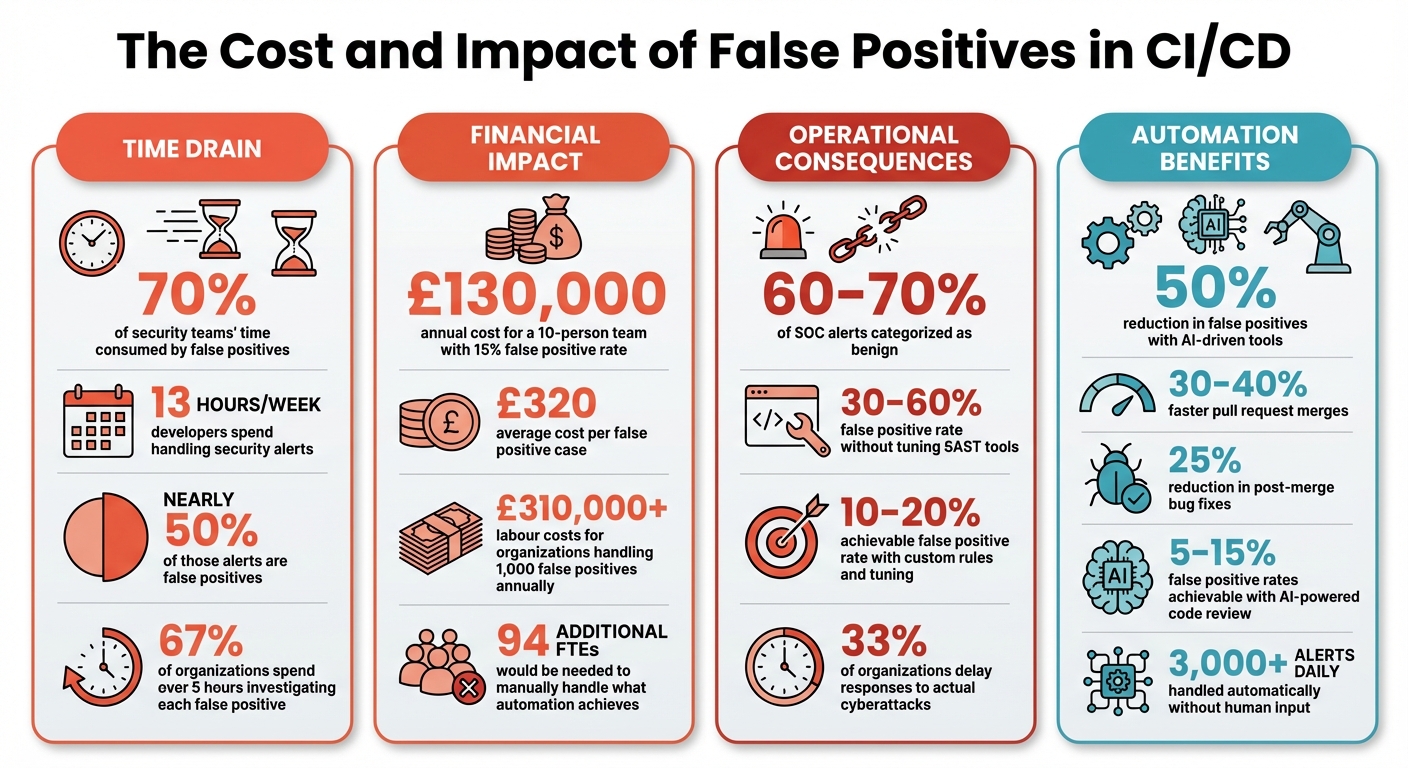 {The Cost and Impact of False Positives in CI/CD Pipelines}
:::
{The Cost and Impact of False Positives in CI/CD Pipelines}
:::
What Causes False Positives in CI/CD
Configuration Problems in CI/CD Tools
A major source of false positives in CI/CD pipelines comes from scanning tools that are not properly configured. Many teams rely on default settings, which are designed to cast a wide net rather than focus on the specifics of your codebase. This approach often leads to an overwhelming amount of irrelevant alerts [7].
One notable issue is with CPE-based matching, a standardised system that struggles to differentiate between similar software implementations. For example, in early 2023, the vulnerability scanner Grype flagged Go applications using google.golang.org/protobuf as vulnerable to CVE-2015-5237 and CVE-2021-22570. However, these vulnerabilities only applied to the C++ version of Protobuf. The reliance on CPE-based matching led to confusion across 44 cases in prominent projects like etcd, Prometheus, and kubectl [4].
After experimenting with a number of options for improving vulnerability matching, ultimately one of the simplest solutions proved most effective: stop matching with CPEs.– Keith Zantow, Anchore [4]
Another common misstep is turning off advanced analysis features. For instance, failing to enable cross-function and cross-file analysis prevents scanners from tracking unsanitised variables across the codebase [7]. Secret scanners often flag placeholder or revoked credentials as critical risks because activeness checks are disabled [8]. This leads to wasted time - 67% of organisations report spending over five hours investigating each false positive, with an average cost of £320 per case [8].
While misconfigurations are a major contributor, the absence of contextual analysis makes the problem even worse.
Missing Context in Security Scanning
Static tools often lack the runtime context needed to accurately assess vulnerabilities, which contributes to false positives. These tools analyse code in isolation, leading them to flag safe code as dangerous. For example, a scanner might highlight a SQL injection vulnerability without recognising that your application uses an Object-Relational Mapping (ORM) that automatically parameterises queries [9].
SAST sees your code in isolation. It does not know that a particular input field only accepts values from a dropdown, or that an internal API is never exposed to external users. Everything looks like untrusted input.– Suphi Cankurt, Application Security @ Invicti [9]
Framework-specific protections, like Django's auto-escaping for templates or Spring Security's built-in CSRF protection, often go unnoticed by scanners. Similarly, traditional reachability analysis may flag vulnerabilities in code paths or packages that are never actually executed or exposed to user input. As a result, developers spend an average of 13 hours per week handling security alerts, with nearly half of those alerts being false positives [9].
Redundant or Overlapping Tools
False positives are further inflated by uncoordinated or redundant security measures. Many organisations create reactive rules that are rarely updated, leading to outdated logic and technical debt [11]. When multiple security tools scan the same codebase without coordination, overlapping results force teams to investigate duplicate alerts.
Traditional alert writing treats detections as isolated responses to specific incidents - rules created reactively, rarely tested, and seldom revisited. This approach leads to rule sprawl, inconsistent logic, and mounting technical debt.– Abnormal AI [11]
Shadow IT adds another layer of complexity. Teams often set up cloud instances or API integrations outside official channels, causing scanners to flag activity from unrecognised IP addresses as suspicious [12]. Without cross-team communication, tools may fail to distinguish between a genuine leaked secret and an example used in documentation. For organisations handling 1,000 false positives annually, the labour costs can exceed £310,000 [8]. Additionally, 60–70% of alerts reviewed by SOC teams are categorised as benign, which contributes to analyst fatigue and increases the likelihood of missing real threats [11].
These challenges highlight the need for automated solutions that can provide better context and reduce the burden of false positives.
Methods for Automating False Positive Management
Setting Up Context-Aware Scanning
Reducing false positives starts with giving scanning tools the context they need to make smarter decisions. Techniques like cross-function and reachability analysis allow scanners to map data flow across files and verify whether flagged dependencies are actually executed [7]. This approach, often referred to as taint analysis, helps cut down on unnecessary alerts by tracing how data flows through your application.
Dynamic Application Security Testing (DAST) adds another layer by validating if a vulnerability can actually be exploited [5]. For example, in early 2026, a Midwestern Bank integrated Bright Security's DAST scanner into its CI/CD pipeline, which reduced their preliminary scanning workload by 70% [5].
Static findings are useful, but they do not tell you whether something can actually be exploited. Dynamic validation answers that question by interacting with the application the way an attacker would.– Bright Security [5]
Other methods, like production context filtering, use metadata from external registries (e.g., JFrog Artifactory) or deployment records to prioritise alerts that impact production environments or internet-exposed artefacts [14]. Diff-aware scanning focuses only on code changes relative to a baseline commit, ensuring developers aren’t overwhelmed by legacy findings during pull requests [13].
Building on these context-aware approaches, AI brings an additional level of precision to filtering out false positives.
Using AI and Machine Learning for Pattern Recognition
AI tools excel at recognising patterns in false positives, filtering them out before they reach developers. For instance, neural networks can transform log messages into high-dimensional vectors, clustering similar alerts together for easier analysis [3]. Harness applied this technique in April 2018, cutting false positives in log analysis by 50% [3].
AI also enables automated triage, where findings are marked as “provisionally ignored” based on their likelihood of being false positives. This approach keeps potential false alarms out of developers’ immediate view while still allowing for human oversight [1]. In October 2025, Codacy introduced Smart False Positive Triage
for its Business plan customers. This system analyses the full context of code changes during pull requests, providing clear explanations for its decisions and avoiding the pitfalls of a black box
process [17].
Instead of just matching static patterns, our engine now analyses the full context of the code during a Pull Request... to determine if it's a false alarm or a real problem.– Codacy [17]
AI-powered reachability and applicability analysis goes a step further, determining whether a flagged vulnerability is actually reachable within the specific configuration of your application [16][1]. Ensemble learning techniques, which combine methods like logistic regression, gradient-boosted trees, and deep neural networks, create composite risk scores for code changes. This helps prioritise real threats over false alarms, improving CI/CD pipeline efficiency by cutting down on manual triage [15].
Creating Automated Feedback Loops
Automated feedback loops take false positive management to the next level by continuously integrating what the system learns into the CI/CD process. By embedding these loops directly into developer workflows - such as IDEs, pull requests, and CI pipelines - alerts can be triaged more effectively and in real time [10][13]. For example, when a developer marks an alert as a false positive, the system can automatically close the incident, log the reason, and add the flagged entity to a global exclusion list [18][19].
AutoTriage reasoning gates evaluate the exploitability and likelihood of an issue before it even reaches a human. These gates often rely on large language models or simple rules to make their assessments [10]. Tools like the Exploit Prediction Scoring System (EPSS) can automatically downgrade low-risk issues based on real-world threat intelligence [10]. Temporary exceptions can also be set to expire after a specific period, such as during maintenance windows, to ensure security coverage isn’t permanently compromised [18][19].
Vulnerability management is equally an engineering and process problem, and Aikido takes a strategic approach to reduce noise and accelerate the fixes that matter.– Madeline Lawrence, Aikido [10]
Centralised watchlists streamline exception management, while AutoFix features can generate pull requests for identified vulnerabilities. Developers’ decisions to accept or reject these pull requests feed directly back into the system, improving its accuracy over time [10][14]. Diff-aware scanning ensures feedback loops focus only on new findings from specific commits, avoiding the re-triaging of old false positives [13].
For organisations aiming to fine-tune their CI/CD pipelines, Hokstad Consulting offers customised solutions to optimise DevOps workflows and improve overall efficiency.
Developer-First DAST: Fix Security Issues Before They Reach Production
Tools and Practices for Effective Automation
When it comes to managing false positives in CI/CD pipelines, the right tools and well-thought-out configurations can make all the difference.
Top Tools for Automating False Positive Management
Semgrep provides a flexible way to tackle false positives. With its AI-powered Semgrep Assistant, potential false positives are flagged as provisionally ignored
before they even reach developers [1]. Its diff-aware scanning focuses only on new code changes [13]. The platform is free for up to 10 users [7], and its YAML-based rule engine allows teams to define custom sanitisers and proprietary libraries, effectively muting generic false alerts [9].
GitLab Duo leverages AI to assign confidence scores to alerts. Vulnerabilities identified by SAST are scored, with findings rated between 80% and 100% flagged as likely false positives.
Alerts scoring below 60% are marked as likely not a false positive
, requiring further manual review [20].
Meanwhile, Bright Security takes a different approach by combining SAST with DAST to validate whether static findings are actually exploitable [5]. Kunal Bhattacharya, Head of Application Security at SentinelOne, highlighted its impact:
Empowering our developers with Bright Security's DAST has been pivotal... It's not just about protecting systems; it's about instilling a culture where security is an integral part of development[5].
The tool integrates smoothly into staging and testing environments, enabling runtime validation without disrupting deployment workflows.
Contrast Assess employs Interactive Application Security Testing (IAST) to monitor runtime data flows, helping to confirm or dismiss static findings through runtime instrumentation [9].
While selecting the right tools is key, fine-tuning pipeline configurations is equally important for managing false positives effectively.
Configuration Practices for CI/CD Pipelines
Severity and confidence filtering is a must for cutting down false positives. Configure CI pipelines to block only High Confidence
and High Severity
findings initially, and gradually lower thresholds as the system becomes better tuned. Without tuning, SAST tools can produce false positive rates of 30%–60%. Custom rules and framework-aware configurations can reduce this to 10%–20% [9].
Framework-specific rule packs help minimise noise by recognising built-in protections like auto-escaping, CSRF tokens, and parameterised queries. Disable rules that don't apply to your tech stack, such as raw SQL rules if you're using an ORM [9].
Baseline management ensures legacy code doesn't overwhelm developers. When deploying a tool for the first time, mark all existing issues as a baseline
while surfacing only new findings in pull requests. Use environment variables like SEMGREP_BASELINE_REF to configure incremental scans, so only issues introduced by new code changes are reported [9][13].
Enforced suppressions with justification promote accountability. Require developers to include clear justifications for inline suppressions (e.g., // nosemgrep) [1][9]. Reject pull requests with unjustified suppressions, and consider implementing time-limited suppressions - such as 90-day expiry periods - to ensure periodic re-evaluation of flagged code [9].
By combining the right tools with these tailored configuration practices, organisations can streamline their CI/CD processes, reduce manual triage efforts, and enhance overall pipeline efficiency.
For those seeking expert guidance, Hokstad Consulting offers services to optimise CI/CD pipelines, including automated configurations and custom solutions tailored to specific security needs.
Business Benefits of Automating False Positive Management
Reducing Costs and Increasing Productivity
False positives can be a major drain on resources. For example, a 15% false positive rate can cost a 10-person team around £130,000 annually due to wasted engineering hours [6]. On top of this, security teams spend a staggering 70% of their time investigating false positives [2].
In May 2024, the Elastic InfoSec team tackled this issue head-on by introducing an automated triage workflow with Tines to manage SIEM alerts. The results were impressive: the system handled and closed over 3,000 alerts daily without requiring human input. To achieve the same level of detection manually, Elastic estimated they would need an additional 94 full-time employees. Considering that each manual triage takes an experienced analyst more than 15 minutes, the cost savings were substantial [12].
Beyond financial savings, automation also eliminates the inefficiency caused by constant context switching. Each interruption can cost up to 23 minutes of lost focus [6]. Sonali Sood, Founding GTM at CodeAnt AI, highlights the problem:
Your AI code review tool flags a SQL injection vulnerability... Your senior engineer investigates for 20 minutes, only to discover the input is already sanitized upstream. Multiply that across 50 weekly PRs, and you're wasting valuable development time instead of shipping features[6].
By addressing these inefficiencies, automation not only reduces costs but also allows developers and testers to work without unnecessary distractions, leading to better productivity.
Improving Developer and Tester Efficiency
False positives don’t just waste time - they can also lead to alert fatigue, where engineers start ignoring all alerts, including critical ones. This creates dangerous gaps in security. Sonali Sood explains:
High false positive rates don't just waste time, they degrade your security posture through alert fatigue: engineers stop treating 'critical' as urgent[6].
By cutting down on false positives, organisations can speed up pull request (PR) merges by 30–40% and reduce post-merge bug fixes by 25% [6]. This shift allows security teams to focus on proactive strategies rather than constantly reacting to false alarms.
These improvements not only make day-to-day operations smoother but also set the stage for more scalable and effective long-term solutions.
Scalability and Long-Term Benefits
In today’s fast-paced cloud environments, manual triage simply can’t keep up. With ephemeral infrastructure and rapidly growing identities, automation becomes essential. Automated triage allows organisations to deploy detection rules that would otherwise overwhelm teams without requiring a massive increase in staffing [12].
Aaron Jewitt from Elastic's InfoSec team summarised the challenge:
One of the biggest SIEM management problems SOC teams face is that they are often overwhelmed by false positives, leading to analyst fatigue and visibility gaps[12].
Automation ensures that high alert volumes - sometimes thousands per day - are handled efficiently. It applies consistent, repeatable filtering logic that not only adapts to evolving threats but also optimises CI/CD pipeline performance over time.
For businesses looking to streamline CI/CD pipelines and cut operational overhead, Hokstad Consulting offers tailored DevOps transformation services. These include automated configurations and security-focused strategies designed to meet the demands of modern workflows.
Conclusion
False positives in CI/CD pipelines can seriously disrupt both security and productivity. With teams reportedly spending 70% of their time dealing with false alerts and 33% of organisations delaying responses to actual cyberattacks, it's clear that automation isn't just helpful - it’s essential[2].
Back in April 2018, members of the Harness Data Science Team - Parnian Zargham, Raghu Singh, and Sriram Parthasarathy - introduced a neural network-based solution that cut false positives in log analysis by 50% compared to traditional methods[3]. This achievement highlights the importance of a well-structured, layered automation strategy.
One such strategy involves context-aware analysis, which examines cross-file and cross-function relationships to reduce noise by pinpointing exploitable code paths. Setting baselines for existing code also helps teams focus on new vulnerabilities without drowning in legacy technical debt. Additionally, treating detection rules like code - complete with version control, peer reviews, and automated testing - ensures a consistent and high-quality pipeline[22].
AI-driven analysis and automated triage workflows are paving the way for the future of CI/CD security. Current industry benchmarks show that AI-powered code review systems can achieve false positive rates as low as 5% to 15%[6][21]. However, maintaining these results requires constant refinement - updating known good
lists, addressing noisy rules, and tracking metrics like False Positive Ratio and Mean Time to Remediate are key[23]. These approaches, as outlined above, can lead to real progress in improving both security and team efficiency.
FAQs
Which CI/CD security alerts should we automate first?
Automating alerts for false positives in security scans, SIEM investigations, and vulnerability detection is a smart starting point. These processes tend to produce an overwhelming amount of alert noise, which can waste valuable time and resources. By automating how these false positives are handled, you can simplify workflows and redirect attention to actual threats that require immediate action.
How can we prove a finding is actually exploitable?
To determine if a finding can be exploited, you need a mix of manual testing, contextual analysis, and controlled reproduction of the issue. Manual testing ensures the vulnerability isn’t just a false alarm. Key elements such as credentials, network access, and specific configurations are examined to evaluate how likely it is for the vulnerability to be exploited in practice. While detection tools can help fine-tune the process, manual verification is essential to confirm whether an attacker could realistically take advantage of the issue.
How do we stop suppressions becoming permanent blind spots?
To prevent suppressions from becoming lasting blind spots in CI/CD pipelines, it's essential to handle them with care and consistency. Regularly review these suppressions to ensure they address benign behaviour without being too rigid or static. Periodically assess their relevance to evolving contexts.
Keep thorough documentation explaining why each suppression was applied. This transparency helps teams understand their purpose. Additionally, establish feedback loops with developers to validate suppressions, ensuring they strike the right balance between maintaining security and supporting operational efficiency.