
I start an AI roadmap with a business target - not a tool. For example, cutting enquiry-handling time from 8 minutes to 5 means little if errors or costs rise.
I use the roadmap to connect that target to five checks:
- Define success: Set a baseline, targets, budget and named owners.
- Check readiness: Confirm data access, system links, staff capacity and UK privacy duties.
- Plan delivery: Choose build, buy or partner, then set phases and approval gates.
- Test the workflow: Measure quality, time and total cost, including human review.
- Control release: Set access limits, monitoring, support and rollback rules. Expand only when live results justify it.
My rule is simple: a working pilot is not permission to deploy. Each next step needs measured results, agreed controls and someone accountable for saying go - or stop.
::: @figure 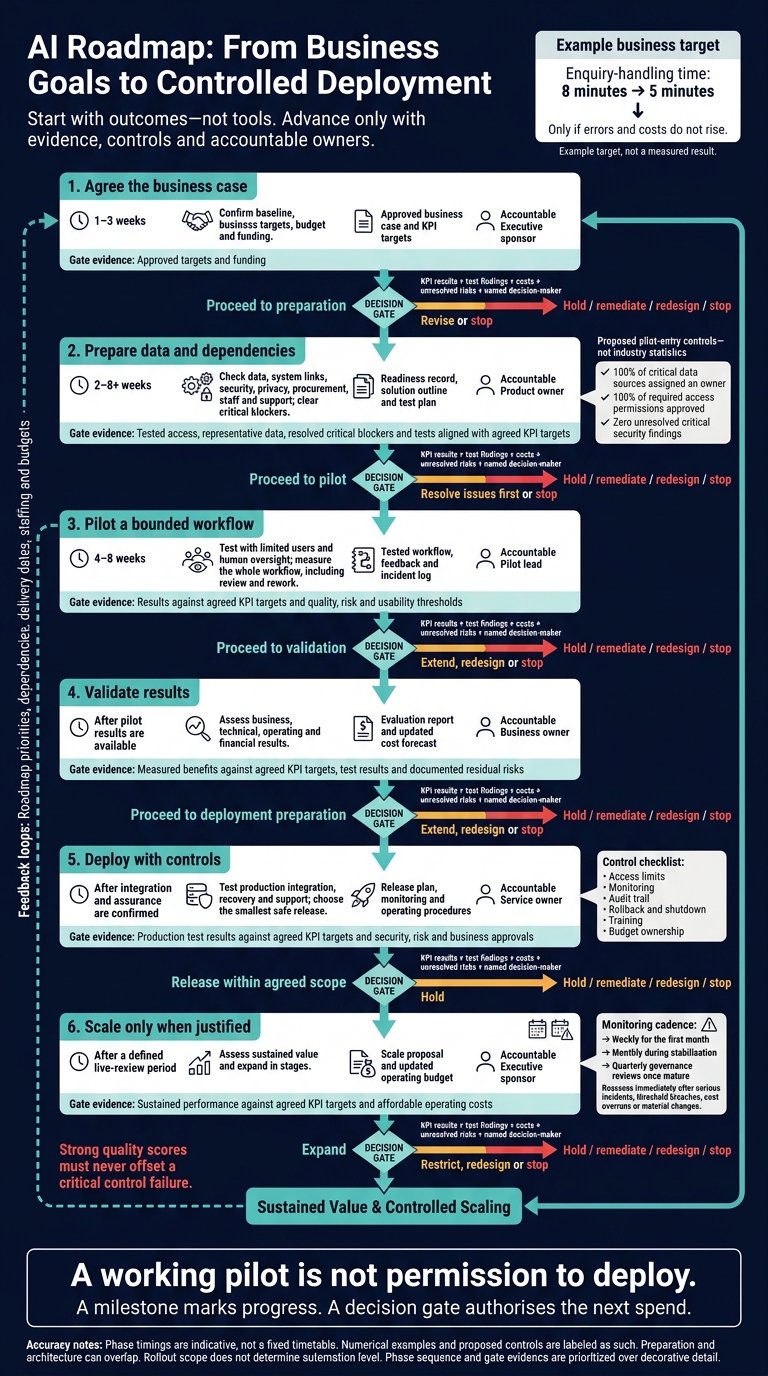 {AI Roadmap: From Business Goals to Controlled Deployment}
:::
2. Check Readiness and Map Dependencies
Document Data, Security and Support Needs
Create a readiness record for each use case. Include data sources, owners, lineage, update frequency, permitted uses, access rights and retention rules. Set measurable data quality thresholds before development. Then document system interfaces, hosting, demand and response-time needs.
Check staff skills, reviewer capacity, workflow ownership and support cover together. Usable data alone does not make a pilot ready. Once the record is complete, map the blockers that could delay deployment.
Confirm where inputs, outputs, logs and backups will be stored, who can access them, and whether suppliers can retain or reuse them. Document the UK data protection and sector rules that apply. Complete a data protection impact assessment (DPIA) before processing that is likely to create high risk to individuals. Revisit it when the purpose, scope or data changes.[2] Include API access controls, incident handling and deletion arrangements in the security review.[3]
Map Dependencies and Readiness Criteria
Link each use case to its data pipelines, business systems, APIs, hosting, identity controls, human reviewers and support. Classify each dependency as available, remediable, requiring procurement or development, or blocking delivery. Record its owner, target date, cost, evidence needed and the effect of any delay. This helps identify integration work, procurement lead times and training gaps.
Set clear pilot entry criteria. Recommended thresholds include 100% of critical data sources assigned an owner, 100% of required access permissions approved and zero unresolved critical security findings. These are proposed controls, not industry statistics.
Also require tested integration, agreed human review, named business and technical owners, support cover, and a way to stop and investigate the system. Critical gaps block launch. Non-critical gaps need an approved exception, an owner and a resolution date. Use these blockers to help decide which use cases can move first.
Prioritise Use Cases by Value and Feasibility
Compare measurable benefit with delivery effort, running costs and risk - not novelty. Ask stakeholders from business, data, security, legal and operations to validate the ratings. Put high-value but blocked ideas on a preparation track rather than forcing them into the first pilot.
Rank use cases by what can be delivered now, what needs remediation and what should wait. The table below is a prioritisation template; its ratings are illustrative.
Use case Business value Data readiness Technical complexity Risk exposure Dependency burden Internal policy-search assistant using approved documents Medium to high High if documents are controlled and current Low to medium Medium; inaccurate answers require clear warnings Low to medium Customer-service summarisation with human approval High Medium Medium Medium to high because personal data and customer outcomes are involved Medium Predictive maintenance using sensor data High where downtime is costly Medium to high if telemetry is reliable and labelled Medium to high Medium; operational errors may affect safety or availability High if plant, IoT and maintenance systems must be integrated Automated recruitment ranking High potential efficiency Variable High High because employment decisions and Article 22 considerations may apply High
Use the gaps and rankings to select the first phase, set the next decision gate and build the phased roadmap.
3. Build a Phased Roadmap with Decision Gates
Use the readiness record to turn the business case into a delivery plan with clear approval points.
Plan Phases from Business Case to Scale
A milestone marks progress. A decision gate authorises the next spend. Use the sequence below as a guide, not a fixed timetable. Timing depends on data maturity, integration complexity, risk and team capacity.
| Phase | Indicative timing | Activities | Deliverables | Accountable owner | Dependencies | Entry criteria | Evidence for the next gate | Gate decision |
|---|---|---|---|---|---|---|---|---|
| Agree the business case | 1–3 weeks | Confirm the business case and funding | Approved business case and KPI targets | Executive sponsor | Process data and finance input | Priority use case selected | Approved targets and funding | Proceed to preparation, revise or stop |
| Prepare data and dependencies | 2–8+ weeks | Clear blockers and define the solution and test plan | Readiness record, solution outline and test plan | Product owner | Data, security, procurement and integration teams | Business case approved | Tested access, representative data, resolved critical blockers and tests aligned with agreed KPI targets | Proceed to pilot, resolve issues first or stop |
| Pilot a bounded workflow | 4–8 weeks | Test with limited users and human oversight | Tested workflow, feedback and incident log | Pilot lead | Working interfaces and trained reviewers | Scope, fallback and test plan approved | Results against agreed KPI targets and quality, risk and usability thresholds | Proceed to validation, extend, redesign or stop |
| Validate results | After pilot results are available | Assess business, technical, operating and financial results | Evaluation report and updated cost forecast | Business owner | Pilot evidence and separate validation data | Pilot results available | Measured benefits against agreed KPI targets, test results and documented residual risks | Proceed to deployment preparation, extend, redesign or stop |
| Deploy with controls | After integration and assurance are confirmed | Test production integration, recovery and support | Release plan, monitoring and operating procedures | Service owner | Production systems, support and approvers | Validation accepted | Production test results against agreed KPI targets and security, risk and business approvals | Release within agreed scope or hold |
| Scale only when justified | After a defined live-review period | Assess sustained value and expand in stages | Scale proposal and updated operating budget | Executive sponsor | Live results and support capacity | Stable, controlled deployment | Sustained performance against agreed KPI targets and affordable operating costs | Expand, restrict, redesign or stop |
Data preparation and architecture design can overlap. Procurement can also progress during the pilot where justified. But a successful pilot does not prove production readiness.
At each gate, attach KPI results, test findings, costs and unresolved risks. Record the decision, any conditions and the person responsible for follow-up. Extend a pilot only to answer one unresolved question. This supports NIST’s approach of testing before deployment and regularly during operation.[1][8]
Once the phases are set, choose a delivery model that meets the same control and support requirements.
Choose Architecture and Delivery Ownership
Treat architecture and delivery ownership as a gate decision: both shape pilot scope, support arrangements and release risk. Compare build, buy and partner options against the same requirements before committing funds.
Test integration, security, auditability and support assumptions - not just delivery speed. A hybrid approach can combine purchased capabilities, internal components and specialist delivery.
| Approach | Integration | Security | Customisation | Operating cost | Long-term ownership | Maintenance and support |
|---|---|---|---|---|---|---|
| Build | Internal teams design and maintain interfaces | Internal team owns control design and assurance | Greatest flexibility, subject to skills and budget | Engineering, infrastructure and operations costs are internal | Internal team owns the platform and technical debt | Internal teams handle releases, defects, monitoring and incidents |
| Buy | Faster where existing interfaces fit; gaps still need work | Requires supplier due diligence, contractual safeguards and access controls | Limited by configuration and product boundaries | Subscription, usage, integration and support charges | Organisation depends partly on supplier direction and contract terms; exit planning matters | Supplier maintains the core service; internal teams own configuration and oversight |
| Partner | Specialist help can support complex integration | Responsibilities must be divided through contracts and assurance checks | Tailored delivery within the agreed scope | Delivery fees plus platform, support and change costs | Ownership depends on the agreed operating model and documentation | Named responsibilities for defects, monitoring, incidents and escalation |
Document hosting, data flows, interfaces, access controls, audit logs and exit terms. Assign named owners for business approval, data quality, technical validation and production support. State who accepts residual risk and who can stop or roll back the system. Outsourcing implementation does not transfer accountability for business outcomes or appropriate use.[1][7]
Separate one-off costs from recurring running costs. Include data remediation, integration, testing, training, licences, hosting, monitoring, human review and support. Show cost ranges in £ for the pilot, first release and scaled operation, alongside assumptions for transaction volume, support hours and how often data is refreshed.
Review the architecture and cost forecasts after the pilot, before approving production spending. Use the approved phases and architecture choices to set pilot scope, acceptance thresholds and rollback rules.
4. Run Pilots and Assess Results
Test only the workflow and dependencies cleared in the roadmap.
Define Pilot Scope and Acceptance Thresholds
Write a one-page pilot charter covering objectives, one bounded workflow, the user group, data, exclusions, owners, risks, test methods, budget, end date and gate criteria. Name the human decision-maker who can approve exceptions or suspend testing.
Before testing, measure the current process: handling time, errors, rework and cost per case. Use representative users and cases.[6] This turns the approved roadmap into a bounded test, with measured results to support the next gate decision.
Agree mandatory limits and improvement targets before testing. Set gate criteria for data access, integration, task quality, user testing and rollback drills. Cover quality, safety, security, adoption, cost and incident handling. Specify permitted actions, required human approvals and stop conditions. For personal data, document the purpose, lawful basis, transparency, retention and data-minimisation controls.[4]
Treat feasibility as a test result, not permission to release. Test unseen cases, incomplete data, unauthorised access, prompt injection, peak demand and dependency outages. Check that fallback procedures work and that logs let you reconstruct incidents.
Measure the whole workflow, including review and rework. Include training, support and monitoring in the cost calculation. A pilot can show that the model works but still fail release checks: performance may drop with incomplete data, supplier logs may lack detail, integration downtime may have no fallback, or total costs may exceed the business case.[9][10]
Decide Whether to Proceed, Extend, Redesign or Stop
Use a scorecard that links each measured result to test evidence, sample size and test dates. Apply approved, risk-based limits; the thresholds below are examples. Record actual measurements, not just a “pass”.
Area Target or threshold Actual result Business impact Unresolved risk or remediation Data and integration Approved sources available; 99% successful data refreshes 96%; two source-system failures Delayed responses during outages Add validation and fallback integration Task performance At least 95% correct on representative holdout cases 93% overall; 87% on complex cases Reduced manual effort, but rework remains high Restrict scope and improve retrieval Safety and compliance No critical incidents; 100% review for high-risk outputs No critical incidents; review applied in 98% of cases Acceptable only for low-risk work Fix two missed-review alerts User adoption At least 80% weekly active use; positive usefulness rating 76%; 4.0/5 rating Moderate productivity benefit Improve training and interface Workflow impact 20% lower handling time without higher error rates 15% lower handling time; errors unchanged £18,000 estimated annualised saving Extend pilot to validate savings Cost and capacity Below £1.00 per case; supports forecast peak £0.92 per case; peak test passed Business case remains viable Confirm supplier pricing Reliability and support 99.5% availability; incident response under 30 minutes 99.1%; response averaged 42 minutes Not ready for broad deployment Strengthen on-call coverage
Have business, technical and risk owners record one decision: proceed to controlled deployment, extend for one evidence gap, redesign for material change, or pause or stop. Record dissent, residual risks, remediation owners and the next decision date, then update the roadmap.
Strong quality scores must never offset a critical control failure. Only a pilot that clears these controls moves to release scope and production monitoring.
5. Approve Deployment and Monitor Results
If the pilot passed its gate, define the smallest safe release. Apply the roadmap’s gate-based checks: outcomes met, dependencies cleared and controls in place.
Set Release Scope and Production Controls
Choose rollout scope and automation level separately. These release models can overlap. A limited rollout can still require human review, while broader access does not have to mean more autonomy.
Use the pilot results and dependency map to choose the safest scope - not the broadest rollout.
| Release model | Suitable conditions | Oversight | Main risk |
|---|---|---|---|
| Internal controlled release | Low risk, proven value and trained internal users | Restricted access, logging and a named owner | Failures outside pilot conditions may go undetected |
| Limited user rollout | Measurable value and risk that can be controlled at limited scale | Staged access, feedback and a rollback plan | Behaviour and demand may differ from the pilot |
| Human-reviewed production | Value depends on outputs affecting customers, employees, finances or regulated decisions | Trained reviewers approve, amend or reject outputs, with clear escalation | Reviewers may over-trust outputs; monitor for automation bias |
| Broader automation | Sustained value, low residual risk and reliable operations | Exception handling, live monitoring and shutdown capability | Errors can spread fast and escape early detection |
Before approval, confirm these release controls:
- Access: Confirm authorised users, permitted actions, mandatory reviewer approvals and escalation rules.
- Monitoring: Set up live alerts and assign response owners for availability, latency, output quality, drift, unusual usage and security events.
- Audit trail: Check that live logs can trace outputs, overrides, approvals and material changes.
- Rollback and shutdown: Name the authorised owner and test restoration of the previous workflow. Confirm how to stop automated actions, preserve evidence and switch to manual operation.
- Training: Train affected staff on appropriate use, limitations, review duties and escalation. Update operating procedures when responsibilities change.
- Budget ownership: Name the owner of running and human-review costs, and track monthly costs in £.
Keep ownership of risks, budgets, approvals and monitoring within the organisation.
Every mandatory row must pass before approval. Record the final decision - go, conditional go, extend, redesign or stop - along with the approved scope and review date. Use conditional approval only when the outstanding issue has a named owner, deadline, compensating control and explicit approval.[7][1][5][12][13][11]
| Evidence | Threshold | Owner | Decision | Follow-up action |
|---|---|---|---|---|
| Technical evaluation and integration tests | Reliability, latency, security and data quality meet release limits | Technical or platform owner | Pass / fail | Fix failures and retest |
| Pilot KPI results and user feedback | Agreed business improvement achieved; cost per case, transaction or user within budget | Business owner | Pass / fail | Release within scope, revise workflow or stop |
| Privacy, security and risk assessment | No unresolved high-severity risk | Risk, legal or compliance owner | Pass / fail | Add controls, restrict scope or stop |
| Operational-readiness record | Monitoring, training, support, budget and recovery procedures ready | Service owner | Pass / fail | Complete missing work before release |
Review Performance Before Scaling
Once the release is live, use evidence from production to decide whether to scale, hold or narrow its scope.
Review operations weekly for the first month. During stabilisation, review performance and risk monthly, then move to quarterly governance reviews once mature. Compare business outcomes, quality across relevant groups, override rates, complaints and cost per successful outcome against approved limits.
Reassess immediately after a serious incident, threshold breach or cost overrun. Do the same after a change to data, models or suppliers; a new failure mode reported by users; or a change in regulation, policy or priorities.
Scale only when live evidence confirms the original business outcome. Otherwise, hold, narrow, redesign or suspend. Use production evidence to update roadmap priorities, dependencies, delivery dates, staffing and budgets.[7][1]
Conclusion: Start with Outcomes, Dependencies and Gates
Define measurable outcomes, check readiness, map dependencies, phase delivery and validate pilots before deployment. Before committing to broader implementation, prepare one initiative brief, one dependency map and agreed gate criteria.
FAQs
How can we set realistic AI targets without reliable baseline data?
Record how the process performs today to set a baseline before estimating improvements. Hokstad Consulting advises choosing one specific business result rather than a broad list of pilots. Map inputs, transformations and outputs to spot friction, then set one primary KPI and quality guardrails.
Run small-scale tests to gather evidence, check assumptions and build a case for scaling. Use those results to guide your roadmap, so each step rests on verifiable outcomes rather than guesswork.
How should we prioritise dependencies shared by several AI projects?
Use a value–feasibility matrix to prioritise high-value projects that can be delivered in small, clear steps. If high-value work has unresolved system or data dependencies, put it on a preparation track outside the core delivery plan.
Hokstad Consulting recommends classifying dependencies as ready, partial or blocked. Keep a readiness register for each project, with evidence, an accountable owner and a target date for closing dependency gaps before the pilot.
How can we tell whether human review will scale affordably?
Calculate the true cost per successful task by dividing total delivery spend - including human review resources and correction time - by the number of accepted tasks. Reviewers need both the skills and the authority to spot and prevent errors reliably.
Track reviewer effectiveness, agreement and missed-error rates, not just generation speed. If reviewers can’t keep up with the workload, or review becomes a bottleneck, the process isn’t ready for production at scale.