
Cloud costs can be unpredictable, making budgeting tough for businesses. AI-driven cloud cost scenario modelling helps tackle this challenge by forecasting expenses and identifying cost drivers. Here's what you need to know:
- What it does: Predicts cloud costs under different scenarios, like traffic surges or pricing changes.
- How AI helps: Analyses historical data, detects patterns, and provides faster, more accurate forecasts.
- Proven results: Companies like Netflix and the BBC have saved millions by using AI for cloud cost management.
- Key techniques: Time series forecasting predicts trends, while explainable AI identifies the reasons behind cost changes.
- Implementation: Effective models require clean data, proper training, and regular simulations to explore cost scenarios.
For UK businesses, where overspending on cloud budgets is common, adopting AI tools can reduce cost overruns by 25–40% and improve financial planning. Hokstad Consulting offers tailored solutions with a No Savings, No Fee
model, ensuring measurable savings without upfront risks.
Unlocking the Power of Forecasting and Cost Optimization with AI
Need help optimizing your cloud costs?
Get expert advice on how to reduce your cloud expenses without sacrificing performance.
AI Techniques for Cloud Cost Forecasting
AI-driven forecasting combines two key approaches: time series analysis for predicting future costs based on past trends, and explainable AI (XAI) for uncovering the reasons behind those cost behaviours. Together, these methods shift cloud cost management from reactive problem-solving to proactive strategic planning. Let’s dive into how these techniques work together to refine cost predictions.
Time Series Forecasting for Cloud Costs
Time series forecasting leverages 12–18 months of billing data to project future spending by identifying and extending historical growth patterns. This method works well for workloads with stable usage, but accuracy can be significantly improved by integrating business context through driver-based forecasting. By factoring in variables like product launches, regional expansions, or Kubernetes scaling events, forecasting accuracy can increase by up to 3.3 times compared to relying solely on historical data [1].
Precision also improves when forecasts are broken down by team, product, or environment, rather than aggregated across the entire organisation. This segmentation helps identify smaller anomalies that might otherwise be overlooked [1]. To further enhance monitoring, graduated alert thresholds - set at 50% (early warning), 80% (approaching limit), and 100% (forecasted overrun) - can flag cost spikes before they disrupt budgets [1].
Explainable AI for Understanding Cost Drivers
While time series forecasting highlights cost trends, explainable AI digs deeper to reveal the why behind these patterns. Traditional AI models often operate as black boxes
, generating accurate predictions but offering little insight into what drives cost fluctuations. Explainable AI solves this problem by providing transparent, actionable insights that enable targeted interventions.
For example, in 2025, Palo Alto Networks used autonomous AI systems to optimise its cloud infrastructure, cutting Kubernetes costs by 46% and saving £3.5 million overall. Similarly, KnowBe4 adopted the Sedai autonomous platform, led by Matt Duren (VP of Software Engineering), achieving 50% cost savings in production and 87% in development - all without service disruptions. Another success story comes from a UK-based logistics platform that partnered with Hokstad Consulting. By implementing AI-driven DevOps solutions, they reduced cloud expenses by 31% in just two quarters through improved forecasting and better resource allocation.
These AI techniques enable businesses to build robust scenario models, empowering them to manage cloud cost variability with confidence and precision.
Building AI-Powered Cloud Cost Scenario Models
Creating AI-driven cost models involves three key steps: gathering and organising your cloud data, training models to interpret your spending habits, and running simulations to explore different financial scenarios. Each step builds upon the last, transforming raw billing data into practical forecasts that help you manage fluctuating costs.
Data Collection and Preparation
The foundation of effective AI forecasting lies in thorough data collection. Start by compiling a comprehensive billing history, including usage metrics, cost allocation tags, and pricing SKUs. The quality of your predictions depends on how well this data is structured. To enhance accuracy, include additional context like lagged usage values, moving averages, and calendar-related effects such as UK bank holidays or month-end cycles. These markers help AI models identify patterns that might not be obvious in raw historical data.
For generative AI workloads, the focus shifts significantly during data preparation. Instead of monitoring traditional CPU metrics, you’ll need to track token usage (for services like OpenAI) or GPU and RAM capacity (for in-house cloud systems). Many organisations overlook hidden costs here - tasks like cleaning data and involving subject matter experts to maintain model precision can add a surprising amount of overhead [2]. It's crucial to allocate resources for data governance from the start.
Training and Deploying AI Models
Once your data is ready, you can train and deploy AI models using serverless orchestration tools. For example, AWS Step Functions Express Workflows are a cost-effective option, offering savings of up to 90% compared to Standard Workflows - around £3.00 versus £30.00 per 100,000 requests [4]. This serverless method also helps monitor token usage and resource limits before expensive inferences occur [4].
For generative AI workloads, consider implementing automated circuit breakers. These systems activate when token usage reaches predefined budget limits, shifting from reactive alerts to proactive cost management [4]. As Lee Moore, VP of Google Cloud Consulting, explains:
We want to ensure that AI is not just a technological implementation, but a strategic enabler for our customers' businesses [3].
With your models deployed, the next step is to test and simulate various cost scenarios.
Simulating Cost Scenarios
After deploying your trained models, you can simulate a range of scenarios - like launching new products, expanding into different regions, or choosing between third-party and in-house AI systems. To manage costs effectively, decide between token-based pricing (Third-Party Closed Source) and GPU/RAM-based pricing (DIY Cloud systems), depending on your scalability and customisation requirements [2]. Provisioned capacity, such as 8,000 tokens per second, can offer lower rates when fully utilised [2].
Focus on metrics like Cost per GPU Hour
and aim for 100% GPU utilisation rather than relying on traditional CPU-based benchmarks [2]. Regularly review forecasts - weekly or monthly - to catch any cost anomalies early, avoiding the delays of quarterly assessments [2] [3]. These simulations provide actionable insights that directly support strategic planning and help mitigate cost fluctuations effectively.
Tools and Frameworks for Implementation
::: @figure 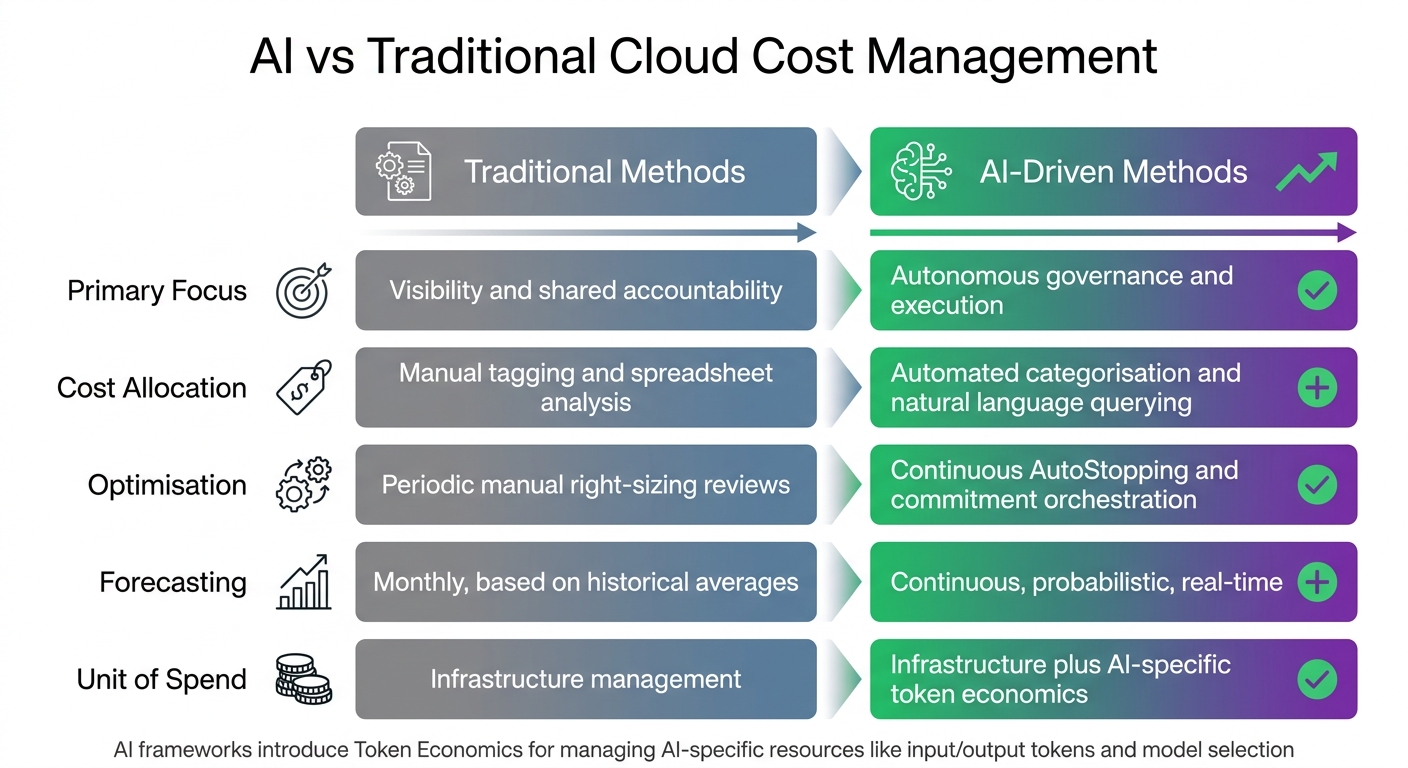 {AI-Driven vs Traditional Cloud Cost Management Methods Comparison}
:::
{AI-Driven vs Traditional Cloud Cost Management Methods Comparison}
:::
Integrating FinOps and AI
FinOps is moving beyond manual tagging and periodic reviews, thanks to AI-driven tools that predict, optimise, and act in real time. Where traditional approaches relied on manual dashboard analysis, AI frameworks now enable proactive management. For instance, Harness CCM employs AutoStopping technology to automatically shut down idle non-production resources, cutting costs by over 70% [6].
AI also simplifies cost allocation with features like Virtual Tags (VTags) and granular IAM principal-based attribution, which track spending by team, project, or user - even for complex AI inference workloads. This eliminates the need for manual tagging [12][13]. For federated users or LLM gateways, session tags ensure detailed cost attribution flows seamlessly into AWS Billing and Cost Explorer, giving finance teams precise insights [12].
These advancements are made possible through platforms that seamlessly integrate AI into cloud cost management.
Platforms and Frameworks
Several platforms now embed AI directly into cloud cost management workflows:
-
Amazon Bedrock: Utilises a multi-agent system where a Supervisor Agent coordinates specialised sub-agents to handle FinOps tasks. Salman Ahmed, Senior Technical Account Manager at AWS, highlights its transformative potential:
AI agents are revolutionising how businesses enhance their operational capabilities... combining foundation models with APIs and data to process user requests [7].
A typical Bedrock implementation costs around £23.00 per month for 3,000 requests [10].
Infracost: Works with Terraform workflows and CI/CD pipelines to provide cost estimates before deployment, helping teams avoid unexpected bills [9]. This
shift-left
approach brings cost awareness into the early stages of development.Amnic's X-Ray Agent: Delivers a financial health scan in just 30 seconds without requiring manual tagging. It also offers a 30-day free trial [5].
Conversational FinOps Tools: Tools like Harness and Akira AI use natural language interfaces, allowing teams to query cloud spending or get optimisation advice without navigating complex dashboards [6][8]. This makes cost data more accessible, even for non-technical finance teams.
AI vs Traditional Methods Comparison
AI-driven FinOps tools redefine traditional practices, as shown in the table below:
| Feature | Traditional Methods | AI‑Driven Methods |
|---|---|---|
| Primary Focus | Visibility and shared accountability | Autonomous governance and execution |
| Cost Allocation | Manual tagging and spreadsheet analysis | Automated categorisation and natural language querying |
| Optimisation | Periodic manual right-sizing reviews | Continuous AutoStopping and commitment orchestration |
| Forecasting | Monthly, based on historical averages | Continuous, probabilistic, real-time |
| Unit of Spend | Infrastructure management | Infrastructure plus AI-specific token economics |
AI frameworks also introduce Token Economics, which manage costs for AI-specific resources like input/output tokens, model selection, and context window sizes - areas that traditional methods overlook. As Greg Leonardo, Cloud Architect at TampaDev, puts it:
The future of cloud economics isn't about seeing your costs - it's about trusting intelligent systems to manage them better than humans ever could [11].
Hokstad Consulting's Approach to Cloud Cost Engineering
Cloud Cost Engineering and AI Strategy
Hokstad Consulting focuses on blending cloud cost engineering with AI-driven strategies to cut infrastructure expenses while enhancing system performance. Their approach often results in savings of 30–50% across public, private, and hybrid cloud setups. Beyond just cutting costs, they also aim to improve deployment speed and system reliability, setting their methods apart from more conventional cloud optimisation efforts.
What makes their strategy stand out is their use of AI tools within DevOps workflows. For example, they incorporate AI-based scenario modelling to predict cost fluctuations, helping businesses manage budgets more effectively. Their services extend to DevOps transformation, strategic cloud migrations, and custom software development, ensuring systems remain operational without interruption. By embedding AI techniques into their framework, Hokstad Consulting shifts the focus from reacting to cost issues to proactively managing them. This proactive mindset is also reflected in their pricing structure, which is designed to minimise risk for clients.
No Savings, No Fee Model
Hokstad Consulting operates under a 'No Savings, No Fee' pricing model. Clients only pay a fee based on a percentage of the verified savings achieved, which means there’s no upfront financial commitment. This approach removes the financial uncertainty for businesses looking to optimise their cloud infrastructure, especially for organisations in the UK.
This model applies to a variety of services, including cloud cost audits, hosting setups, and hybrid cloud solutions. By tying their fees directly to measurable results, Hokstad Consulting ensures their goals align with the financial outcomes of their clients. This performance-based approach highlights their dedication to delivering real, quantifiable savings.
Client Applications
Hokstad Consulting’s AI-driven strategies are applied across a range of industries, helping businesses achieve cost efficiencies in diverse ways. Their expertise includes automated CI/CD pipeline development, advanced caching and offloading solutions, and zero-downtime cloud migrations. For businesses requiring ongoing support, their retainer model provides continuous monitoring and optimisation, offering flexibility for evolving needs.
For organisations investing in AI capabilities, Hokstad Consulting also provides private cloud implementations and custom AI agent development. These projects deliver precise insights, enabling smarter decision-making and more accurate budget planning.
Conclusion and Key Takeaways
The Benefits of AI for Cloud Cost Management
AI is transforming cloud cost management from a reactive task into a forward-thinking strategy. Tools like time series forecasting uncover usage patterns that are often missed by manual methods, while explainable AI pinpoints which services, regions, or projects are driving costs. Together, these capabilities provide precise predictions and practical insights. According to McKinsey, enterprises using AI forecasting reduce cloud cost overruns by an average of 28%, while AI-driven cost optimisation can deliver savings of 25–35% on cloud bills. With UK cloud spending projected to hit £65 billion in 2024 - a 20.4% increase from the previous year - having the ability to simulate a wide range of cost scenarios quickly is becoming a necessity for effective budgeting and managing variability.
Scenario simulation offers businesses the chance to test different infrastructure setups without incurring actual costs. For instance, in 2023, Netflix leveraged AI-powered scenario modelling to forecast demand, cutting AWS costs by 20% (£12 million annually). This initiative, led by Cloud Cost Optimisation Engineer Priya Patel, achieved an impressive 99.9% accuracy in predictions by simulating demand variability. Similarly, Dropbox used machine learning models through Databricks in Q1 2024 to analyse multi-cloud cost scenarios. By automating spot instance usage and rightsizing 40% of its virtual machines, Dropbox reduced its Google Cloud and AWS bills by 35%, saving £8.5 million annually. These real-world examples underscore how AI can significantly reduce cloud cost variability and support smarter financial planning.
Why Partner with Hokstad Consulting
These benefits highlight the importance of expert guidance in implementing AI-driven cost management. Success in this area requires more than just technology - it demands deep expertise in cloud infrastructure and machine learning. Hokstad Consulting brings both to the table, combining cloud cost engineering with AI strategy to help UK businesses design scenario models tailored to their unique needs. They address common challenges like incomplete cost data, limited AI expertise, and integration hurdles.
Hokstad’s 'No Savings, No Fee' model ensures zero financial risk for clients. Payment is based on a percentage of verified savings, aligning their success with measurable results. This performance-based approach extends to cloud cost audits, hybrid cloud solutions, and ongoing optimisation through their retainer services. For organisations investing in AI, Hokstad also offers private cloud setups and bespoke AI agent development, enabling smarter decision-making and precise budget management - all without requiring an upfront commitment.
FAQs
What data do I need to start AI cloud cost scenario modelling?
To kick off AI-driven cloud cost scenario modelling, start by collecting comprehensive billing and usage data from the past 12 months. This helps uncover patterns and seasonal trends. Make sure to include details like workload variability - such as traffic spikes and resource usage - and external influences like seasonal demand or market changes. If you're using a multi-cloud setup, integrating live billing data can provide even more precise insights. With this information, AI can refine forecasts, automate cost management, and offer strategic guidance for smarter cloud spending.
How does explainable AI show what’s driving my cloud costs?
Explainable AI (XAI) digs into the details behind cloud costs by analysing key data like usage trends, workload variations, and pricing structures. It can pinpoint the reasons for unexpected cost increases, highlight seasonal fluctuations, and uncover inefficiencies such as overprovisioned resources.
XAI also enables scenario planning, allowing businesses to simulate different usage patterns and predict how these changes might affect expenses. This level of clarity empowers organisations to fine-tune their spending and make smarter decisions. Importantly, it bridges the gap between technical teams and non-technical stakeholders, ensuring everyone benefits from a clearer understanding of cloud expenses.
How often should we rerun cost scenarios to stay accurate?
To keep your models accurate and aligned with evolving usage patterns, it’s important to revisit cost scenarios on a regular basis. Many experts suggest carrying out these reviews at least once a month to ensure your data and trends are always up to date.