
AI champions help colleagues use AI safely - they don’t replace managers or trainers. I’d start with a written role brief, agreed support hours and named contacts for questions outside their remit.
Here’s what I’d put in place:
- Clear roles: champions coach peers, managers decide work and resources, and trainers plan formal learning.
- Practical coaching: listen, start with the task, demonstrate approved methods and let colleagues practise and check their work.
- Firm limits: peer support is not approval. Access, deployment, policy and risk decisions stay with accountable owners.
- A route for help: pause affected work and seek specialist advice when data, legal, security or technical concerns arise.
- Support and review: choose trusted colleagues, provide training and protected time, then review learning, workload and results after four weeks, against a starting baseline.
My focus would be independent judgement, not just more AI use. I’d review results at team level, protect privacy and expand only when learning, safety and workload checks support it.
::: @figure 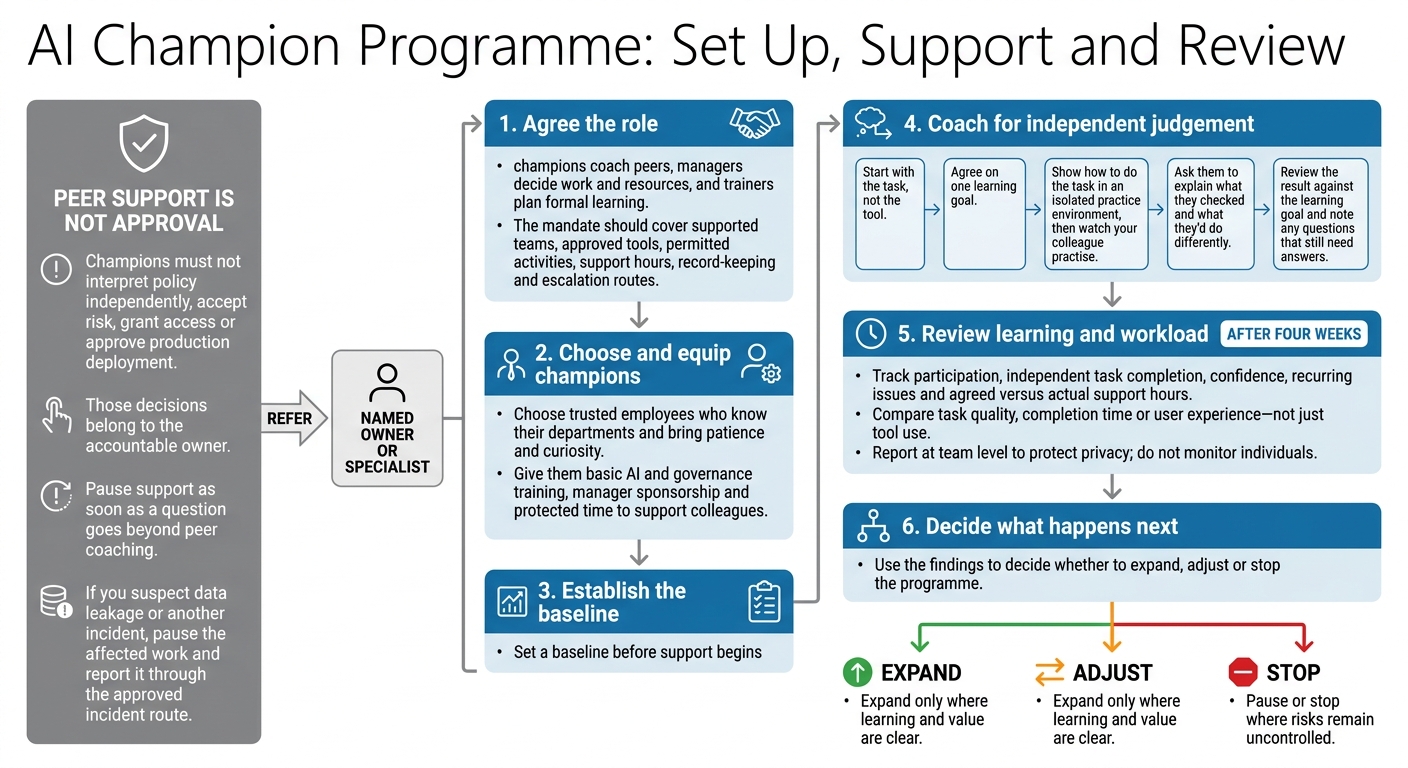 {AI Champion Programme: Set Up, Support and Review}
:::
{AI Champion Programme: Set Up, Support and Review}
:::
How AI champions, managers and trainers differ
Keep peer support clear by separating the champion role from management and training.
Champions coach peers, managers decide work and resources, and trainers design learning. This split keeps coaching, formal decisions and training from getting mixed up.
| Responsibility | AI champion | Manager or work owner | Trainer |
|---|---|---|---|
| Accountability | Support peers and share approved practices | Decide work, set priorities and allocate resources | Design learning, ensure accessibility and set assessment standards |
| Authority | Coach within an agreed remit | Approve work and allocate resources within delegated authority | Set learning activities and assessments within the training remit |
| Everyday activities | Answer questions, coach colleagues and report recurring issues | Set priorities, assign work and resolve resource needs | Design and deliver formal training |
| Success measures | Helpful support and less unapproved AI use | Resolution time, delivery pace and cost savings | Learning completed and skills improved |
| Escalation duties | Refer unresolved questions or those needing specialist input to the relevant specialist | Pass decisions beyond their authority to the right person | Flag learning barriers and refer questions beyond their expertise |
Keep peer support separate from authority
A champion shows colleagues how to use approved practices; managers make formal decisions. Repeated questions may point to gaps in guidance or training. They shouldn’t become informal judgements about individuals.
If someone holds several roles, state which role applies before offering advice, giving feedback or making decisions. Keep peer coaching separate from formal assessment and performance discussions. Make it clear when a question needs a management decision or specialist advice.
Coaching skills AI champions need
Once the role is clear, champions coach colleagues through short, practical conversations.
Listen, ask questions and explain clearly
Keep support practical, conversational and peer-led. Start with the task, not the tool. Ask what your colleague needs to achieve and where they’re stuck. Listen and check your understanding before suggesting an approach. Use plain English, adjusting the pace or format to suit their confidence and learning needs.
Help them assess whether AI fits the task. Is the goal clear? Is the data suitable? Is the benefit worth the effort, and can someone reliably review the output? Support their judgement rather than deciding for them.
Demonstrate, practise and review
Agree on one learning goal. Show how to do the task in an isolated practice environment, then watch your colleague practise. Explain your checks as you go so they can review outputs themselves.
Resist the urge to take over. Ask them to explain what they checked and what they’d do differently. Review the result against the learning goal and note any questions that still need answers.
Make space for questions and feedback
Run short peer sessions with time for questions and feedback. Give everyone a chance to contribute and help people feel safe sharing concerns.
Keep feedback specific to the work and the checks used. Address reported errors or unsafe practices without blame. If you’re unsure, say so and check. If a question goes beyond approved practice, pause and refer it on.
Set role limits, support hours and escalation routes
Put role boundaries in writing so champions know what support they can offer and colleagues know what to expect. The mandate should cover supported teams, approved tools, permitted activities, support hours, record-keeping and escalation routes.
Define what champions can and cannot decide
Champions can coach colleagues within approved practice, share agreed guidance, report issues and help with authorised pilots within set limits.
Champions must not interpret policy independently, accept risk, grant access or approve production deployment. Those decisions belong to the accountable owner. Anything outside the champion’s remit goes to the named owner or specialist.
One person may hold several roles, but every decision still needs a clear owner. Use the table to distinguish who routes an issue from who decides it.
| Area | Champion support | Accountable owner |
|---|---|---|
| Workload and priorities | Report capacity limits | Manager agrees time and priorities |
| Process changes and deployment | Support authorised pilots | Business owner approves changes and production deployment |
| Access and technical support | Route access requests | Technology lead and data owner authorise access |
| Security | Report suspected leakage or unsafe connections | Security directs incident handling |
| Legal matters | Refer legal questions | Legal specialists advise accountable decision-makers |
| Data protection | Flag personal-data and permitted-use questions | Data owner assesses use and compliance |
| Policy and remaining risk | Refer concerns for a decision | Risk approver decides policy and risk questions |
| Service requests | Route faults and service requests through agreed channels | Operations owner manages service stability |
Protect time and manage support requests
Agree a fixed time allocation with the champion’s manager and send all requests through one process. When that time is used up, the manager should re-prioritise work or defer requests - not rely on unpaid goodwill.
Know when to pause and seek specialist advice
Pause support as soon as a question goes beyond peer coaching. Seek specialist advice on personal or confidential data, UK GDPR and the Data Protection Act 2018, legal matters, unapproved integrations, automated actions or technical failures outside the champion’s remit.
If you suspect data leakage or another incident, pause the affected work and report it through the approved incident route.
Set up and review an AI champion programme
Choose, train and support champions
Once the role and its boundaries are clear, focus on recruitment, training and support. Choose trusted employees who know their departments and bring patience and curiosity. Give them basic AI and governance training, manager sponsorship and protected time to support colleagues.
Keep administration proportionate. A small programme may only need a shared role brief, contact list and short issue log. Programme support does not replace internal accountability or advice from legal, security and data protection teams.
Measure learning, workload and results
After setup, check whether the programme is making work easier and helping people feel more confident.
Set a baseline before support begins, then carry out an early review after four weeks. Track participation, independent task completion, confidence, recurring issues and agreed versus actual support hours. Compare task quality, completion time or user experience - not just tool use.
Report at team level to protect privacy; do not monitor individuals. Record only what the review needs and restrict access. Update guidance when tools, policies or workflows change.
Use the findings to decide whether to expand, adjust or stop the programme. Expand only where learning and value are clear. Pause or stop where risks remain uncontrolled.
Conclusion: agree the role before expanding it
Expand only when the mandate, coaching skills, workload and escalation routes are working. Review learning, safety and workload before scaling.
FAQs
How do we prevent coaching from becoming informal management?
Give each team member clear responsibilities and ownership so they can work independently, without micromanagement or too many meetings. Keep executive decisions and authority separate from day-to-day delivery so everyone knows what they’re accountable for and where their role ends.
Hokstad Consulting helps teams put this into practice through AI strategy and implementation, defining delivery roadmaps and ownership structures.
What if champion requests exceed protected support time?
Mentors should review their capacity to provide support and check for skill gaps. If demand remains high, they should ask management to review workloads or put formal training resources in place.
To avoid becoming bottlenecks, mentors should seek specialist advice or outside expertise when technical problems are complex or keep recurring. Hokstad Consulting specialises in AI strategy and implementation, helping organisations optimise their use of AI and tackle implementation challenges.
How can champions recognise when specialist advice is needed?
AI champions should seek specialist advice when a challenge falls outside their remit, whether it involves technical issues, regulatory compliance or cloud strategy. Expert input also matters when tools reach their limits, new AI initiatives need evidence-based feasibility checks, or AI integration touches sensitive, high-risk workflows.
Hokstad Consulting helps fill these expertise gaps with support for AI strategy, custom agent implementation and DevOps transformation.