
A £1 million liability cap does not mean you can recover £1 million. I’d first check which losses the contract allows, how its limits work together and whether the supplier can pay.
For an English-law business contract, I’d compare three options:
- Fixed cap: a set amount, suited to risks you can put a clear limit on.
- Fee-based cap: linked to spend. For example, 150% of £100,000 in qualifying fees gives a £150,000 ceiling - not a guaranteed payment.
- Separate risk-specific caps: limits for named risks, such as data breaches or IP claims. Check whether these share or add to the general cap.
Quick Comparison
| Check | Fixed cap | Fee-based cap | Risk-specific caps |
|---|---|---|---|
| Calculation | Stated sum | Defined fees × agreed multiple | Amount set for each named risk |
| Main weakness | Earlier claims may use it up | Low fees can mean low cover | Overlapping limits can reduce cover |
| What I’d agree | Reset dates and claim grouping | Fee definition, calculation date and minimum floor | Clear triggers and rules on shared limits |
My next step? Test one likely agent error against the whole contract. Check recoverable transaction losses, restoration costs, third-party claims, exclusions and indemnities - not just the headline cap.
I’d also match the contract to the agent’s permissions, require logs and incident evidence, and review insurance and payment support. The supplier’s cap does not limit your liability to regulators or third parties, and some liabilities cannot lawfully be capped.
::: @figure 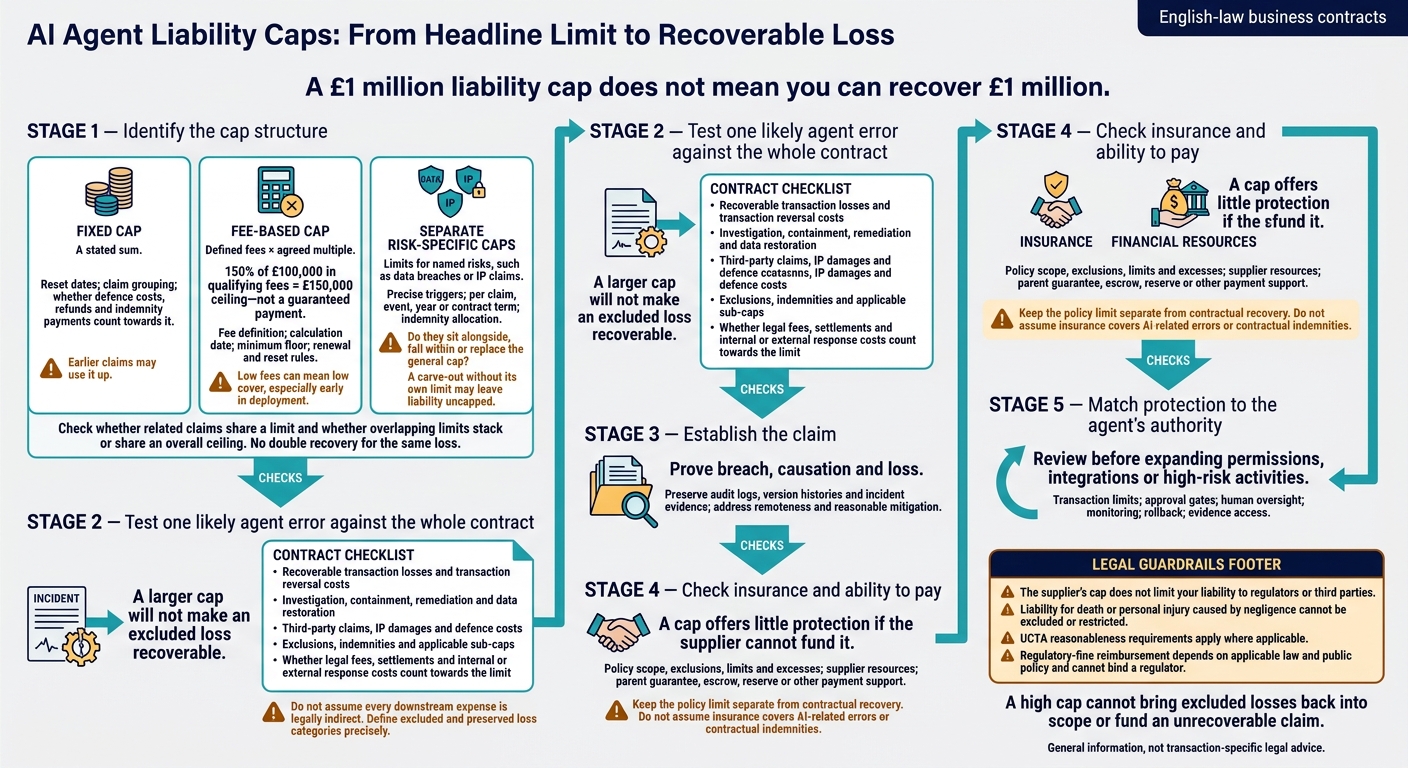 {AI Agent Liability Caps: From Headline Limit to Recoverable Loss}
:::
1. Fixed Caps
Calculation and scope
A fixed cap works only if it covers the ways the agent could fail. Specify whether it resets annually or applies across the full contract term, and whether related claims share one limit. Make clear whether defence costs, refunds and indemnity payments count towards it.
The scope should also cover changes that cause a failure, including updates, integrations and manual configuration. Without clear wording, the parties may dispute whether the clause covers the change responsible.
Exposure and predictability
Set the cap against likely loss, not just the service fee. Assess transaction limits, user volumes and reversal costs. Fixed caps are better suited to contained workflows where errors can be reversed than to payment execution or large-scale personal-data handling. One aggregate cap may leave little protection once an early claim has used up much of the limit.
Exclusions and recoverable losses
Expressly preserve the right to recover reasonable costs for investigation, containment, data restoration and transaction reversal. Check that exclusions for inaccurate outputs or autonomous actions do not rule out liability for failures in the core service.
Set out how losses with more than one cause will be allocated, while keeping the supplier liable for its own failures. Require audit logs and version histories to help establish who is responsible.
Negotiation and enforceability
Record why the cap fits the agent’s authority, the supplier’s resources and its insurance cover. Under the Unfair Contract Terms Act 1977, resources and insurance matter when assessing whether a monetary limit is reasonable, where that test applies.[4]
Agree to review the cap before expanding the agent’s permissions or integrations, rather than waiting for the added exposure to result in a claim. If exposure grows with fees or higher-risk activities, the parties may need to replace the fixed cap with another structure.
2. Fee-Based Caps
Calculation and scope
Unlike a fixed cap, a fee-based cap grows with the commercial value of the relationship. Specify whether it uses total contract fees, annual fees or fees from the previous 12 months, and whether a multiple applies.
Exposure and predictability
Use one defined fee basis: paid, payable, invoiced, accrued or contractually committed. Fees payable can include charges owed but not yet paid. Even so, a 12-month window may offer little cover early in deployment. Specify the date that fixes that window.
A higher multiple increases potential recovery, but the cap still tracks spend - not the value of transactions the agent controls. A fee cap works best when the agent’s commercial footprint matches its operational risk. This makes the fee base itself the main lever for allocating risk.
Exclusions and recoverable losses
A larger fee multiple won’t make an excluded loss recoverable. Under English law, lost profits may be direct loss, so don’t rely solely on broad consequential-loss wording to allocate them.
Define excluded categories precisely. Make clear whether those exclusions also apply to indemnified claims within the fee cap. Expressly list recoverable response and remediation costs, including whether they cover internal staff time and external professional fees. Where loss of data, confidentiality or personal data is material, avoid excluding those categories indirectly through broad consequential-loss wording.
Negotiation and enforceability
Add a minimum floor so the cap isn’t nominal during implementation or low-usage periods. Specify whether each renewal creates a new cap and how claims spanning contract years are allocated.
Check the formula for reasonableness under the Unfair Contract Terms Act 1977 where applicable. Match it to the agent’s authority, transaction volume and risk class, rather than applying one percentage across all services. Apply the same approach when the agent’s permissions, integrations or transaction volume increase.
3. Separate Risk-Specific Caps
Calculation and scope
Use a separate cap when a named risk needs its own ceiling, rather than relying only on a fixed or fee-based general cap. Make its relationship with the general cap clear: does it sit alongside that cap, fall within it or replace it? A carve-out without its own limit may leave liability uncapped.
State whether each risk-specific cap applies per claim, per event, per year or across the contract term.
Exposure and predictability
Use a precise trigger, such as “unauthorised disclosure of Customer Data”, not “AI-related harm”.
Set the limit based on the agent’s authority, transaction volume and the risk of repeat incidents. Define how claims arising from the same event are grouped, and rule out double recovery for the same loss.
Exclusions and recoverable losses
For each risk, spell out which losses can still be recovered despite broader exclusions.
Specify recoverable costs arising from agent mistakes: data-breach investigation and notification, unauthorised transaction losses, third-party IP damages and defence costs.
Link each indemnity to the intended cap. State whether legal fees and settlements count towards that limit.
Negotiation and enforceability
Read the cap alongside the rest of the contract. Check that indemnities, exclusions, confidentiality terms, data-processing terms and service schedules treat the same risk consistently. Limits cannot exclude liability for death or personal injury caused by negligence.
AI Vendor Contracts Shift the Risk to You - Here’s What to Watch For
Compare Exposure and Claim Recovery
The same loss can lead to very different recovery amounts. Much depends on how the contract calculates the cap and which losses it excludes.
Cap Calculations and Coverage
Compare the cap formula, not just the headline amount. Define whether fees are paid or payable, when the calculation takes place, and how it treats implementation, service, support, usage, pass-through charges, taxes and credits. A paid-only formula can leave early deployments underprotected. A floor or defined annual amount can address that gap.
| Model | Fee inclusions | Aggregation | Indemnity position |
|---|---|---|---|
| Fixed | Independent of fees | Specify whether the cap applies per claim, year or contract term; group related claims | State whether indemnities consume the cap |
| Total contract value | Identify implementation, recurring and variable charges; address renewals | A single term-wide aggregate may run out before expiry | State whether indemnities sit inside or outside the cap |
| Annual fees | Specify service, support and implementation charges | Set the reset date and explain how related or continuing claims are treated | Confirm whether indemnities reset with the general cap |
| Rolling fees | Specify usage, pass-through and recurring charges | Fix the measurement date; a rolling calculation does not reset the aggregate | Use the same calculation date unless expressly varied |
| Risk-specific | Define the fee base where relevant | Allocate overlapping claims; state whether limits stack or share an overall ceiling | Map confidentiality, data protection, cybersecurity, IP and out-of-authority indemnities to shared or separate limits |
Exposure and Predictability
Test every model against the same incident. This makes the gap between the headline cap and actual recovery easier to see.
| Model | Scalability | Affordability | Proportionality and recovery |
|---|---|---|---|
| Fixed | Does not automatically follow usage | May require higher pricing | Can cover high-value losses, but earlier claims may exhaust a shared cap |
| Annual fees | Follows defined annual charges | Links exposure to remuneration | May understate risk when transaction values exceed fees |
| Rolling fees | Follows recent spend | Becomes predictable once the fee base stabilises | Low-spend periods can reduce protection even when authority stays unchanged |
| Risk-specific | Needs review as defined risks grow | May increase pricing and total exposure | Reserves capacity for severe risks unless an overall ceiling absorbs it; precise triggers and overlap rules matter |
| Non-limitable liabilities | Independent of fees or usage | Exposure cannot be contractually capped | No contractual cap; recovery still depends on proof and ability to pay |
Exclusions and Recoverable Losses
A cap does not guarantee recovery. Expressly preserve direct transaction losses, restoration expenses and reasonable remediation costs. Treat regulatory fines separately: reimbursement depends on applicable law and public policy, and cannot bind a regulator. [10][12]
| Wording | Customer risk | What to specify |
|---|---|---|
| Indirect or consequential loss excluded | Classification may be disputed; not every downstream expense is legally indirect | Intended scope and priority of express exceptions |
| Named losses excluded | Profit, revenue, business, goodwill, savings, data, use and opportunity may be excluded even when direct | Whether exclusions cover direct losses and whether restoration expenses remain protected |
| Expressly preserved losses | Protection may fail if another clause overrides it | Investigation, containment, remediation, restoration, regulatory response, valid third-party claims and traceable transaction losses; identify the applicable cap |
To recover under the chosen structure, the customer must still prove breach, causation and loss.
Negotiation and Enforceability
Each structure changes the evidence needed to establish the available limit and what can be recovered in practice. Customers need logs and incident evidence. Suppliers need protection against duplicate claims and losses caused by customer misuse. Claimants must also address remoteness and support reasonable mitigation. [6][7][11]
| Model | Supplier position | Customer protections | Drafting dependencies | Enforceability considerations |
|---|---|---|---|---|
| Fixed | Measurable maximum exposure | Minimum protection independent of low fees | Amount, aggregation and carve-outs | Assess commercial context and reasonableness where applicable |
| Fee-based | Exposure follows remuneration | Floor, higher multiple or dedicated payment protection | Fee base, measurement date, resets and pass-through costs | Scrutinise low early-contract caps where large risks were foreseeable |
| Risk-specific | Targeted, but potentially higher total exposure | Reserved capacity for severe risks | Triggers, overlap, priority and indemnity allocation | Clear drafting cannot cure a prohibited restriction |
| Non-limitable liabilities | No contractual cap | No agreed ceiling for liabilities that cannot lawfully be limited | Clear recognition of mandatory exceptions | Recovery still depends on proof and ability to pay |
Liability for death or personal injury caused by negligence cannot be excluded or restricted. Other negligence restrictions must meet UCTA’s reasonableness requirement where applicable. Treat fraud separately from wilful misconduct and ordinary breach: do not assume all deliberate conduct falls outside the cap. [7][8][9]
Cap Trade-offs and Contract Safeguards
Once you choose a cap model, make sure the operating controls and allocation of losses follow the same risk split. These safeguards help protect recovery when an agent causes a breach.
| Model | Predictability | Adequacy | Negotiation complexity | Recovery potential |
|---|---|---|---|---|
| Fixed cap | Clear budget; scope must match authority | Check against serious errors | Low to moderate | Indemnities may exhaust the shared limit |
| Fee-based cap | Depends on the formula; follows contract economics | Check against operational risk | Moderate | A low-fee agent can cause costly data, IP, security or third-party losses |
| Separate risk-specific caps | Depends on classification | Match controls to named risks | High | Can protect priority losses; resolve overlapping indemnities |
Define Agent Authority and Controls
Make the authority schedule match the current configuration.
- Role and boundaries: define permitted actions, approved data sources and prohibited actions.
- Controls and response: set monetary and operational approval thresholds, human oversight, escalation routes and incident-notification deadlines.[1][13]
Tie warranties to instruction-following, security, guardrails, availability and change management - not perfect outputs. Require evidence to be preserved and made available during an investigation. Don’t leave access to the supplier’s discretion.[13][14]
Align Indemnities, Exclusions and Caps
Map each indemnity to its cap, defence control, notice duty and settlement-consent rule. Identify which exclusions apply to intellectual property claims and agent-caused third-party claims.
Prevent settlements from imposing admissions, injunctions or continuing obligations without consent. State whether defence costs, investigation expenses, interest and enforcement costs count towards the limit. Separate supplier failures from customer misuse, unapproved configuration, inaccurate customer data and failure to follow documented safeguards.[5][2]
Check Insurance and Ability to Pay
A cap offers little protection if the supplier cannot fund it.
Request policy evidence covering scope, exclusions, limits, excesses, territorial cover, retroactive dates, subcontractors and notice duties. Keep the policy limit separate from contractual recovery. Don’t assume insurance covers AI-related errors, contractual indemnities, data incidents, intellectual property claims or regulatory costs.
Assess the supplier’s financial resources as well as its insurance. If the agreed ceiling could otherwise be unfunded, consider a parent guarantee, escrow, reserve or other payment support.[15][16]
Link Agent Implementation to Contract Terms
The contract should reflect the technical design, not sit apart from it.
Before finalising the contract, technical and legal teams should map permissions, data flows, failure modes, approval gates, monitoring, rollback and evidence needs. Require testing and sign-off for high-risk actions, a fallback process, and a contract review when permissions or use cases materially change.
Conclusion: Match Caps to Agent Risk and Recoverable Loss
Choose a cap based on the loss the contract can realistically cover once exclusions and recoverable-loss definitions apply. Use a fixed cap for bounded exposure, a fee-based cap when fees track likely loss, and separate risk-specific caps for named high-risk actions.[17][18][19]
Test a likely incident against the whole contract, including loss definitions, exclusions, indemnities, sub-caps and overlapping limits. Calculate how much could be recovered. Then check whether the supplier can pay that amount, taking its insurance position into account.[4][20]
A high cap cannot bring excluded losses back into scope or fund an unrecoverable claim. Match the contract to the losses that matter, rather than the largest number on the page.[3][4]
This article provides general information, not transaction-specific legal advice. Before agreeing terms, obtain advice on the governing law, contract wording, regulatory context and proposed agent deployment.
FAQs
How do I choose a cap for an agent with changing permissions?
Set hard spending, volume and rate limits in the execution layer, separate from permissions. Before every call, recheck the authority, target, tool and parameters. Block any call that breaches these limits - even if a human has approved it.
Review limits whenever permissions, tools or workflows change. Apply cumulative spending caps to catch repeated small actions. Prevent agents from changing their own limits or adding recipients, and keep an audit trail.
What if an agent error falls under two liability caps?
Your contract must spell out how the caps interact: do they add together, apply separately, or does the lower limit take precedence? State whether one overall cap applies or separate caps cover different risk categories.
Work with your legal advisers to define recovery precisely. Unclear or overlapping wording can lead to disputes and leave you without enough legal recourse for a serious error.
How can I check whether exclusions undermine my cover?
Review the master agreement, order forms, licence terms and exit schedule with solicitors. Check whether loss exclusions and liability caps leave you with meaningful remedies for agent-related migration failures or failures during day-to-day use. Also check whether retrieval rights, including data access, continue after termination.
Confirm that the supplier lists all exclusions and known limitations affecting your assets. Make sure your internal exit checklist flags supplier ownership claims over outputs and any fees outside the main exit documentation.