
My takeaway: spectral scoring can help flag poisoned training samples, but it cannot prove your data is clean. Before using it, I would test whether filtering and retraining reduce backdoor attack success without harming clean accuracy.
Tran, Li and Madry’s 2018 study, tested on CIFAR-10, looks for unusual patterns in a model’s internal features - not just its inputs. I focus on three points:
- The method: use singular value decomposition (SVD) to score samples within each class, remove high-scoring candidates and retrain.
- The limits: weak separation can hide poison, while legitimate rare groups may be flagged. Training data and internal feature access are required.
- The checks: try several removal thresholds, measure missed poisons and clean samples removed, and test subgroup accuracy and costs.
For UK teams, I would treat this as a diagnostic filter and run a controlled pilot on their own data. A high score is a reason to review a sample - not proof of an attack.
How Spectral Signature Detection Works
::: @figure 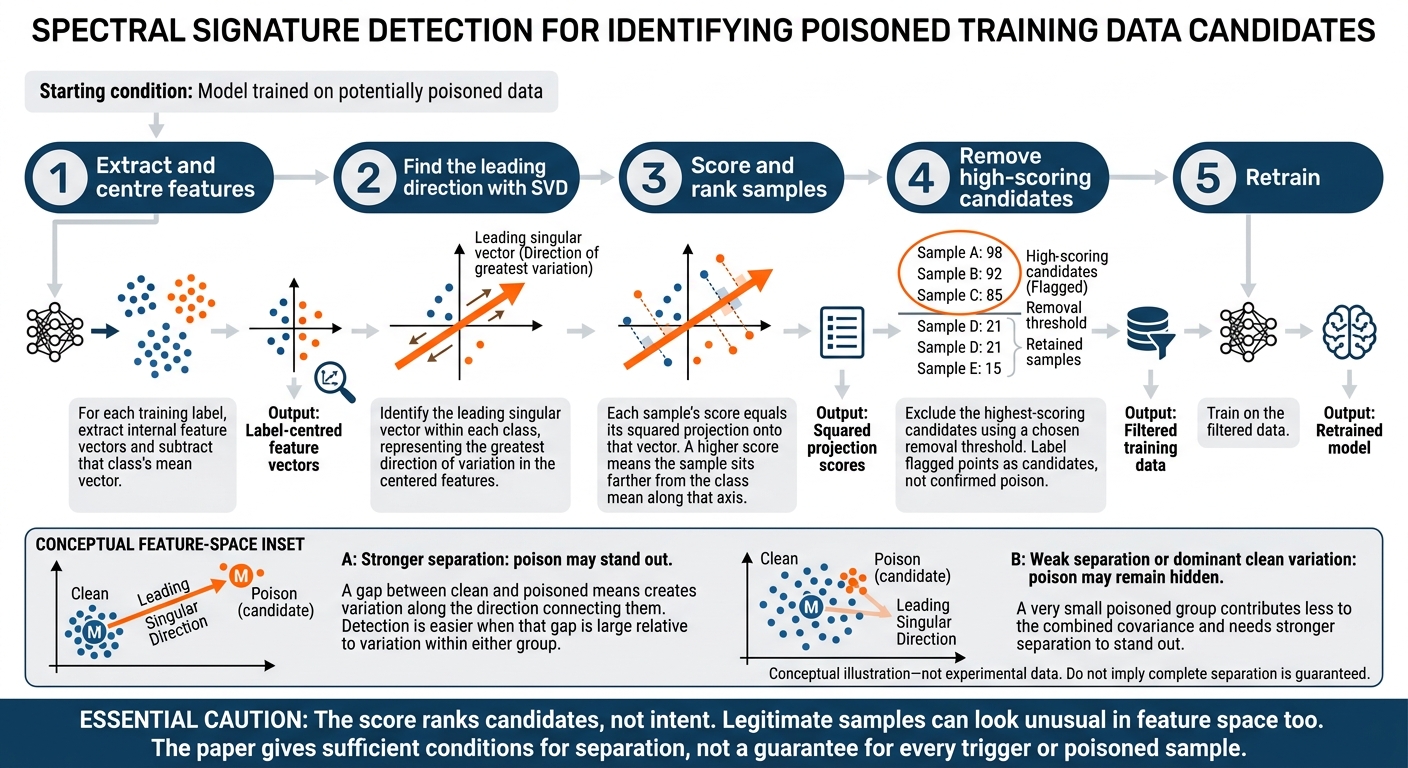 {Spectral Signature Detection: Score, Filter and Retrain}
:::
{Spectral Signature Detection: Score, Filter and Retrain}
:::
Raw inputs don't always show what a model has learned. Spectral signatures look at internal features, where poisoned samples may stand out more clearly. The method detects outliers within each class’s feature space, then removes candidates and retrains the model. A spectral signature is an unusual covariance structure in the learned representation.
Extracting Features, Scoring Samples and Retraining
The process starts with a model trained on potentially poisoned data. For each training label, it extracts feature vectors and subtracts that class’s mean vector. SVD identifies the leading singular vector: the direction of greatest variation in those centred features.
Each sample gets a score equal to its squared projection onto that vector. A higher score means the sample sits farther from the class mean along that axis.
| Process step | Purpose | Output |
|---|---|---|
| Feature extraction | Extract and centre features | Label-centred feature vectors |
| Spectral scoring | Rank samples by projection | Squared projection scores |
| Sample removal | Exclude highest-scoring candidates | Filtered training data |
| Retraining | Train on filtered data | Retrained model |
The score ranks candidates, not intent. Legitimate samples can look unusual in feature space too.
Mean Separation, Variation and Poisoned Fraction
A gap between the clean and poisoned means creates variation along the vector connecting them. That direction is easier to detect when the gap is large compared with variation within either group.
The poisoned fraction matters too. A very small poisoned group contributes less to the combined covariance, so it needs stronger separation to stand out.
The paper gives sufficient conditions for separation, not a guarantee for every trigger or poisoned sample. If clean variation dominates, or poisoned features overlap strongly with clean features, the top singular vector may fail to separate poisoned samples. The next section examines whether these conditions appear in the paper’s CIFAR-10 backdoor experiments.
Experiments and Results
The paper’s CIFAR-10 backdoor experiments test whether the theoretical separation conditions hold in poisoned training runs. They use class-centred spectral scoring to assess how much the attack is reduced and how well clean accuracy is retained.
Poisoning Scale and Evaluation Metrics
The paper uses two measures: attack success and clean accuracy. Attack success is the proportion of triggered source-class inputs misclassified as the target label. Clean accuracy measures correct predictions on unmodified test inputs.
Results Before and After Cleansing
Before cleansing, the paper measures both scores for the poisoned model. After spectral filtering and retraining, it checks whether attack success drops while clean accuracy is preserved.
The trade-off is straightforward: remove the backdoor without harming normal predictions. The next section examines where this evaluation can fail, including class structure, threshold choice and feature access.
Assumptions, Limits and Further Tests
The paper’s method works only under specific data and model conditions. It depends on separation between clean and poisoned representations. These limits affect which samples you score and remove, and how you retrain the model.
| Area | Practical limit |
|---|---|
| Representation separation | Weak separation reduces detection power. A low score does not prove a sample is clean. |
| False positives | Legitimate rare groups can score highly. Review flagged samples before deleting them, and test subgroup accuracy. |
| Removal threshold | The chosen threshold can leave poison behind or remove clean data. |
| Feature access | The method needs training data and internal features. Prediction-only access is not enough. |
Class Structure, Removal Thresholds and Feature Access
Test several removal thresholds rather than relying on one assumed poison fraction. Check whether filtering removes a disproportionate share of smaller groups. Also confirm that your pipeline can extract the features needed for scoring. These checks determine whether you can use the method in your training pipeline.
Testing Beyond CIFAR-10
Before deployment, test the method on your target dataset and model family. Score, filter and retrain using your own features. Include clean-label poisoning and adaptive attacks that reduce representation separation, then measure residual attack success, clean accuracy and subgroup harm.
Run a clean baseline to measure false removals. Treat new attack claims as unverified until you reproduce them on your data. Pilot the method on a low-risk workload before using it in production.
Conclusion: What the Findings Mean for UK AI Use
Poisoned samples can leave detectable spectral signatures when learned representations separate enough. Treat the method as a diagnostic filter - not proof of clean data. Its usefulness depends on representation separation, which samples you remove and access to internal features. The practical question is whether that separation appears in your own data.
Pilot Testing Before Deployment
Start with a controlled pilot before deployment. UK CTOs and IT managers should set acceptance criteria and check whether the same feature separation appears in their data.
Use separate clean and trigger-bearing test sets to compare performance before filtering and after retraining. When poison labels are known, measure detection precision and recall. Record both missed poisons and clean samples removed.
Audit removals and test rare subgroups separately, so overall accuracy does not hide harm to niche classes. Include the costs of feature extraction, manual review and retraining - not just scoring.
FAQs
Which model layer should I use for spectral scoring?
The provided search results don’t cover spectral signature detection or the model layers used for spectral scoring. Based on these sources, I can’t recommend which layer to use.
How do I set a removal threshold without knowing the poison fraction?
Use historical data to set baselines that separate normal behaviour from anomalies. Combine unsupervised machine learning with rule-based methods: use the former to detect unknown threats and the latter to apply predefined thresholds [1].
Send uncertain events for human review instead of forcing a yes-or-no decision [2]. Adjust confidence levels and set rules that fit your application to help minimise false positives when the poison fraction is unknown [3].
How can I test for backdoors without knowing the trigger?
Use behavioural anomaly detection rather than trigger-based detection. Poisoned samples can leave lasting patterns in learned representations. Build baselines from historical logs, metrics and traces, then watch for unusual resource usage, unexpected network traffic or abnormal process executions.
Hokstad Consulting recommends adding machine learning-based detection to CI/CD pipelines to flag anomalies in real time. Human review is still needed to separate genuine threats from harmless events.