I’d use incremental updates for routine changes and full rebuilds for corpus-wide changes or faults that cost more to repair. With 500,000 chunks and 2% changing per month, around 10,000 chunks need attention - not the entire index.
But less processing does not always mean lower total cost. I’d compare corpus size, change rate, update deadlines, retrieval quality, reliability and total spending in £, including engineering, validation and recovery.
Quick Comparison
| Criterion | Incremental updates | Full rebuilds |
|---|---|---|
| Processing | Added, changed and deleted content | The whole corpus |
| Best fit | Frequent, small changes | Model or chunking changes; system-wide repair |
| Cost | Less routine processing; more change-tracking work | More batch processing; temporary storage for two indexes |
| Update delay | Depends on queues and search visibility | Depends on build time and change replay |
| Main risks | Missed deletions, stale chunks and mixed versions | Missing records, old source data and faulty cutover |
| Checks | Versions, permissions, retries and reconciliation | Coverage, permissions, retrieval tests and rollback |
My rule: test before you trust either approach. I’d measure retrieval accuracy and update delays, check deletions and access rules, and compare repair costs with rebuild costs before switching methods.
Smarter RAG Indexing – How to Keep Your Vectorstore Clean
How Incremental Updates Work
Incremental indexing compares source changes against a document-chunk manifest, then inserts, replaces or deletes only the affected entries. If the changed fraction of chunks is p and the total is N, routine embedding work scales with pN rather than N. Change detection, validation and recovery still add cost, so this approach works best when only a small share of the corpus changes between runs.[4][10][5]
The trade-off: less routine processing, but more work to control how updates reach the index.
Detect Changes and Update Affected Chunks
Give each document a stable document_id. In a document-chunk manifest, track its source version, normalised-content hash, chunk IDs and indexing status. Change-data-capture events, webhooks or polling identify records to check, while hashes help skip unchanged text. Use source versions to order updates, rather than relying on timestamps alone.[4][9] Updates also need to remain safe when events arrive out of order or processing is retried.
For additions, chunk the text, create embeddings and insert the entries. For edits, re-chunk the document: even a small change can shift later chunk boundaries. Upsert replacement chunks with deterministic, version-specific IDs, then retire the obsolete chunks recorded in the manifest. Metadata-only changes can skip re-embedding if the embedded text stays the same and the store supports separate metadata updates. Permission changes still need to reach the index promptly.[4][9]
Keep Updates Consistent and Maintain Index Health
Make retries safe and reject stale events. Record event IDs and applied source versions, use durable checkpoints, and put failed-event handling in place. Where the store supports it, write replacement chunks as a pending generation, verify them, then switch visibility and retire the previous version. Writes may not become searchable immediately. Measure the full delay from source change to retrieval, including permission changes and deletions.[8][13][14] Without these controls, stale results and permission drift can weaken retrieval quality.
Treat deletion as an explicit event that marks every associated chunk as deleted. Reconcile the index against a complete, authoritative source snapshot to catch missed events and orphaned chunks. An incomplete snapshot must not trigger mass deletion. Depending on the store, tombstones may need later compaction to reclaim space. Keep embedding models, dimensions and retrieval settings aligned. Handle chunking changes as controlled migrations with backfilling and validation - not silent configuration changes.[11][12][13]
Incremental Updates: Pros and Cons
Here’s how those mechanics affect day-to-day indexing.
| Criterion | Advantage | Drawback |
|---|---|---|
| Processing scope | Processes only affected documents or chunks. | Needs accurate change tracking and chunk manifests. |
| Indexing latency | Small changes can become searchable quickly. | Queues and asynchronous writes can delay visibility. |
| Recurring cost | Reduces routine work when changes are sparse. | Monitoring, reconciliation and recovery add engineering cost. |
| Infrastructure | Can use change feeds, webhooks or scheduled polling. | Needs durable queues, checkpoints and observability. |
| Deletion handling | Deletes only the affected document’s chunks. | Missed deletions leave stale results; tombstones can accumulate. |
| Failure recovery | Failed documents can be replayed separately. | Partial writes need version-aware, retry-safe recovery. |
| Consistency | Generation controls can prevent mixed document versions. | Out-of-order events and eventual consistency need explicit handling. |
| Long-term maintenance | Avoids reprocessing unchanged content. | Compaction, configuration migrations or a rebuild may still be needed. |
How Full Rebuilds Work
Use a full rebuild when incremental repair can no longer give you a reliable index.
A full rebuild recreates the entire retrieval index from the source corpus, applying ingestion rules to every document. It can reuse cached embeddings only when the text, model, dimensions and processing settings still match. Unlike incremental updates, a rebuild resets the whole index state in one pass. Model or chunking changes generally mean reprocessing content. A rebuild restores consistency; it does not guarantee better retrieval.[16][18]
When a Rebuild May Be Needed
A rebuild may be needed for embedding-model migrations, new chunking or parsing rules, and corpus-wide metadata changes. Changes to distance metrics or index settings may also require one, depending on the vector store. Large-scale edits or incomplete change tracking can make rebuilding safer than repairing records whose state is uncertain.
Stale entries, failed updates or fragmentation alone are not reasons to rebuild. Try repair or compaction first, and rebuild only if they fail.[15][16]
Once you know why a rebuild is needed, focus on validation and a safe switch to the replacement index.
Build, Validate and Switch Indexes Safely
The main risk is not the rebuild itself. It is putting an unverified replacement into use.
Build a staging index alongside the live index, using a recorded source snapshot and versioned configuration. Record the embedding model version, chunking rules, metadata schema, distance metric and index settings, then ingest the full corpus. Before making the new index live, reconcile document and chunk counts, verify deletions and permissions, and compare representative searches with the live index. Check recall, ranking quality and latency - not just ingestion success.[16][17]
Track source changes during construction. Before cutover, replay additions, edits, deletions and permission revocations, then switch to the new live index atomically where supported. Retain the previous index for rollback, but do not let it restore deleted content or revoked access. Replay the latest deletion and permission state before switching back. If search must stay online during the rebuild, keep the live index available, but expect it to serve older content until cutover.[7][19]
Full Rebuilds: Pros and Cons
Budget separately for full-corpus processing, embedding generation, index construction and validation. Cached embeddings can reduce embedding charges, but they do not remove index construction work. Running both indexes side by side also requires temporary storage for both versions. Record these costs in pounds sterling rather than assuming a universal rebuild price.[16][18]
| Criterion | Benefit | Drawback |
|---|---|---|
| Correctness | Applies corpus-wide rules consistently. | Still depends on source integrity, change tracking and validation. |
| Delay | Establishes a validated baseline after the build and replay. | Changes may remain unavailable until construction and replay finish. |
| Compute | Supports parallel processing and embedding reuse. | Processes the full corpus, including unchanged content. |
| Downtime risk | Side-by-side construction can keep search available. | In-place rebuilding risks interruption or partial results. |
| Rollback | A retained version supports fast recovery. | Adds storage cost and must preserve current deletion and permission rules. |
| Process simplicity | Creates one controlled, auditable index generation. | Requires orchestration, validation, change replay and clean-up. |
| Large corpus use | Supports necessary corpus-wide migrations. | Often wasteful when only a small share of content changes. |
Incremental Updates vs. Full Rebuilds
::: @figure 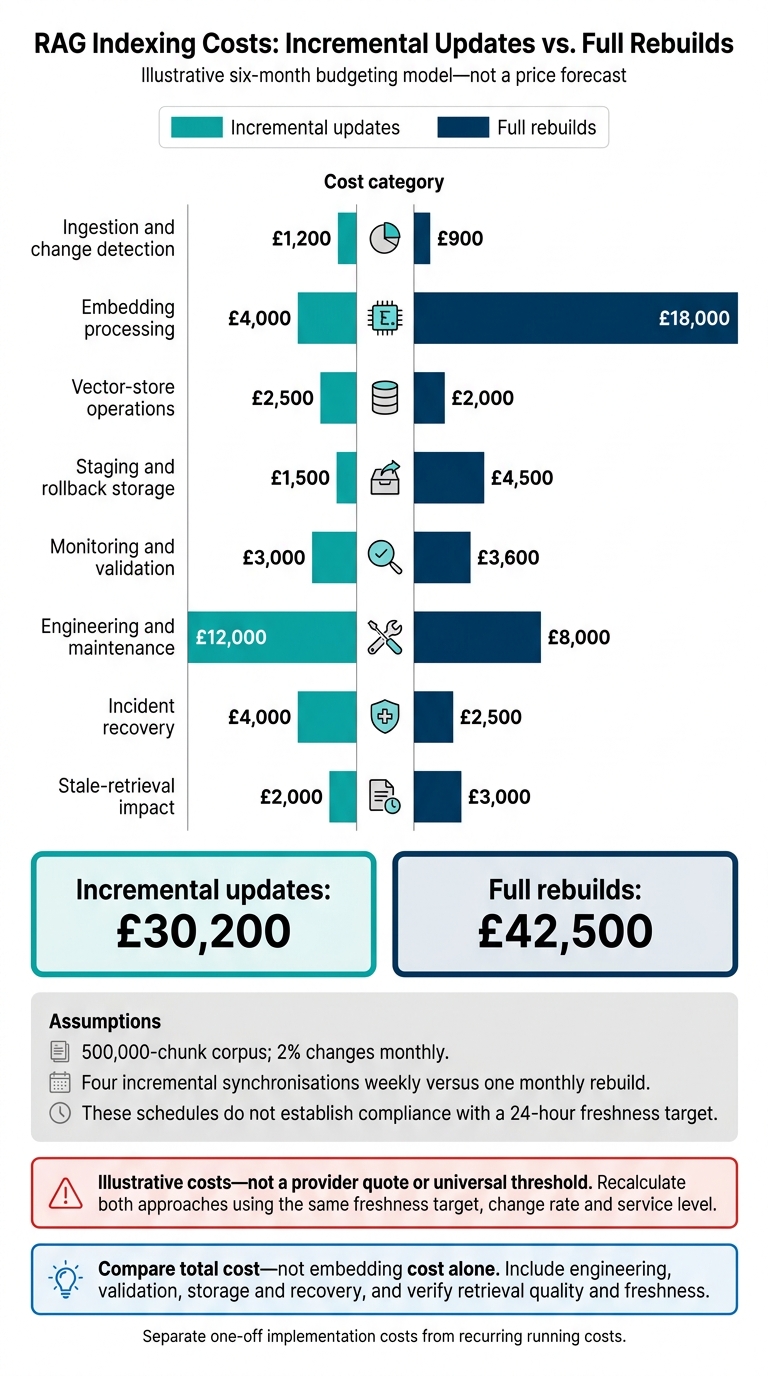 {RAG Indexing Costs: Incremental Updates vs. Full Rebuilds}
:::
Choose based on corpus size, change rate, how current results need to be and recovery risk. No fixed chunk-change threshold suits every workload.[7][6] Use the mechanics above to match the update method to the workload, rather than relying on a rule of thumb.
| Operating condition | Incremental updates | Full rebuilds | Decision guidance |
|---|---|---|---|
| Small corpus | Saves processing but adds change-tracking logic. | May finish fast enough to be simpler. | Prefer incremental updates unless structural changes are planned. |
| Large corpus, few changes | Avoids processing unchanged chunks. | Processes the whole corpus each time. | Prefer incremental updates if change detection is reliable. |
| Frequent updates | Supports near-real-time or scheduled synchronisation. | Must finish within each update window. | Prefer incremental updates. |
| Large change set | Savings fall as more chunks change. | Bulk processing may be more efficient. | Compare elapsed rebuild time with incremental throughput. |
| Embedding or chunking changes | Risks mixing incompatible versions. | Applies one configuration across the corpus. | Prefer a versioned full rebuild. |
| Unreliable change detection | Can silently miss edits and deletions. | Can reconcile against authoritative source data. | Prefer a full rebuild until detection controls improve. |
| Tight update deadline | Can expose changed content quickly, depending on consistency settings and visibility delay. | May not finish before the next update cycle. | Prefer incremental updates when current results are the priority. |
| Limited engineering capacity | Needs reliable IDs, manifests, retries, idempotency and monitoring. | Simpler in concept but requires heavier batch processing. | Choose the approach the team can run reliably. |
| Maintenance pressure | Requires compaction and drift checks. | Can replace an unhealthy index. | Rebuild when deletes, fragmentation or declining recall become a problem. |
| Recovery needs | Repairs isolated records efficiently. | Provides a clean baseline for system-wide faults, but rollback risks restoring outdated permissions or deletions. | Keep rebuild capability even when incremental updates are the default. |
| Retrieval risks | Missed events can leave stale or duplicate chunks. | A faulty replacement can introduce errors across the corpus. | Validate both approaches and use atomic cutover for rebuilds. |
Compare Total Costs in Pounds Sterling
Treat this six-month example as a budgeting model, not a price forecast. Recalculate both approaches using the same freshness target, change rate and service level.
The example assumes a 500,000-chunk corpus changing by 2% monthly. Four incremental synchronisations weekly versus one monthly rebuild do not establish compliance with a 24-hour freshness target.
Cost category Incremental updates Full rebuilds What to measure Ingestion and change detection £1,200 £900 Source reads, parsing, hashes and manifests Embedding processing £4,000 £18,000 Actual text requiring embeddings; valid cache reuse Vector-store operations £2,500 £2,000 Writes, deletes, compaction and index construction Staging and rollback storage £1,500 £4,500 Stored volume multiplied by retention time Monitoring and validation £3,000 £3,600 Freshness checks, evaluations and release gates Engineering and maintenance £12,000 £8,000 Recorded hours at internal labour rates Incident recovery £4,000 £2,500 Repair, replay and restoration effort Stale-retrieval impact £2,000 £3,000 Attributable support work and incorrect-answer costs Illustrative six-month total £30,200 £42,500 Not a provider quote or universal threshold
Compare like-for-like service levels. Separate one-off implementation costs from recurring running costs. Multiply measured usage by contracted rates, and engineering hours by internal labour costs. A lower embedding bill alone does not make an approach cheaper - and lower spending only helps if retrieval stays accurate and current.
Compare Retrieval Quality and Consistency
A more current incremental index can outperform a rebuilt index that is already stale. A complete rebuild does not, by itself, guarantee up-to-date results.
Run controlled tests using the same representative queries and labelled source versions. Include recent edits, deletions, restricted documents, long documents and difficult terminology. Keep retrieval settings fixed unless you are testing a configuration change.[20][21]
| Quality measure | Incremental-update risk | Full-rebuild risk | Validation method |
|---|---|---|---|
| Recall@k | Missing updates or fragmented indexing can hide relevant chunks. | Configuration errors can reduce relevant matches. | Measure the share of labelled relevant results retrieved within the top k. |
| Retrieval delay | Freshness lag or visibility delay postpones updates. | Build and replay time delay availability. | Measure end-to-end freshness and retrieval latency. |
| Stale or deleted results | Missed edits or deletes leave obsolete chunks. | An old snapshot can restore obsolete content. | Search for superseded wording and deleted document IDs. |
| Document and chunk coverage | Partial updates create gaps or duplicates. | Ingestion failures omit documents or sections. | Reconcile IDs and versions against the source manifest. |
| Permissions accuracy | Missed access changes expose restricted content. | Outdated permissions can enter the replacement. | Test allowed and denied queries using different user roles. |
| Answer quality | Answers may combine inconsistent versions. | A consistent index may still retrieve poor evidence. | Score answers for correctness, source support and appropriate refusal. |
Poor source content and weak chunking remain separate problems.
Choose an Index Update Policy
Turn the cost and quality comparison into a working rule. Set measurable limits for the freshness deadline, processing window and total budget in £.
| Workload condition | Approach | Prerequisites | Time and cost (£) |
|---|---|---|---|
| Large corpus, frequent small changes, tight deadlines | Incremental updates | Stable source IDs, reliable change detection, retries and explicit deletes | Changed records must become searchable within the freshness deadline; include maintenance costs |
| Small corpus, infrequent changes | Scheduled full rebuild | Reproducible source snapshot and tested build process | Use when a full rebuild fits the processing window and costs less than maintaining change tracking |
| Large-scale edits or major chunking changes | Full rebuild | Measured throughput, versioned configuration and validation | Include processing time, temporary storage and engineering effort |
| Embedding-model migration | Controlled rebuild into a separate index | New compatible index, full re-embedding and rollback plan | Budget for corpus-wide re-embedding and parallel storage |
| Unreliable change tracking | Reconciliation, then rebuild if drift is material | Authoritative inventory and source-to-index comparison | Establish how much needs repair before committing to rebuild costs |
Set Checks and Rebuild Triggers
Set release gates with workload-specific thresholds for changed-record share, deletion backlog, tombstone ratio (where used), failed updates, recall decline and time since successful reconciliation. Base these thresholds on measured throughput, retrieval performance and business deadlines - not percentages borrowed from other workloads. A breached threshold should trigger an investigation, not an automatic rebuild. Compare the costs of repair, compaction and rebuilding first.
Name an owner for each area: change detection, indexing operations, retrieval evaluation and business sign-off. Record the source checkpoint, pipeline version and embedding-model version for every release.
Test embedding-model migrations in a separate index before switching traffic. Reject the switch if integrity checks fail, required records are missing, freshness or latency targets are breached, or the evaluation set shows a material decline. Keep failed batches replayable from a durable checkpoint. If a migration fails, leave the previous index serving traffic.
Apply the same rule to business systems whose source data changes frequently.
Apply the Policy to UK Business Workloads
For UK e-commerce catalogues, use stable product identifiers to update affected content and explicitly remove withdrawn products within the freshness deadline. Check volatile stock in the live inventory system, not the vector index.
For SaaS support content, a change to both chunking and embeddings calls for a separate corpus version, tested against labelled support queries before cut-over.
Conclusion: Update Incrementally and Rebuild When Needed
Use incremental updates for routine changes. Rebuild when drift, schema changes or a drop in quality make repairs inefficient. For large corpora with frequent small edits, process only the content that has changed. Migrations and large-scale edits may justify a full rebuild.[3][4][6]
Weigh that choice against your delivery and budget limits. Base the decision on corpus size, change rate, how soon updates must be available, total cost in £ and retrieval quality - not embedding cost alone. A rebuild isn’t automatically better: test retrieval quality before switching over.
FAQs
Can I combine incremental updates with scheduled rebuilds?
Yes. Keep incremental updates flowing, and schedule full rebuilds to reset consistency. Treat changes within your ingestion window as still processing.
To check for drift, compare a source snapshot with the published index. Check document IDs, revisions and chunk/embedding hashes, and run retrieval tests.
If you detect drift, partial updates or corrupted updates, republish only the affected revisions. Periodically rebuild a new, compatible index generation to establish a clean baseline or reconcile differences at a larger scale.
How do I calculate my index’s rebuild break-even cost?
Compare the total cost of incremental maintenance with a full index rebuild. Include model calls, processing and storage at every pipeline stage [1].
Calculate the cost of each model call using rates per million tokens [1]:
Cost = (input tokens × input rate + output tokens × output rate) / 1,000,000
A rebuild is justified when the cumulative cost of incremental fixes exceeds the one-off cost of creating a clean, validated index [2].
How can I tell whether poor retrieval needs a rebuild?
First, compare the source and index manifests - document IDs, revisions and content hashes - to tell index drift apart from temporary processing delays. If current revisions rank too low or are missing, check the embedding settings, filters and approximate-search configurations.
A full rebuild is justified only when the embedding model, vector dimensions or core index contract changes. These changes require a separate, validated generation. Otherwise, repair the ingestion stage that failed.