
I’d start with one prompt - and add a chain only when testing shows better results or a required review point. Three dependent 500 ms calls take at least 1.5 seconds before overhead, so extra steps need to justify their cost and delay.
My rule: compare both workflows on the same tasks. Check accuracy, median and p95 response times, tokens, retries, privacy, maintenance and cost per successful task in £, including human corrections.
Quick comparison
| Criterion | Single prompt | Prompt chain |
|---|---|---|
| Best starting use | Low-risk classification and short summaries | Document processing and approval steps |
| Accuracy and checks | Check the final answer | Check outputs between stages; errors can still spread |
| Response time | One call is usually faster | Dependent calls add delay |
| Tokens and cost | Usually less repeated context | Extra calls cost more; smaller models and targeted retries may offset this |
| Error handling | Often retry the whole task | Retry a failed stage |
| Tracing and maintenance | Fewer parts, less view of subtask failures | More visible steps, more code and interfaces to maintain |
| Branching and approval | Handled within the prompt or application | Separate routes and review points need coordination |
| Privacy | Fewer data hand-offs | Check access, storage and retention at each stage |
I’d use code checks before another model call, set clear stop and retry rules, and retest after changes. If a stage neither fixes a measured failure nor provides a required control, I’d leave it out.
::: @figure 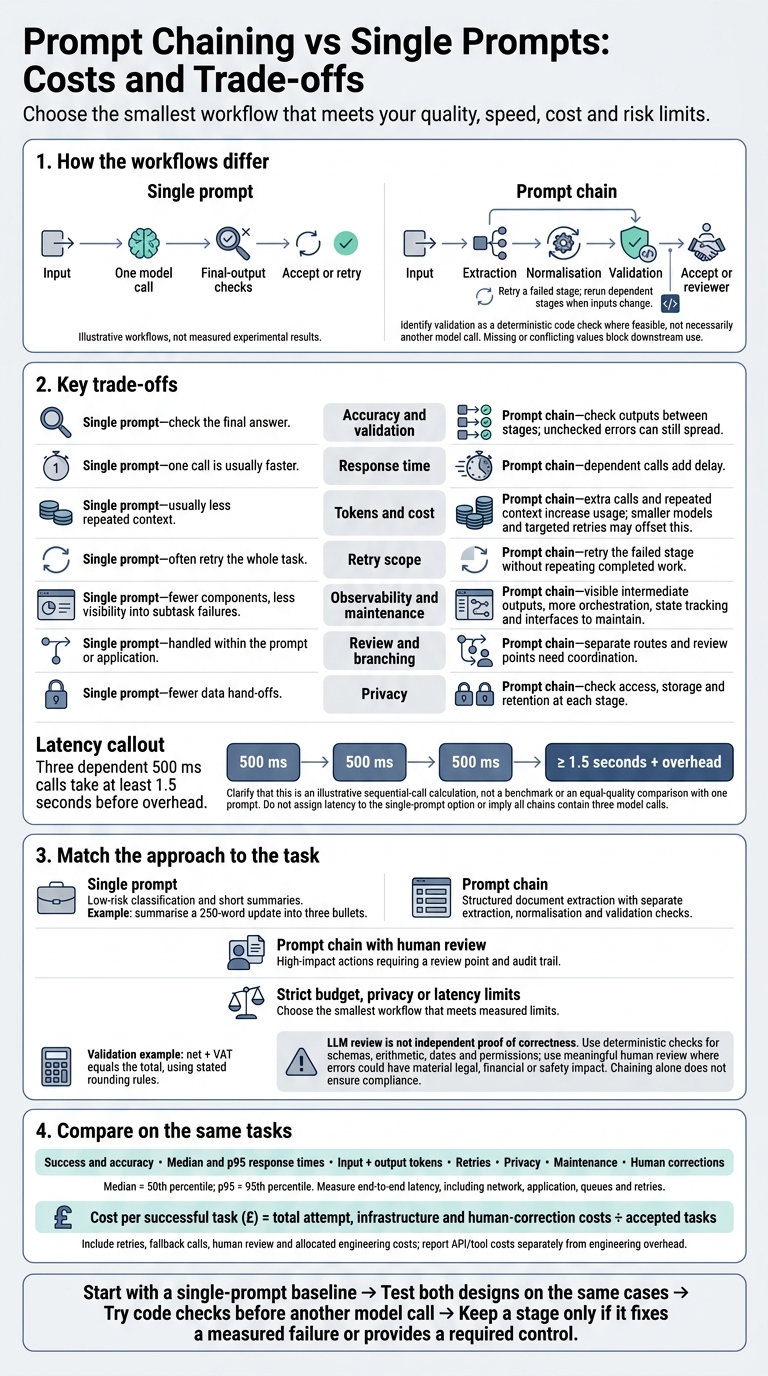 {Prompt Chaining vs Single Prompts: Costs and Trade-offs}
:::
{Prompt Chaining vs Single Prompts: Costs and Trade-offs}
:::
What is Prompt Chaining in AI Agents? - Theory and Code
Prompt Chaining vs Single Prompts: Key Trade-offs
Chaining adds control only when its checkpoints prevent costly errors. Those checks need to cut enough risk to justify the extra cost and delay. Conditional routes and parallel work also need orchestration to track state, handle time-outs and merge results - not just a fixed sequence of calls.[5]
| Dimension | Prompt chaining | Single prompt |
|---|---|---|
| Accuracy | Breaking tasks into stages and adding structured checks can improve accuracy and consistency | Works well for clear, simple tasks; competing subtasks can reduce accuracy |
| Latency | Sequential calls add delay | One round trip is usually faster |
| Tokens | Every stage’s input and output counts, including reused context | Usually repeats less context, though large prompts still use many tokens |
| Error propagation | Incorrect intermediate results can affect later stages | Hidden failures can affect several parts of the final answer |
| Implementation and maintenance | Needs more orchestration, state tracking and failure handling | Simpler to build, but large prompts are harder to edit safely |
| Observability | Intermediate outputs and checks are available for inspection | Call-level tracing reveals less about subtask failures |
| Validation | Checks between stages | Final-output checks |
| Retries | Retry the failed stage | Retry the whole request |
| Branching | Conditional routes need an orchestrator | Routes must be expressed in the prompt or application code |
Accuracy, Validation and Error Handling
Narrow stages help isolate faults, but weak checks still let wrong answers through. LLM review is not independent proof of correctness: the reviewing model may share the original model’s blind spots. Use deterministic checks for schemas, arithmetic, dates and permissions. Use human review where errors could have a material legal, financial or safety impact.[4][7]
| Control | Prompt chaining | Single prompt |
|---|---|---|
| Failure isolation | Identifies the failed stage | Final errors may not reveal which subtask failed |
| Validation | Checks can run between stages | Checks usually apply to the final output |
| Retry scope | Retry the failed stage without repeating completed work | Often reruns the complete prompt |
| Error propagation | Later stages may amplify unchecked errors | Multiple failures may stay hidden in one response |
Response Time, Token Use and Total Cost
Measure end-to-end response time, including time spent on the network, in the application, in queues and on retries.
Three dependent 500 ms calls take at least 1.5 seconds before overhead.
Record both median and p95 latency. Averages alone can hide slow responses.[6]
| Cost factor | Prompt chaining | Single prompt |
|---|---|---|
| Sequential latency | Adds together dependent stages’ response times | One request-response cycle |
| Repeated context | Intermediate outputs count again as input | Context is supplied once per attempt |
| Model selection | Smaller models can handle narrow stages | One model handles all subtasks |
| Retries | Saved outputs avoid repeating completed work | Usually repeats all token usage |
| Engineering overhead | More testing, monitoring, storage and recovery logic | Fewer workflow components |
Compare workflows using cost per successful task: total attempt, infrastructure and human-correction costs ÷ accepted tasks.
Narrow prompts, smaller models and early rejection can offset extra calls, but measure those savings rather than assuming them. Include allocated engineering costs, too. A cheaper call does not mean a cheaper workflow if it leads to more rework. When weighing these trade-offs, look for the simplest workflow that meets the task’s risk, speed and approval needs.
Matching the Approach to the Business Task
Use the trade-offs above to choose the smallest workflow that meets each task’s risk, speed and approval limits.
| Business requirement | UK business scenario | Starting approach | Rationale |
|---|---|---|---|
| Low-risk classification with a short response target | A Manchester retailer categorises support messages as delivery, refund, product query or other. | Single prompt | Use one prompt if test cases meet accuracy, error and response-time targets. |
| Short summary of internal information | A Bristol software company summarises a 250-word update into three bullets. | Single prompt | Short, stable transformations usually need no intermediate checks. Measure factual omissions, unsupported additions, token use and latency before adding stages. |
| Structured extraction with validation | A Leeds wholesaler extracts fields from emailed invoices. | Prompt chain | Separate extraction, normalisation and validation so checks happen before accounting use. |
| Human approval for a high-impact action | A UK lender prepares a document summary for human review before a case decision. | Prompt chain with human review | Staged outputs provide review points and an audit trail. Chaining alone does not make the outcome compliant or autonomous. |
| Strict cost, privacy or latency limits | A Welsh charity handles low-risk enquiries within a small monthly API budget. | The smallest workflow that meets the measured limits | Compare both designs on the same cases. Include input, output, retries, validation and human-review costs - not just the model’s per-token price. |
Keep simple, low-risk tasks simple unless testing shows a clear need for stages.
Low-Risk Tasks with Short Response Targets
For classification, require exactly one label plus a confidence or escalation flag, rather than a long explanation. Test spelling errors, slang, mixed requests and ambiguous messages.
For short summaries, specify the maximum length, required points, prohibited inventions, intended audience and acceptable reading time. Pay particular attention to decisions and risks. Stick with one prompt if it meets accuracy and latency targets without intermediate checks.
Add stages only when a step needs its own check before the next can proceed.
Document Processing and Human Approval
Separate extraction, transformation and validation when each needs its own check. Extract structured fields, normalise dates to a consistent UK format and standardise currency values in pounds sterling. Then check required fields and confirm that net + VAT equals the total, using the stated rounding rules. Missing or conflicting values should block downstream use and go to a reviewer.
Log the document ID, model or prompt version, failed checks, reviewer corrections and final outcome. Human approval creates a deliberate decision point for exceptions and uses with serious consequences. Reviewers must be able to inspect the source, challenge the output and correct errors. Prompt chaining alone does not ensure compliance, accuracy or lawful decision-making; approval criteria and meaningful oversight are still needed.[11][12]
Quality, Budget and Privacy Limits
Choose the smallest workflow that meets your accuracy, latency, budget and review limits. Weigh task complexity, traceability, changing rules and the availability of representative evaluation data. Add stages only when they produce a repeatable improvement or provide a required approval point.
Apply data minimisation, access controls and defined retention periods. The ICO highlights data minimisation, storage limitation, security and accountability. Chains increase exposure because the same data may pass through several prompts, services or stored outputs.[8][9][10] Assess privacy impact and supplier arrangements at each stage.
Building, Testing and Maintaining the Workflow
Start with a single-prompt baseline and save its test results. Add a stage only if it fixes a repeated, measurable failure. Try deterministic checks before adding another model call.
Compare accuracy, latency, token use and maintenance effort. Keep the staged workflow only if it improves measured results. Otherwise, stick with the single prompt.
Stage Inputs, Outputs, Checks and Logs
Give each stage an owner. Check formats and business rules in code before moving to the next stage. Cap retries and use back-off only for recoverable failures. Retries must not repeat external actions. When inputs change, rerun every stage that depends on them.
Keep enough records to audit the cost–accuracy trade-off: prompt, model and application versions, validation results, latency, tokens and retries. Protect logs through redaction, restricted access and retention limits. Store identifiers rather than full content where possible.
Test each stage against the same cases used for the full workflow.
Testing Both Approaches on the Same Cases
Give both designs the same source data, expected outputs and acceptance criteria. Test incomplete, ambiguous, long and adversarial inputs. Repeat runs when output variability matters. Record these metrics for both approaches on the same test set.
| Metric | Measurement method |
|---|---|
| Success | % meeting every acceptance criterion |
| Completeness | % of required fields or facts present and correct |
| Format compliance | Valid schema, required fields and permitted values |
| Consistency | Agreement across repeated runs or reference answers |
| Safety | Unsafe, privacy-breaching or injection-prone outputs |
| Policy compliance | % meeting business and regulatory rules |
| Median latency | 50th-percentile end-to-end time, in milliseconds |
| Tail latency | 95th-percentile end-to-end time, including retries |
| Tokens | Input plus output tokens per task, including retries |
| Cost per successful task | Total API, tool and retry cost ÷ successful tasks |
Count failed runs, retries and fallback calls in the cost calculation. Report API and tool costs separately from engineering overhead, including time spent on development, evaluation, monitoring and maintenance. Weigh the extra cost against the value of the improvement.[3][13][14][15]
Maintenance and Change Risks
Once the workflow is live, versioning and change control help keep the gains intact. Changes to prompts, schemas or models can affect output quality, latency and compliance with business requirements.
| Area | Single prompt | Prompt chain |
|---|---|---|
| Versioning | Fewer artefacts, but one large prompt can hide intertwined rules | Version each prompt, schema, router, model and interface |
| Regression testing | Small wording changes can affect many behaviours | Test stages separately; end-to-end tests must cover hand-offs |
| Dependency changes | External tool or model changes still need testing | Model, schema, retrieval and API changes can break downstream interfaces |
| Debugging | Subtask failures can be hard to trace to their cause | Traces show the failing stage, but debugging spans more components |
| Ownership | Assign responsibility for the prompt and acceptance criteria | Assign responsibility across orchestration, stages, integrations and operations |
Treat changes to prompts, models, schemas and business rules as releases. Use version control, peer review, regression tests and a rollback route. After deployment, watch for increases in retries, validation failures and p95 latency.
Conclusion: Choose the Simplest Workflow That Works
Use one prompt if it meets your quality, speed, cost and risk limits. Use a chain only when a stage delivers a measured gain or a required control. Every added stage increases latency, token use and orchestration overhead.[17][19][5] Make the decision using the same success, latency, token and maintenance metrics used in testing.
Compare cost per successful task, including retries, corrections and human review - not just the price of the first call. A cheap response is poor value if it creates more work.[3][18][19]
Implementation Checklist
Run these checks before implementation.
- Document acceptance thresholds, then compare a single-prompt baseline with a chain using the same cases.
- Include the human-review workload in your cost comparison.
- Check every data hand-off for privacy compliance. Set clear stop, retry, fallback or human-review rules for validation failures.[16][13][20]
If a check can run reliably in code, it doesn’t need another model call. Keep a stage only if it prevents a specific failure or provides a required control. Otherwise, leave it out.[3][5][19]
FAQs
How much improvement justifies adding a prompt chain?
A prompt chain makes sense when it cuts enough repetitive manual work to save time and lower monthly running costs [1]. Consider it when manual oversight becomes impractical at scale [2], frequent tasks can break even within three months, or compliance calls for consistent audit trails [1].
Before committing, plan for failures, state management and idempotency - so retrying an action doesn’t duplicate its effects - to reduce the risks of partial failures across services [2].
Can I chain only the complex parts of a task?
Yes. Use simple, single-step prompts for straightforward actions. Save durable, multi-step chains for complex workflows that need state management, human approval or coordination across services [1].
Keep the complex parts in event-driven workflows. This helps you maintain control and reliability without the extra work of chaining simple tasks. Using orchestration only where it’s needed also helps you optimise costs and performance [1][2].
How do I budget for human review costs?
Measure total workflow costs, including model usage, compute, retries and human review time. Track spending in pounds (£), and set alerts at 70% and 90% of monthly limits to spot cost drift early [1].
Assign someone to track review time and use that data in monthly cost reviews. If manual review slows the workflow, consider orchestration or automation to cut repetitive work and long-term labour costs, while accounting for upfront implementation costs [2].