
I’d start with voting for fixed answers and add debate only when tests show fewer errors. Keep agents’ first answers separate, limit debate to 1–2 rounds, and send unresolved or high-stakes cases to human review.
The choice is not just about accuracy. I’d compare delay, cost in £ per completed decision, shared mistakes and how each approach handles missing answers. More agreement does not mean fewer errors.
Quick Comparison
| Factor | Voting | Debate |
|---|---|---|
| Best fit | Fixed labels, routing and extraction | Conflicting sources and disputed assumptions |
| Process | Count separate answers | Critique, revise, then judge or vote |
| Quality risk | A wrong majority can win | Persuasion can replace a correct answer |
| Time and cost | Parallel calls; usually less delay and spend | Extra rounds add delay, tokens and coordination |
| Controls | Valid outputs, quorum and tie rules | Round limits, source checks and stopping rules |
| Review | Escalate weak or disputed results | Escalate unresolved claims or missing support |
For mixed workloads, I’d use a hybrid: vote first, then debate selected disputes. Before release, I’d test accuracy, p95 latency, cost and review rates - and keep agreement separate from permission to act.
19. Agentic Engineering - Debate and Voting
Decision Quality: Voting vs Debate
The choice comes down to whether the task needs independent counting or structured challenge. Voting often matches debate on fixed-output tasks. Custom agent systems still need testing: agents may share prompts, tools or retrieval paths. Test debate when critique leads to measurable, verifiable corrections - not just more agreement.
| Dimension | Voting | Debate |
|---|---|---|
| Output type | Fixed labels, comparable extracted fields and validation results | Decisions that need evidence comparison or trade-offs |
| Independence | Keeps first-pass answers separate, though errors may still be correlated | Starts independently, then agents influence one another |
| Critique | Needs a separate validation stage | Included in critique and revision rounds |
| Error handling | Can outvote independent mistakes, but a correct minority can lose | Can rescue minority evidence or spread persuasive errors |
| Explainability | Vote counts, margins and selected outputs | Claims, challenges, revisions and a final rationale |
| Reproducibility | Easier to control through fixed schemas, settings and counting rules | Also depends on turn order, wording and judge decisions |
| Task suitability | Classification, routing, extraction and structured validation | Ambiguous or evidence-heavy decisions with assumptions worth challenging |
For fixed-output tasks, set clear counting rules before running the agents.
Voting: Count Independent Answers
Run agents in parallel and keep their responses separate. Validate each output against a strict schema, normalise equivalent outputs and count only the target field. For free-form text, document how answers map to countable outputs first. Reject malformed outputs and record those failures separately.
Define strict majority, plurality and tie rules upfront. Specify whether a tie triggers another independent sample or a review, and whether results without a majority return abstain. Set a minimum valid-vote threshold so malformed responses cannot skew acceptance.
Debate: Critique and Revise Answers
Keep initial answers independent, then let agents exchange evidence and short justifications. Each critique should name one disputed assumption. Limit debate to one or two revision rounds, then finish with a judge, rule or vote.
Judge claims against evidence, not confidence or verbosity. This can protect a well-supported minority. But anchoring, conformity and persuasive errors can also turn a correct answer into a wrong one.[5]
Shared Errors and Quality Tests
Voting works when single-agent accuracy is decent and errors are independent. Adding agents does not fix shared failures. Where independence matters, vary prompts and use separate retrieval paths; different agent names alone do not make answers independent.
Compare voting and fixed-round debate on the same held-out cases, including incomplete, conflicting and adversarial inputs. Measure task success, confidence calibration where available, abstention quality, shared-error frequency and stability across repeat runs.
Preserve initial decisions so you can count both wrong-to-right corrections and right-to-wrong reversals, including cases where debate rescues a correct minority. Keep development examples separate from the final evaluation, and calibrate confidence thresholds for deferral rather than assuming them.[6]
Latency, Cost and Risk
Once decision quality is comparable, latency and spend determine whether debate is worth the extra coordination.
Parallel Voting vs Sequential Debate
Measure wall-clock time until the workflow has a usable decision - not the sum of call durations. Voting usually waits for the slowest required response before aggregating results. Concurrency limits can also add queuing.
Debate adds sequential rounds, context handoffs and adjudication, though agents within each round can still run concurrently. Test both approaches on the same dataset and record p50 and p95 latency, completion rates and timeout rates.[4]
| Measure | Parallel voting | Sequential debate |
|---|---|---|
| Model calls | N independent calls; optional judge call | About N × R calls, plus judge, validation and retries |
| Execution | One parallel response stage, then aggregation | Dependent rounds, then adjudication |
| Tokens and context | Repeated task inputs; bounded aggregation context | Repeated task inputs plus growing critiques and transcripts |
| Coordination | Quorum, validation and tally rules | Round state, transcript passing, stopping rules and judge review |
| Observability | Track votes, failures and aggregation | Also trace changes between initial answers, critiques and revisions |
| Timeout handling | Continue only with a valid quorum; otherwise abstain | Mark incomplete rounds; retry within budget or escalate |
| Main risk | Shared errors can produce confident majority mistakes | Sequential rounds add queuing, context-window pressure and failure opportunities |
| Resource trade-off | Predictable resource use and easier capacity planning | Extra coordination justified only by material error reduction |
Cost per Decision and Monthly Spend
After latency, cost determines whether the protocol can work at scale. Use current provider prices, convert them to £ at the estimate date, and include retries, cache misses, tool calls and human review.
\frac{ (\text{input tokens} \times \text{input price}) + (\text{output tokens} \times \text{output price}) }{1{,}000{,}000} + \text{tool and review costs} ]
Here, input and output prices are quoted per million tokens. Monthly spend equals per-decision cost multiplied by completed monthly volume.
Prices vary widely by model, provider and cache tier. Output tokens often cost much more than input tokens.[7][9][11] To calculate the full cost per completed decision, divide all incurred costs, including failed calls and storage, by the number of completed decisions. Budget for human escalations using the review rate and cost per review.
Spending more does not prove that a system is more reliable. Compare cost with serious-error rate, abstention quality and downstream loss. Set workflow limits so weak consensus does not become a forced answer.
Budgets, Timeouts and Human Review
Set separate caps for input tokens, retrieved evidence, output length, total spend, retries and elapsed time. Start with one or two debate rounds, with deadlines for both individual calls and the whole workflow.
Missing critiques do not count as assent. If evidence is missing, conflict remains unresolved or quorum fails, abstain or escalate rather than force an answer.
Require appropriately qualified human review for decisions with material legal, financial, safety or personal effects. Give reviewers the evidence, concise reasoning summaries and unresolved issues - not just the winning answer. Log escalation reasons, human overrides, and the protocol and model versions needed to trace each decision.[8][10]
Choose and Build a Consensus Protocol
::: @figure 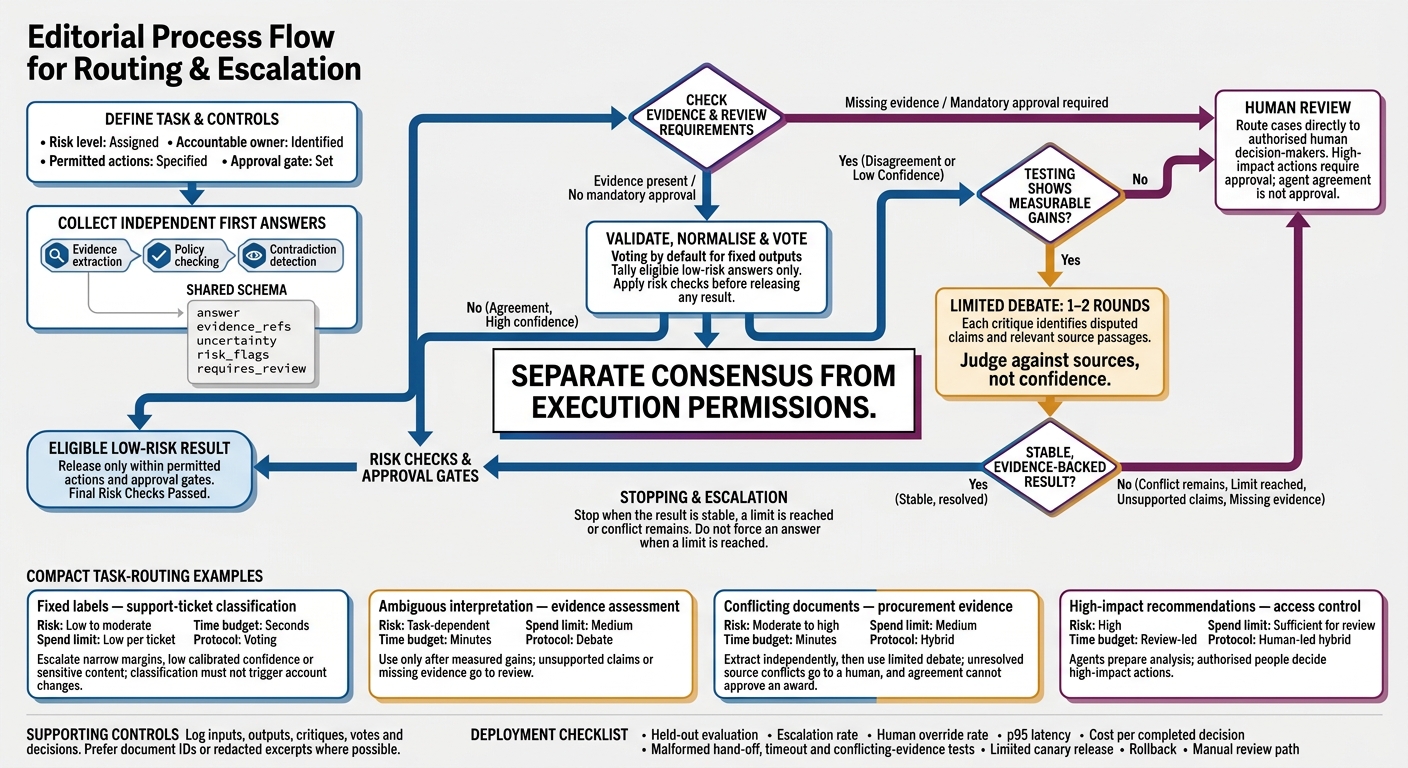 {Multi-Agent Consensus: Voting, Debate and Human Review}
:::
Protocol choice matters only when routing, escalation and release rules are clear too. Once you’ve decided whether debate justifies its extra cost, define when the system should use it.
When to Use Voting, Debate or a Hybrid
Use voting by default for fixed outputs. Send only disputed or low-confidence cases into debate. Add debate only when testing shows a measurable gain in corrections. A hybrid suits mixed workloads, but its routing rules matter as much as its agents. Use calibrated confidence to decide which cases need closer review.
Task and example Risk Time budget Spend limit Protocol and routing rule Fixed labels - support-ticket classification Low to moderate Seconds Low per ticket Voting: escalate narrow margins, low calibrated confidence or sensitive content; classification must not trigger account changes. Ambiguous interpretation - evidence assessment Task-dependent Minutes Medium Debate: use only after measured gains; send unsupported claims or missing evidence to review. Conflicting documents - procurement evidence Moderate to high Minutes Medium Hybrid: extract independently, then use limited debate; unresolved source conflicts go to a human, and agreement cannot approve an award. High-impact recommendations - access control High Review-led Sufficient for review Human-led hybrid: agents prepare analysis; authorised people decide high-impact actions.
Build an Escalation Workflow with Clear Limits
Once routing is clear, set explicit hand-offs and stopping rules.
Define a shared schema: answer, evidence_refs, uncertainty, risk_flags and requires_review. Give agents complementary roles - evidence extraction, policy checking and contradiction detection - rather than copies of the same prompt. Validate and normalise outputs before tallying eligible low-risk answers. Apply risk checks before releasing any result.
Send disagreement or low calibrated confidence to limited debate. Cases with missing evidence or mandatory approval should go straight to review. Require critiques to identify disputed claims and the relevant source passages. Judge against those sources, not how confident an argument sounds.
Set a maximum number of rounds. Stop when the evidence-backed result is stable, a limit is reached or conflict remains. Record inputs, outputs, critiques, votes and decisions. Where possible, use document IDs or redacted excerpts rather than full sensitive documents.[12][14]
Set Governance and Deployment Controls
Governance defines who owns the workflow, what it may do and when it must stop.
Assign each workflow a risk level, accountable owner, permitted actions and approval gate. Separate consensus from execution permissions. Before deployment, compare protocols on a held-out set using escalation rate, human override rate, p95 latency and cost per completed decision. Test malformed hand-offs, timeouts and conflicting evidence. Then run a limited canary release with rollback and a manual review path.[8][13]
Conclusion: Start with Voting and Test Selective Debate
Start with parallel voting for comparable, discrete outputs, balancing quality, latency and cost. It provides a low-cost baseline when agents can answer independently. Debate can help agents correct errors, but it also adds persuasion risk.
Agreement doesn’t prove correctness. Agents may share the same weak source, prompt or assumption. Track cases where the majority is wrong separately from agreement rates.
Use bounded debate only when tests show a measurable gain that justifies the added cost and latency. Re-test whenever a model, prompt, tool or role changes.[5][3] Keep human review for high-stakes decisions.[15] Judge debate by the evidence, not by consensus.
FAQs
How many agents do I need for reliable voting?
There’s no fixed number. Start with a small pilot group - 5 to 20 samples is a useful test range - and add more gradually until the majority vote stabilises for your task.
Agents can make the same mistakes, so agreement doesn’t prove correctness. Hokstad Consulting recommends weighing accuracy gains against the extra time and cost. Treat the leading answer as a confidence signal, not proof, and verify it independently - especially for high-risk decisions.
How can I detect shared errors between agents?
Agreement between agents isn’t proof of accuracy. They may rely on the same source or share a flaw in their logic. Use distributed telemetry to trace each output’s dependencies. Inspect hand-offs, shared-state writes and tool boundaries to find where the data first went wrong.
When agents return the same incorrect value, check their sources. Treat shared upstream data or reasoning as one evidence trail, not separate checks. Use controlled replays to isolate where the error began.
What error reduction would justify debate’s extra cost?
Debate is worth the extra cost only when verified reductions in accepted errors outweigh the added latency and token costs. Test it against a single-agent or majority-vote baseline in controlled comparisons. Measure verified accuracy, cost per accepted task (£) and end-to-end latency.
Agreement doesn’t guarantee correctness: agents can share the same errors. Require independent verification, with human review for high-risk outcomes. If the accuracy gains disappear after verification, debate isn’t worth the extra cost [1][2].