More training cannot replace labels that have not arrived. In online continual learning, retraining should follow verified label availability, changes in the data and the cost of errors - not just the arrival of new records.
A NeurIPS 2024 study compared four approaches to delayed labels. Accuracy fell as delays grew, and extra compute did not remove the effect. Similarity-based rehearsal narrowed the accuracy gap; the tested semi-supervised and test-time methods did not beat basic training on delayed labels.
For deployment, the priorities are clear:
- Track label timing: record when outcomes arrive, pass review and become eligible for training.
- Test without future labels: replay data in time order using only feedback available at each point.
- Weigh results against costs: check accuracy, memory, compute and update time.
- Control releases: assign owners, set approval rules and keep a rollback option.
The study used simulated delays, so each policy needs testing against actual label arrival patterns before release.
What Research Shows About Label Delay
Label Delay in Online Continual Learning by Csaba Botos, Wenxuan Zhang, Matthias Müller, Ser-Nam Lim and co-authors was published at NeurIPS 2024. Its arXiv preprint is 2312.00923.[1][2][5] The main finding: delay changes the learning problem, not just the update schedule. It affects when retraining can draw on reliable feedback.
How Label Delay Affects Accuracy and Compute
Performance fell as delay increased, though the summary does not give accuracy losses for each delay level.[1][4] Even the study’s large compute budget did not remove this effect. More compute alone is not enough to address delayed labels in retraining.[1][2]
Comparing 4 Learning Approaches
The study compared four responses to delayed supervision. The tested semi-supervised and test-time adaptation methods did not beat naïve delayed supervision. That result applies to the implementations tested - not every method in either group.[1][3]
| Approach | Uses current unlabelled data? | Reported result |
|---|---|---|
| Delayed supervision | No, not directly for supervised updates | Naïve baseline; updates wait for labels |
| Semi-supervised learning | Yes, to find learning signals before labels arrive | Tested methods did not beat the baseline |
| Test-time adaptation | Yes, to adapt using current inputs | Tested methods did not beat the baseline |
| Similarity-based rehearsal (IWMS) | Yes, to select relevant labelled examples from memory | Narrowed the delay-induced accuracy gap with little increase in computational complexity |
IWMS uses the current unlabelled stream to retrieve similar labelled examples from memory. It first filters by predicted class, then compares feature similarity.[1][2][3]
How the Study Was Tested and Where It Falls Short
The comparison helps assess these approaches, but the results depend on how the study simulated delay. Its framework compares immediate supervision with labels arriving d steps after their observations.[1][3]
| Condition | Label availability | Training opportunities | Evaluation purpose |
|---|---|---|---|
| Non-delayed reference | Current labels available immediately | Updates use current labelled examples | Measures performance without artificial delay |
| Delayed supervision | Labels arrive d steps later | Updates use historical labels, optionally alongside current unlabelled data | Measures the effect of delay |
| IWMS rehearsal | Historical labels and labelled memory available | Rehearses memory examples resembling current observations | Tests whether targeted rehearsal narrows the accuracy gap |
The summary does not verify datasets, model types, delay values, memory size, run count or evaluation schedule.[1][3] Simulated delays also do not fully match production workflows, where labels may arrive late, go missing or be revised. Whether the findings carry over depends on distribution shift and the availability of useful historical matches.
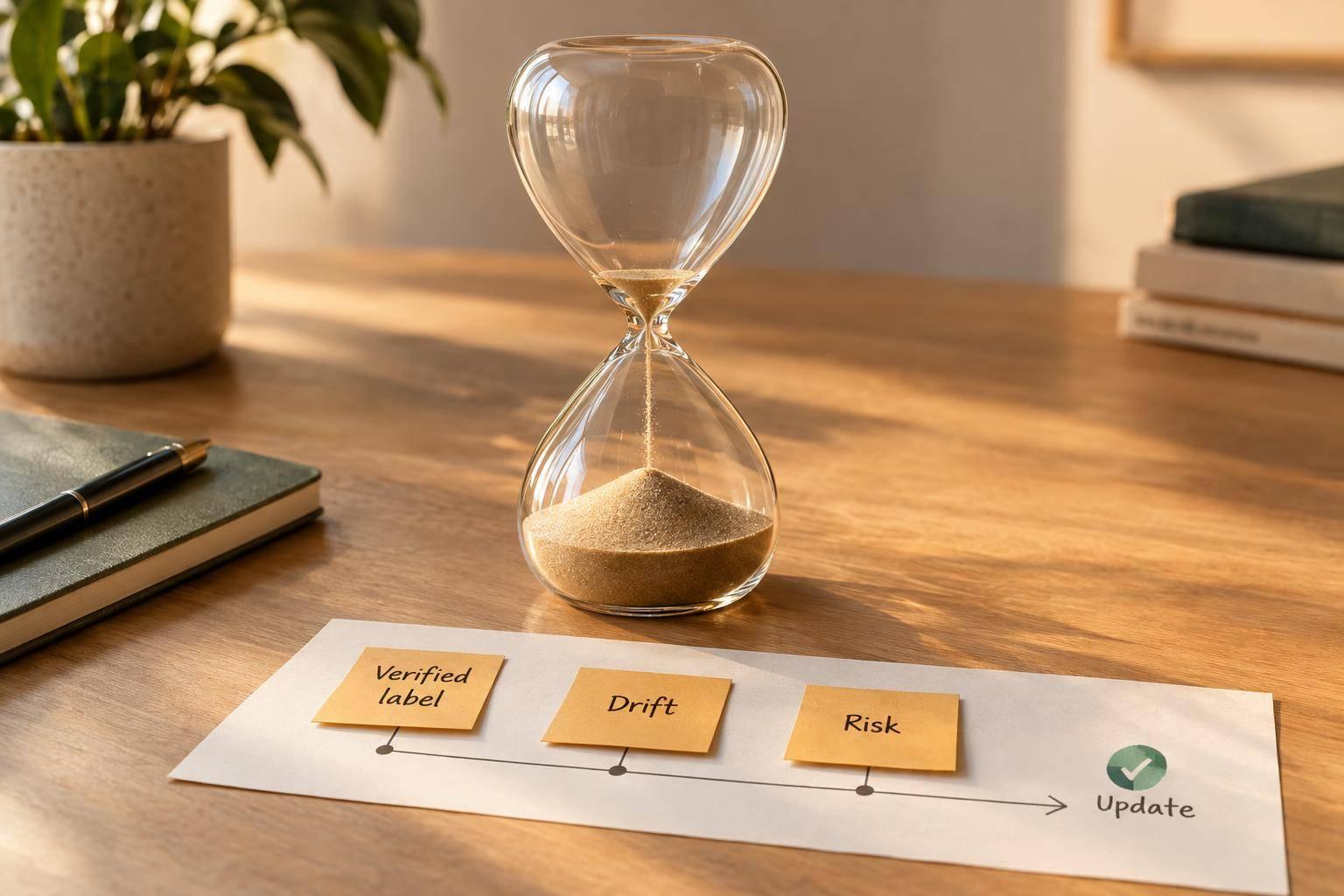
Business retraining policies therefore need testing against actual label arrival times and permitted memory use, with predictive performance, compute and storage measured separately.[1][2] This leaves a policy question: how should label latency, drift and risk determine which approach is worth using?
Choosing a Retraining Policy
The study found no single winner across delayed-label methods. Choose a retraining policy based on delay length, drift speed and deployment risk.[1][2]
Match Actions to Delay, Drift and Risk
Use these conditions to decide when to wait, retrain or limit updates.
| Label-delay condition | Drift | Business risk | Recommended action | Validation needed |
|---|---|---|---|---|
| Short, predictable delay | Low | Low | Wait for verified labels and retrain on a schedule | Compare accuracy on mature labels with the current model |
| Long or variable delay | Low to moderate | Low to medium | Retrain on delayed labels; keep a labelled memory and test similarity-based rehearsal | Check accuracy by delay bucket and memory size |
| Labels unavailable during active drift | Moderate to high | Medium | Prioritise targeted annotation, freeze or limit updates, and trial unlabelled-data methods under controlled conditions | Use time-ordered replay with no future-label leakage |
| Delayed outcomes where labels arrive selectively | Any | High | Add human review, conservative thresholds and escalation rules; require verified labels before promotion | Assess subgroup performance, calibration and false-negative cost |
| Severe degradation after deployment | Any | High | Roll back or hold the model, investigate drift and label quality, then retrain with confirmed outcomes | Require pre-set rollback and release thresholds |
To judge whether the policy works, measure label latency separately from performance after each update.
Track Label Latency and Model Performance
Record when each observation occurs, when its label is expected and when that label arrives. Report latency, the number and share of unresolved cases, their age distribution, throughput, correction rate and class balance. Measure performance separately for fast- and slow-maturing labels, then compare both with drift during the wait.
Each measure answers a different question. Latency guides retraining timing. The unresolved share shows how much evidence is available. Class balance guides bias and recall checks, while the correction rate helps assess label reliability. Keep unresolved cases visible, and revisit prediction cohorts as their labels mature.
For retrieval-based methods, check whether retrieved examples still fit the task and cover new patterns. Assess whether they justify the storage, memory, lookup time and compute costs.
Test Retraining Policies Before Deployment
Test each policy in time order, using only labels available at that point. Release labels at their actual availability timestamps. Keep future labels out of training, retrieval, drift detection, hyperparameter tuning and policy choice.
Include stable periods, sudden and gradual drift, and changes in annotation capacity. Compare policies using the same label-availability rules and resource ceilings.[1][2]
When annotation capacity is limited, prioritise representative labels from changing or under-represented groups - not just easy cases.
| Policy | Predictive quality | Time to adapt | Compute | Memory | Deployment risk |
|---|---|---|---|---|---|
| Scheduled retraining on delayed labels | Accuracy on mature labels, calibration and segment metrics | Label wait plus time to scheduled release | Training and monitoring usage | Labelled window, archive and model size | Existing rollback exposure; promotion gates limit risk |
| Similarity-based rehearsal | Accuracy during the delay and after labels arrive | Retrieval plus update time | Retrieval and update overhead | Labelled memory size | Requires local validation |
| Unlabelled-data adaptation | Metrics during the drift window and calibration | Near-real-time updates | Additional adaptation overhead | Temporary state or feature memory | Errors may compound |
Before testing, set minimum gains, limits on performance disparities between segments, adaptation-time caps, and memory or compute ceilings. Include annotation, human review, infrastructure and prediction-error costs in the assessment. The research provides no verified business-cost figures.
Use shadow or canary deployment where possible, and retain the previous model. Release only when pre-set thresholds are met. Specify who can pause release if error limits are breached, calibration fails, retrieval errors occur or resource budgets are exceeded.
Building Label-Aware Workflows
::: @figure 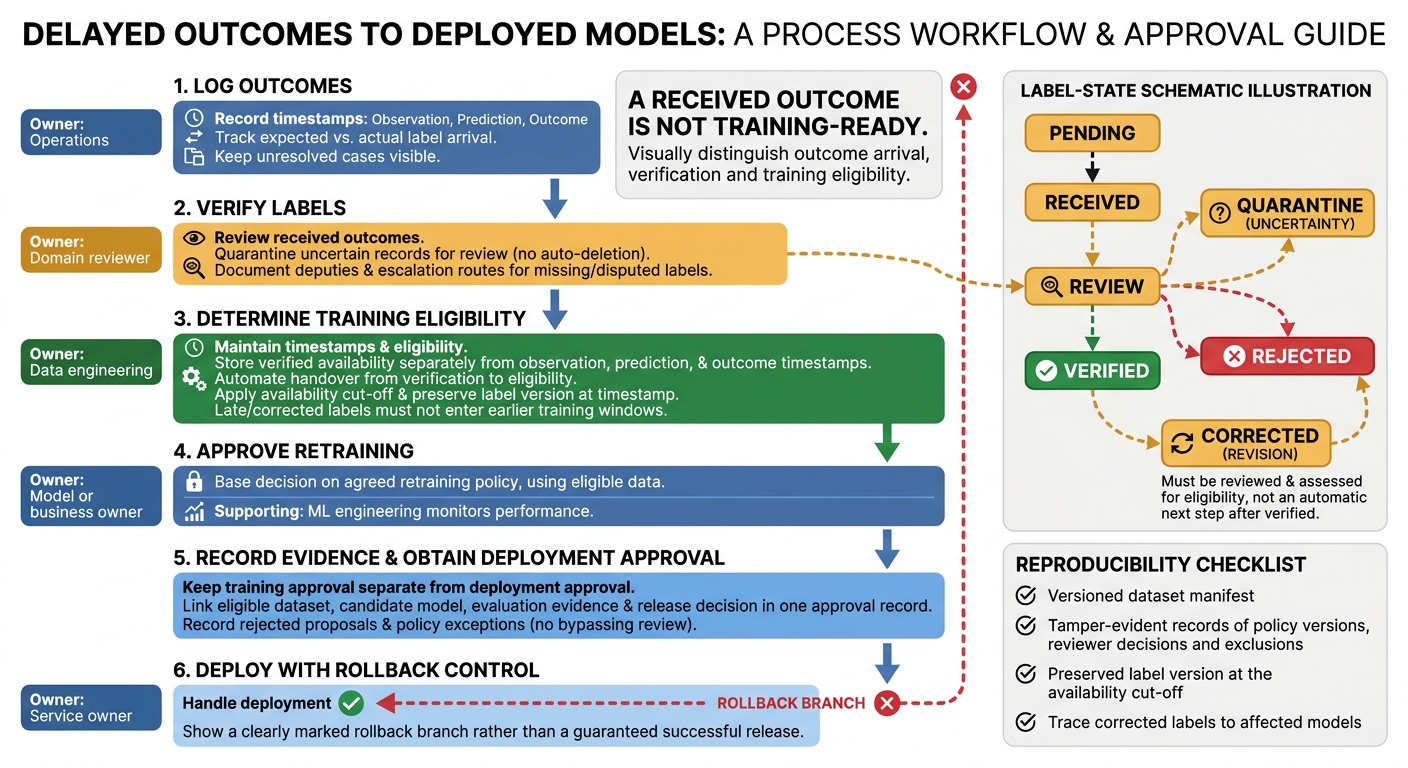 {Label-Aware Retraining Workflow}
:::
Assign Responsibility for Labels and Retraining
Once the retraining policy is set, the workflow needs to control when labels become eligible and who can release the model. Give each stage of delayed-label handling a named owner:
- Operations logs outcomes; a domain reviewer verifies labels; data engineering maintains timestamps and eligibility.
- ML engineering monitors performance; the model or business owner approves retraining; the service owner handles deployment and rollback.
Document deputies and escalation routes for missing or disputed labels.
A received outcome is not training-ready. Track pending, received, verified, rejected and corrected states. Store verified availability separately from observation, prediction and outcome timestamps. This keeps late or corrected labels out of earlier training windows. Quarantine uncertain records for review rather than deleting them automatically.
Automate the handover from verification to eligibility. Apply the same availability cut-off and preserve the label version present at that timestamp. Keep a versioned dataset manifest and tamper-evident records of policy versions, reviewer decisions and exclusions. These records make training decisions reproducible and help trace corrected labels to affected models.
Keep training approval separate from deployment approval. Link the eligible dataset, candidate model, evaluation evidence and release decision in one approval record to enforce the retraining policy. Record rejected proposals and policy exceptions so automated jobs cannot bypass review.
Implementation Support from Hokstad Consulting
These controls need to work within the workflow - not just appear in policy documents.
Hokstad Consulting can support readiness assessment, label-latency measurement, retraining-policy design and workflow automation. Agree deliverables and acceptance criteria upfront: timestamp completeness, correct eligibility decisions, reproducible historical tests and acceptable operating costs. These are implementation goals, not performance guarantees.
Conclusion: Base Retraining on Available Labels
The evidence points to one rule: label delay limits learning, not just data delivery. Faster ingestion cannot provide supervised feedback before outcomes are known. Base retraining on label timing, drift, risk and cost - not record volume alone.[1]
Of the delay-aware methods tested, similarity-based rehearsal showed the clearest gains by narrowing the accuracy gap. But those results came from the study’s simulated delay setting; they don’t guarantee production performance.[6]
Before release, test that policy through time-ordered replay and shadow deployment using your actual delay distribution, including late or missing labels. Compare predictive performance with memory use, update time and compute cost, and check governance requirements. Retrain only when verified labels, drift and risk justify a meaningful update - not simply because more data has arrived.
FAQs
How can I distinguish label delay from model drift?
Check when the discrepancies appear and what they involve. Model drift is a drop in predictive performance caused by changes in real-world data patterns or distributions. Label delay means ground-truth labels aren’t yet available for recent observations.
If performance drops, check whether data patterns have changed or recent labels are missing or outdated. Run controlled retraining tests with and without the suspect data segments to see whether addressing label delays or distribution shifts restores performance.
How should I choose a rehearsal memory size?
Choose the smallest rehearsal memory that carries the lesson into the next attempt while meeting your quality thresholds, business risk profile, and limits on cost, latency and context-window size.
Test it against a no-memory baseline on representative tasks. Track task success rates, token overhead and total cost per successful task in pounds (£). Give these results more weight than arbitrary similarity scores.
How do missing labels bias retraining decisions?
When labels are missing or delayed, you lack the ground truth needed to check performance, tell genuine outliers apart from corrupted data, or accurately measure precision, recall and clean-accuracy loss.
To reduce this bias, quarantine uncertain data rather than deleting it automatically. Run controlled, versioned retraining tests with and without the suspected samples. Then compare the results using verified, clean validation data.