
Breaking silos in DevOps is all about improving teamwork, communication, and alignment across teams to deliver software faster and more reliably. Many organisations struggle with isolated teams that slow progress, cause delays, and increase costs. Here’s a quick summary of how to fix this:
- Spot the signs: Misaligned goals, poor communication, and duplicated efforts are key indicators of silos.
- Tackle the costs: Silos lead to slower deployments, higher failure rates, and increased expenses.
- Fix the problem:
- Improve communication with regular check-ins and shared tools.
- Set shared goals and metrics like deployment frequency and recovery objectives.
- Build cross-functional teams to encourage collaboration from start to finish.
- Invest in continuous learning to upskill teams and avoid knowledge gaps.
- Leadership matters: Leaders and DevOps champions must lead by example, remove barriers, and promote collaboration.
Breaking down silos isn’t just about avoiding delays - it’s about transforming how teams work together for better results. With the right strategies, you can turn isolated teams into a well-connected powerhouse.
DevOps Topologies 10 years on: What have we learned about silos, collaboration, and flow?
How to Identify Silos in Your Organisation
::: @figure 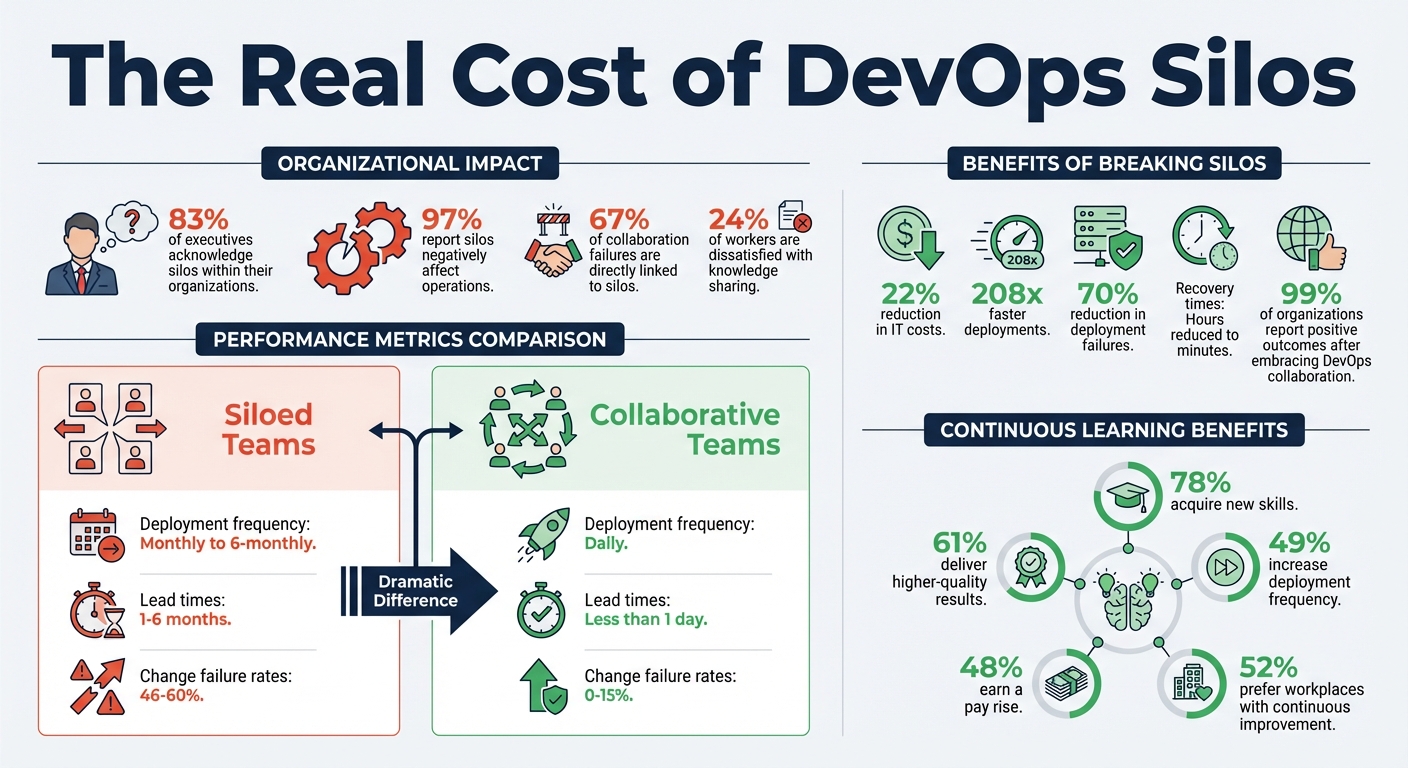 {The Real Cost of DevOps Silos: Statistics and Impact}
:::
{The Real Cost of DevOps Silos: Statistics and Impact}
:::
Common Warning Signs
Spotting silos early can save your organisation from unnecessary delays and growing frustrations. The signs might seem small at first, but they tend to escalate quickly if ignored.
One major clue is misaligned ambitions - when teams set bold goals that don’t match the realities of other departments’ workloads or capabilities [1]. For instance, your development team might commit to delivering a new feature by month’s end, while the operations team is bogged down with unexpected infrastructure issues. This disconnect often results in missed deadlines and mounting tension.
Another clear sign is the presence of information silos. Teams may become so focused on their own tasks that they fail to communicate or collaborate effectively [8]. Engineers might remain unaware of their colleagues’ progress or testing results, partly because of a reluctance to share unfinished work [3]. This lack of transparency can lead to duplicated efforts, with teams unknowingly tackling the same problems or using tools that don’t work well together [2][4].
Be cautious of shadow infrastructure. To bypass delays with DevOps, engineers might create their own testing environments [6]. While this might seem like a quick fix, it can lead to unexpected costs or outages that only come to light when a massive cloud bill arrives [4]. Additionally, communication gaps between technical teams (focused on code and systems) and non-technical teams (concerned with budgets and business outcomes) can cause misaligned priorities, further hindering collaboration [4].
These warning signs don’t just disrupt workflows - they also have tangible impacts on costs and performance, as we’ll see next.
The Real Cost of Silos
The effects of silos go beyond frustration - they’re measurable and often expensive. Studies reveal that 83% of executives acknowledge silos within their organisations, and 97% report that these silos negatively affect their operations [7]. Even more striking, 67% of collaboration failures are directly linked to silos [7].
What does this look like in practice? Siloed teams experience slower deployment cycles, longer downtime, and increased operational costs. While collaborative teams might deploy updates daily with lead times of less than a day, siloed teams are often stuck with monthly - or even six-monthly - deployments, with lead times stretching from one to six months. Change failure rates in isolated teams can soar to 46–60%, compared to just 0–15% in more collaborative settings [2].
The risks don’t stop there. Silos can also compromise security. When responsibilities aren’t clearly shared across teams, vital security protocols can easily be overlooked [9]. On top of that, the lack of understanding between departments often leads to unrealistic expectations and a stressful work environment, as teams fail to appreciate the challenges faced by their colleagues [1].
How to Break Down Silos
Tackling the inefficiencies and delays caused by silos requires a combination of better communication and organisational alignment. Once you've spotted the signs of siloed teams, it's time to take action. The following strategies are practical steps that many organisations have successfully used to turn isolated teams into collaborative powerhouses.
Improve Communication Between Teams
Start by introducing regular, short check-ins. A quick 20-minute meeting - like a Monday morning sync-up - can keep everyone updated on progress and highlight any issues that need collaboration [2][11].
But meetings alone won’t fix the problem. You need to break down information barriers. Share data, test results, and feedback openly, allowing teams to learn from past efforts and ongoing work [3]. Tools that integrate workflows can provide real-time insights, reducing repetitive work and miscommunication [3]. This level of openness ensures that teams don’t waste time duplicating efforts.
Another effective approach is to set working agreements every 6–12 months. These agreements establish expectations for how teams will interact and collaborate [10]. Consider running pre-mortems
to identify risks before major releases and retrospectives to evaluate what needs improvement [10]. These structured discussions are especially helpful for maintaining connection in hybrid or remote work environments, where casual interactions are less frequent.
Creating an environment of psychological safety is also essential. Ariel Hunsberger, Head of Learning and Development at Slack, explains:
People can't be afraid, when they speak up and say something, that the reaction from the room is gonna be 'God, that was a stupid idea or How do you not know that?'[13]
Without this sense of safety, even the best communication systems will fall apart.
Once communication is flowing, the next step is to bring teams together with shared objectives.
Set Shared Goals and KPIs
Different teams often have conflicting priorities - developers focus on speed, while operations prioritise system stability. The solution? Establish a unified product vision that aligns everyone [9]. Shared goals provide a common definition of success, bridging these divides.
Use tools like Programme Increment (PI) planning to track progress and adjust goals as needed [9]. A RACI matrix can clarify who is Responsible, Accountable, Consulted, and Informed for specific tasks [2]. Shared metrics, such as deployment frequency and cycle time, help keep everyone on the same page [6][14].
- Deployment frequency encourages collaboration on streamlining the CI/CD pipeline [6].
- Cycle time highlights inefficiencies in handoffs between teams [14].
- Recovery Point Objective (RPO) and Recovery Time Objective (RTO) align teams on disaster recovery and availability priorities [6].
Mapping out end-to-end workflows creates a clear framework that acts as a contract between teams. Everyone knows what’s expected, by when, and in what format [12]. This transparency makes it easier to address roadblocks and resolve issues quickly [6][14].
With shared goals in place, the next step is to restructure teams for better collaboration.
Create Cross-Functional Teams
Instead of keeping development and operations separate, bring diverse skills together within a single team. Cross-functional squads - composed of developers, operations engineers, and testers - can work on projects collaboratively from start to finish [6].
Pairing developers with operations engineers is a simple yet effective way to integrate skills and build mutual understanding [3]. This approach not only speeds up collaboration but also helps team members appreciate each other's challenges [3].
Workshops can be useful at the outset to define roles and identify skill gaps [10]. Establishing clear working agreements ensures everyone knows how the team will collaborate and interact [10]. These agreements set expectations and prevent misunderstandings.
Another strategy is to form communities of practice - groups focused on specific disciplines like QA or security that meet regularly to share knowledge across teams [5]. Currently, 36% of organisations include these communities in their DevOps strategies [5]. They allow teams to maintain specialised expertise while fostering knowledge-sharing.
Finally, equip cross-functional teams with the right tools. Using Infrastructure as Code (IaC) ensures that all team members work in consistent, predictable environments. This standardisation simplifies debugging and peer programming, reducing friction between team members [6].
Why Continuous Learning Matters
Building on shared goals and better communication, continuous learning strengthens collaboration across teams.
Cross-functional teams and shared goals only succeed if everyone has the skills to contribute effectively. Continuous learning helps avoid expert silos
- situations where only one person understands a crucial system, leaving the team vulnerable if that person is unavailable [5]. When team members share core DevOps skills, collaboration becomes more seamless and dependable.
Upskilling also builds confidence, empowering engineers to experiment and collaborate more openly. Technology writer Robert Sheldon highlights this, saying:
The more thoroughly each team member understands what DevOps is and how it works, the more likely the effort will succeed[5].
The benefits are clear. With continuous learning, 78% of DevOps practitioners acquire new skills, 61% deliver higher-quality results, 49% increase deployment frequency, and 48% earn a pay rise [17]. For employees, 52% prefer workplaces where processes are constantly improving [15], making continuous learning a critical factor for retention and job satisfaction.
Run Workshops and Training Sessions
Regular, structured learning sessions help teams stay aligned and minimise knowledge gaps. Weekly Knowledge Sharing Sessions (KSS) and monthly Knowledge Meets
are great formats where team members can share insights on debugging, new tools, or updates in cloud services [18]. Keep these sessions engaging by incorporating brief, interactive presentations followed by Q&A [18].
Hackathons are another effective tool. These events bring together engineers and non-technical staff to solve practical challenges in a gamified setting [18]. Gamification boosts participation: introduce a points system where team members earn badges or certificates for leading sessions, contributing to documentation, or answering questions in forums [18]. This fosters friendly competition while promoting a culture of shared learning.
Such dynamic training initiatives pave the way for smoother knowledge sharing across the organisation.
Make Knowledge Sharing Easy
Structured learning is just the start - effortless knowledge sharing is essential to keep the momentum going.
Training programmes lose impact if information doesn’t flow freely. 24% of workers are dissatisfied with how knowledge is shared in their organisation [15], emphasising the need for better systems. Start by creating a centralised repository on platforms like GitHub or Confluence, where teams can access resources such as microservices libraries, automation scripts, and troubleshooting guides [16][18].
Appoint a librarian
to maintain and update documentation [16][18], ensuring teams don’t waste time reinventing solutions that already exist.
Peer mentoring and pair programming are also valuable. Pair programming uses a driver/navigator setup where two engineers collaborate, enabling real-time knowledge transfer while improving code quality [18][6]. Assign mentors to new hires to speed up onboarding and share institutional knowledge [18]. As Karandeep Singh from TO THE NEW points out:
DevOps isn't only about fancy tools, it's a culture. Investing in knowledge-sharing helps organisations in long-term team success, quick problem solving, and improves team performance[18].
Finally, foster a mindset shift from just fix it
to document it, share it, grow from it
[18]. Encourage engineers to document solutions as soon as they solve problems. This turns individual expertise into institutional knowledge, preventing recurring issues and saving time for the entire organisation [18].
Need help optimizing your cloud costs?
Get expert advice on how to reduce your cloud expenses without sacrificing performance.
What Leaders Need to Do
Once technical and team dynamics are addressed, leadership becomes the driving force behind dismantling silos. Leaders play a critical role in encouraging continuous learning and promoting knowledge sharing. Their actions set the stage for collaboration - leaders can either perpetuate silos or actively work to eliminate them. By modelling openness and removing barriers, they inspire teams to work seamlessly across departments.
Lead by Example
Leaders need to be the champions of DevOps, actively participating in planning sessions and cross-departmental discussions. They should focus on eliminating hurdles, whether it’s cutting through red tape or resolving conflicts between teams. By fostering transparency and communicating a unified vision, leaders help their teams see the broader goals, enabling more informed decisions during development and deployment processes [5]. Listening to team concerns and engaging with them demonstrates that collaboration is not just encouraged but essential.
Practical strategies can bolster these efforts. For instance, running pre-mortems during a project’s early stages can help teams anticipate potential challenges before they become major issues. Establishing and periodically revisiting working agreements - essentially “social contracts” outlining how teams collaborate - every 6–12 months ensures these practices remain relevant. Regularly using health monitors to evaluate team performance against traits of high-performing groups also provides actionable insights [10].
These proactive steps create an environment where DevOps advocates can further bridge gaps and enhance collaboration.
Assign DevOps Champions
DevOps champions are essential for connecting development and operations, facilitating communication, and breaking down silos [5]. These individuals advocate for DevOps principles and work to unite teams under a shared vision. It’s important to choose champions from diverse backgrounds and give them the freedom to select effective methods for delivery. They also play a key role in encouraging cross-functional knowledge sharing [5]. This approach integrates collaboration into the daily workflow, making it second nature for teams.
When leaders and DevOps champions work in tandem, they lay the foundation for a truly collaborative and agile DevOps culture.
How Hokstad Consulting Can Help

Expert guidance can make all the difference when it comes to breaking down silos and achieving seamless DevOps collaboration. Hokstad Consulting offers tailored strategies and hands-on implementation to address the specific challenges that might be holding your teams back. Instead of relying on one-size-fits-all solutions, they focus on understanding your organisation’s unique needs, aligning their approach with your existing infrastructure and team dynamics. Here’s how their expertise can drive real progress.
Tailored Solutions for Your Team
Hokstad Consulting specialises in crafting automated CI/CD pipelines that remove the need for manual handoffs, streamlining roles and responsibilities to improve team coordination. They also tackle financial inefficiencies caused by isolated decision-making through their cloud cost engineering services. By focusing on strategic cloud migration, they ensure teams operate within a unified infrastructure, eliminating issues caused by fragmented environments.
Their custom automation solutions are designed to reduce repetitive tasks, allowing teams to concentrate on meaningful collaboration. Whether it’s automating testing, deployment, or system monitoring, these tools free up valuable time. Additionally, their expertise in AI strategies and agents can simplify workflows even further, enabling teams to prioritise high-impact tasks over administrative burdens.
Proven Results
Hokstad Consulting doesn’t just deliver technical solutions - they back them up with measurable outcomes. Clients often see faster deployment cycles and achieve cloud cost reductions of 30–50% as manual processes are replaced with automated pipelines. Their no savings, no fee
pricing model, ranging from £250 to £1,200 per day for UK cloud optimisation services, ensures you only pay when results are delivered.
Beyond the financial benefits, organisations experience enhanced team efficiency through improved communication and shared tools. By combining technical expertise with cultural insights, Hokstad Consulting helps transform disconnected departments into unified DevOps teams with shared goals and a collaborative mindset.
Conclusion
Breaking down silos isn't just about saving money - it's about delivering results faster and more effectively. Collaborative DevOps practices have proven to cut IT costs by 22% while enabling deployments that are 208 times faster. Aligned teams also see deployment failures drop by up to 70%, with recovery times shrinking from hours to mere minutes. These numbers highlight the real-world impact of integrating DevOps practices into an organisation's workflow.
The key to success lies in fostering better communication, setting unified KPIs, building cross-functional teams, and embracing continuous learning. And these aren’t just theories. In 2022, a European fintech company demonstrated this by slashing cloud costs by 35% in just six months, thanks to automated scaling and unified resource management.
The cost of not doing it is far greater than the cost of doing it. If teams go off to do their own thing... it leads to all sorts of problems with getting to market on time, dissatisfied customers - the risks are tremendous.- Ron Ashkenas, Co-author of [The Harvard Business Review Leader's Handbook](https://store.hbr.org/product/harvard-business-review-leader-s-handbook-make-an-impact-inspire-your-organization-and-get-to-the-next-level/10158?srsltid=AfmBOor6BKtraAMCjoe2geT6FuxU3NX1gSmOz5wsZwF8wP-cBWylS9) [2]
Leadership plays a pivotal role in this transformation. When executives lead by example and appoint DevOps champions, they create an environment where teams feel empowered to experiment, fail, and learn without fear of blame. This cultural shift is crucial - it turns reactive, blame-heavy workplaces into proactive organisations. In fact, 99% of organisations report positive outcomes after embracing DevOps collaboration. Unified leadership is the driving force behind this change.
FAQs
How can organisations spot and address silos in their DevOps teams?
To spot silos within DevOps teams, organisations should pay attention to warning signs like poor communication, repeated work, or workflows that don’t align. These silos often emerge from unclear responsibilities, varying skill sets, or even teams being spread across different locations. Catching these issues early is crucial.
Promoting open communication through regular practices like team meetings, stand-ups, and retrospectives can reveal where collaboration is falling short. Watching how teams interact and keeping an eye on workflows can also expose groups or individuals working in isolation. Once silos are identified, taking steps such as encouraging cross-functional teamwork or implementing shared tools can help close the gaps and build a more connected DevOps team.
What are the main advantages of using cross-functional teams in DevOps?
Cross-functional teams in DevOps bring clear benefits, helping organisations operate more efficiently and respond to changes with agility. By uniting people from various departments, these teams break down barriers that often hinder progress. This collaborative setup promotes open communication and teamwork, building trust and ensuring everyone is aligned with shared objectives. The result? Faster project delivery and better overall performance.
On top of that, diverse skills and perspectives within these teams spark creative problem-solving and lead to stronger, more effective solutions. By reducing the reliance on sequential handoffs, workflows become more streamlined, enabling faster decisions, shorter development timelines, and quicker rollouts. These advantages not only boost productivity but also help businesses stay competitive in a fast-changing tech environment.
Why is continuous learning important for DevOps collaboration?
Continuous learning plays a key role in successful DevOps collaboration. It helps teams stay agile, embrace new ideas, and share knowledge effectively. By regularly updating skills, tools, and workflows, teams can tackle emerging technologies and challenges head-on, leading to smoother software delivery and improved operational performance.
Creating a learning-focused culture also strengthens communication and teamwork. For instance, staying updated on practices like integrating security early in the development process (DevSecOps) allows team members to collaborate more effectively and minimise errors. Prioritising ongoing learning encourages openness, builds trust, and nurtures innovation - all essential ingredients for a thriving DevOps environment.