
Time saved with AI coding tools is not cash saved. I start with a 60–90-day baseline, count the full cost of adoption, and check whether accepted work increases without more defects or rework.
My reporting checklist is simple:
- Count every cost: licences, usage, setup, training, review and governance.
- Check net hours saved: subtract extra prompting, testing and correction time.
- Separate the gains: lower spending, avoided costs and added delivery capacity are different results.
- Check delivery and quality: compare similar work and include developer feedback.
- Report monthly: link each claim to records, state assumptions and get finance and engineering approval.
The cash test matters. If a programme costs £3,000 but spending does not fall, its spending-reduction ROI is −100% - even if it frees up time. I report that time separately as capacity, and only claim added delivery when records show more completed, accepted work.
::: @figure 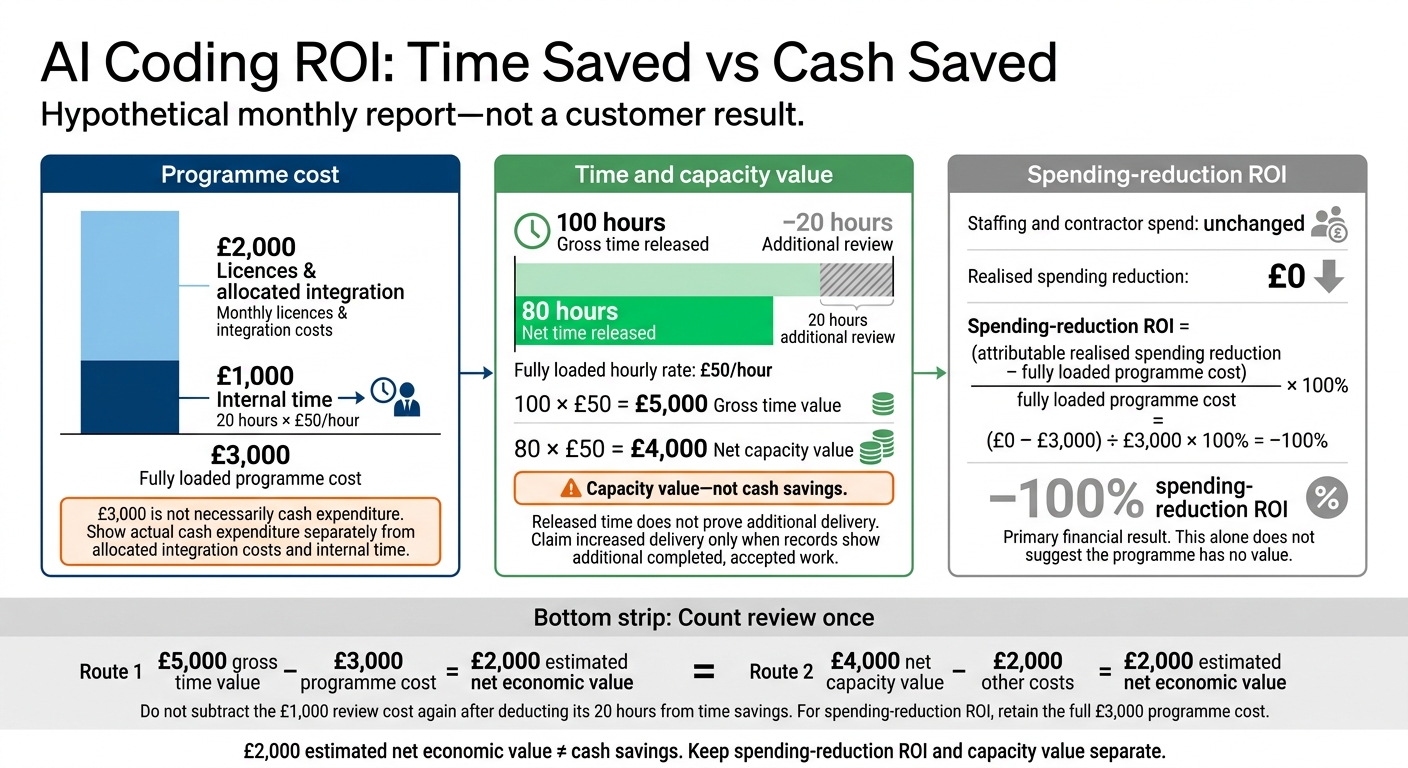 {AI Coding ROI: Time Saved vs Cash Saved}
:::
2. Build an AI Coding Cost Register
Use the baseline worksheet definitions to build your cost register - the cost side of the ROI method. Give each cost item its own row, with its source, owner, team, cost centre and reporting period. Report in pounds. For overseas invoices, also retain the original currency and exchange rate. Keep cash spend, allocated internal-time value and allocated period value separate.
State how you treat VAT: exclude recoverable VAT, include irrecoverable VAT and retain gross invoice amounts for reconciliation. Ask your tax adviser to check any uncertain or mixed-use treatment.[4]
Record Licence, Usage and Integration Costs
Count every paid seat, including unused ones, and reconcile the total to invoices. Record usage charges separately from subscriptions, without counting consumption covered by an allowance.
Include hosting and execution, repository and CI/CD connections, identity and access management, telemetry, security controls, data protection reviews and internal platform engineering. Allocate shared costs using billing tags or measured usage. Where you cannot measure usage directly, document the basis for the allocation.[2][3]
Keep one-off setup costs separate from recurring costs. Include configuration, training, documentation and rollout support, assigning each activity to one category only.
For one-off costs, retain the original payment and show the allocated period value under a stated rule. Treat this as a management-reporting allocation unless your accounting policy says otherwise. Never add the original payment and its allocated share to the same cost total.
Record Review and Governance Costs
Record only verification, prompt refinement, testing, code correction and pull-request discussion attributable to AI use. Exclude ordinary review already covered by the baseline. Link this effort to accepted work so you do not mistake faster generation for reliable delivery.
Value hours at a documented fully loaded hourly rate. State whether that rate includes salary, employer National Insurance, pension, benefits, equipment and overheads.[2][3]
Put supplier charges and staff hours in separate rows.
| Category | Calculation | Treatment | One-off or recurring | Owner | Reporting period |
|---|---|---|---|---|---|
| Licences | Paid seats × contracted seat rate | Cash | Recurring | Engineering operations | Selected month |
| Usage, hosting and execution | Billable units × rate, after included allowances | Cash | Recurring | Platform team | Selected month |
| Integration | Supplier charges; recorded hours × loaded rate | Separate cash and internal-time rows | One-off | Platform engineering | Selected month |
| Enablement | Training charges; recorded hours × loaded rate | Separate cash and internal-time rows | One-off | Enablement lead | Selected month |
| Attributable review and correction | Additional hours × loaded rate | Internal time | Recurring | Engineering teams | Selected month |
| Governance | Monitoring charges; specialist hours × loaded rate | Separate cash and internal-time rows | Recurring | Security and compliance | Selected month |
Close the register each month and total all six categories. Combine allocated period value and internal-time value to calculate the period cost. Match each entry once to invoices, usage exports or time records, and flag exclusions or uncertain allocations. These totals provide the cost input for the time-savings and ROI calculation that follows.
3. Check Time Savings and Classify Gains
Measure Gross and Net Time Savings
Once costs are recorded, check whether AI freed up time on comparable tasks. Compare like-for-like bug fixes, endpoints or test modules, accounting for scope, complexity, repository and developer experience. Record active implementation, review, testing and rework time for each task. Report the sample size, median and range, and note any process changes made at the same time. Compare tasks and teams without ranking individuals.[1][5]
Gross saving = baseline implementation hours − AI-assisted implementation hours. For net saving, subtract extra prompting, review, testing, correction and follow-up maintenance time - but only if those hours haven't already been counted.
Label the evidence as measured, sample-based estimate or developer assessment. A timed sample projected across a team is still an estimate. Survey responses do not count as measured savings.
Keep labour hours separate from elapsed delivery time. Pull-request timestamps include waiting, not just active work. Check whether faster tasks also improve change lead time and deployment frequency without increasing change failure or deployment rework rates.[6]
Where practical, track AI-assisted changes for 30–90 days. Compare incidents, escaped defects, rollbacks and maintainability findings with baseline work. Treat recent results as provisional until follow-up is complete.
Separate Spending Reductions, Avoided Costs and Capacity
Released time is capacity, not cash, unless payroll or supplier spend falls. Record net hours first, then classify the outcome using the evidence below. Unused capacity does not count as additional delivery.
| Gain | Calculation basis | Cash impact | Supporting records | Reporting treatment |
|---|---|---|---|---|
| Realised spending reduction | Actual reduction in paid labour, overtime or supplier invoices | Cash outflow falls | Payroll, invoices and finance ledger | Record as verified reduction |
| Avoided cost | Spend removed from an approved or documented plan | Future outflow prevented | Approved budget and cancellation record | Report separately as avoided cost |
| Additional delivery capacity | Net hours released multiplied by a fully loaded hourly rate, or reported as hours alone | £0 unless staffing or external spend falls | Task records, staffing plan and release records | Report separately as capacity value |
If released hours replace a planned contractor engagement, count either the avoided contractor cost or the hour value - not both. Use these gain classes as the benefit inputs for the ROI calculation and monthly dashboard in the next section.
4. Calculate ROI and Publish the Report
Calculate Spending-Reduction ROI and Capacity Value
Once the cost register is complete and time savings have been checked, use the gain classes above to keep cash savings separate from capacity value. If programme cost exceeds £0, calculate:
Spending-reduction ROI = (attributable realised spending reduction − fully loaded programme cost) ÷ fully loaded programme cost × 100%
Include licences, usage, integration, training, support, governance and allocated internal time. Show cash expenditure separately from internal-time costs. Only realised spending reduction belongs in this calculation. Report all other gain classes separately.
Value each benefit once: use either the value of released hours or outcome value, not both. Count review effort once, either as a cost or as a deduction from saved hours. For spending-reduction ROI, retain the fully loaded cost, including review. Apply these rules to both baseline and post-adoption periods so the comparison uses the same basis.
Compare Baseline and Post-Adoption Results
Compare equal-length periods, comparable work and, where practical, the same team. Record dates, sample sizes and outcome definitions alongside the results. Use the same cost categories for both periods, including AI costs after adoption.
Label findings measured, estimated, modelled or unverified, and disclose changes to staffing, release policy or other factors. Before-and-after differences show association; they don't prove that AI caused the result. Report the following measures together so readers can see cost, value and quality on one page.
| Measure | Baseline and post-adoption entries | Evidence and comparison rule |
|---|---|---|
| Delivery | Change lead time; deployment frequency | Delivery records; state the number of changes |
| Quality | Change failure rate; escaped defects | Incident records; keep the same failure definition |
| Developer experience | Same survey score; report response rate | State respondent counts and response caveats |
| Cost per agreed outcome | Total delivery cost ÷ accepted outcomes delivered | Finance and acceptance records; use the same outcome unit |
Build a Monthly Reporting Dashboard
Give finance and engineering the same claims to check. Show programme cost, cash spend, time impact, realised spending reductions, avoided costs, capacity, quality and developer experience. Include gross and net hours, and keep spending-reduction ROI, capacity value and outcome-based ROI separate.
Give every line a source, confidence level and accountable owner. State GBP, UK-format reporting dates, headcount basis, exclusions and VAT treatment. Also state whether implementation costs are charged immediately or allocated over time.
During rollout, track active use, review hours and pull-request cycle time. Wait until an agreed review point, such as three complete post-adoption months, before drawing ROI conclusions. Before publication, finance should approve costs and spending claims, while engineering should approve delivery and quality evidence.
Work Through a Hypothetical Monthly Report
Hypothetical - not a customer result. Monthly licences and allocated integration costs are £2,000; additional review takes 20 hours at £50 per hour (£1,000 internal time), making programme cost £3,000. Releasing 100 gross hours at £50 gives £5,000 gross value and £2,000 estimated net economic value: equivalently, 80 net hours are worth £4,000, less £2,000 in other costs. This is not cash savings: with staffing and contractor spend unchanged, realised spending reduction is £0. Spending-reduction ROI is (£0 − £3,000) ÷ £3,000 × 100% = −100%. Show actual cash expenditure separately from allocated integration costs and internal time; claim increased delivery capacity only when records show additional completed, accepted work from the released time.
5. Conclusion: Make ROI Claims Traceable
Every ROI claim needs an auditable baseline, cost register and net time-savings test. Report realised spending reductions separately from avoided costs and delivery capacity. Include the reporting period, assumptions and quality results alongside the financial figure.
Start with one team, one repository set and one workflow. Agree success thresholds before adoption, and retain human sign-off for production changes. Expand only after the agreed review point.
Use the monthly dashboard as your reporting template. Link each ROI figure to an invoice, time record or delivery evidence. Log any changes to definitions or assumptions so reports stay comparable over time.
If your team lacks the skills or resources, Hokstad Consulting can support AI strategy and implementation. Your ROI claims must still rest on your own baseline, costs and measured results.
FAQs
How can I isolate AI’s impact from other workflow changes?
Use a matched comparison group or phased rollout to separate AI’s impact from changes in demand, staffing or processes. Keep task definitions, baseline dates and task IDs fixed.
Track existing spending separately from new AI costs. An unchanged salary bill is not a cash saving. Only credit the agent with gains when clear evidence supports that link. Otherwise, describe the gains as associated with deployment - not caused by it.
How should I report review effort without double-counting it?
Count review time once. Either deduct it from gross time savings or record it as a separate operating cost. Apply your choice consistently - never do both.
Don’t add failed-run or retry usage if your model or tool bills already include it. Reconcile your ledger monthly, and document your chosen approach with supporting evidence so the figures aren’t inflated.
When does extra delivery capacity justify negative cash ROI?
Extra delivery capacity only justifies a negative cash ROI if it produces cash benefits, rather than just ‘time saved’. Under Hokstad Consulting’s approach, freed-up capacity counts as value only when it cuts spending, avoids hiring or generates extra sales margin. That value must be calculated after deducting all additional costs, including licences, integration and human review.
There is no payback until cumulative cash flow reaches zero, even if capacity is growing.