
When AI agents disagree, I match the merge method to the conflict - not the vote count. Fan-in brings their outputs into one result, a stated uncertainty or a referral for review.
I use 3 methods:
- Rule-based merging for fixed fields and clear conditions.
- Ranked evidence for factual disputes, checking source quality and independence.
- Synthesis-agent review for differences in meaning, assumptions or context.
Agreement is not proof. If 3 agents rely on the same source, I treat that as 1 evidence trail, not 3 separate checks.
Quick Comparison
| Method | Best for | Decision record | Time and cost |
|---|---|---|---|
| Rule-based merging | Structured conflicts | Inputs and rules applied | Usually lowest |
| Ranked evidence | Conflicting facts | Sources and ranking reasons | Retrieval and checks add work |
| Synthesis-agent review | Differences in reasoning | Findings, uncertainty and review reasons | Extra model calls and tokens |
Whichever method I choose, I check the result before it moves forward, retain unresolved disagreements and set clear stop rules. High-risk actions need human sign-off, a written rationale and a rollback plan - not just a polished answer.
::: @figure 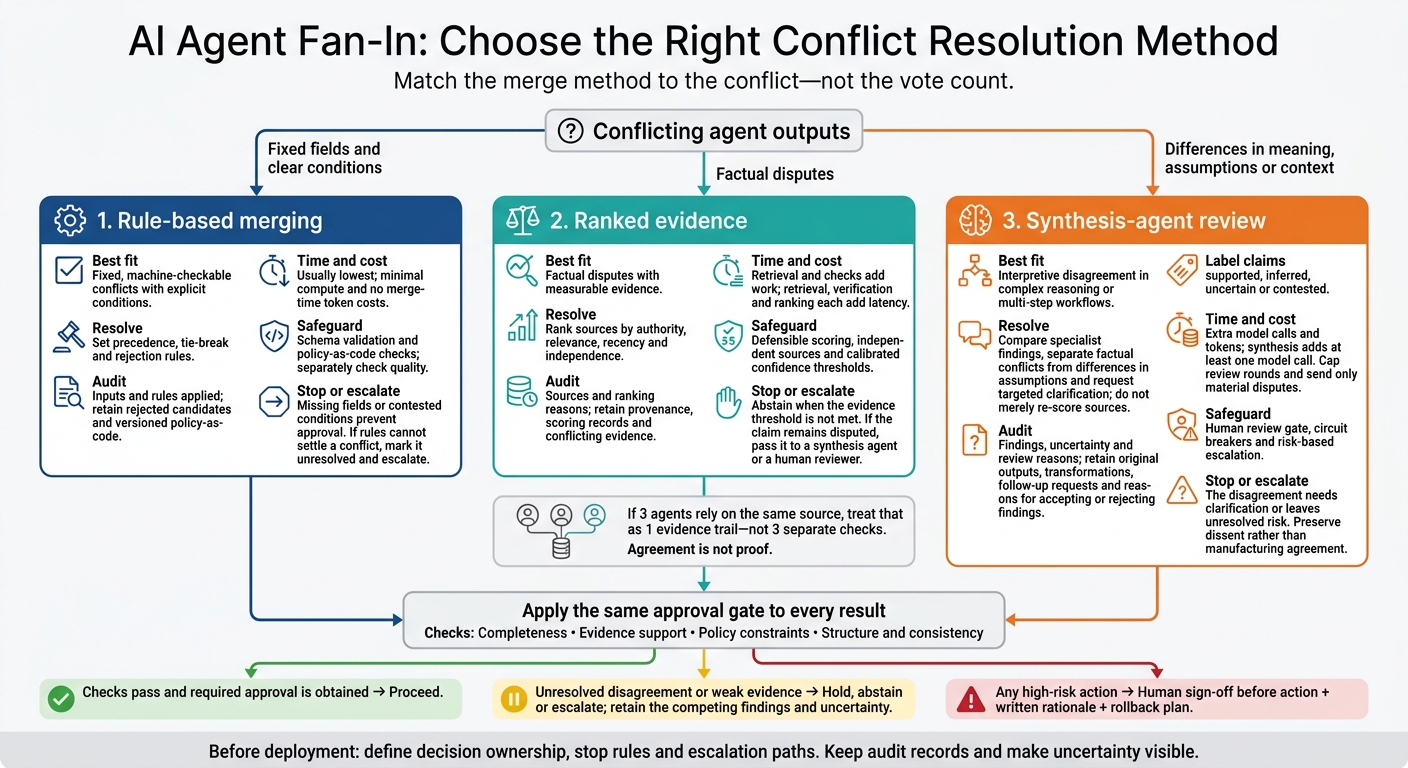 {AI Agent Fan-In: Choose the Right Conflict Resolution Method}
:::
{AI Agent Fan-In: Choose the Right Conflict Resolution Method}
:::
Conflict Resolution in AI Systems Explained How Multi Agent AI Handles Disagreements
1. Rule-Based Merging
Use this method when outputs fit a fixed schema and rules can resolve conflicts mechanically. It’s the most reliable fan-in pattern for structured outputs.
Conflict Resolution
Set precedence, tie-break and rejection rules for incompatible outputs. Precedence defines priority; tie-break rules choose between candidates with equal priority. Reject candidates that fail fixed schemas or constraints [1]. If the rules cannot settle a conflict, mark it as unresolved and escalate.
Explainability and Auditability
Deterministic rules make each choice easy to explain: the result follows a defined rule, not an agent’s interpretation. Store rules as versioned policy-as-code. Log the inputs, rejected candidates and rule applied so reviewers can trace each decision.
Latency and Cost
This clarity comes with low execution overhead. Scripted merging adds less latency than synthesis-agent inference and avoids merge-time token costs. Update the rules as conflict patterns change.
Validation and Decision Risk
Following the rules does not guarantee correctness. Validate the schema first, then run a separate quality check against multiple agent outputs before merging [1]. Do not let unresolved outcomes trigger downstream actions.
Rule-based merging handles structured, machine-checkable conflicts - not disagreements about meaning. When rules cannot settle a conflict, ranked evidence is the next option.
2. Ranked Evidence
When rules cannot settle a conflict, rank the evidence behind each claim.
Conflict Resolution
Rank evidence, not agent counts. Weigh each source’s authority, relevance, recency and independence. Outputs drawn from the same source count as one evidence trail - not separate confirmation. Use this approach when agents disagree on facts, not schema.
Explainability and Auditability
Store source provenance and scoring records with each claim. Show where the evidence came from, why it ranked above the alternatives and which evidence still conflicts. Reviewers should be able to check the reasoning without relying on the agent’s confidence score.
For factual disputes, ranked evidence is stronger than rule-based merging, but it takes longer.
Latency and Cost
Retrieval, verification and ranking each add latency. Measure them separately to identify the costliest step. Set a retrieval budget and a stopping rule. If the evidence remains insufficient, leave the claim unresolved.
Validation and Decision Risk
Check that the strongest evidence supports the claim and address contradictions backed by sound sources. Abstain when the evidence threshold is not met. Use threshold-based approval for medium-risk decisions. High-risk decisions need human sign-off, a written rationale and a rollback plan. If the claim remains disputed, pass it to a synthesis agent or a human reviewer.
3. Synthesis-Agent Review
Conflict Resolution
When ranked evidence still leaves material disagreement, a synthesis agent compares specialist findings. It separates factual conflicts from differences in assumptions and asks for targeted clarification. Its role is to resolve disputes about interpretation and context - not to re-score sources. It reconciles findings only when the evidence justifies it, while retaining unresolved conflicts and recording what evidence is still needed to settle them.[4][11]
Explainability and Auditability
Require a decision record alongside the final answer. Record original outputs, transformations, follow-up requests, rejected findings and the reasons for accepting or rejecting each finding. Label claims as supported, inferred, uncertain or contested instead of hiding those differences behind a single confidence score.[10][11]
Latency and Cost
Synthesis adds at least one model call, plus tokens for processing evidence and any clarification calls. Cap review rounds, pass structured claims rather than full transcripts, and send only disputes that could affect the outcome to the model. Compare quality gains with total latency and cost per completed task.[5][6]
Validation and Decision Risk
Validate source links and check numerical consistency before synthesis. Then check that the merged conclusion stays within the evidence’s scope. Test deliberately conflicting, missing and duplicated sources - not just straightforward cases. For high-risk decisions, unresolved material conflicts should trigger human review before action. Give the reviewer the competing findings and uncertainty, not just the polished answer.[7][8][9]
Comparing the Methods in Practice
Parallel agents assess a supplier payment request and disagree on whether the evidence is sufficient and the approval conditions are met.
The outcome of this dispute depends on the fan-in method used.
Handling Conflicts
Check contradictions separately from missing fields. Keep unresolved findings visible until they are checked again or escalated.
| Approach | Disagreement handling | Evidence requirements | Unresolved-conflict outcome |
|---|---|---|---|
| Rule-based merging | Checks structured values against explicit approval conditions | Required fields and evidence for every mandatory condition | Approve if rules pass; hold if fields are missing or conditions are contested |
| Ranked evidence | Weighs conflicting evidence using evidence scores | Supporting sources for each claim | Approve only if the evidence threshold is met; otherwise escalate |
| Synthesis-agent review | Examines why agents read the evidence differently | Original findings, supporting evidence and approval criteria | Recommend a hold for missing information or escalate unresolved risk |
The decision also needs to be traceable. Recording the outcome alone isn't enough.
Explaining and Auditing Decisions
Keep the original findings and approval criteria visible. Show how they led to the recommendation.
| Approach | Audit focus |
|---|---|
| Rule-based merging | Show the structured values and the rule applied |
| Ranked evidence | Show the evidence scores and their supporting sources |
| Synthesis-agent review | Show the disagreement, missing context and final recommendation |
Processing Time and Cost
Higher-cost methods allow more depth when interpreting evidence. They don't give permission to bypass risk controls.
| Approach | Operating cost |
|---|---|
| Rule-based merging | Lowest; minimal compute |
| Ranked evidence | Moderate; several low-cost agent calls |
| Synthesis-agent review | Highest; larger model-token spend[1] |
After the merge, apply the same approval gate to every result.
Validation, Risk and Human Review
Before any decision, check completeness, evidence support and policy constraints. For high-risk payment requests, make human review an explicit workflow state.
| Method | Escalate when |
|---|---|
| Rule-based merging | Missing fields or contested conditions prevent approval |
| Ranked evidence | Conflicting evidence leaves the evidence threshold unmet |
| Synthesis-agent review | The disagreement needs clarification or leaves unresolved risk |
Refer unresolved disagreement, weak evidence or any high-risk payment decision to a human reviewer before release.
Strengths and Limitations
Each fan-in method has trade-offs. The right choice depends on the conflict and the risk.
| Method | Advantages | Disadvantages | Best fit | Required safeguard |
|---|---|---|---|---|
| Rule-based merging | Repeatable decisions with a clear audit trail | Struggles with ambiguity; new failure patterns may fall outside existing rules | Fixed, machine-checkable conflicts with explicit conditions | Schema validation and policy-as-code checks |
| Ranked evidence | Weighs competing signals and makes uncertainty explicit | Weak telemetry or poorly calibrated scores can distort rankings | Factual disputes with measurable evidence | Defensible scoring, independent sources and calibrated confidence thresholds |
| Synthesis-agent review | Interprets open-ended findings and differences in reasoning | Can miss edge cases, manufacture agreement or reach unsupported conclusions | Interpretive disagreement in complex reasoning or multi-step workflows | Human review gate, circuit breakers and risk-based escalation |
For rule-based merging, test missing, contradictory and unseen inputs. Repeatable decisions alone don’t prove that the rules cover every case. Use this method for structured tasks with clearly defined conflicts.
For ranked evidence, use calibrated thresholds rather than arbitrary scores, and test them against historical incidents. Check that sources are independent: correlated sources can make weak evidence look stronger than it is. This method suits disputes where evidence can be measured.
Synthesis should preserve disagreement, not smooth it away. Link conclusions to supporting evidence, and keep dissenting findings and unresolved exceptions in the decision record. For high-risk cases, require human review and choose the simplest method that can still handle the conflict safely.
Conclusion: Match the Method to the Risk
When agents disagree, choose a fan-in method based on the conflict and the risk of acting on it. Use rules for structured decisions, ranked evidence when source quality matters, and synthesis for qualitative judgement.
Add quality gates at key hand-offs to check structure and consistency before work continues [1]. Send unresolved high-risk conflicts for human review.
Before deployment, define who owns each decision, when work must stop and when to escalate. Require human sign-off and a rollback plan for high-risk actions. Keep audit records and document the reasoning behind each decision.
Make uncertainty visible so people can act on it. Treat disagreement as a controlled decision path - not a false consensus.
FAQs
Can I combine fan-in methods in one workflow?
Yes. You can combine fan-in methods within a single workflow to handle complex agent outputs, routing work according to risk, state and business requirements. For standard tasks, use rule-based merging. For high-risk or sensitive actions, use ranked evidence or human review gates.
Hokstad Consulting specialises in custom agent implementation and AI strategy. It helps organisations design layered workflows that support reliability, control and optimised AI performance.
How can I check whether sources are truly independent?
Check that the data comes from separate telemetry streams that do not overlap [1]. Bring together logs, metrics and traces from across your environment to break down data silos [2]. Check agent findings against raw telemetry, rather than relying on the agent’s internal reasoning [1].
For high-risk decisions, use human-in-the-loop checks to test assumptions and confirm that the supporting evidence does not come from a single, potentially biased source [1][3].
How do I set thresholds for human review?
Set human-review thresholds using risk tiers, evidence and measurable metrics.
For low-risk tasks, use advisory or no-action modes, with post-action audits. For medium-risk tasks, set confidence and performance thresholds. Send any decision below the minimum confidence threshold for human review.
High-risk actions need human sign-off before execution. Give reviewers access to the task, evidence, likely impact, rationale and rollback plan. Record the approver, policy version and outcome.
Critical or regulated actions need dual authorisation and full audit records.